What a diagnostics lab app does
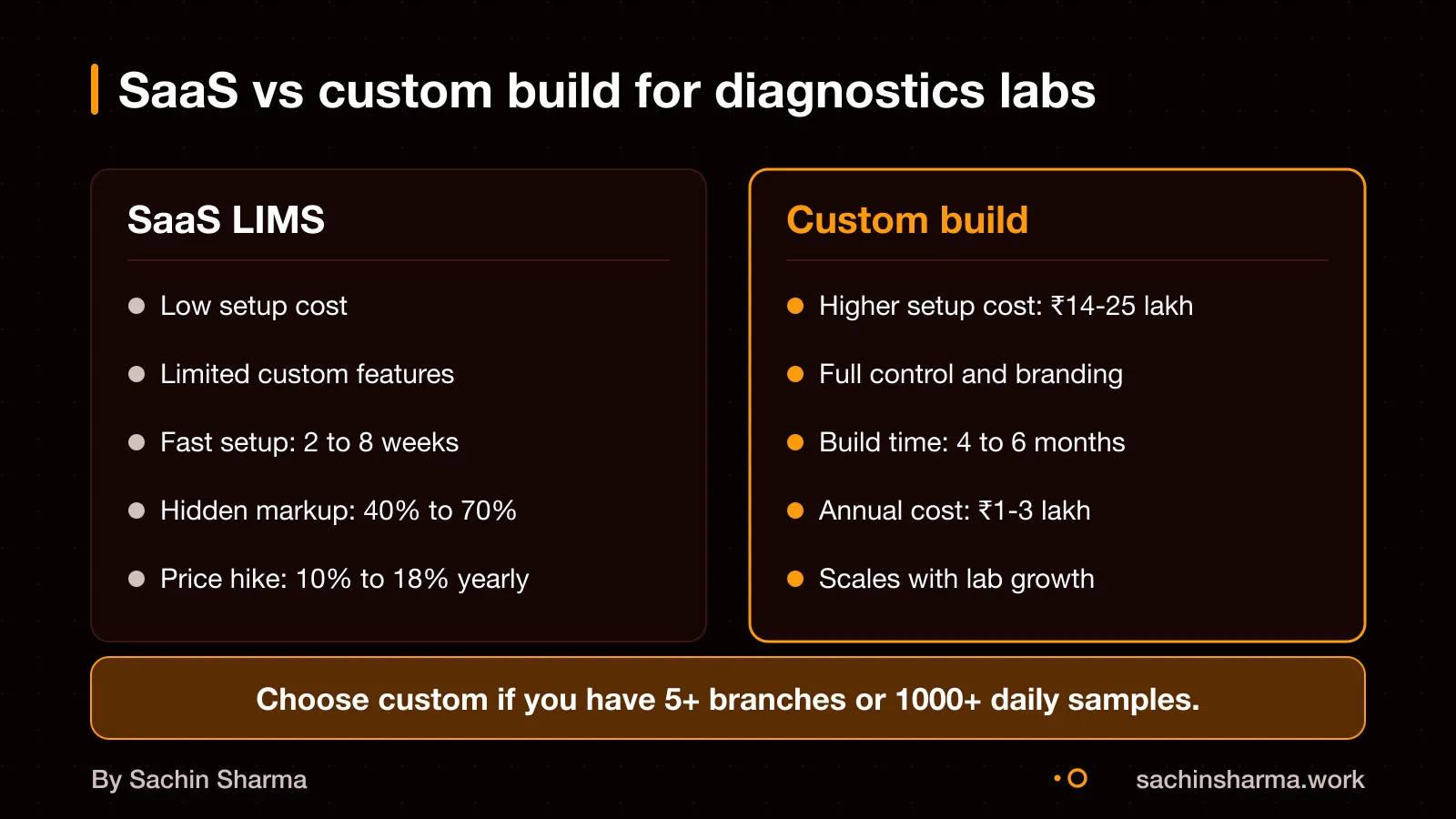
A diagnostics lab app manages patient registration, sample tracking with barcodes, test processing, reporting, and billing across multiple branches. It connects collection centres (spokes) to a central lab (hub), so operations run as one unit. Each branch can have its own pricing, and the system tracks which tests are ordered where and processed at the hub. Settlement reports and affiliate commissions are generated automatically per branch or partner. After a doctor signs off, reports go to patients by WhatsApp or SMS without manual steps. For example, a patient in Nagpur gets their blood test report on WhatsApp minutes after approval, while the Raipur branch receives credit for the order. This keeps workflows smooth and reduces delays. You can see a full list of must-have features for a diagnostics lab app if you want to explore further.
Build or buy: custom app vs SaaS LIMS
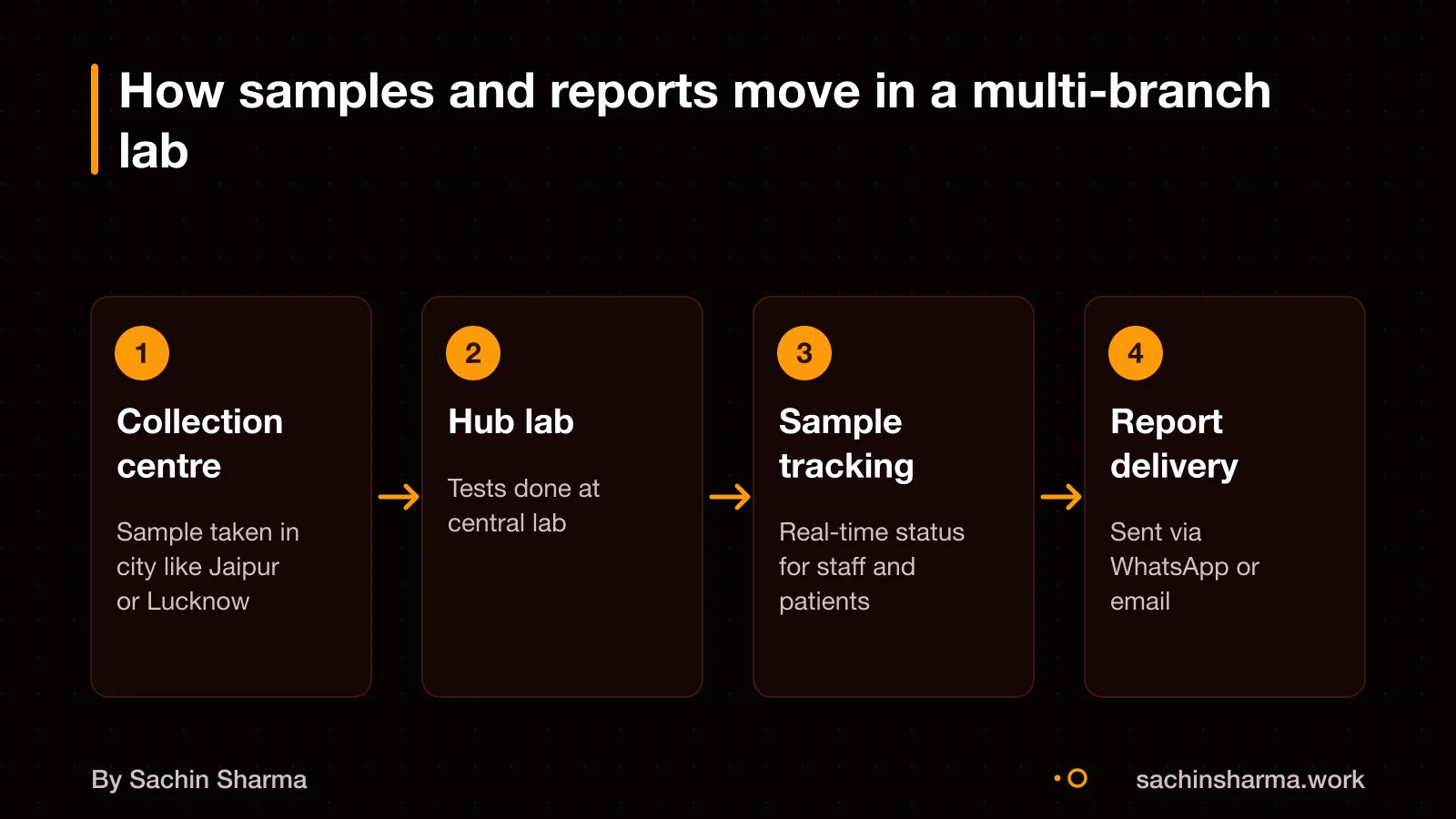
Choose a custom app if your lab has 5 or more branches. At these scales, SaaS fees add up to ₹15 to 25 lakh a year, and off-the-shelf tools lack the workflow control you need. Custom software ties together billing, inventory and reporting across locations.
SaaS LIMS is better if you are a single-location lab handling under 300 samples per day with a standard test menu. Little B2B work. It is faster to start and cheaper at first. New labs should almost always begin with SaaS and reassess at 18 to 24 months.
Franchise labs that use single-location software face real problems. They lack a central dashboard, consolidated reports, and cross-branch sample tracking. This makes billing reconciliation a manual, error-prone task done in spreadsheets. A unified system from the start avoids this. For a full comparison, see our guide on how to build or buy a diagnostics lab booking app.
How much it costs to build
After launch, expect annual costs of ₹1 to 3 lakh for hosting, maintenance, and updates. These are direct costs; other hidden costs are not specified.
SaaS LIMS providers often quote lower headline prices, but the real total cost of ownership (TCO) is typically 40% to 70% higher over time. This gap comes from forced add-ons, data migration fees, and limited customisation. Also, SaaS plans raise prices by 10% to 18% every year, which you must budget for.
For example, a SaaS plan quoted at ₹10 lakh per year could cost ₹14 to ₹17 lakh in real terms by year three. This is even without adding new features. In contrast, your custom app has no forced hikes. You control the budget.
You may save on booking-only apps, which focus only on patient scheduling.
Want a number for your idea? Send one line on WhatsApp. I reply with what drives the cost and what to cut.
Message me on WhatsAppHow long it takes to build and launch
A custom diagnostics lab app takes 4 to 6 months to launch. A SaaS LIMS setup takes 2 to 8 weeks. "Production-ready" means the app has auto-update, signing, icons and docs.
Custom builds take longer because they are made for your lab’s workflow. You get a unique app that fits how you work. For example, a 4-month build may include patient booking, sample tracking, and report delivery.
SaaS setups are faster. You pick a ready-made system and add your lab’s details. You go live in weeks, not months.
A production-ready app works on phones without extra steps. It updates itself and has your logo. It is signed for security.
For a timeline on simpler apps, see the timeline for a diagnostics lab booking app.
Milestones and deliverables
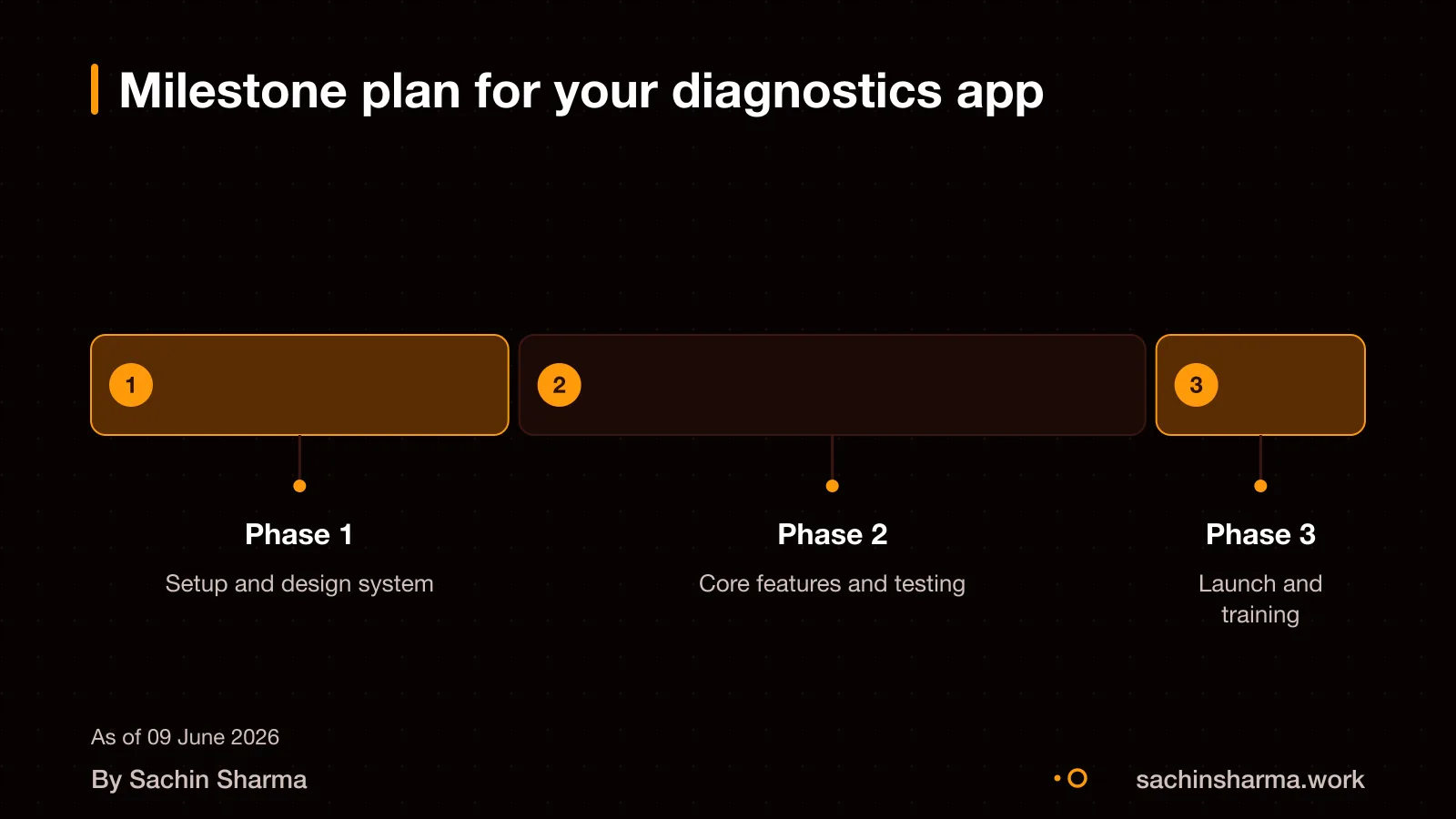
You get a working diagnostics lab app in clear phases, with verified deliverables at each step. I break the work into milestones so you see progress early and can give feedback.
The first milestone delivers a working lab setup guide. You can configure email, WhatsApp, SMS, lab analyzers, and printing from day one. This ensures your team can start integrating tools without waiting for the full build.
The second milestone gives you a complete design system. It includes style tokens, UI primitives, and a ready-to-use SCL logo component. This keeps the app’s look consistent and speeds up development.
The third milestone is the first working version of the app, marked as v1.0.0 in the changelog. From here, every update is tracked in a clear log. You get to test features as they are built, not just at the end.
Progress is measured by completed milestones, not hours. Each phase ends with a working piece of software you can review. If something does not fit your workflow, we fix it before moving on. This keeps the project on track and aligned with your needs.
How we communicate during the project
We use WhatsApp and email for daily updates, and monthly video calls on Google Meet for review and planning. You get progress reports every two weeks with screenshots and next steps. My team shares technical logs weekly in a shared folder. This keeps everyone aligned and cuts down on confusion.
Executives see high-level summaries every fortnight, focused on milestones and risks. The lab operations lead gets workflow updates after each test cycle. Developers on my side log progress daily in a tracker you can view on request.
Miscommunication can cause scope creep and missed deadlines. To avoid this, we follow a standard structure for updates. You decide how deep you want to go, from one-line status checks to full walkthroughs.
Proof: diagnostics apps I've built
Yes, I built NamAsta-Diagnostics, an offline-first desktop app for Sharma Clinical Laboratory. It was used in production and included patient registration, billing, result entry, and report generation with SCL letterhead. The app runs on desktops without internet and stores data locally, so work continues during outages. Since it was built for a real lab, the workflows match how staff actually operate. For example, reports are pre-filled with lab details and formatted on SCL letterhead for trust and consistency. You can see how I scoped a similar workflow app how I scoped a workflow app.
Code and account ownership
You own the code and data after final payment, as confirmed in the contract. This means you can move the app to another developer if needed. The app is built so that data can be exported in standard formats for your records or future use.
We will confirm the exact scope of deliverables, including source code, design files, and database schema, in writing before work starts. This ensures you know what you are getting and can manage the app long term.
How you host the app (self-hosted or cloud) may affect access, but you always have the right to export patient and business data. For full clarity, we will list all deliverables and ownership rights in the contract.
Post-launch support and updates
Post-launch support and updates are not defined in the available evidence. Whether bug fixes or updates are provided, and at what cost, is not specified. As an estimate, assuming a custom agreement, maintenance could cost ₹1 to 3 lakh per year for hosting, updates, and minor fixes. However, this range is based on general project data and not a fixed offer.
When this is not the right path
When this is not the right path
Do not build a custom diagnostics lab app if your lab is new. Start with a SaaS LIMS instead and re-evaluate at 18 to 24 months. SaaS is better if your lab processes fewer than 300 samples per day, has only one location. Offers standard tests, and does not serve other labs as clients. A custom app is not worth the cost or risk for small or single-location labs. If you are just starting out, focus on patient volume and operations first. Use off-the-shelf software to run your lab smoothly until growth justifies a custom build. Custom development makes sense only when SaaS limits your workflow or costs rise too high.
Next step: ask me how to start, I will explain the process once we connect.
Message me on WhatsAppAssumptions behind the numbers
- Thresholds like 5 branches or 1,000 samples are illustrative, not verified
Write your brief
A developer can only price what you describe. Fill the fields, and the brief writes itself.
Ask these of any developer who reads it
- Who will write the code, by name?
- Is offline mode tested in poor signal areas?
- How is customer data protected?
- What happens if the server is down for a day?
- Do you own the full codebase after launch?
- What does post-launch support include?
Questions people ask
You likely need a custom app if your lab has 5 or more branches. Gets over 40% of revenue from B2B work, or processes 1,000+ samples per day. At these scales, SaaS fees add up and standard tools lack needed workflows. Otherwise, a SaaS LIMS may be enough.
SaaS LIMS typically costs 40-70% more than the headline price due to add-ons and overage fees. Annual price hikes are 10-18% per year. Custom builds have no such hikes but need ₹1 to 3 lakh yearly for maintenance.
Ownership terms must be confirmed in your contract. I ensure you own the code and data after final payment, so you can switch developers if needed. Always get this in writing.
You can check progress through live demos every 2 weeks, a shared changelog, and a design system with approved UI components. These let you see working features early and give feedback.
Post-launch support is not defined in the current plan. I recommend budgeting ₹1 to 3 lakh per year for updates, hosting, and fixes. Confirm the scope before launch.
NABL accreditation is not legally mandatory but is needed for hospital tie-ups, insurance panels, and tenders. Your app should support NABL-compliant reporting if you aim for these. Check this for your case with a chartered accountant or lawyer.
Data portability must be confirmed in your contract. I ensure you get full access to your data in standard formats so you can move it later. Ask for export tools and file formats upfront.
Message me on WhatsApp with what you want to build. I will reply with the next steps, what I need from you, and how we can move fast. No forms or sales calls.