What a D2C app actually does for your business
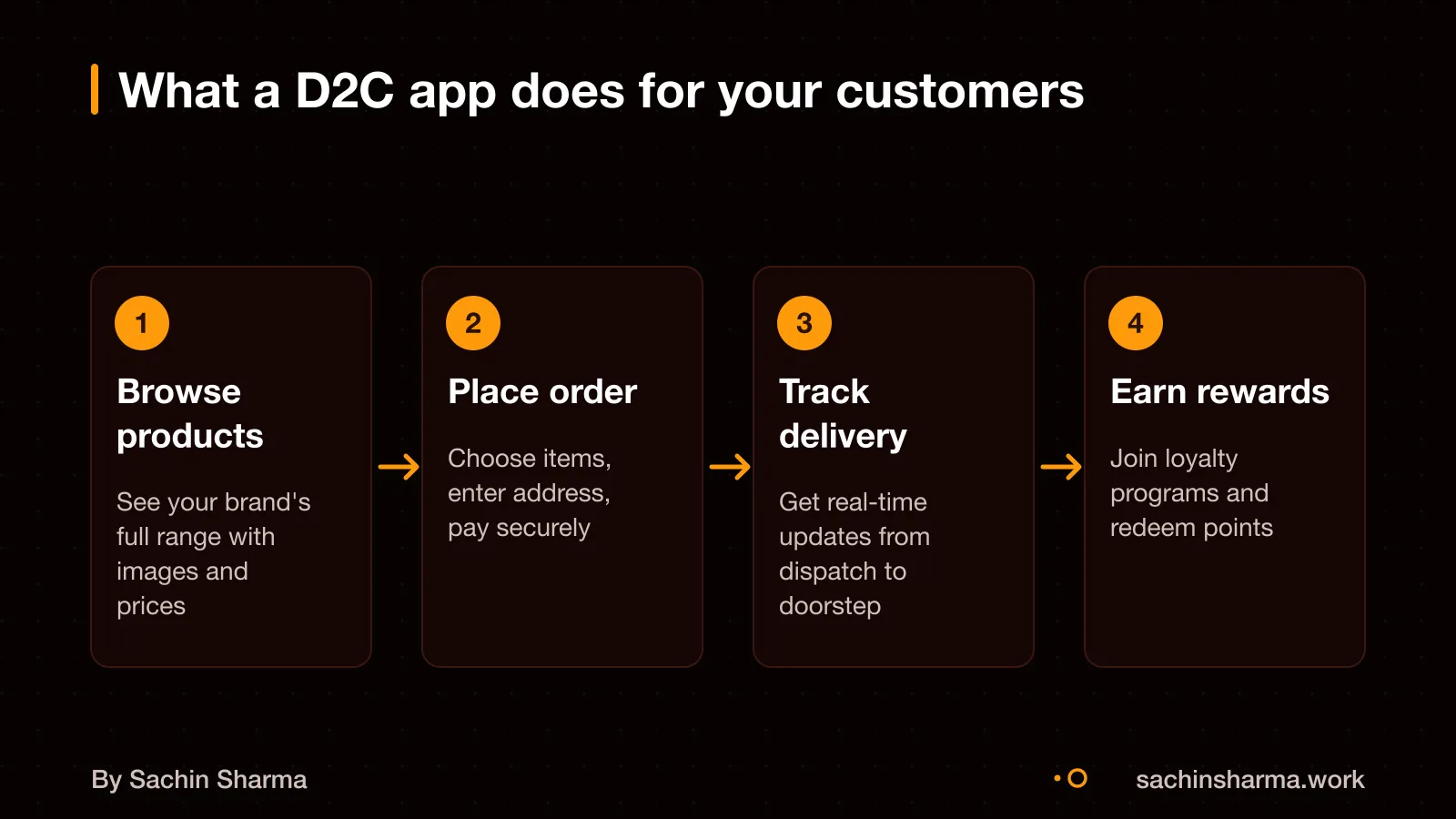
A D2C app helps you sell directly to customers while keeping full control over pricing, data, and experience. It solves the problem of relying on third-party platforms that take fees and limit access to your customers. Unlike a website or social media store, an app gives you a dedicated space on the customer’s phone. Enabling faster checkout, real-time order tracking, and direct support updates. You also keep customer data in-house, which helps in building loyalty and running targeted offers. For example, a skincare brand can push a restock reminder when a user’s moisturiser runs low, based on past purchase dates. This kind of personal touch is hard to achieve on Instagram or a generic e-commerce site. [[cta]] Want to know when a custom app beats an AI builder? Read when a developer beats an AI app builder.
When Shopify or no-code tools are enough
You can use Shopify instead of a custom app if your brand needs standard features like product listings, checkout, and order tracking. Shopify supports D2C, subscription, and social commerce from one dashboard. For most small businesses, this is enough at first.
A custom app becomes necessary when off-the-shelf tools limit your brand experience or operations. If you need unique features like offline access, real-time group shopping, or a custom loyalty flow, off-the-shelf solutions may not meet your demands. Custom apps let you control the user journey, sync with internal tools, or support low-network customers.
For example, if your customers often browse without internet, an offline-first app with local caching works better than a web store. Or if you run events and want fans to “listen together” live, a real-time socket model can offer what off-the-shelf tools cannot.
But if you are testing demand or scaling slowly, stick with Shopify or no-code. Save custom development for when growth or customer needs push past standard tools.
Cost of building a D2C app in India
Generic cost estimates for D2C apps often fail because they assume limited integrations, basic checkout flows, and minimal personalization. Costs rise with complex checkout flows, third-party API access, custom animations or admin panels. You can reduce cost by focusing first on core purchasing flows.
You pay 18% GST on custom software development services under SAC 998311. This applies to all IT service invoices in India. The final price you pay includes this tax unless your business is registered and provides valid documentation for input credit.
Always ask for a GST invoice with the SAC code listed so your business can claim credit if eligible.
Want a number for your idea? Send one line on WhatsApp. I reply with what drives the cost and what to cut.
Message me on WhatsAppHow long it takes to build and launch
As an estimate, a D2C brand app with core purchasing flows takes 6 to 8 weeks from idea to launch. This assumes a focused scope, clear input from you, and no major changes during development. Cost and timeline are closely linked: shortening the timeline usually increases cost, and cutting cost often extends the time needed. Projects take longer when the scope includes non-essential features like social feeds, complex loyalty systems or real-time chat. Reducing initial scope to focus on core purchasing flows can shorten timelines and lower cost while still delivering value. For example, launching with product browsing, cart, checkout and order tracking gets you a working app faster than adding wishlist sharing or AI recommendations upfront.
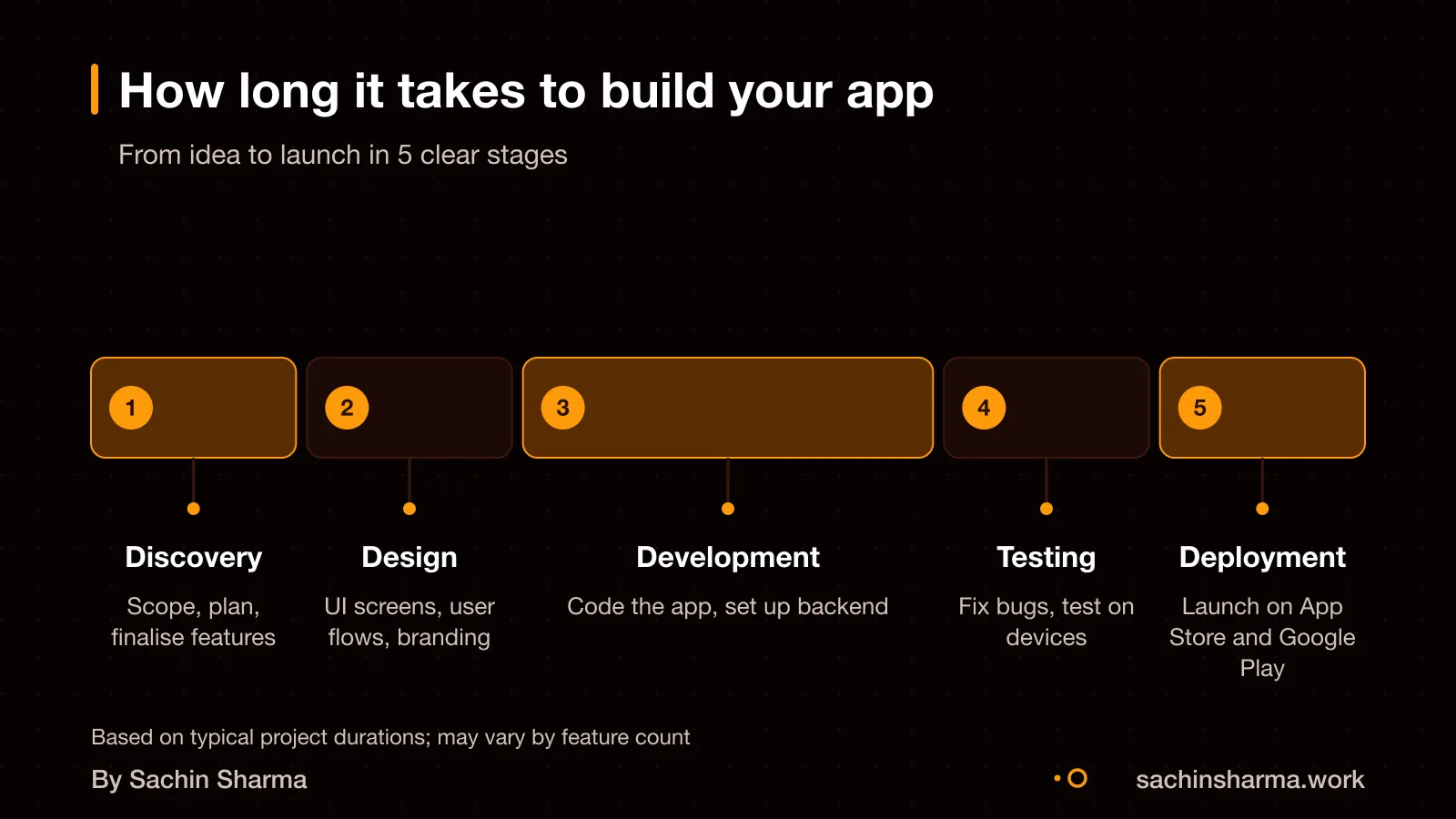
D2C mobile app development typically includes stages such as discovery and planning, design, development, and testing and quality assurance. Each stage adds time, but skipping or rushing them often leads to rework. If you change the design after coding starts, it can add 1 to 2 weeks. Late access to brand assets or content can delay the project by up to 10 days. The exact timeline depends on your decisions, not just technical work.
The 5 stages of building your D2C app
Custom D2C mobile app development typically progresses through well defined phases: Discovery and planning, Design, Development, Testing, Deployment and stabilization. Each stage has a specific goal and moves your app closer to launch. This process keeps the work focused and gives you control at every step.
Discovery involves defining the app’s purpose, target users, and core features. You lead this phase by sharing your brand’s goals and customer needs. The output is a clear scope that avoids costly changes later.
Design includes creating wireframes and mockups for app screens. These show how users will navigate and interact with your brand. You review and approve each design before we move on.
Development involves coding the app in stages. The app is built in small blocks, so you can see progress early. I focus on performance, security, and offline function where it matters.
Testing ensures the app works as expected across devices and network conditions. I test for bugs, crashes, and usability issues. You also get a test version to try with real customers before launch.
Deployment includes publishing the app to app stores as part of the final phase. I handle the technical setup, store listings, and initial release. After launch, we monitor for any issues.
What you must provide as the brand owner
You must supply brand assets, product data, and copy, and grant access to key accounts. As the owner, you are responsible for providing logos, brand colours, fonts, and any existing design guidelines. You also need to share accurate product details, pricing, inventory levels, and high-quality images or videos.
You must make decisions at the start and during key stages. This includes confirming the app’s core features, user flow, and screen designs before coding begins. Further decisions come during testing, such as approving changes or finalising content. Delayed input can slow progress.
I will need login access to your business systems. This includes your inventory, order management, payment gateway, and customer database if they are to be linked to the app. Without access, integration cannot be tested or completed.
As the brand owner, your role is active and ongoing. Development moves fastest when you provide complete assets early, respond to queries within two working days, and avoid major changes after the plan is set.
You own the code, design and accounts
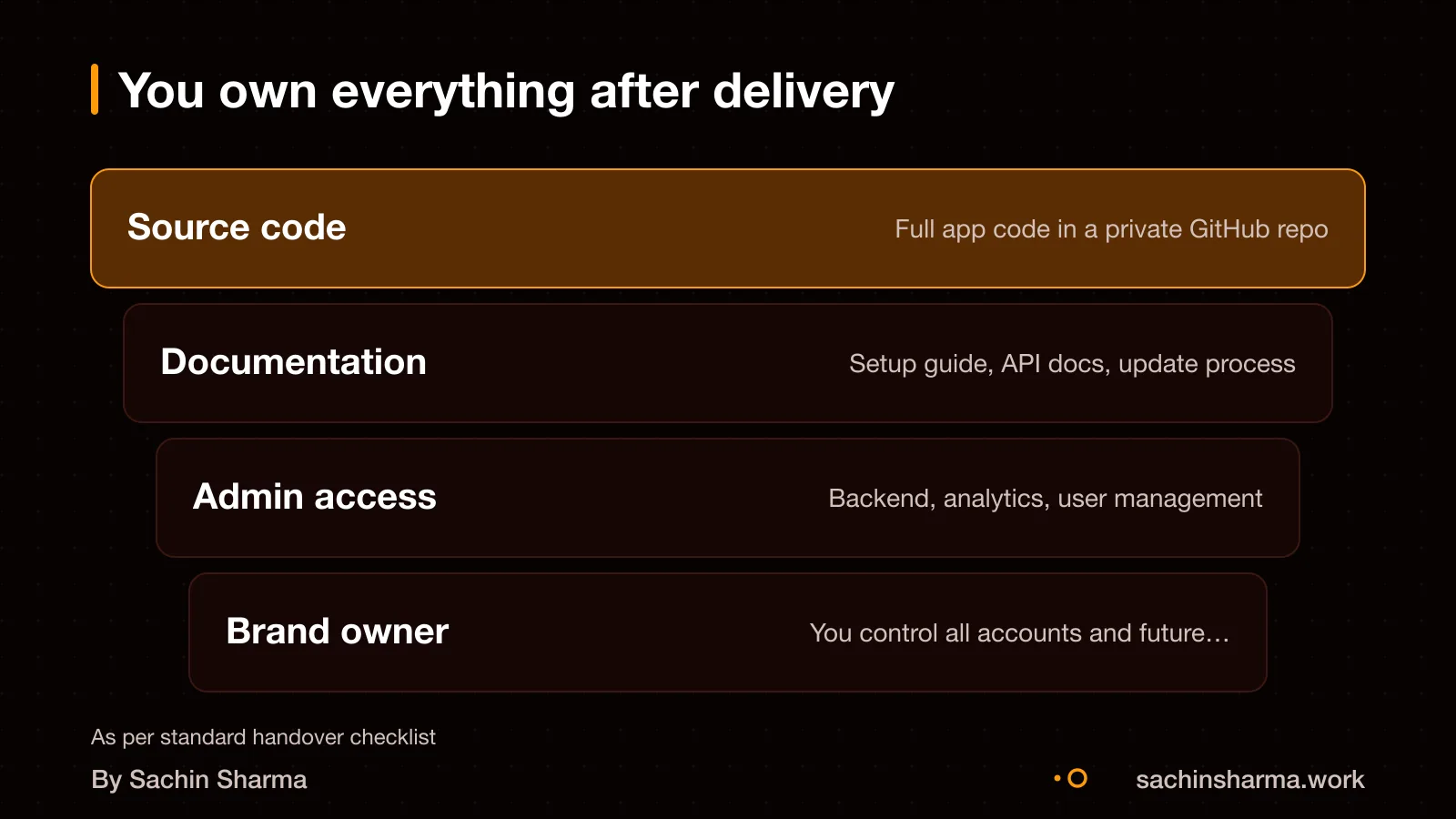
You own the full app, source code, design files, and all service accounts, from day one. I deliver everything in your name, with no lock-in. You can move it to another developer anytime. This practice is followed in projects I work on.
I hand over the source code in a private GitHub or GitLab repository that you control. You get admin access. I also share all design files (Figma or Adobe XD), backend documentation, API keys, and credentials for services like Firebase, payment gateways, and hosting platforms.
You can audit, modify, or hand the project to any other team. I do not charge for future access or updates. There are no licences, subscriptions, or hidden fees tied to my involvement.
For example, I delivered a multi-tenant platform for a family-run conglomerate (5 brands, 8 outlets), reported at ₹150 Cr+ revenue.
This full handover means you keep control of your brand’s digital assets. No agency holds your work hostage. You are free to scale, change, or pause as your business needs evolve.
What happens after your app launches
You decide what happens after launch. I offer optional support to fix bugs or add features, but only if we agree to it upfront. Without a support agreement, the project ends at launch. With a support agreement, support terms can be arranged.
Adding new features works as a mini-project. You describe the change, I reply with effort, time and cost. If you approve, it goes into the queue. Support plan duration varies by client.
You always keep full control. You own the code, the design files, and all accounts. You can take the app to any developer at any time. I do not lock you in. Support is a choice, not a lock-in tactic.
When a custom D2C app is not worth it
When a custom D2C app is not worth it
Off-the-shelf tools like Shopify support B2C, D2C, B2B, subscription, social commerce, and marketplace selling from a single admin. If your idea does not need unique tech, a standard store may be an option. Without your input, even the best developer cannot deliver what your customers will use.
Related reading: when a developer beats an AI app builder, build a local marketplace app, how an engagement runs for a field-staff app, hire a developer for an edtech startup.
Assumptions behind the numbers
- Core app includes browsing, cart, checkout and order tracking
- App works online with optional offline features
- Design is provided or built from wireframes
- Third-party integrations are limited to standard tools
- Timeline is flexible around 6 to 8 weeks
- Budget aligns with estimated range of ₹3.5 to 4.5 lakh
Write your brief
A developer can only price what you describe. Fill the fields, and the brief writes itself.
Ask these of any developer who reads it
- Who will write the code, by name?
- Is offline mode tested in poor signal areas?
- How is customer data protected?
- What happens if the server is down for a day?
- Do you own the full codebase after launch?
- What does post-launch support include?
Questions people ask
We begin with a call to define your app's scope, timeline, and cost estimate. I ask about your brand, goals, and must-have features to shape the plan. Then I share a clear outline of next steps.
We stay in touch through weekly updates and async messages. I share progress, blockers, and decisions needed. You reply when free, so it fits your schedule.
You own the source code, design files, and all service accounts from day one. I deliver everything in your name with full documentation.
Yes, I can review the app if you give me access to the code, documentation, and service accounts. Then I suggest fixes or upgrades based on what’s possible.
Yes, I work remotely with brands across India and abroad.
You can add features anytime. I offer optional post-launch support if we agree on scope and cost upfront.
Yes, MojoPlay is a music app I built with real-time "Listen Together" sessions, mood-based discovery, and offline playback. It is a public showcase, though the source is closed.
Timelines can shift if scope changes or input is delayed. I build in buffers and keep you informed. Cost and timeline are linked, so changes affect both.