What is a local marketplace app?
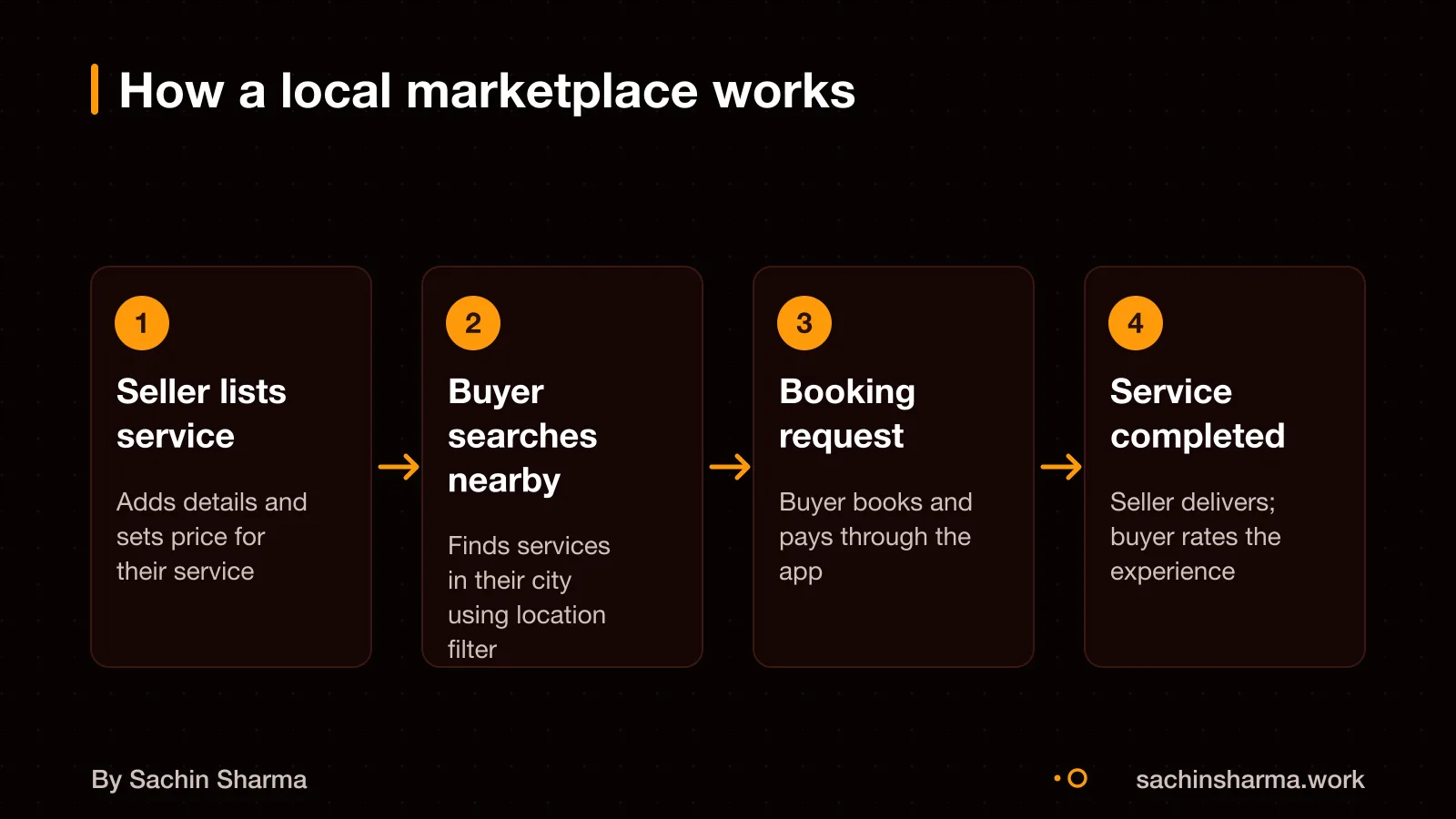
A local marketplace app connects buyers and sellers within a specific region. It helps them meet face to face for services or goods. Unlike e-commerce, which ships items across the country, local marketplaces focus on nearby transactions. This makes trust and timing easier to manage. For example, Ola in India links riders and drivers in cities. Grab in Thailand does the same for food and rides. These apps solve local problems better than global platforms. A local marketplace can cover delivery, rentals, repairs or bookings. It works best when the service happens in person. You can build one for your city or community. The app gives you control over users, rules and fees.
Build custom or use a white-label platform?
Build custom if you expect 5,000 or more active users. At that scale, per-transaction fees on white-label platforms become expensive. You also gain full control over branding, data, pricing and user experience.
A white-label platform is enough if you want to test your idea fast. These platforms, like Yelo or Growcer, let you launch a beta in 1 to 2 weeks. The cost is between ₹1.5 lakh and ₹5 lakh.
The trade-off is control versus speed. Custom apps take longer and cost more but grow with your business. White-label tools save time early on but limit how much you can change later. For example, you may not be able to add unique features or switch pricing models.
If you are testing demand, start with a platform. If you are building a long-term business, custom is better. Compare your options for rental models Build or buy a rental marketplace app or B2B models Build or buy a B2B marketplace app.
How much does it cost to build?
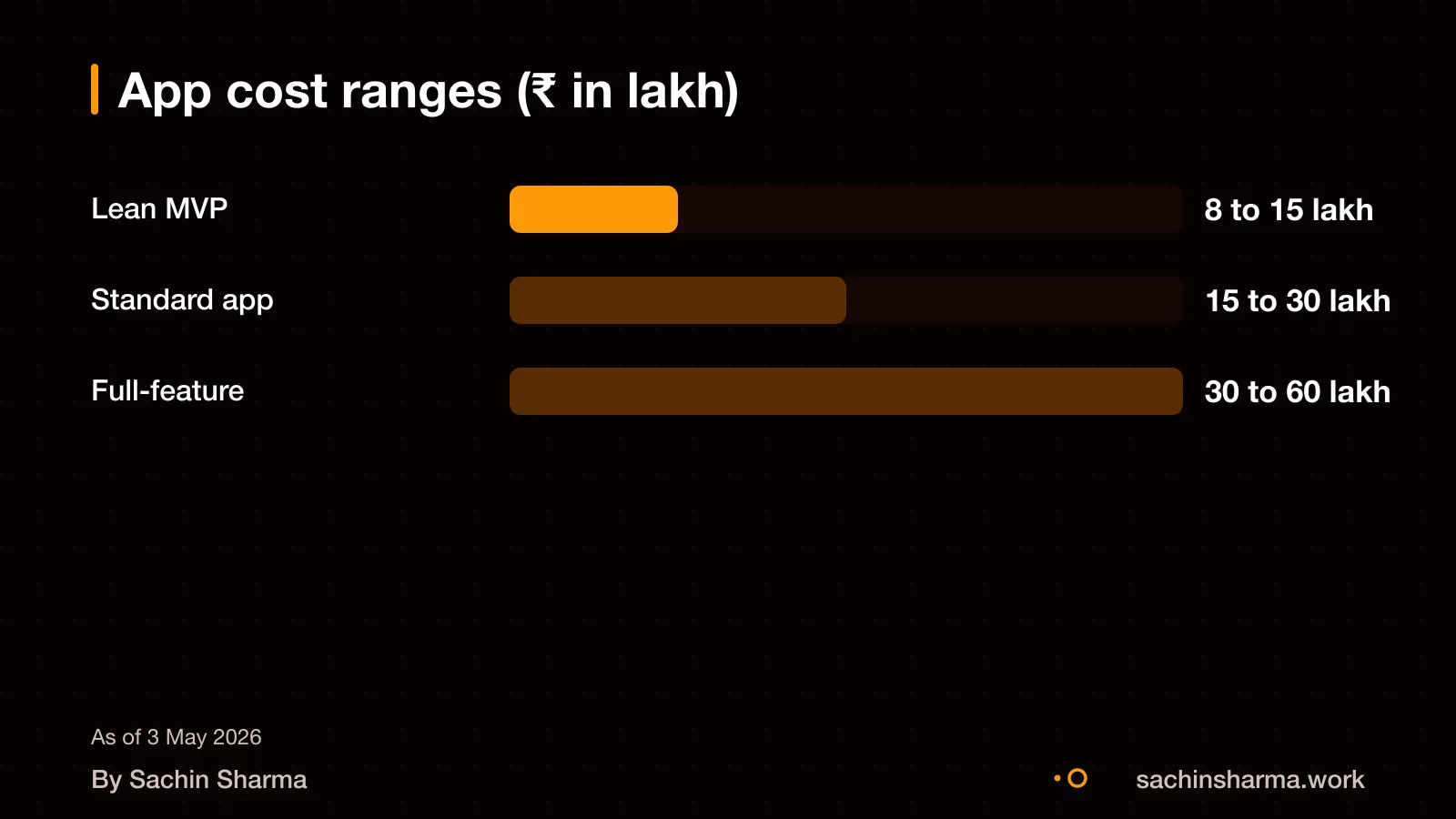
This covers a web dashboard and one mobile app (iOS or Android), basic listing, search, and messaging. It assumes one service or product category and no advanced payments.
Costs rise when you add more features. A standard app with multi-category support, both iOS and Android apps, in-app payments, and user reviews costs ₹15 lakh to ₹30 lakh. A full-feature app like Urban Company, with provider tracking, dynamic pricing, and admin workflows, costs ₹30 lakh to ₹60 lakh.
What drives cost up: - More screens or user roles (e.g. customer, seller, delivery) - Complex workflows like booking, scheduling or dispatch - Advanced features like real-time maps, AI matching or chatbots - Third-party integrations (payment gateways, SMS, GST invoicing)
There are no hidden fees in my engagements. You pay only for what is agreed. The quote includes development, testing, and deployment. Hosting, domain, and ongoing maintenance are discussed separately if needed.
As an estimate, a lean MVP with 6 core screens, one payment method, and email/SMS alerts falls in the ₹8L, ₹15L range. This assumes no custom design system and use of proven tools like Firebase or Supabase.
Cost to build a B2B marketplace app Cost to build a second-hand goods app
Want a number for your idea? Send one line on WhatsApp. I reply with what drives the cost and what to cut.
Message me on WhatsAppHow long does it take?
A lean MVP for a local marketplace app takes 10 to 14 weeks. This includes one category, a web admin panel, and one mobile app (iOS or Android). You get a working product with core features like listings, search, and booking.
Delays happen if requirements change mid-way, if integrations take longer (like payment or location services), or if content and images are not ready on time. Clear scope and fast feedback keep the timeline tight.
It can be faster for simpler needs. If you only need a single platform (like Android only) or fewer features, the timeline shortens. For example, a basic version with listings and contact forms can go live in under 10 weeks as an estimate, assuming no third-party approvals.
A standard app with multiple categories and both iOS and Android support takes 16 to 22 weeks.
How long for a B2B marketplace app?
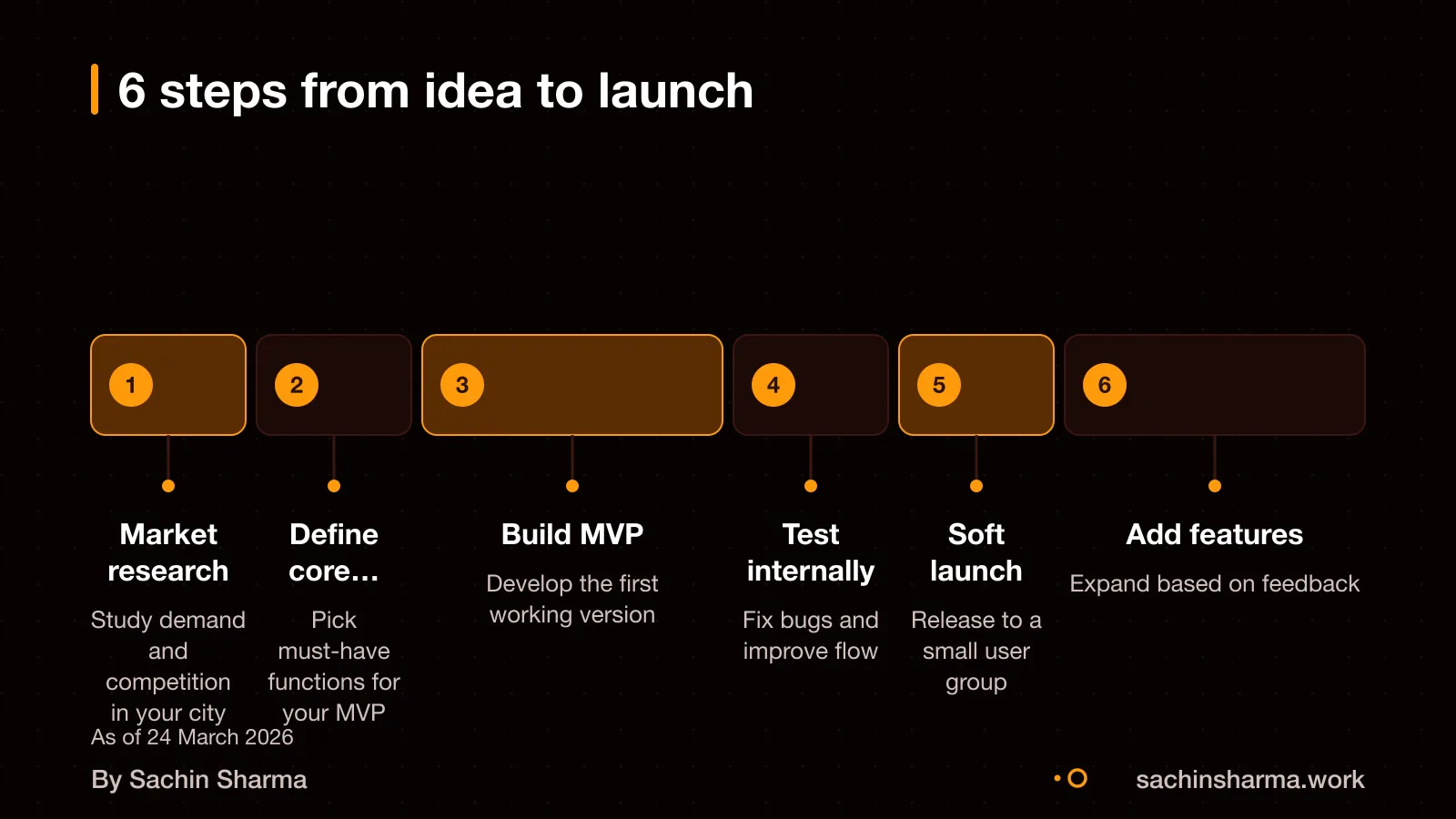
The 6 steps from idea to launch
You act at key points to confirm direction. We stay aligned through weekly demos and shared goals.
1. Define the core transaction We identify the main action users will take, such as booking a service or buying a product. You confirm the buyer and seller roles. This keeps the MVP focused.
2. Map the user journey I sketch the steps each user takes, from onboarding to completing a transaction. You review and adjust based on real customer habits.
3. Prioritise features for the MVP We pick only the features needed to test the marketplace model. You decide what stays based on your budget and risk.
4. Build the web dashboard and mobile app You get weekly updates with working screens.
5. Test with real data and users We run internal tests with sample listings and messages. You join to spot issues before launch.
6. Soft-launch to a small user group The app goes live to a limited audience. You collect feedback and decide on the next move.
Market research helps shape the MVP, including understanding your audience. Each step builds on the last, with your input guiding progress.
You see working software every week
You get weekly updates with working screens. This lets you see progress in real time, not just screenshots or promises. Each week's build includes the latest features and fixes, ready to run on your device or browser.
These are real functions, not mockups. You test them as a user would, on your own phone or computer.
I note them, prioritise by impact, and resolve them before adding new features. This keeps the app stable and user-ready at all times.
As part of the process, you may get early access to soft-launch the MVP in a small group of real-world users. This helps you gather real feedback before a full rollout. You decide who joins, and I help set up access.
You own everything
You own 100% of the source code once the project is complete. I publish the app under your own Apple Developer and Google Play accounts, not mine. This means you control all updates, distribution, and store policies. No third party holds your code hostage.
You also own the domain and hosting setup. I help you register them in your name, using providers like AWS or DigitalOcean. You pay the renewal fees directly. There are no hidden charges or middlemen.
Even after launch, you can take the code to any developer. I deliver clean, documented code in a private GitHub repository that you fully own. You are free to modify, resell, or scale it without asking me.
Who owns the app I pay for?
Proof: apps I can show you
I have built apps with a multi-vendor + rider-dispatch architecture used in grocery (Blinkit), pharmacy (1mg), and services (Urban Company). These use a multi-vendor setup with dispatch logic, as seen in Blinkit, 1mg, and Urban Company.
For example, MojoCinema is a Flutter app that helps users discover movies, view trailers, and save titles to a local watchlist. It prioritises Indian and regional content and uses a public catalog API. There is no account system or tracking.
Sameframe is a desktop app built with Next.js and Electron that finds duplicate photos and videos using SHA-256 and visual similarity models. It runs offline, with no uploads or accounts.
FlashDrop is a secure, LAN-only file transfer tool between phones and Macs using a QR code and encrypted chunks. It resumes transfers and works without internet.
These apps show my ability to build reliable, user-focused tools that run locally or in real time, with attention to security and performance. They are public showcases, though source code is closed.
How to start working with me
The first step is a 30-minute scoping call with me, a senior marketplace engineer, to discuss your idea and goals. There is no trial build, but you get a fixed-scope quote after the call, with no sales pitch. We talk directly, no middlemen, via WhatsApp or video call, whichever you prefer. For example, one client shared a rough sketch over WhatsApp, and we had a call scheduled within 24 hours.
Next step: message me on WhatsApp with what you want to build. No forms, no sales team.
Message me on WhatsAppWhen this approach is wrong
When this approach is wrong
Do not hire a custom developer if your budget is under ₹8 lakh. A custom app needs this minimum to cover core features, testing and launch. At lower budgets, use a no-code platform or rent a white-label solution instead.
Do not choose custom development if you need instant scale. White-label platforms handle thousands of users from day one. Custom apps take 10 to 14 weeks to build and need time to grow user trust.
Do not go custom if you need full hand-holding. This model works best if you can make product decisions weekly. If you need a developer to manage marketing, legal, and operations too, hire an agency or co-founder instead.
Avoid custom builds if your idea is highly regulated, like health or finance. These need compliance work beyond standard development. You will need legal counsel and domain experts before writing code.
Write your brief
Tell me what you're building. I'll give you a brief that developers can price.
Ask these of any developer who reads it
- Who will write the code, by name?
- Is offline mode tested in poor signal areas?
- How is customer data protected?
- What happens if the server is down for a day?
- Do you own the full codebase after launch?
- What does post-launch support include?
Questions people ask
It starts with a free 30-minute scoping call with a senior engineer. We discuss your idea, define the core features, and agree on the next steps. You need not prepare anything formal, but clarity on your target users and service type helps. I then provide a fixed-scope quote with no sales pitch.
We use WhatsApp or email for daily updates and quick queries. Weekly builds are shared for live testing. You get a working version every week, not just screenshots. This lets you give feedback early and often, and I adjust the roadmap if needed.
You own 100% of the source code once the project is complete. The app is published under your own Apple Developer and Google Play accounts, not mine. No access is withheld. You can take the code to any developer later without lock-in.
I can share screenshots, feature lists, and live demos of non-client projects like MojoCinema and Daily. For client work, I share only what is public or allowed. The core architecture is similar to apps that use multi-vendor and dispatch logic, such as Ola and Blinkit.
You can switch at any time. I provide full source code, documentation, and access to all accounts. Handover is clean and fast. No hidden files or access barriers. You own everything from day one.
Yes, ongoing support is optional. It includes bug fixes, updates, monitoring, and feature upgrades. We agree on a monthly or per-task rate. This is not automatic, you choose when to use it.
I build the app, not the users. The MVP tests if buyers and sellers will transact, not if the business will scale. Success depends on your marketing, pricing, and operations. I focus on a working product, not user growth.
Legal structure and GST depend on your business type, sole proprietor, LLP, or private limited. These affect compliance and tax. I do not set your structure. Check this for your case with a chartered accountant.