What is Bolt.new?
Bolt.new builds websites, web apps and mobile apps using AI. It creates full-stack applications with JavaScript-based frameworks. These include marketing sites, portfolios, online stores, dashboards and internal tools.
It is for independent developers who want to ship production apps quickly. The Pro plan supports this use case as of 24 July 2026.
Bolt.new does not build native mobile apps with deep device integration or offline-first features. It does not support custom backend logic outside JavaScript frameworks. It does not offer full control over data storage or code ownership by default.
If you need a Flutter or native iOS/Android app with offline sync or background tasks, Bolt.new may not meet your needs. For such cases, a custom app built with Flutter or native tools gives more control.
You might also look at FlutterFlow alternative if you are comparing no-code platforms.
Bolt.new cost at different volumes
Bolt.new’s Pro plan costs $20 to $25 per user per month for 10-13M tokens. At 50 users, this totals $1,250 per month. At 100 users, it rises to $2,500 per month. The headline price is not always the full cost, as usage beyond token limits or add-on features may increase the bill. For example, heavy automation or AI workflows could push usage into overage. These figures are based on third-party tracking and may vary slightly based on region or negotiated terms.
Want a number for your idea? Send one line on WhatsApp. I reply with what drives the cost and what to cut.
Message me on WhatsApp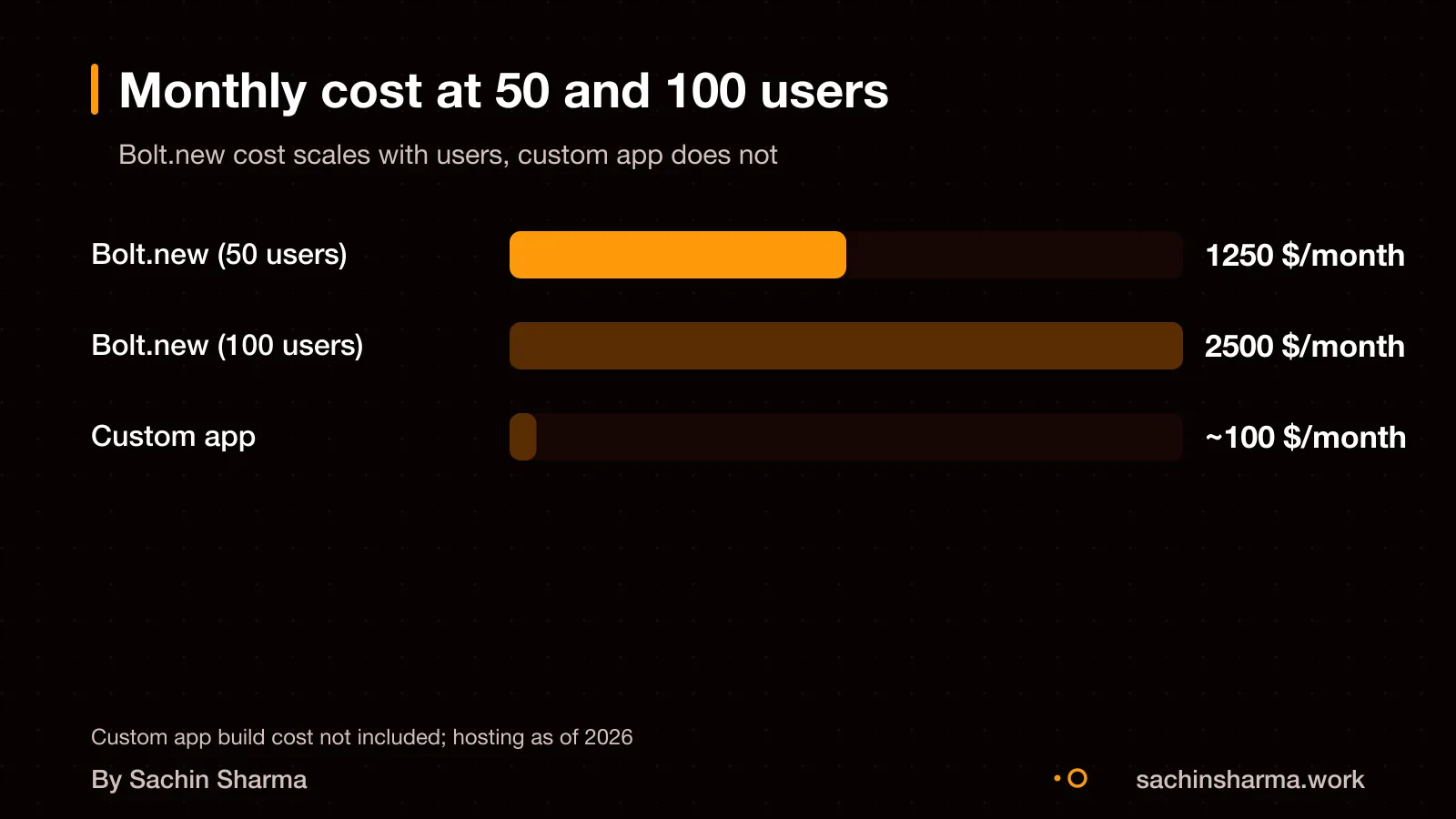
Who owns the code and data?
You own neither the code nor the data when using Bolt.new, as it is a hosted platform. The app runs on Bolt’s infrastructure, and you have no access to its source code. For a custom app, ownership must be written into the contract before work starts. I include a clause that assigns all right, title, and interest in the code to you on payment. Deliverables include the full Git repository with history, source code, database schemas, and build scripts. This ensures a clean handoff: any new developer can take over without needing me. Avoid contracts that only grant a license, lock you to a builder-controlled platform, or exclude source code, these are red flags. A fair contract protects your long-term control.
hire a developer if you need help reviewing or drafting ownership terms.
Can you move your app later?
Yes, you can transfer ownership of an app built with Bolt.new to another developer or organisation. The app stays available on the App Store during and after the move. You retain all user reviews, ratings and update history. The Bundle ID, which identifies your app, remains unchanged after transfer.
However, Bolt.new does not host your production app. You must export the code and deploy it yourself, either through GitHub or a direct download. This means you can host it on your own infrastructure once exported. Auto-renewable subscriptions require an app-specific shared secret, which you must set up during deployment.
For example, if you start on Bolt.new and later want full control, you can export the code. Transfer the app to your own App Store Connect account, and keep all existing reviews and the app ID. But you must manage hosting, updates and compliance yourself after export.
Support and technical help
Paid users get email support for product and technical questions. This support is available Monday through Friday during business hours. You will not get help outside these times or on weekends. Free users do not get email support. Instead, they must reach out on Discord, where community members may help. Discord is not monitored by Bolt’s team, so responses are not promised. If you need reliable, timely help, a paid plan is required. For urgent issues, neither option offers 24-hour coverage.
Legal and GST compliance for shipping
You are responsible for ensuring your shipments follow Indian law, including GST invoicing and e-way bills. If you claim input tax credit, you must have a valid GST invoice for each shipment. Bolt.new does not confirm whether it generates GST-compliant invoices, so check with your CA or the platform directly before relying on it for compliance.
For international orders, you are legally responsible for lawful import at the destination. Bolt.new informs you during checkout if any part of an order requires international shipping and shows the product value. One purchase per person per day under $800 USD is duty-free due to the de minimis rule. This helps small exporters avoid customs issues, but does not replace proper documentation.
It is not known what value threshold triggers e-way bill requirements in India. It is not known whether Bolt.new generates or supports e-way bill data. If you ship high-value items, confirm whether your platform provides the invoice details. Transporter ID and other fields needed to generate one on the GST portal. For strict compliance needs, see the online pharmacy rules.
Why this advice is for Indian businesses
This advice is for Indian businesses because shipping needs here depend on local couriers, regional compliance and customer habits. It is not known whether Bolt.new supports regional couriers. A custom app can integrate with specific couriers if developed to do so. It is not known whether Bolt.new supports local languages in customer-facing tracking or notifications. A custom app can include multilingual support if implemented during development. If you rely on regional logistics networks or serve customers who prefer vernacular updates, this could be a deciding factor.
WhatsApp API providers shows how local integrations can improve delivery coordination. For your specific courier or language needs, it is best to check directly with Bolt.new or discuss your use case with a developer.
When Bolt.new is still the better choice
- It is not known whether Bolt.new is cheaper than a custom app for fewer than 50 orders a day.
- It is not known how long it takes to build a custom app or whether Bolt.new is faster to launch.
- It is not known what maintenance a custom app requires or whether Bolt.new reduces risk without a developer.
- It is not known whether Bolt.new avoids complexity for simple needs or when custom apps add value.
Next step: message me on WhatsApp with what you want to build. No forms, no sales team.
Message me on WhatsApp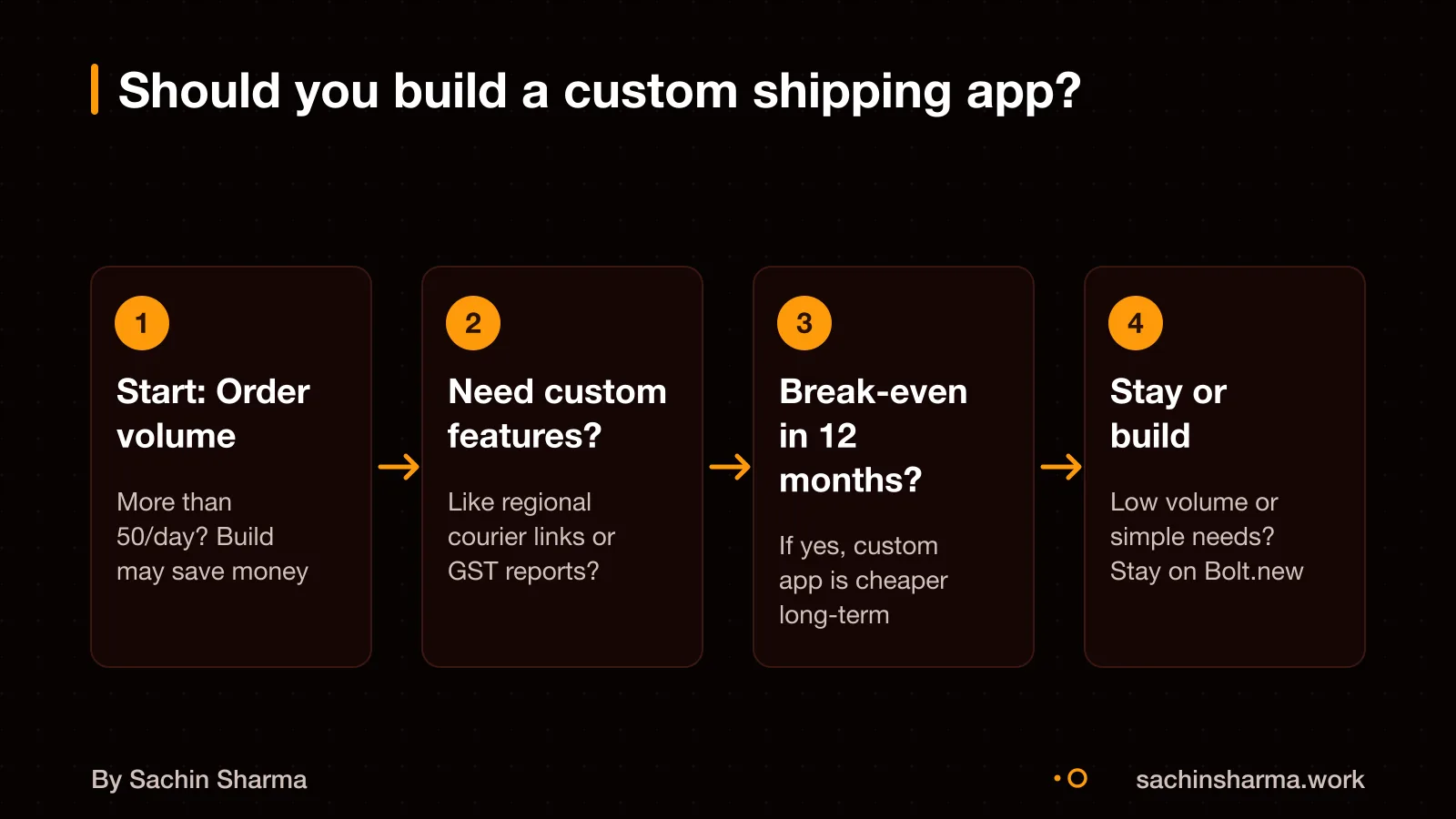
Assumptions behind the numbers
- Break-even time for custom vs Bolt is not known from evidence
- Custom app cost and timeline depend on developer scope, not pre-set
Which path fits you
Bolt.new helps you build apps fast. But when shipping volume grows, a custom app may save money. This page tells you when to switch.
Answer all 2 questions
The outcome appears when every question has an answer. The default is stay on bolt.new.
Honest comparison
Where Bolt wins
Speed to first version, no coding skills needed, and low upfront cost.
Where custom wins
Control over data, exact feature fit, and lower long-term cost at scale.
Where both lose
If the idea has no market. Ship a test version first, either way.
Questions people ask
I recommend Bolt.new for simple, low-volume needs because it has a lower upfront cost. A custom app may save money for high-volume or complex needs, but the break-even point depends on unknown factors.
It is not known how the plan changes if you switch between Bolt.new and a custom app. Check your specific needs before deciding.
It is not known whether Bolt.new allows full export of shipping history or data [unknown]. If you plan to move later, this could be a risk. Want to assess your current setup? Send me a line on WhatsApp and I will tell you what to check.
It is not known whether Bolt.new supports GST invoicing for shipments [unknown]. You are responsible for compliance, including valid invoices for input tax credit. Check this for your case with a chartered accountant or test the feature directly.
Yes, a custom app can integrate with WhatsApp and Excel using tools like n8n. You can set up automated workflows between WhatsApp Business Cloud and Microsoft Excel 365. For full control, use APIs with pre-built actions or raw HTTP requests.
You can test a custom app using free and paid tools. TestFlight supports up to 10,000 external iOS testers. Google Play offers free closed and open testing. Firebase Test Lab has a free tier for automated tests on real devices. For more, BrowserStack starts at $29 per month.
It is not known what ongoing maintenance a custom app requires [unknown]. Common needs include updates for security, OS changes and third-party API shifts. Message me on WhatsApp with your app plan and I will list what to expect.