What is a quick commerce app?
A quick commerce app delivers small orders in 10 to 30 minutes, using dark stores within 2 to 3 km of customers. It differs from regular delivery by speed, order size, product range, and use of micro-fulfilment centres. Regular delivery may take hours or days and ships from central warehouses. While quick commerce relies on local dark stores with 1,500 to 4,000 fast-moving items.
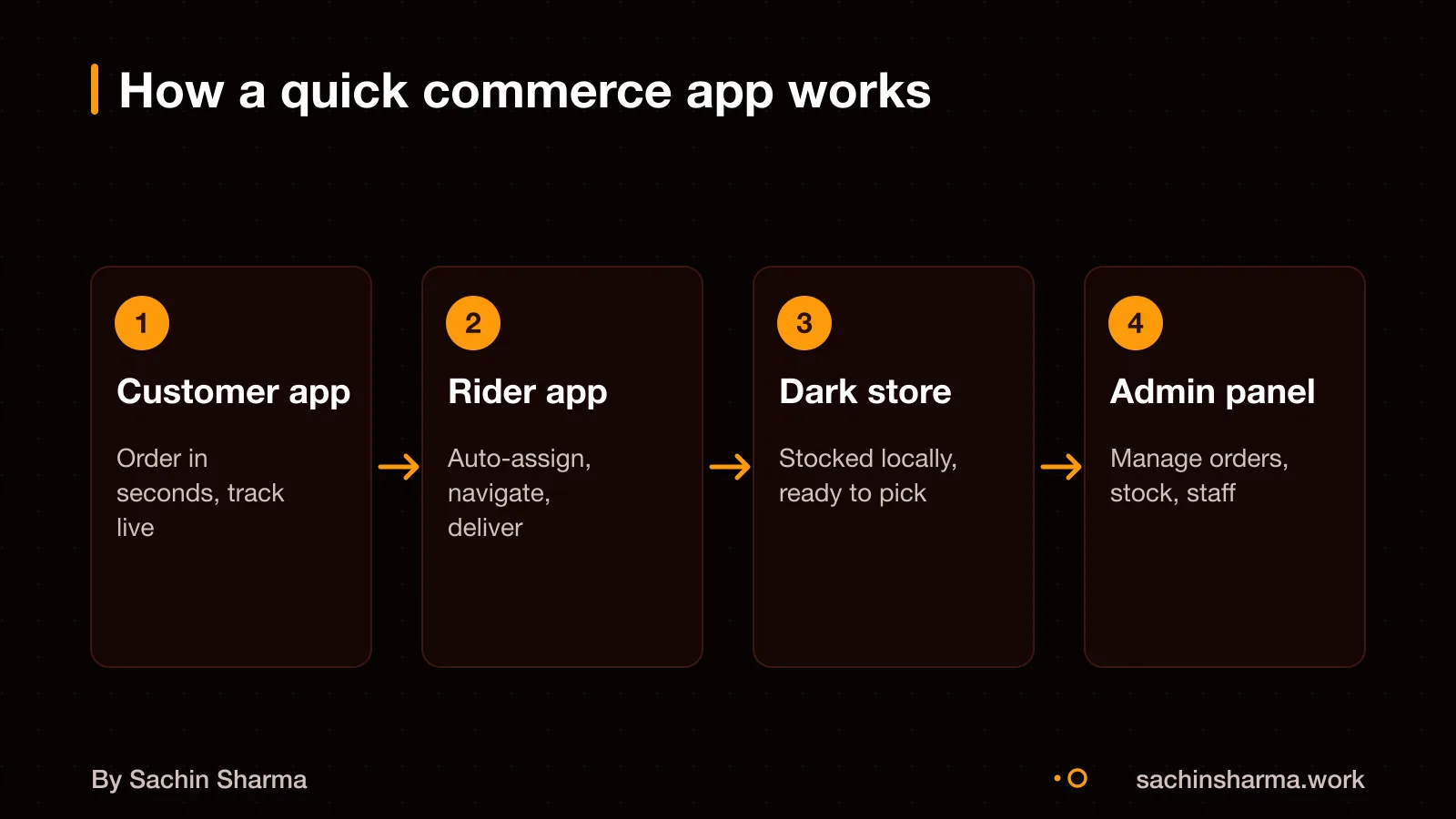
The app must have four connected systems: a customer app, a rider app, a dark store operations panel, and an admin dashboard. These systems work together to confirm orders, assign riders, manage stock, and track performance. The customer app shows only items in stock at the nearest dark store, and location is checked before the catalogue loads.
Speed alone is not enough. You also need accurate inventory, fast rider dispatch, and real-time updates. If stock is wrong or riders are delayed, delivery fails even if the app is fast. For more on how delivery systems work, see how a food delivery app works.
Do you need a custom app to start?
You can start without a custom app. Many quick commerce businesses begin with WhatsApp as their ordering system. This is low cost and fast. You only need a phone number and a team to respond. As your orders grow, you can connect WhatsApp to other tools like payment gateways and inventory systems. A custom app is worth it only when you plan to scale fast or have unique needs like special delivery rules or deep brand control. Until then, a white-label or platform-based solution can handle core functions. These include customer orders, rider tracking, dark store management and admin reporting. White-label apps are almost always cheaper than building from scratch because you skip engineering, hosting and maintenance costs. They also launch faster. So if you are testing demand or starting small, begin with WhatsApp or a ready-made platform. Upgrade later when the numbers justify it.
Cost to build a custom quick commerce app
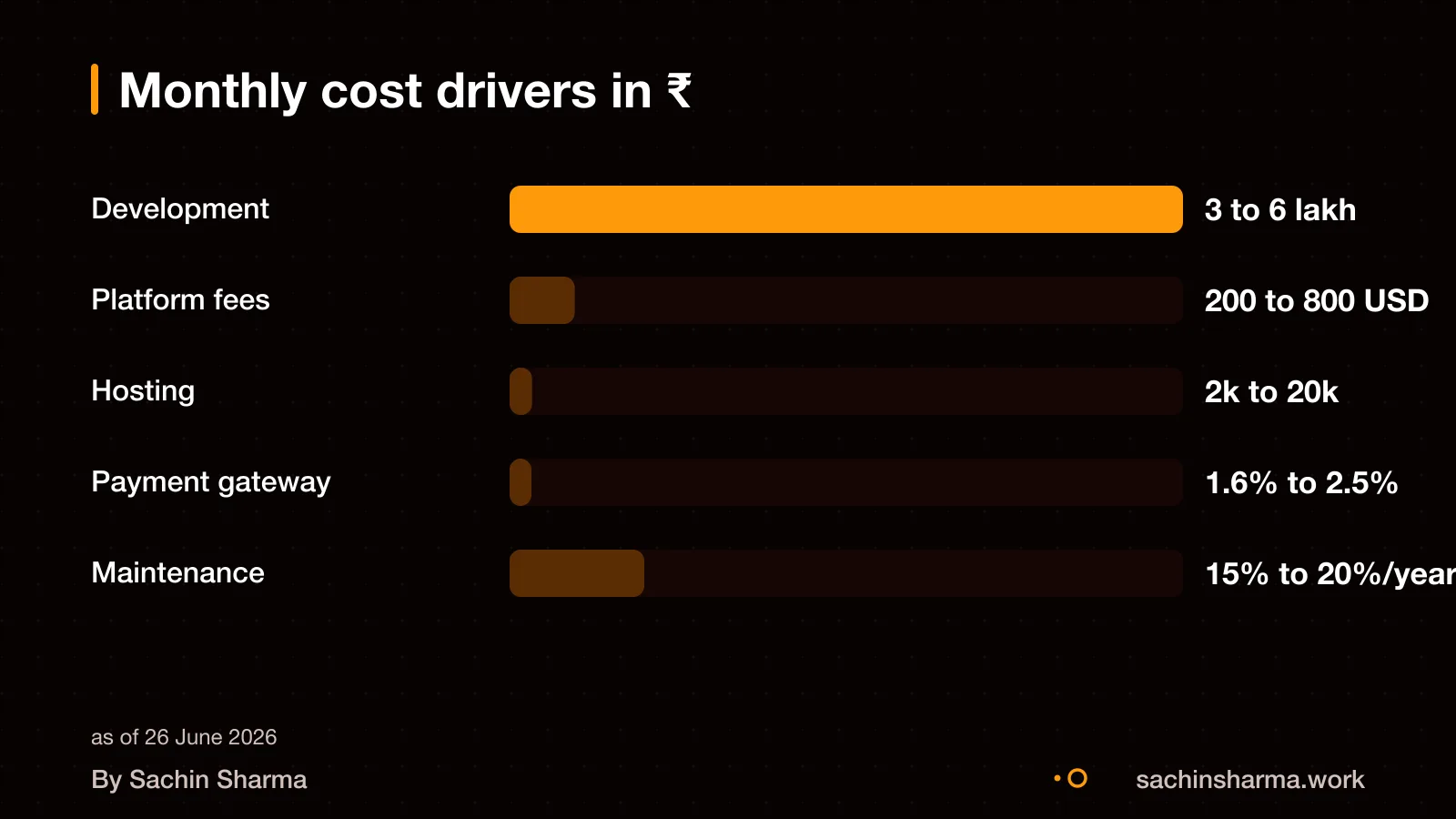
A custom quick commerce app costs ₹3,00,000 to ₹6,00,000 for a standard version and ₹10,00,000 to ₹25,00,000 for a complex one. This range covers a two-sided marketplace with real-time delivery tracking, user and vendor dashboards, and payment integration. You save 30 to 40% by using React Native, which builds for both Android and iOS from one codebase. This cuts time and effort compared to writing separate native apps.
You can reduce cost by starting with an MVP that includes only core features like product listing, cart, checkout, and delivery tracking. Avoid advanced AI recommendations or dynamic pricing at first. Use open-source tools for notifications and analytics. On the other hand, cost rises if you add multi-warehouse sync, custom logistics routing, or deep ERP integration. Apps with advanced admin controls, fraud detection, or multi-brand support fall into the ₹10 to 25 lakh range. For instance, a multi-tenant platform for a family-run conglomerate with five brands cost ₹15 lakh.
Want a number for your idea? Send one line on WhatsApp. I reply with what drives the cost and what to cut.
Message me on WhatsAppCost of a white-label quick commerce app
A white-label quick commerce app costs $200 to $800 per month for entry-level tiers. This range is based on global agency pricing and does not reflect a verified India-specific rate. The subscription typically includes hosting, maintenance and updates, which helps avoid surprise bills. Enterprise plans are not priced openly and involve custom, negotiated contracts. These may cost significantly more than standard tiers, depending on features and scale.
Compared to a custom build, white-label is usually cheaper upfront and over time. Custom apps often need a one-time development cost of ₹15 to 25 lakh or more, plus separate hosting and update expenses. White-label spreads the cost monthly and bundles key services. However, long-term payments can exceed custom build costs after several years.
As an estimate, assuming a five-year run, a $500/month plan totals $30,000 (about ₹24 lakh at ₹80/USD). Which overlaps with the lower end of custom development. For short-term testing or limited budgets, white-label is cost-effective. For long-term ownership, the break-even point depends on your scale and update needs.
Hidden costs in ready-made platforms
Ready-made platforms often charge fees that rise as your sales grow, such as revenue-based pricing models. These fees can take a larger share of your profit as you scale, making long-term margins tighter. For example, a platform might take 5% of every order, which adds up quickly at high volume.
Third-party apps for advanced search can cost $500 to $2,000 per month. These are rarely included in base plans. You may need several, and their combined cost can exceed the platform subscription itself. As an estimate, three such tools could add $1,500 to $6,000 monthly.
Integrations with ERP, CRM or inventory systems create technical debt over time. Each link between systems can break or need updates, raising maintenance needs. This "disconnection debt" means more developer hours later. Hidden annual maintenance charges (AMC) may also appear in the contract fine print, not the advertised price. Always read the T&Cs for AMC and renewal terms.
Ongoing and hidden costs
Annual maintenance costs 15 to 20% of the original build cost each year for updates, bug fixes and compatibility with new OS versions. This keeps your app secure and functional but is often overlooked in early budgeting.
App store fees are mandatory. Apple charges ₹8,500 per year for the Apple Developer Program. Google Play has a one-time ₹2,100 fee to publish your app. Both are non-refundable and must be paid to stay live.
Hosting costs depend on traffic and features. A basic backend runs ₹2,000 to ₹20,000 per month. This covers server space, data transfer and cloud services like Firebase or AWS. High-order volumes or real-time tracking push costs toward the upper end.
Payment gateway charges include several layers. The Transaction Discount Rate (TDR) is 1.6 to 2.5% per successful transaction. On top of that, 18% GST applies to the TDR. For instant bank settlement (T+0), add 0.25 to 1% more. Each refund costs ₹5 to ₹25, often not disclosed upfront. Setup fees (₹5,000 to ₹50,000) and annual maintenance charges (₹2,400 to ₹9,999/year) may also apply.
For example, a ₹10,000 order processed via Razorpay-style pricing would pay a TDR of ₹160 to ₹250, plus ₹28.80 to ₹45 in GST. Instant settlement adds ₹25 to ₹100 more. Ten refunds in a month add ₹50 to ₹250 extra.
Know how Razorpay charges work in practice, including hidden fees and settlement timelines how Razorpay charges work.
Time to launch a custom app
A single-city MVP for a quick commerce app takes 8 to 12 weeks to build. This estimate is based on global benchmarks and may vary by team and scope. A growth build takes 14 to 18 weeks. A multi-city platform takes 20 to 30 weeks. These timelines come from development benchmarks for apps with defined feature sets. For an MVP, you get the customer app, rider app, basic admin panel, one payment gateway, and live tracking in 8 to 12 weeks. The growth build adds dark store inventory sync, wallet and coupons, vendor panel, and analytics, taking 14 to 18 weeks. A multi-city platform includes AI routing, demand forecasting, multi-vendor and multi-warehouse support, and ERP or POS integrations, needing 20 to 30 weeks. These are global estimates and may vary based on team size, feature changes, or approval delays. The exact time to launch a custom quick commerce app in India is not known.
Time to launch with white-label
You can go live with a white-label quick commerce app in 18 to 40 days. This is the time needed for onboarding through the supplier portal, which includes brand vetting and dark-store allocation. Delays happen if your brand documentation is incomplete or if suitable store locations are not available in your target area. As a result, going live in under 6 weeks is possible only if all steps move quickly and the vendor has capacity. The process does not include app customisation time, which may add more days. Since the exact steps and client inputs needed are not known, plan for the full 40-day window.
Who owns the app and data?
You own the app code only if your contract says so. Without a written agreement, the developer may keep ownership, even if you paid for it. Always ask for full intellectual property (IP) rights to be assigned to you in the contract. This is the only way to be sure you can update, sell or transfer the app later.
You can transfer the entire app to a new owner while keeping it live on the App Store. When this happens, the app keeps its Bundle ID, which identifies it on devices and cannot be changed after the first build. This means your users will not lose access during the transfer.
But if your app uses Apple Pay, the merchant ID linked to your business does not move with the app. You must set up a new Apple Pay account under the buyer’s name. This is a separate step and can delay the handover.
For custom apps, get a sample IP agreement to check your contract covers ownership, source code access and transfer rights. Without it, you risk losing control.
Have a quote in hand? Send it to me and I will mark what is missing.
Message me on WhatsAppBiggest risks: unit economics and contracts
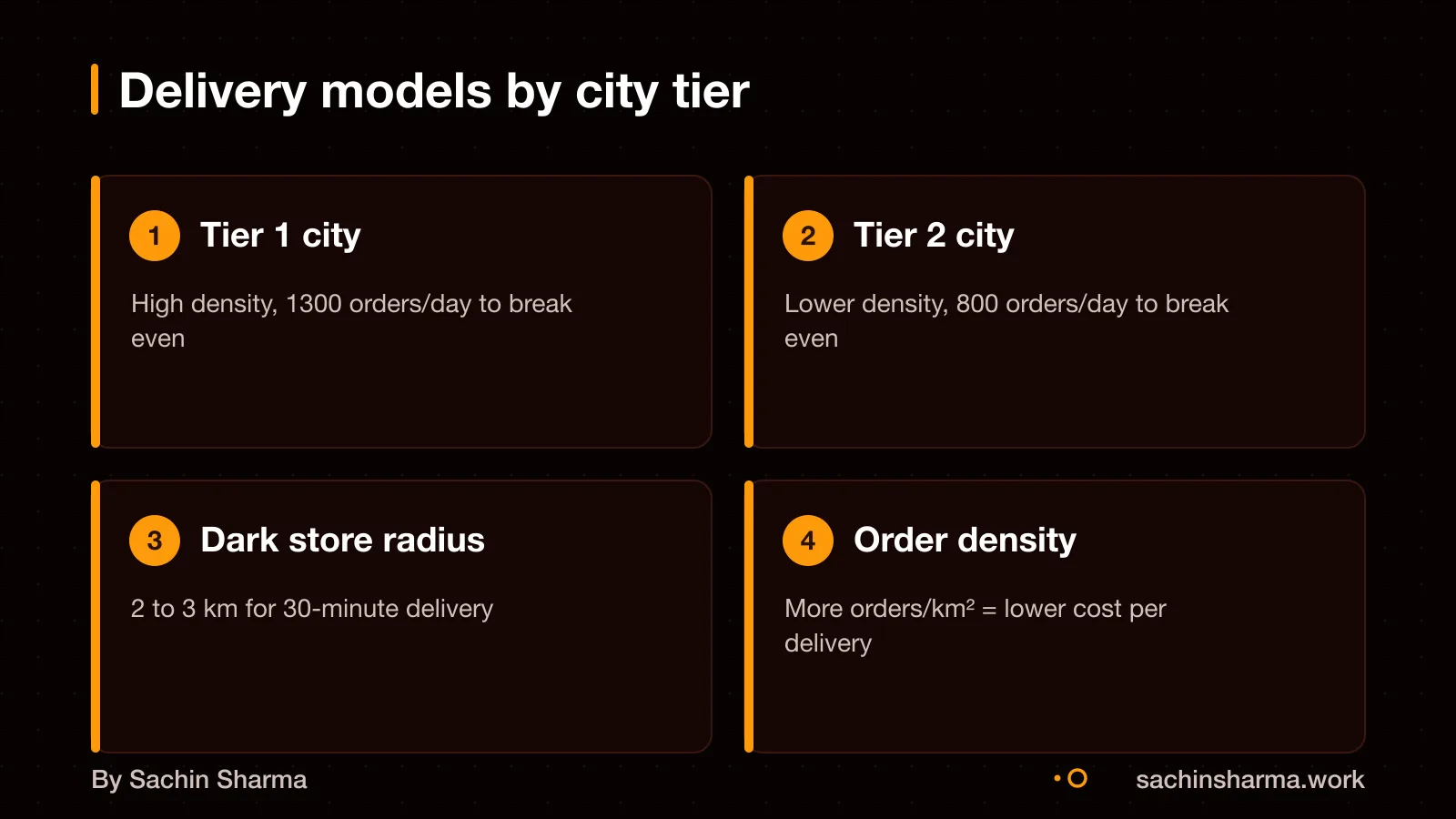
Profitability depends on delivery radius, order density and basket size, not the app model. These three factors must be set before development starts. A narrow delivery radius increases delivery cost per order because last-mile logistics take up a large share of expenses. Most quick commerce startups fail due to poor unit economics, not technology flaws.
In a Tier 1 city, a dark store needs about 1,300 orders per day. In a Tier 2 city, that number drops to about 800 orders per day. These are averages and depend on local rent, staffing costs and average order value. If your area cannot support this order density, the business model will lose money no matter how good the app is.
Contracts are just as risky. With white-label and platform models, you may not own the app or the customer data. Some vendors shut down without notice, and you lose everything. Check for clauses on data portability, exit terms and exclusivity. Always review contracts with a lawyer before signing. Ask: "Can I take my data and branding elsewhere if I leave?" If the answer is no, you are locked in.
Delivery models that work
Yes, WhatsApp can work as a starting point for taking orders. Many quick commerce businesses use WhatsApp alongside websites and delivery platforms to manage early demand. It helps you test customer interest without building an app first.
Dark stores are key once you scale. These small warehouses stock fast-moving items. They work best when placed within 2 to 3 km of your customers.
Delivery times of up to 30 minutes are below the noticeable level for Tier 2 and Tier 3 cities. Lower real estate prices there make dark stores more affordable. For example, a dark store in Raipur or Coimbatore may cost much less than one in Mumbai or Delhi. Helping you launch with lower upfront investment.
When this advice is wrong
Do not build a quick commerce app if you have not validated demand in your city. Many startups fail not because of bad tech but due to weak unit economics. If orders per square km are too low, even the best app cannot help. This is common in Tier 2 and Tier 3 cities where order density is not yet proven.
Custom development is overkill if you only want to test your idea. Building from scratch takes time and money. If your goal is learning, not scaling, start with WhatsApp orders or a simple form. Use that to check if customers return before investing in an app.
Platforms are risky if you plan to grow. Most charge a percentage of sales, which eats into margins as you scale. They also control your data and can change terms suddenly. If the vendor shuts down or raises prices, you have no fallback. This makes long-term planning hard.
Related reading: WhatsApp ordering, sample IP agreement.
Next step: message me on WhatsApp with what you want to build. No forms, no sales team.
Message me on WhatsAppAssumptions behind the numbers
- White-label launch time is 2 to 4 weeks based on typical onboarding.
- Scalability of white-label depends on provider infrastructure.
- Support for custom apps requires paid maintenance.
Pick your situation
I build custom apps, so I benefit from the first answer. That is why the table also shows when white-label or platform options are better picks.
Pick your situation
Custom wins. Custom gives full control over features and branding when scaling. A clear scope avoids cost overruns.
The whole comparison
| Custom | White-label | |
|---|---|---|
| Initial cost | ₹3,00,000 to ₹6,00,000 | $200 to $800/month |
| Time to launch | 8 to 12 weeks | 2 to 4 weeks (ready-made) |
| Control over features | Full control | Limited to platform options |
| Data ownership | Yours, if contract says so | Shared with provider |
| Scalability | Built for growth | Moderate, depends on provider |
| Support and updates | You pay for ongoing work | Included in subscription |
Whichever you choose, ask these
- Who owns the code and data?
- Can I move to another vendor later?
- What happens if the platform shuts down?
- Will I be able to add payment gateways?
Questions people ask
I recommend a custom app if you plan to scale and need full control over features and data. A white-label solution is better for speed and lower upfront cost, while a no-code platform works for testing demand. Each choice affects your contract terms, fees, and ability to switch later.
Yes, you can migrate your app to a custom build later. Your data and branding can be exported, but you must check the platform's export terms first. Apple allows app transfers while keeping the same Bundle ID.
Choosing a white-label or platform option saves time and upfront cost but limits control. You may face revenue-based fees that grow with sales. A custom app costs more initially but avoids long-term fees and gives full ownership.
Yes, you need GST registration if your annual turnover exceeds ₹40 lakh. You can apply using your PAN, business name, email and mobile number. You may also opt for the composition scheme to simplify tax.
Cash-on-delivery processes involve compliance risks in record-keeping, rider contracts and settlement timelines. There is no public guidance on standard practices. Consult a compliance expert or lawyer to set up secure COD workflows for your business.
The Digital Personal Data Protection (DPDP) Act applies to all customer data. As a data fiduciary, you must ensure data accuracy, security, and proper consent. You remain responsible even if you outsource data handling. Check this for your case with a data protection lawyer.
Yes, you can start on a no-code or white-label platform to test demand, then move to a custom app when sales grow. This reduces initial cost and risk. No-code platforms include updates and hosting in their fee.
As an estimate, app updates cost 15 to 20% of the original build cost per year. This covers bug fixes, OS compatibility, and security patches. The actual cost depends on how often you add new features.
A 2 to 3 km delivery radius works best for profit. It supports 10 to 30 minute delivery and reduces transport costs. This radius requires a dark store with 1,500 to 4,000 fast-moving items nearby.
Exclusivity clauses in a white-label contract may limit your market or partners. These terms vary by vendor and are not publicly standardised. Ask for the full contract text and consult a lawyer before signing.