What kinds of app development teams are there in India?
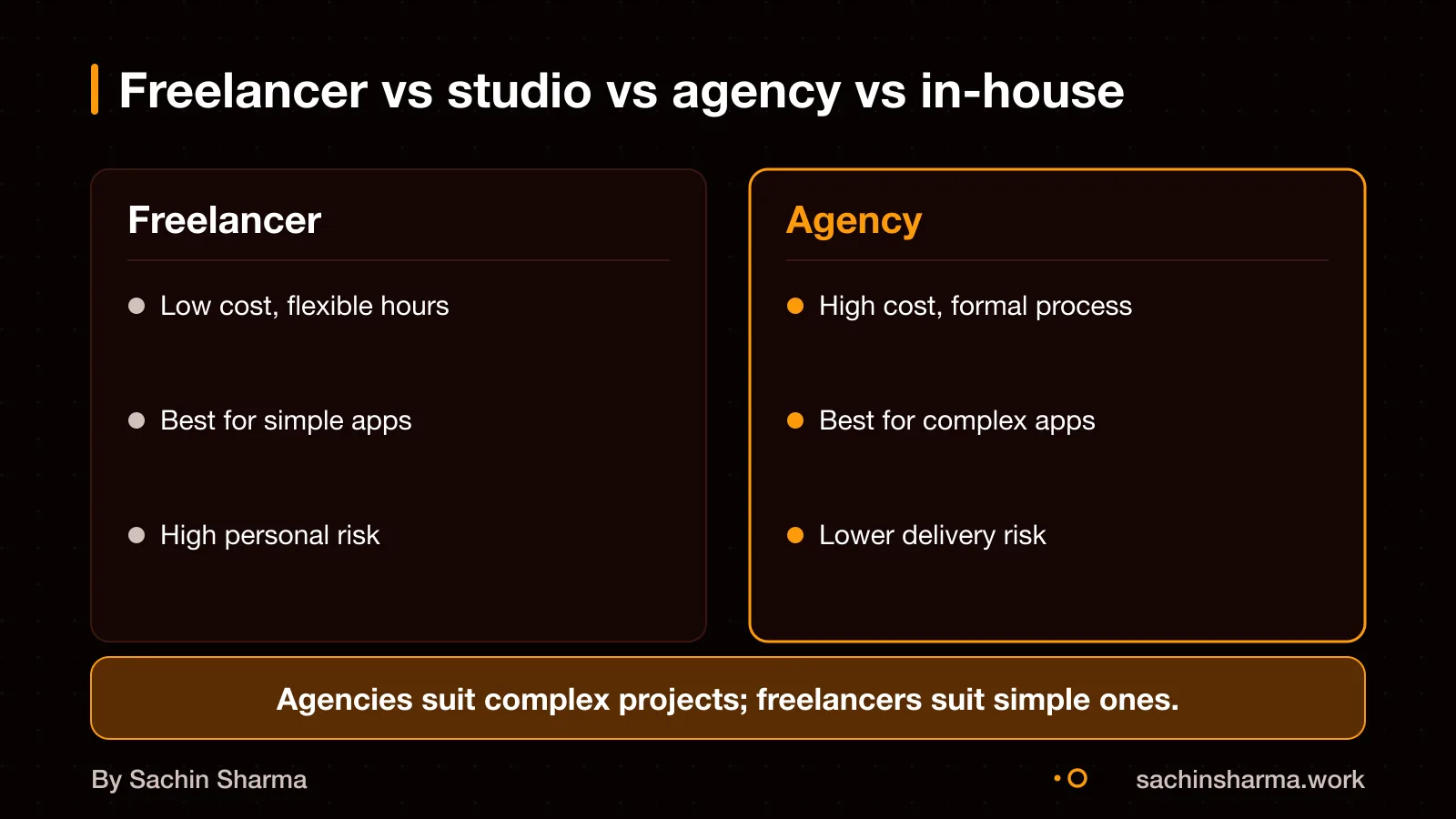
Freelancers, small studios, large agencies, and in-house teams each offer different trade-offs. A freelancer costs less per hour but carries delivery risk. They work alone, so you save money but take on the risk of delays or gaps in design and testing. Small studios may offer development and design services for startups and small businesses.
Large agencies have dedicated roles, architect, project manager, designers, developers, QA, and deliver more predictably. They typically charge 20 to 30% more than freelancers, but this includes services you’d otherwise hire separately. Their structure reduces your management load but adds cost.
In-house teams are employees within your company. They align closely with your goals but take months to hire and cost more in salary and infrastructure. For most small businesses, the choice comes down to freelancers for tight budgets or agencies for reliable delivery.
The best kind of app developer for a startup depends on your risk tolerance and how much you can manage yourself.
How much will it cost and what payment model should I use?
App development in India costs ₹4 lakh for a simple app and ₹25 lakh or more for complex ones. A basic booking app may cost less than a fintech app, which needs extra work for security and compliance. You must also budget for hosting, maintenance, security audits, and app store fees.
Hosting for a small app starts at $70 per month, while mid-size apps pay $500 to $2,000 monthly. High-traffic apps with real-time features can cost $2,000 to $10,000 or more per month. Plan to spend 15% to 20% of the build cost each year on maintenance. A security audit costs $1,000 to $5,000, and a full penetration test on a complex app can run $5,000 to $15,000. Both Apple and Google take 15% to 30% on in-app purchases and subscriptions.
Fixed-price contracts require you to fund each milestone in advance. You review the work within 14 days before approving payment. This model gives you cost control but less flexibility if needs change. Hourly contracts bill weekly based on tracked time. You can set a weekly hour limit to manage costs. This suits evolving projects but needs trust in time tracking. Milestone payments balance both: you pay only after results are shown, and the developer knows the next goal.
As an estimate, a ₹10 lakh app may need ₹1.5 to ₹2 lakh per year in maintenance. Hosting could add ₹50,000 to ₹1.8 lakh per year, depending on users. A security audit may cost ₹8 to ₹40 lakh if done yearly. These costs are often missed in early budgets.
For a clearer cost breakdown, see What does it cost to build an app in India?.
Want a number for your idea? Send one line on WhatsApp. I reply with what drives the cost and what to cut.
Message me on WhatsAppWhat causes delays and how can I avoid them?
Vague requirements and scope creep are the top causes of app project delays. When you do not define what the app must do, or keep adding new features during build. The team cannot plan or commit to a timeline. This leads to confusion, rework, and missed deadlines. For example, asking for a simple booking app but later adding real-time chat, payments, and user profiles without adjusting time or budget will delay delivery.
Unrealistic timelines and poor planning also set projects up for failure. If the deadline is based on hope, not work estimates, the team will rush or cut corners. Lack of daily communication and too many decision-makers cause misalignment. When developers get conflicting instructions from different managers, work stalls until clarity returns.
Technical debt and team instability add further risk. If the code is messy or relies on one key developer, progress halts when issues arise. Agile methods like Scrum help avoid these delays by breaking work into fixed two-week sprints with clear goals. Each sprint ends with a working version, so you see progress early and can adjust before it is too late.
How can I check if a developer's work is real?
Download and test their live apps to verify real work. This shows you the quality and how well it runs. Look for apps you can install from the Google Play Store or Apple App Store. Test at least three apps from their portfolio and use them for 10 to 15 minutes each.
Ask the developer how they built specific features. A real developer can explain their technical choices, like how they handled user login or data sync. This confirms they did the work and understand it. If they avoid the question or give vague answers, that is a warning sign.
Request to see the code repository or technical documentation. Genuine developers use tools like GitHub or GitLab and can show you the code history or project docs. If they refuse or say it is confidential, ask if they can share a redacted version or a sample.
Check if their portfolio explains the problem, approach, and results for each project. Strong portfolios include apps like yours in function or industry. You can also look for verification badges on sites like DesignRush, which check agencies for real clients and reviews.
See real shipped apps in action through the Case study: from paper to platform.
Have a quote in hand? Send it to me and I will mark what is missing.
Message me on WhatsApp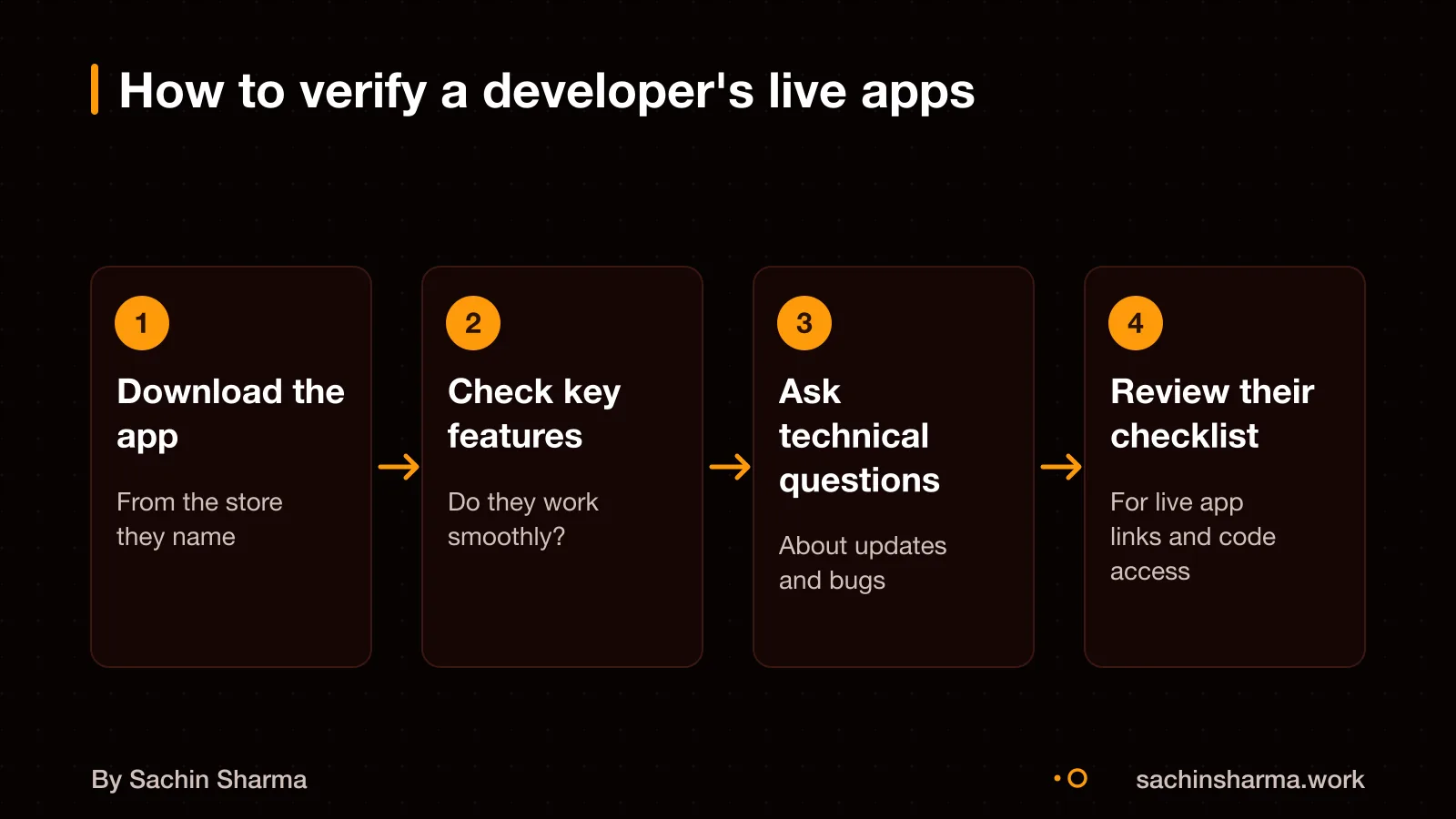
Who owns the code and what legal rights do I have?
Some low-cost vendors retain code ownership and charge you to leave. Get full IP transfer in writing before signing. Make certain it clearly establishes intellectual property rights, your app and associated assets should remain yours by default. Without it, you risk losing control if you switch developers.
If you later transfer the app to another team, the App Store listing can move with its reviews, ratings, and update history intact. The app keeps its Bundle ID, which cannot change once a build is uploaded. The original developer must hand over the code and assets directly to you or your new team.
Your app must follow India’s Digital Personal Data Protection Act, 2023 (DPDPA). If it collects user data in India or offers services to Indian users. Even if your contract says otherwise, you, as the Data Fiduciary, are legally responsible for compliance. This includes keeping user data accurate, protecting it with technical safeguards, and reporting breaches to the Data Protection Board and affected users. The law does not apply to personal or household use.
For most business apps, DPDPA compliance is mandatory. You cannot outsource this duty to your developer. Ask your lawyer to review your data practices and contract terms to ensure you meet your legal duties.
Not sure if your project has this risk? Tell me the plan in two lines and I will say yes or no.
Message me on WhatsAppWhat does app maintenance cost and include?
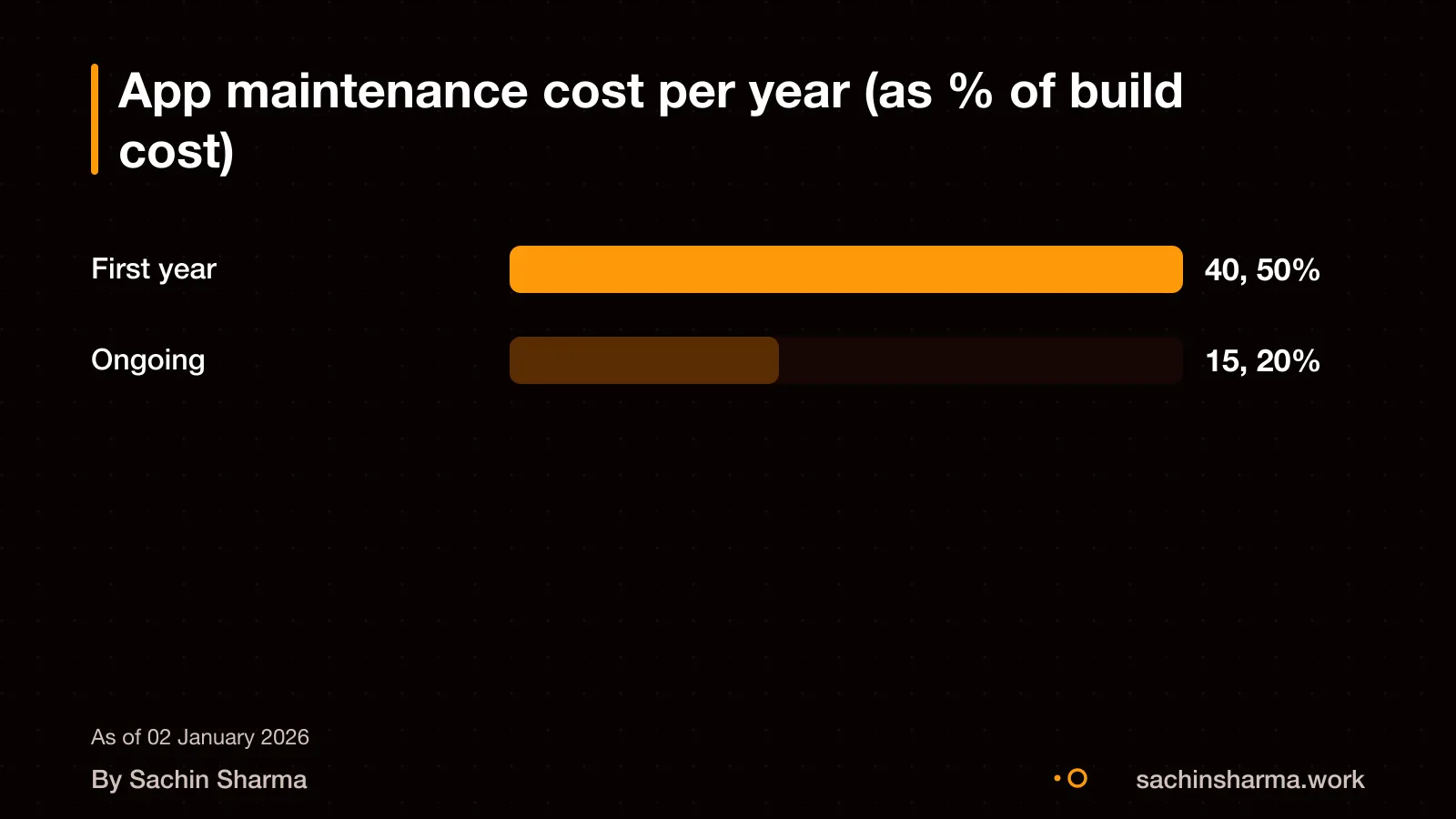
Annual app maintenance costs 15 to 20% of the initial build cost. This covers updates, bug fixes, security patches, and compatibility with new OS versions. For example, a $50,000 app costs roughly $7,500 to $10,000 per year to maintain. The first year often costs more, 40 to 50% of the build cost, because early issues emerge and updates are frequent. This higher cost may also include hosting setup and a security audit. Over time, costs settle into the 15 to 20% range. Some companies bundle hosting and monitoring, so ask what is included. If a quote includes "mandatory support" at a high rate, compare it to this rule of thumb to avoid overpaying. For high-traffic apps, see the Best way to build a quick commerce app to understand added infrastructure needs.
What are the risks and red flags to watch for?
Each team type carries specific risks. An agency team costs more but delivers predictably thanks to defined roles like project manager, designer, and QA.
If a developer refuses to transfer intellectual property (IP) rights, this is a major red flag. Always confirm in writing that you will own the source code upon final payment. A quote that seems too good to be true often excludes critical parts like QA, backend development, or source-code ownership. When you see such a quote, ask: “What is excluded from this price?” and demand a line-by-line breakdown.
For example, a ₹6 lakh quote for a full app may not include backend servers, third-party API costs, or testing cycles. Without these, the app cannot launch. Always review the scope with a technical advisor or experienced developer before signing.
Worked example: cost and timeline for a ₹10 lakh app
Worked example: cost and timeline for a ₹10 lakh app
As an estimate, a ₹10 lakh app has ongoing costs you must plan for. Build cost is just the start.
Maintenance costs 15 to 20% of the build cost per year. For a ₹10 lakh app, that is ₹1.5 to ₹2 lakh per year. This covers bug fixes, updates for new OS versions, and minor feature tweaks.
Hosting for a small app with a few hundred users starts at $70 to $320 per month.
A professional security audit costs $1,000 to $5,000. This is critical for apps that handle user data or payments.
Apple charges $99 per year for its Developer Program. Google charges a one-time $25 fee for the Play Console, or ₹2,075.
Hidden fees add up. Do not skip the audit or hosting. Budget at least ₹2.5 lakh extra in year one for these items. Spread payments using fixed-price contracts with milestones funded before work starts. You approve each milestone before funds release. This protects you and keeps the project on track.
When this advice does not apply
When this advice does not apply
- Do not hire any company if you are still unsure whether your app idea works. First, test it with a no-code tool or a paper prototype. This saves money and gives you real user feedback before writing code. Use the App brief template developers can actually price to shape your idea.
- A solo developer is better for small, well-defined apps like a booking form, internal tool, or content app with fewer than 10 screens. They cost less, respond faster, and avoid team overhead. If your project does not need daily updates or a large team, go solo.
- Consider in-house only if you need constant updates, tight data control, or long-term feature builds. Hiring full-time developers makes sense when you have ongoing work, not for one-off apps. Otherwise, the cost and management effort are not worth it.
Next step: message me on WhatsApp with what you want to build. No forms, no sales team.
Message me on WhatsAppWeigh what matters to you
I won't name a number one, because the best depends on what you weigh. Set what matters and see which kind of team fits.
- 1Solo developer3.8
- 2Small studio3.8
- 3Large agency3.5
- 4Hire in-house3.5
Scores are general tendencies for each kind of team, set out as a starting point. They are not ratings of any named company.
Whoever you pick: checks, in the order they save you
- Open two of their shipped apps on your own phone.
- Ask who will write the code, by name.
- Get the scope, and the not-included list, in writing.
- Ask for milestones you can test.
- Confirm the repository and store accounts are in your name.
- Speak to a past client.
- Ask what happens if you stop midway.
- Ask how changes are priced.
- Ask what the first month after launch costs.
- Compare the assumptions in quotes, not the totals.
Questions people ask
Choose a solo developer for simple apps to save cost, a studio for most projects for balance. Or an agency for complex apps needing full teams. Each fits different size, budget and control needs.
With a solo developer, costs are lower and decisions faster, but you take on higher delivery risk. You may need to hire designers and QA separately.
Yes, you can move your app if you own the source code and app store accounts. Ensure IP transfer and access rights are in the contract from the start.
Do not proceed. If a developer refuses to assign IP, you risk losing control of your app. Walk away or insist on the clause before paying.
Download the app from the App Store or Google Play and use it for 10 to 15 minutes. Check for crashes, bugs and smoothness to test real quality.
Yes, if your app processes digital personal data in India or offers services here. It does not apply to personal or household use. Check this for your case with a lawyer.
Annual maintenance costs 15 to 20% of the build cost. The first year may cost 40 to 50% to fix early issues and stabilise the app.
Hidden costs include hosting, security audits, app store fees and maintenance. Hosting for a small app starts at ₹5,810 per month. Always ask what is excluded.
If a quote is far below market rate, it likely excludes QA, backend work or source-code ownership. Some vendors charge extra to let you leave. Ask what is not included.
If you own the code and accounts, you can move your app. Exit costs 2 to 7 days of work for a moderate app. In a surprise shutdown, recovery depends on your backups.