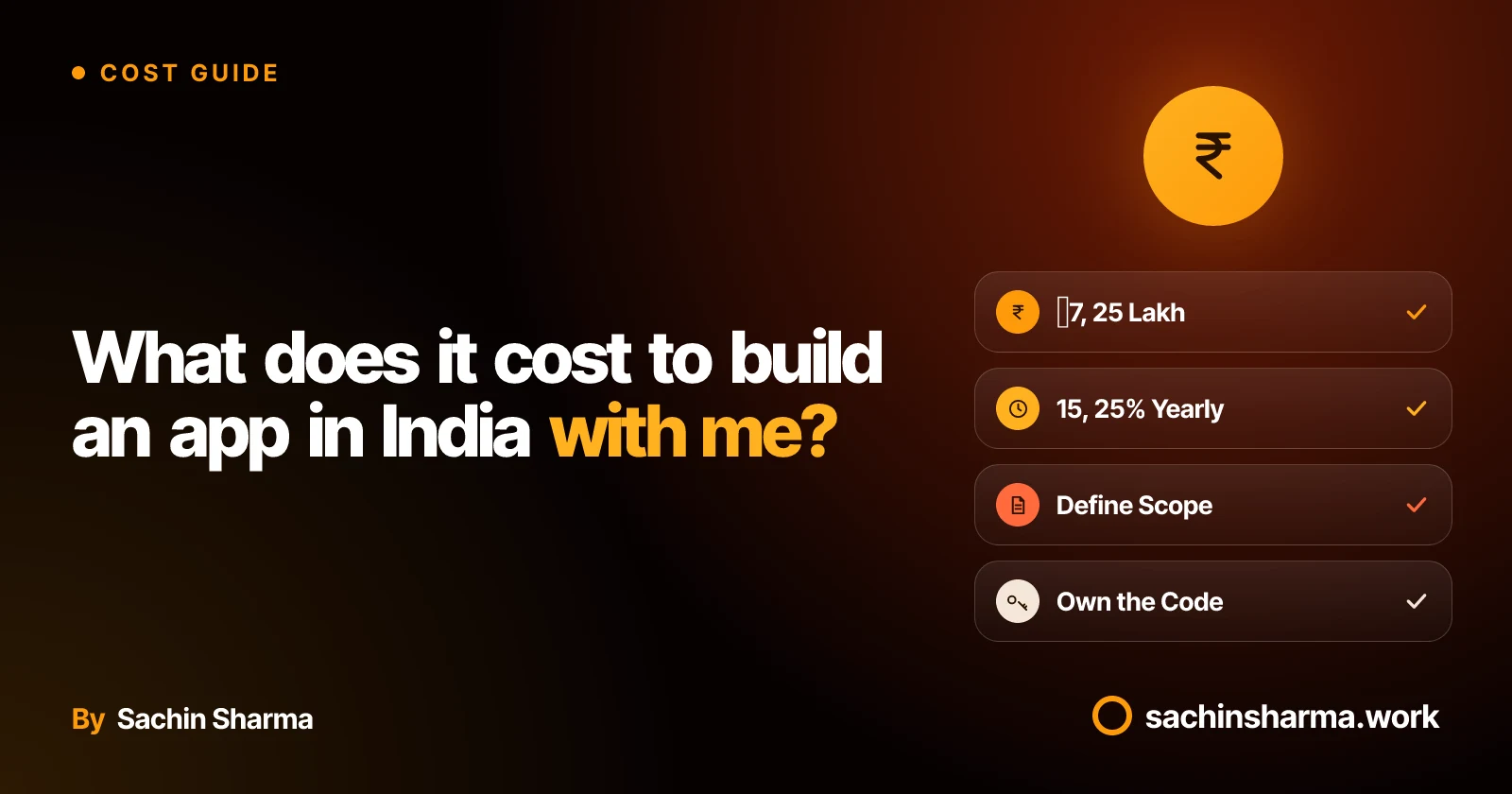
What does a small business app cost in India?
A simple app costs ₹2.5 to 5 lakh, while a complex one costs ₹10 to 25 lakh, based on features and platform needs. Cross-platform apps built with Flutter or React Native fall in these ranges and are common for small businesses. A simple app may have basic screens and forms, while a complex one includes user accounts, real-time updates, and backend systems. An e-commerce app typically costs ₹5 to 15 lakh, covering a product catalog, payment gateway, order tracking, and notifications. This range assumes one platform (Android or iOS) with cross-platform code sharing. For a more precise estimate based on your idea, see the full breakdown of what drives cost. You can also check the cost to build a grocery delivery app if your business fits that model.
Want a number for your idea? Send one line on WhatsApp. I reply with what drives the cost and what to cut.
Message me on WhatsApp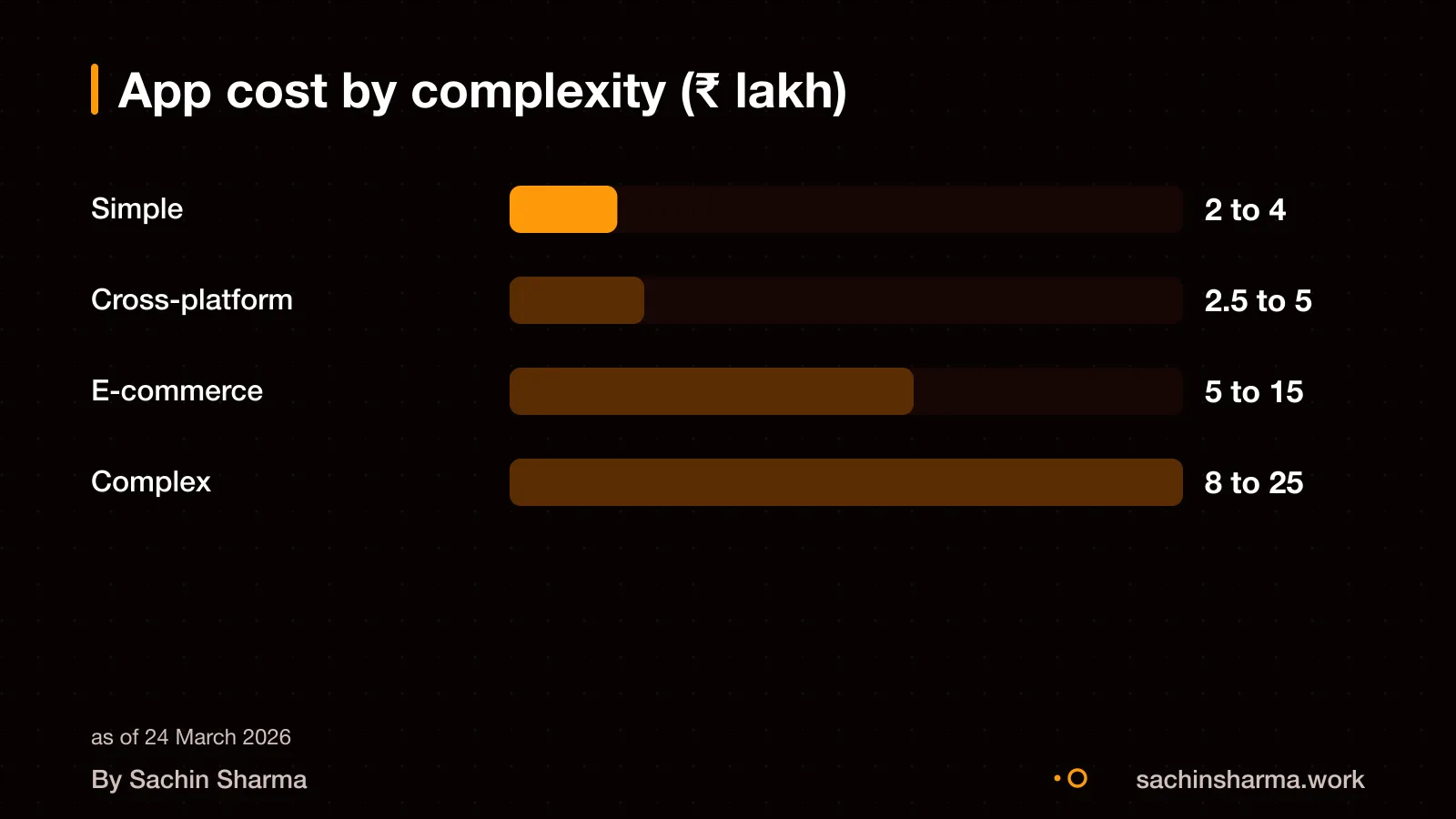
How is app development cost broken down?
The main cost drivers are features, backend complexity, platform choice, team seniority and compliance needs. The backend takes 30 to 40% of the budget for complex apps. Cross-platform development saves 30 to 40% compared to building separate native apps.
Building for both Android and iOS with a shared codebase cuts cost and time. Flutter, which I use, is a cross-platform framework that supports this. You pay less because one team writes code that runs on both platforms. The savings come from reduced development hours and fewer bugs to fix.
Features that need real-time sync, offline access or complex workflows add more cost than simple screens. High-security or regulated sectors like legal or health may need extra compliance checks. Senior developers charge more but deliver faster and with fewer errors.
What is included and excluded in the quote?
Your quote includes design, coding, testing and project management. These are standard inclusions for a complete build. Lowball quotes may exclude quality assurance (QA), backend development or source code ownership, which can cause delays later.
QA, backend and source code are not excluded in my quotes. You get full ownership of the source code and access to all backend systems built for your app. If a provider does not include these, ask why.
Change requests are not part of the base quote. Any change must go through a written process: I give you a time. Cost estimate, and you approve it in writing before work begins. This keeps scope clear and avoids surprises.
Can I get the source code of my app?
What third-party and launch fees do I pay?
You pay app store fees, cloud hosting, SSL certificates, and payment gateway or UPI charges. These are separate from the app build cost and recur yearly. You must budget for them as part of launch and upkeep.
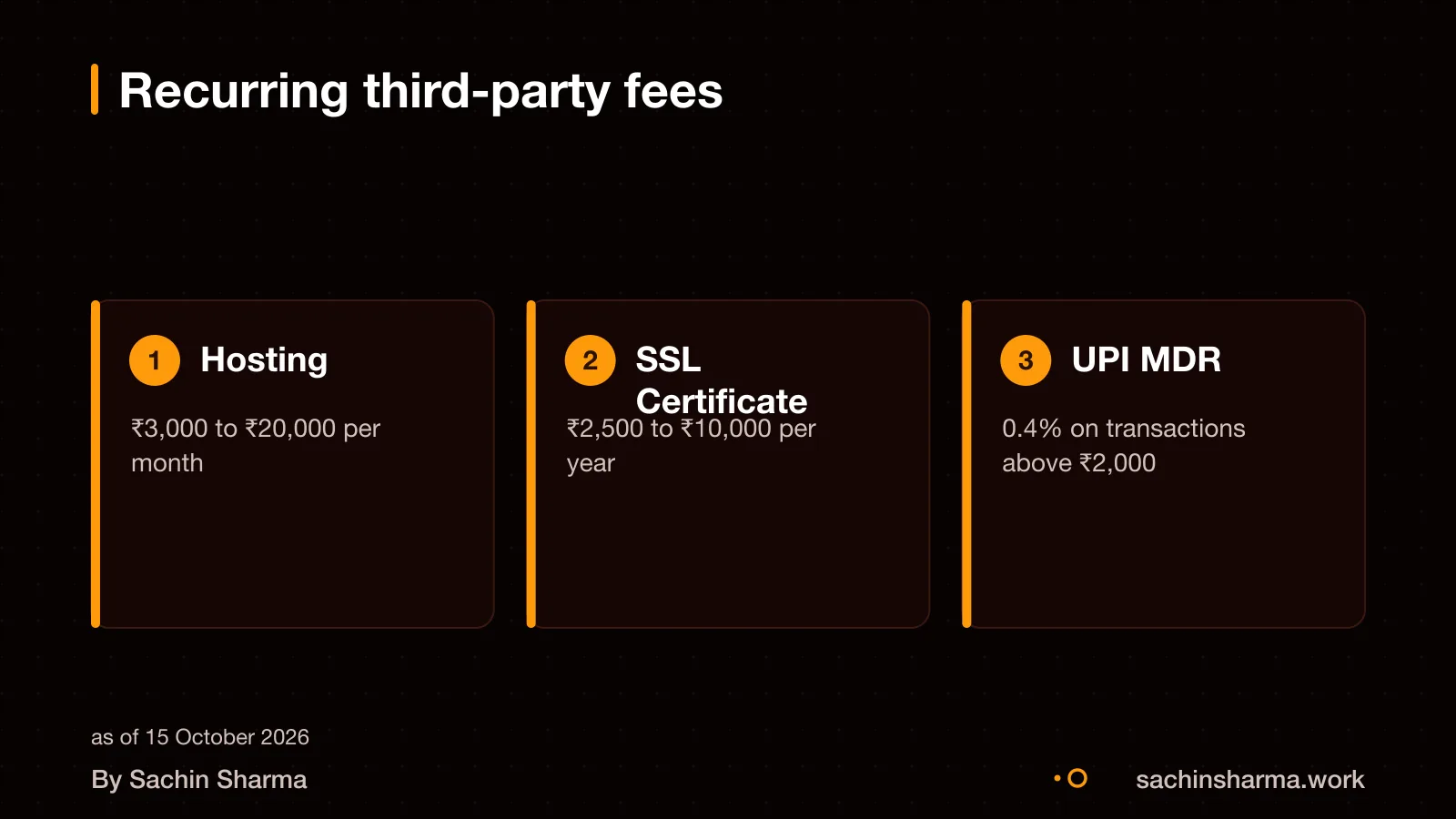
Cloud hosting runs ₹3,000 to ₹20,000 per month, depending on traffic and storage needs. This hosts your app’s backend and data. For example, a service with 10,000 monthly users and file uploads may need ₹12,000/month hosting. An SSL certificate costs ₹2,500 to ₹10,000 per year and secures data between users and your server.
Payment gateways charge a merchant discount rate (MDR) of 1.5% to 3.5% per transaction. For example, a ₹1,000 sale costs ₹15 to ₹35 in fees. UPI payments above ₹2,000 attract a 0.4% MDR, capped at ₹300 per transaction, starting 15 October 2026. Below ₹2,000, no MDR applies. These fees go to banks and payment networks, not the developer.
What does it cost to run the app each year?
Running your app costs 15 to 25% of the build cost each year. For a ₹10 lakh app, that is ₹1.5 to ₹2.5 lakh per year. Monthly, maintenance ranges from ₹15,000 to ₹80,000. This covers bug fixes, OS updates, security patches, hosting, and minor feature improvements. It does not cover major new features or redesigns. The exact amount depends on how often the OS changes and how many users report issues. You may pay more if your app has heavy usage or complex backend logic. For platform-specific details, see the Flutter app development cost page.
What features increase app cost the most?
AI, fintech and healthcare apps cost more than basic apps because they need stronger security, strict compliance and complex architecture. These apps handle sensitive data like financial records or health information, so they require encryption, audit trails and standards like HIPAA or PCI-DSS. For example, a pharmacy delivery app must protect patient data and meet drug traceability rules, which adds to development time and testing.
Deep integrations also raise costs. Linking your app to legacy systems, payment gateways, or third-party APIs like UPI, GSTN, or hospital management software takes extra effort to test and maintain. Each integration must work reliably and securely, which means more code, more reviews, and ongoing updates.
As an estimate, adding AI or fintech features can double the base cost, but the exact impact depends on your app’s scope. Whether supporting tablets or landscape mode increases cost is not known.
How long does it take to build a small business app?
A simple app takes 6 to 8 weeks to build. This includes basic features like user login, a dashboard, and one or two core functions such as booking or tracking. A complex app with advanced features like real-time sync, AI tools, or multi-user workflows takes 4 to 6 months. Platform choice does not delay delivery, cross-platform apps built with Flutter or React Native are delivered in the same time as native apps. For example, a habit tracker with offline sync may fall in the 6- to 8-week range. While a legal document assistant with AI may take closer to 5 months.
Who owns the code and accounts after build?
By default, I own the code I write, as Indian law treats the developer as the owner unless a contract says otherwise. To get full ownership, your contract must include a clear clause that transfers all rights to you. A "Work for Hire" agreement should state that you own all custom code, designs and documentation created for your project. The safest wording uses the phrase “hereby assign” to transfer intellectual property, which reduces the risk of future disputes. With full ownership, you can switch to another developer later without legal or technical blocks. Without it, you may need my permission to make changes or hire someone else.
This means your contract is the key to control. Ask for a clause that says I “hereby assign” all rights to you upon payment. That gives you the freedom to update, audit or hand over the app later. If the contract does not say this, ownership stays with me.
Do I need to pay GST on app development?
Yes, you must pay 18% GST on custom app development services in India unless the service is exported and paid for in foreign exchange. This tax applies because custom software is classified as a service under SAC code 998311. If the development is done within your state, the 18% breaks into 9% CGST and 9% SGST. For example, a ₹10 lakh development contract would include ₹1.8 lakh as GST, making the total payable ₹11.8 lakh.
GST is 0% if the software service is exported and payment is received in foreign currency. In that case, no GST is charged to the foreign client. On your invoice, GST must be shown as a separate line item with the SAC code. Your GSTIN, and the split between CGST and SGST for intra-state supplies. Always verify your developer's GSTIN and ensure the invoice meets these rules to claim input tax credit. For your specific case, consult a tax advisor to confirm how GST applies based on location and payment terms.
How is the work scoped, billed and protected?
A clear scope prevents cost overruns. Include only 3 to 5 essential features at first to keep costs down. Use our app brief template to cover all key points.
Payments are split into milestones: 20 to 30% upfront. 40 to 50% during development in 2 to 3 stages, and 20 to 30% on delivery. This balances risk for both of us.
Your contract must state who owns the code, list what will be delivered. Spell out payment terms, and allow either side to end the project safely. Without these, you risk delays, hidden costs, or losing control of your app.
To check if a quote is realistic, ask for a line-item breakdown. Compare it with your brief. If major features are missing or priced too low, the final cost may rise. A vague quote is a red flag.
Have a quote in hand? Send it to me and I will mark what is missing.
Message me on WhatsAppWhat apps has Sachin built and how much would mine cost?
Sachin has built apps like Loopin, Legease and Aashwasan. Loopin is a privacy-first habit tracker that uses RPG mechanics to keep users engaged. It was built with Flutter, Hive NoSQL and Google Drive API for offline-first data ownership and secure sync. Legease is an AI-driven platform that helps users understand legal documents. It uses PDF processing and end-to-end encryption to keep sensitive data safe. Aashwasan is a gig and contract management app for service businesses. It lets users create contracts, track orders in real time, and message securely. You can see how it works in the full case study: Aashwasan: a gig and contract management app.
As an estimate, a ₹10 lakh app would include 40 screens, one payment gateway, and be built as a cross-platform app using Flutter. This estimate assumes no AI features, tablet support or complex compliance like HIPAA. The build cost covers design, development, testing and project management. Annual maintenance would cost ₹1.5 to ₹2.5 lakh, or 15 to 25% of the build cost. Hosting runs about ₹3,000 to ₹20,000 per month, SSL costs ₹2,500 to ₹10,000 per year. UPI charges 0.4% on transactions above ₹2,000. These are common third-party fees you should plan for.
Next step: message me on WhatsApp with what you want to build. No forms, no sales team.
Message me on WhatsAppWhen should I not build a custom app?
Build a custom app only when you need unique workflows, deep integrations or scale. If your goal is a quick test or an internal tool, no-code may be better. It is faster and cheaper for simple apps and minimum viable products (MVPs).
If your needs are basic, like sharing information, taking bookings or collecting payments, a SaaS tool or website makes sense. You save time and money, and avoid long development. Custom apps are not worth it when pre-built tools can do the job.
For simple tasks, a small business website cost is lower and delivery is faster than an app. Use custom development only when off-the-shelf options cannot handle your logic, data flow or security needs. No-code platforms struggle with real-time, multi-system connections. If you do not need that, skip custom build.
Assumptions behind the numbers
- Team size and weeks per phase are editable inputs.
- Day rate is an editable assumption.
- GST toggle affects the final total.
- Maintenance is set at 15–25% of build cost.
- AI and compliance flags increase cost visibly.
Work out your own number
I won't hand you a number that pretends to be the market. Instead, here is the working: set the weeks, the people and the rate, and see where the money goes.
Your working total
₹4,40,00011 weeks × 2 people × 5 days × ₹4,000- Scope and design18%
- Build55%
- Testing and fixes18%
- Launch and stores9%
The weeks shown are an example of a small app, there to be changed. Fees you pay others (store accounts, cloud, SMS) are not in this total.
What moves the price
- AI features or complex logic
Machine learning models and smart workflows take more design and more testing.
- Compliance needs
Healthcare, finance or education apps need extra layers for data safety.
- More user roles
Each role (admin, rider, vendor) adds screens and permissions.
- Real-time functions
Chat, tracking or live updates need strong backend links.
- One platform first
Starting with Android or iOS cuts early work in half.
- Managed services used
Login, storage or payments from a service save weeks.
- Clear scope up front
Changes mid-way are the most costly weeks.
Fees that go to someone else
Cloud hosting
₹3,000 to ₹20,000 per month. Billed by provider.
SSL certificate
₹2,500 to ₹10,000 per year. Needed for HTTPS.
Payment gateway
1.5% to 3.5% MDR + 18% GST. Paid per transaction.
UPI above ₹2,000
0.4% MDR from October 2026. Paid per transaction.
App store fees
One-time and yearly fees. Paid to Google or Apple.
Ask for these before you sign
- How many weeks per phase, and with how many people?
- What is not included?
- Which fees do I pay to others directly?
- What happens to the price when I change my mind?
- What does the first month after launch cost?
Questions people ask
You get design, coding, testing and project management. The contract must state that you own the source code. Without that clause, Indian law may give the developer ownership by default.
We define the scope in a Statement of Work (SOW). Payments are milestone-based: 20-30% upfront, 40-50% in 2-3 milestones, and 20-30% on final delivery. This balances risk for both sides.
You get wireframes first, then core screens and backend, followed by a testing report, and finally the complete build. Each delivery ties to a payment milestone.
You can request changes, but they need written approval. I will give a cost and timeline impact before any work starts. This keeps the project on track.
An AI-powered app starts at ₹14.25 lakh. Costs go up based on complexity. Usage-based fees may apply; confirm these with your provider.
I work directly with you, with no agency layers. For bigger needs, I bring in trusted specialists. You always deal with me.
Delays usually come from unclear requirements or scope changes. I flag risks early. A clear scope and prompt feedback keep timelines on track.
Ask for live apps, case studies and client references. Check GitHub for public code quality. For my work, see <a href="/projects/aashwasan/">Aashwasan: a gig and contract management app</a>.
Critical bugs are fixed quickly under a maintenance plan. Minor issues are handled in scheduled updates. No developer offers free lifetime support.
Yes, if roles are clear and specs are shared. I coordinate handoffs but need alignment on timelines and tech. Use the <a href="/tools/app-brief-template/">app brief template</a> to align early.