What does 'paper to platform' mean for a multi-brand business?
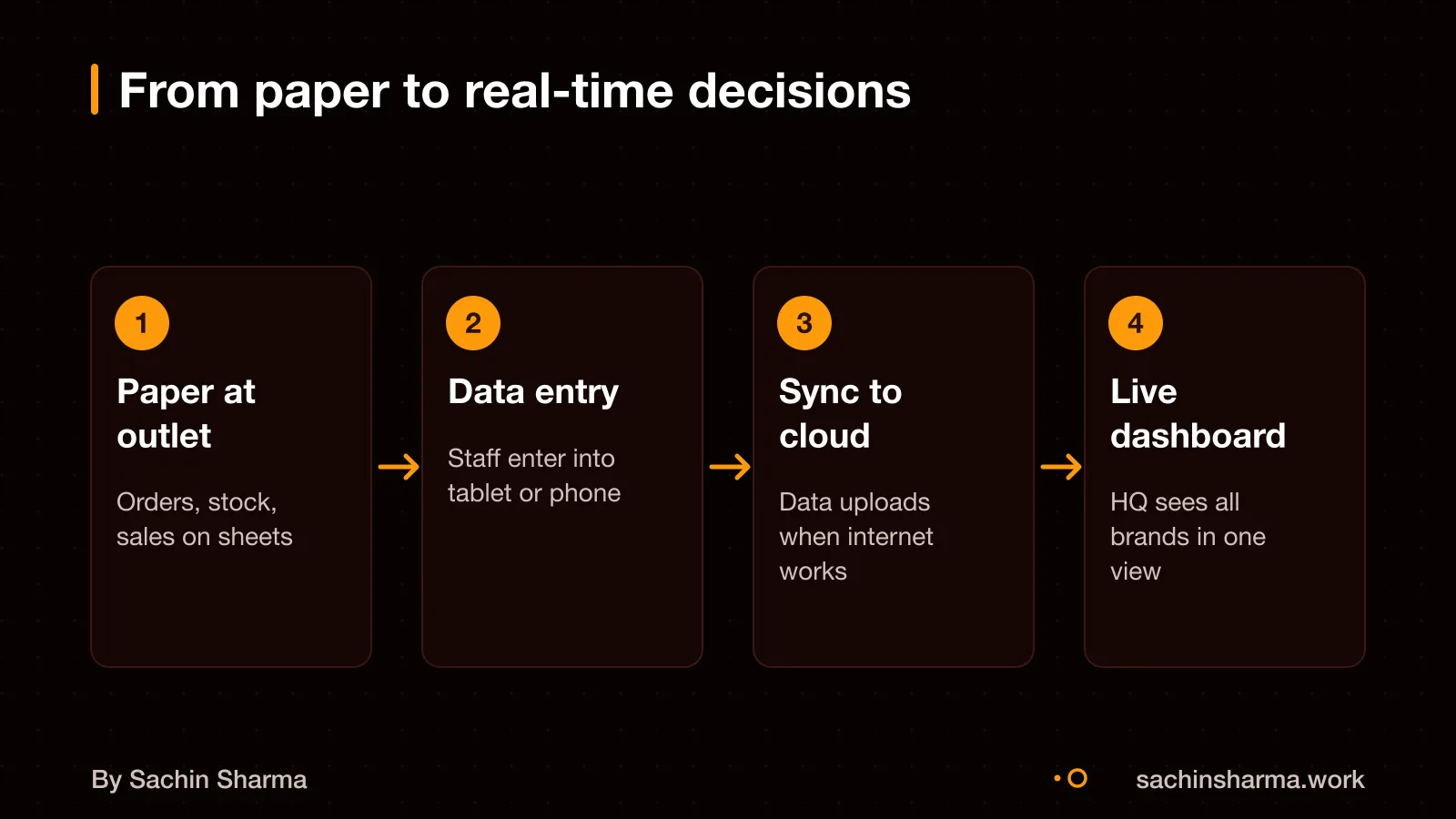
'Paper to platform' means replacing paper records and manual steps with a single digital system that updates in real time. For a multi-brand business, it means all brands run on one shared platform, but each brand's data stays separate and secure. The goal is not just to digitise forms, but to remove delays in decisions. Like stock transfers or approvals, that happen when teams wait for updates.
For example, instead of emailing spreadsheets or carrying registers between outlets, a manager can see live inventory across all brands and act at once. This real-time flow reduces lead-to-delivery time, as seen when a family-run group cut their turnaround from 2 weeks to 4 days. The system works even when internet is poor, by syncing data as soon as connection returns.
How Loopin syncs offline data to Google Drive without losing a write
Why choose one platform for multiple brands?
A single platform cuts costs and simplifies updates across your brands. You manage all from one place, yet each brand keeps its own look, pricing and customer experience. This setup uses shared tools and rules, so you spend less on maintenance and get group-wide reports without extra work.
Think of it like an apartment building: one structure, many households. Each outlet or brand runs independently, but the plumbing and wiring, like user management, order tracking and stock updates, are central and consistent. That means when you fix one thing, it improves all brands at once.
Shared infrastructure also means faster rollouts. When you add a new outlet or brand, you don’t rebuild from scratch. You clone a proven setup and tweak what’s different, saving time and reducing errors. This is how lead-to-delivery time fell from 2 weeks to 4 days in a real case.
You still keep data separate. One brand’s sales or customer list won’t show up in another’s dashboard. The system enforces privacy by design, not just process. And if you later want to sell one brand, its data can be isolated cleanly.
How much does it cost and how long does it take?
A multi-tenant platform supporting growth to thousands of accounts typically costs $300k to $3.5M over 3 years depending on tenancy model and compliance. This includes labour, databases, compliance and data migration. The final cost depends on the tenancy model, security needs and how much custom logic each brand requires.
As an estimate, assuming a pooled tenancy model and moderate compliance needs, a founder MVP costs ₹2.1 to ₹3.7 crore over 3 years. This model shares one database across tenants and is cheaper to start but harder to scale securely. If you later move to a database-per-tenant model after scaling past 500 users, expect a 6 to 12 month re-architecture.
Smaller, focused migrations like this one typically finish within a year. Enterprise-wide changes across thousands of apps take two years or more, but this project is not that scale.
The hidden costs of staying on separate systems, like delays, errors and manual work, are not published. You may already be paying them in lost time and missed sales.
For example:, Assumption: pooled tenancy, moderate compliance, 3-year TCO: $250k, $450k, Build time: up to 1 year for smaller migrations, Migration included: Yes, as part of rollout
Want a number for your idea? Send one line on WhatsApp. I reply with what drives the cost and what to cut.
Want a number for your idea? Send one line on WhatsApp. I reply with what drives the cost and what to cut.
Message me on WhatsAppOne system or separate systems for each brand?
One system for all brands cuts costs and gives you shared control. Maintaining multiple systems adds complexity and ongoing work. Start with a shared database structure and isolate data by brand using row-level access rules. Move only the largest or most regulated customers to a separate schema or database when a contract requires it. If one brand is highly regulated or demands full data isolation, move only that brand to a separate database later.
This choice is hard to reverse, so plan for growth early. A shared system means one codebase, one update cycle, and one team managing it. You save on development, hosting and support. With separate databases, you pay more for each tenant and double the effort to fix bugs or roll out features.
For example, if you run five brands, one system lets you track inventory, sales and staff across all from one dashboard. If a new policy applies to all, you update it once, not five times. But if one brand has strict compliance needs, it may need its own database when a contract requires it.
Still unsure between one system or separate systems? Tell me your brands and goals and I will say which fits.
Message me on WhatsApp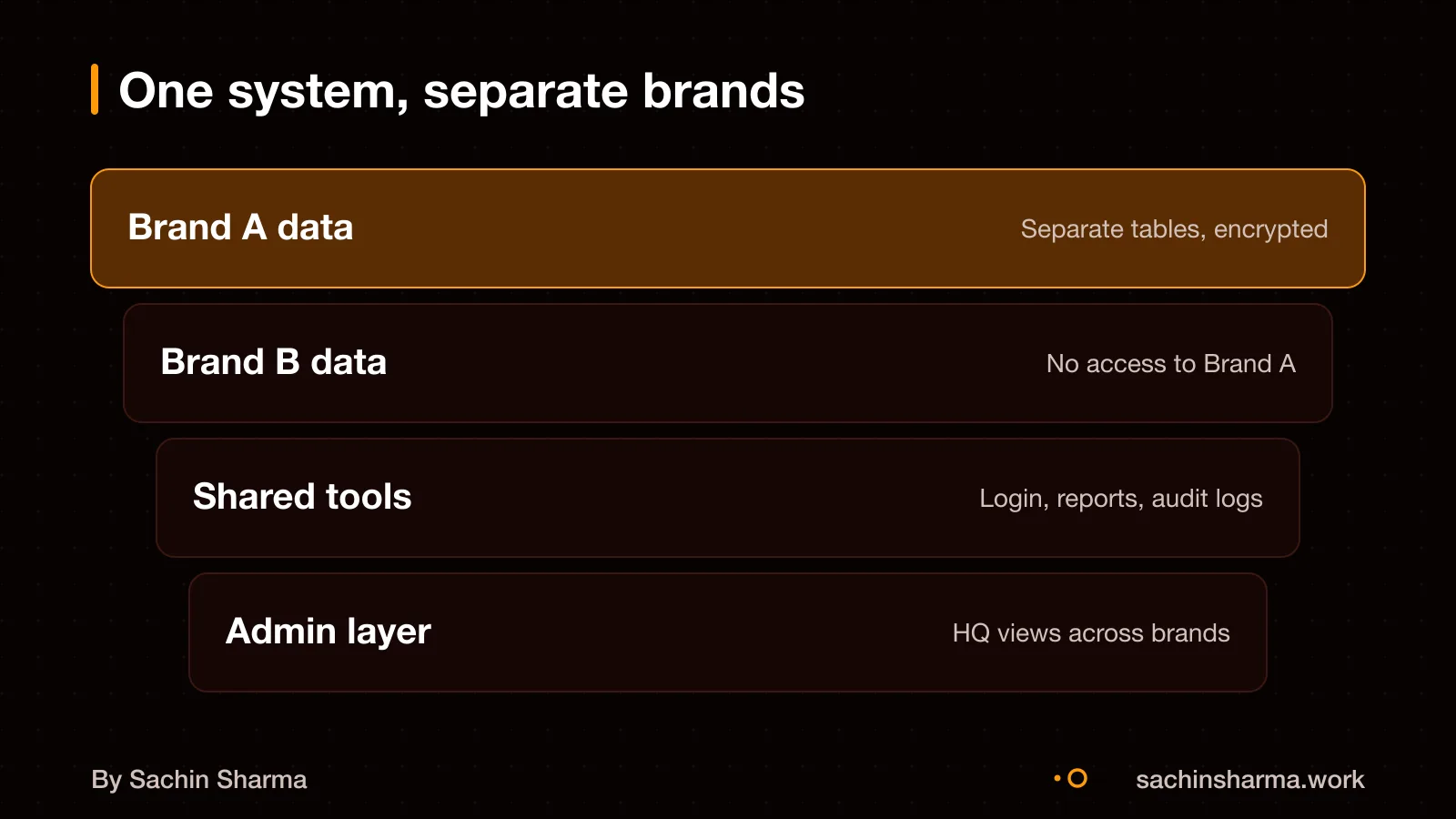
What are the risks and how were they managed?
Data leaks, performance issues, and weak isolation are real risks in a multi-tenant platform. We reduced them by scoping each tenant’s data, applying row-level security (RLS) policies, and using network segmentation to limit access. For example, queries were tested to confirm that one brand’s user cannot see another brand’s data, even during complex reports.
A known PostgreSQL flaw, CVE-2024-10976, showed that RLS policies could fail if user ID changes happen mid-session during subqueries. We designed queries to avoid this pattern and tested edge cases to ensure tenant data stays isolated. This was part of our security review before launch.
Performance risks like the “noisy neighbour” problem, where one brand’s heavy data import slows others, were managed by resource quotas and off-peak scheduling. We also avoided overly permissive IAM roles that could let one tenant access another’s cloud storage.
Each risk was mapped to a control: scope, test, isolate, and monitor. No incidents were reported after rollout. For future updates, we recommend regular security audits and load testing with real-world usage patterns.
How do you keep one brand's data private from another?
Each brand’s data is kept private by design, not just policy. Access across brands is a technical impossibility. This starts with row-level security in the database, where every query includes a tenant ID. Even if someone runs a report, they only see their brand’s rows.
If a tenant downloads another tenant's data, it remains useless without the correct decryption key.
Security shifts from guarding the perimeter to protecting the data path itself. At every layer, database, middleware, and API, requests are checked for tenant context. Identity and access management (IAM) roles enforce that users and services act only within their brand’s scope. Encryption, scoping and access checks work together to isolate data by default.
What technology was used to build the platform?
Ralas One, a client project, was built with Next.js for both frontend and backend. Next.js is the leading React framework. It supports server-side rendering, API routes, and real-time updates in one framework. This helps keep the code consistent and the system fast.
PostgreSQL was used as the database, with row-level security to isolate data between brands. Each brand can only access its own data, even though all are in the same database. This is a standard method for multi-tenancy and keeps costs lower than separate databases.
Real-time sync across outlets was achieved with an offline-first design and background jobs. This means staff can keep working even when the internet is slow or down. Changes sync automatically when connectivity returns.
How does it work in tier-2 or tier-3 cities with poor internet?
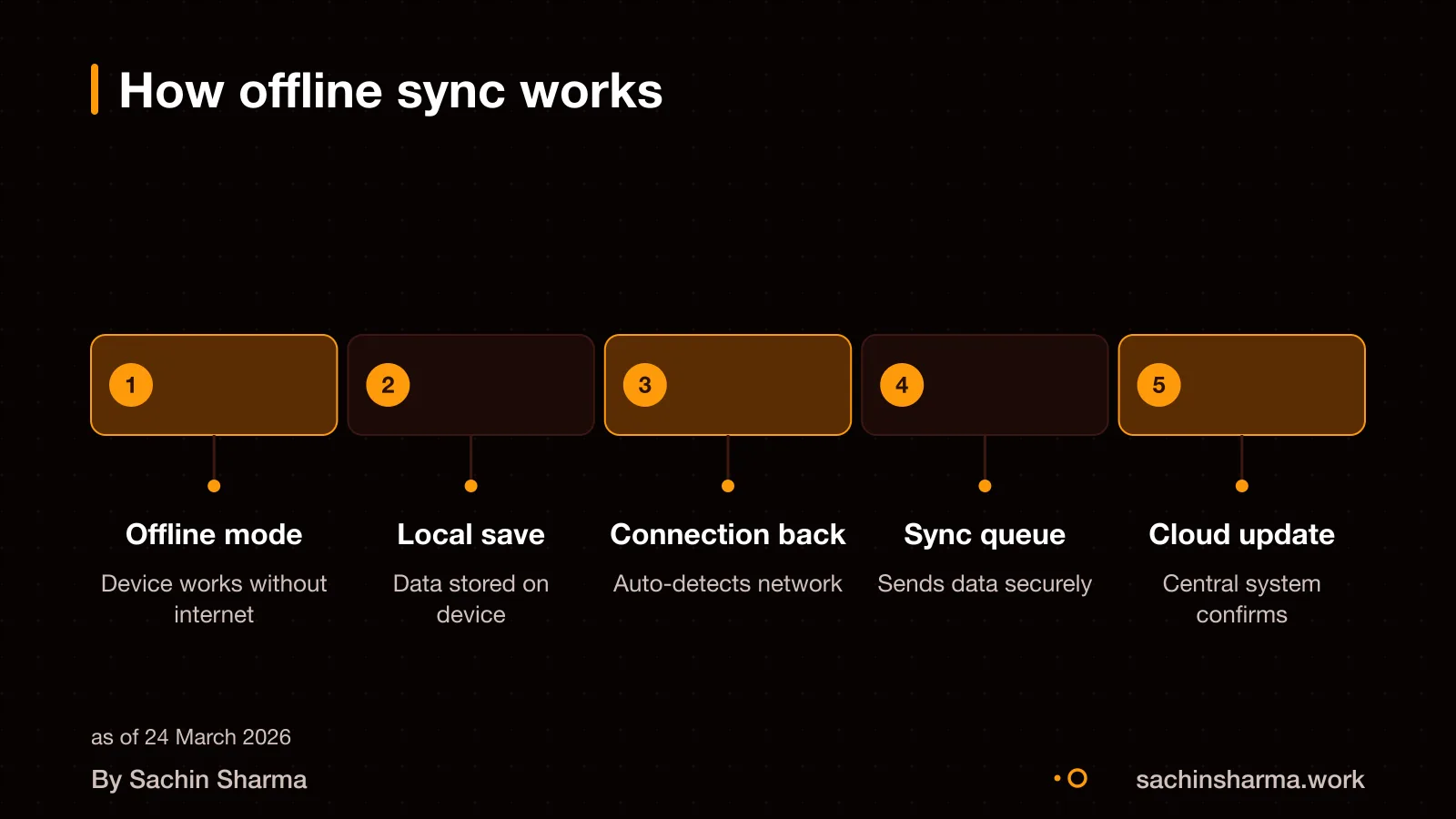
The platform works even with poor internet because it is built to work offline. The system can work offline as it is built with an offline-first design. When the internet comes back, all changes sync securely to the central database. This offline-first design helps with operations during daily network drops common in tier-2 and tier-3 cities.
The system handles variable connectivity in tier-2 and tier-3 cities by using intentional network planning. This approach is proven in real use: the Loopin habit tracker, built with the same offline-first method. Syncs user data to Google Drive only when connectivity allows, without losing a single entry.
The system assumes that poor connectivity is normal, not an exception, so planning for it is built into the core design.
Who owns the code and data? Can you move it later?
You own both the code and your business data. The platform is built so you can take it elsewhere if needed. Using open standards and avoiding proprietary formats ensures you are not locked in.
Export APIs let you move data to another host or developer. You can extract customer records, sales logs and inventory history in common formats like JSON or CSV. This means you keep control even if you change tech partners later.
Integration logic can become fragmented if the platform forces closed ecosystems. Some vendors tie your workflows to their tools only, making future moves hard. But with custom-built integration points, your systems stay flexible.
For example, if you later want to switch hosting or add a new brand-specific tool, the data and logic are designed to move with you. This is different from off-the-shelf platforms that trap data behind closed doors.
See how this compares to other options: Best way to build a quick commerce app: custom, white-label or platform?
When is a multi-tenant platform the wrong choice?
When is a multi-tenant platform the wrong choice?
If your brands are unrelated or have conflicting interests, a shared platform may not work. Each brand needs to benefit from the same rules and workflows. When goals clash, separate systems give more control.
If internet is too unreliable for any sync, even an offline-first system may face delays in updates. While the platform works offline, data must sync when connectivity returns. In areas with no reliable signal, this can slow coordination.
If your business has only one outlet and simple needs, a multi-tenant platform is overkill. You do not need tenant isolation or cross-brand reporting. A simpler app or even spreadsheets may be faster and cheaper to run.
Related reading: How much does it cost to build an E-learning platform app in India?, AI features for an app you already have, or from day one.
Next step: message me on WhatsApp with what you want to build. No forms, no sales team.
Message me on WhatsAppThe story, chapter by chapter
For A family-run conglomerate in Chhattisgarh (name not published). ₹150 Cr+ reported annual revenue across the group. Figures are as reported by the client and have not been audited.
- brands
- 5on one platform
- outlets
- 8connected in real time
- lead to delivery
- 4 daysdown from 2 weeks to 4 days
The ask
Run the whole group on one system
Five brands. Eight outlets. One platform.
Automobile, retail and real estate behave nothing alike, yet one family owned all five brands. The job was one platform that could serve all of them without forcing them into one shape.
The decision
Multi-tenant from the first day
One codebase to run, five businesses kept apart.
Multi-tenant means one system serving many separate businesses, each seeing only its own data. That was the right shape here: the group gets one thing to run and improve, while every brand keeps its own customers, stock and numbers apart.
What changed
Lead to delivery in four days
Two weeks became four days.
The measure the owners cared about was the time from an enquiry to a delivery. It fell from two weeks to four days, because the work stopped waiting on someone to pass it along.
Why real time
Eight outlets, one picture
Stop asking for reports. Look at the thing.
With outlets updating a shared system as things happen, the head office stops asking for reports and starts looking at the thing itself.
Three things to take away
- Pick the shape (multi-tenant, single-tenant) before the features. It is the hardest decision to change later.
- Choose one measure the owners already care about, and design toward it.
- A platform for a group is an operations project first and a software project second.
Questions people ask
Paper to platform means replacing paper records and manual steps with a digital system. This cuts delays and errors in order, inventory and customer tracking.
I will need timely access to your team, clear feedback on designs, and quick decisions on key features.
Migrating from a shared schema to a database-per-tenant model after having 500 customers is a 6-12 month re-architecture project.
Yes, the platform can support auto, retail and real estate workflows using a shared core with brand-specific rules. Each brand keeps its own processes, pricing and customer experience while using the same secure system.
The platform can work in areas with poor internet because connectivity options and last-mile reliability vary in Tier 2 and Tier 3 cities.
You do not need a new government filing just for going digital, but you must keep e-invoicing records and full audit trails under GST rules. All transactions must be logged and available for tax audits. Check this for your case with a chartered accountant.
A public demo is not available, but I can walk you through the full workflow using real examples from past projects. You will see how orders, inventory and reports move across brands and outlets in real time. Message me on WhatsApp to schedule a walkthrough.