What is a native app?
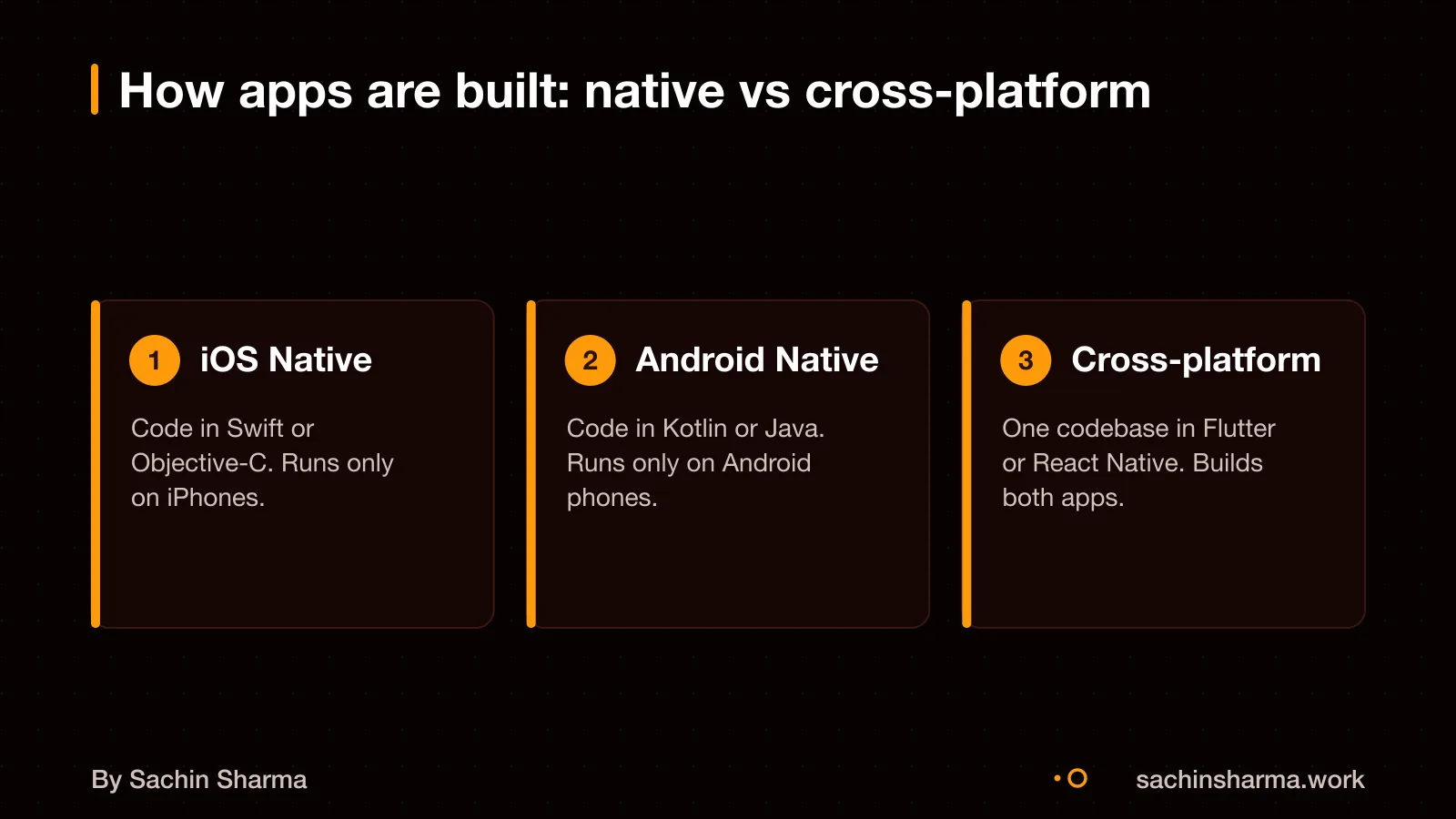
A native app is built for just one operating system, such as iOS or Android. This means it uses tools and languages made for that platform. Native apps give the best performance and full access to device features like the camera, GPS and sensors. Developers use Swift for native iOS apps and Kotlin for native Android apps. Because the code runs directly on the device, it responds faster and works smoothly even with heavy tasks. For example, a video editing app built natively can use the full power of the phone’s processor. This close link to the device is why native apps are often more responsive than other types.
What is a cross-platform app?
A cross-platform app runs on both Android and iOS using one shared codebase. This means you write the code once, and it works on both platforms. Tools like Flutter and React Native let developers build apps this way. Flutter uses the Dart language and compiles directly to native code, while React Native uses JavaScript and a bridge to native modules.
This approach cuts your development cost by 30 to 40 percent and shortens launch time by up to 50 percent. For example, instead of paying for two separate teams (one for Android, one for iOS), you hire one team that builds both at once. Most Indian startups save time and money this way.
If you choose cross-platform, your next decision is which tool to use. Flutter or React Native for an Indian startup?
When does native performance matter?
Native development matters for apps that need real-time video, audio or media processing pipelines. It is also the right choice when your app requires advanced augmented reality (AR) or 3D rendering with high frame rates. These apps demand full access to the device’s GPU, CPU and sensors, which native code can use directly.
Most business apps do not need this level of performance. But if you are building a video editor, live music mixer, AR fitting room or 3D game, native is the safer choice. For example, a real-time music mixing app must process audio with no lag. Cross-platform tools add a layer that can delay the signal. On mid-range phones, this delay may break the experience.
However, native apps run faster because they speak directly to the operating system. Cross-platform apps go through an extra step that slows them down. This gap is small for forms, lists and buttons. It grows under heavy tasks like video encoding or sensor fusion.
If your app’s core function is performance-critical, choose native. If not, you may pay more for speed you do not need.
When is cross-platform good enough?
Cross-platform works well for most business apps, including sales, service, inventory and booking tools. These apps do not need high-end graphics or background sensors. Flutter runs smoothly even on 1GB RAM devices common in rural India. As of 2026, the smartphone user base in India is projected to cross 1.2 billion, with a significant chunk coming from rural areas.
Flutter compiles code directly to native machine instructions and uses its own Impeller engine for smooth scrolling and fast loads. This means startup screens, forms, lists and payments work reliably. UPI Circle, a payment tracker app, runs on Flutter and handles transactions offline before syncing when the network returns.
Yes, Flutter is suitable for Indian startups. It cuts development time and cost by letting one team build for both Android and iOS. Most small businesses need features like login, dashboard, form input and cloud sync, all of which Flutter handles well. You can launch faster and test your idea without overspending.
App or website first? might be a better starting point if you are unsure whether you need an app at all.
How much does each option cost?
A cross-platform app costs less than two native apps for the same features. As an estimate, using an 83.00 INR to 1 USD conversion rate. A native app project ranges from about $10,000 to $500,000 and beyond for a complex enterprise product. For a project that would cost $120,000 with two separate native teams. A single cross-platform team using Flutter can deliver it for $70,000 to $85,000. That means you could save up to ₹45 lakh on mid-sized projects.
These figures are based on average US dollar rates and may vary in India. Development costs depend on app complexity, team rates and timeline. For simpler apps, the savings may be smaller. For complex ones, the gap grows.
Cost to build a quick commerce app gives a real example of how features affect price.
Want a number for your idea? Send one line on WhatsApp. I reply with what drives the cost and what to cut.
Message me on WhatsApp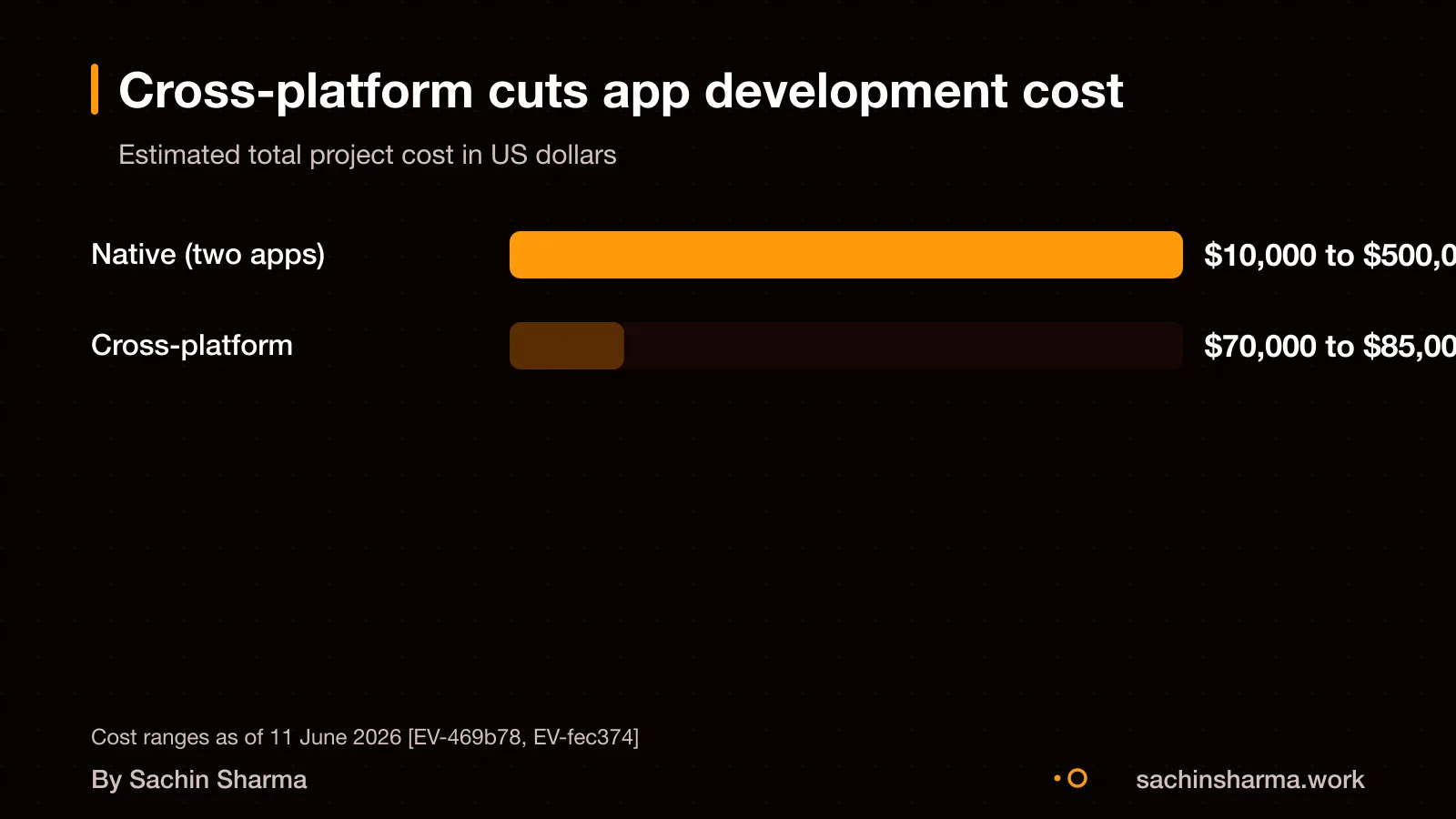
How long does each take to build?
Cross-platform apps use one codebase for both Android and iOS, which can reduce development time. As a result, launch time is cut by up to 50 percent compared to building two separate native apps. For a minimum viable product (MVP), this means you can launch in weeks instead of months, depending on features.
Cross-platform development using frameworks like Flutter or React Native can cut development time by up to 40%. The exact time depends on your app’s complexity, team size and how often you test on real devices.
Delays happen when teams do not plan for platform-specific tweaks. Even cross-platform apps need custom code for permissions, notifications or camera use on each OS. Poor testing on low-end devices common in India can also slow things down.
What are the risks of each option?
Cross-platform apps can have slight performance lags during graphic-intensive animations or complex processing tasks. When Apple or Google releases new features, they are available first on native SDKs. Cross-platform tools may support them 3 to 6 months later. This delay means your app could miss early adoption benefits. Also, relying on a cross-platform framework ties your app to its updates and long-term support, which is a hidden cost.
Native development carries higher risks in cost and time. Building two separate apps for iOS and Android doubles the initial effort and increases testing complexity. Maintenance costs 15 to 20% of the build cost per year, and with native, you pay this for both codebases. If your budget is tight or your timeline is short, native increases the risk of delays or feature cuts.
Not sure if your project has this risk? Tell me the plan in two lines and I will say yes or no.
Message me on WhatsAppAre there Indian apps built with cross-platform tools?
Yes, Indian startups and government platforms use cross-platform tools. UPI Circle, a cross-platform payment system, enables interoperability between BHIM, GPay and PhonePe. This means users can send money across apps without switching platforms. The BHIM app, promoted by the Indian government, lets secondary users initiate payments by scanning QR codes. Entering a Virtual Payment Address (VPA) or typing a mobile number. These features run reliably across Android and iOS devices.
The Startup India Showcase, run by DPIIT, lists startups from across the country that have gone through official programs. While the platform does not state the tech stack of each startup, it proves that early-stage Indian ventures are building scalable digital products. Some of these are likely using cross-platform frameworks to move fast and cut costs.
Sachin has built apps like Loopin, a habit tracker, and Legease, an AI legal-document platform, using Flutter. These run on both Android and iOS with one codebase. He also delivered a multi-tenant platform for a family-run conglomerate with ₹150 Cr+ revenue, using cross-platform tools. See how one dealership group moved from paper to one platform From paper to one platform: a 5-brand, 8-outlet dealership build.
Who owns the code and app accounts?
You legally own the app only if your contract says so. Most freelance developers and agencies keep ownership unless they sign an intellectual property (IP) assignment. You must get this in writing before work starts.
The full handover includes the source code, design files, third-party service accounts and app store credentials. Without these, you cannot update, fix or move your app later. For example, if your developer uses Firebase, you need access to the project dashboard.
To check ownership, ask for the GitHub or GitLab repository and confirm you are listed as owner. Test access to the Google Play Console and Apple Developer Account. If you cannot log in or make changes, you do not fully own the app.
As a buyer, always insist on a clause that assigns all IP rights to you upon payment. Do not rely on verbal promises.
Can I get the source code of my app?
When this advice is wrong
- Choose native if your app needs real-time video, audio or media processing pipelines, such as live broadcasting or high-speed recording. These tasks demand direct access to hardware and low-level control that native tools provide.
- Pick native for advanced augmented reality (AR) or 3D rendering with high frame rates, like in gaming or immersive training apps. Cross-platform frameworks may not support the full range of graphics features or can lag under heavy visual load.
- Even at high user loads, some teams choose cross-platform if they can manage performance through careful optimisation. However, when scale demands fine-tuned resource handling and peak responsiveness, native code offers more control.
- If your app relies on modern device capabilities, like LiDAR scanning, background health sensing or real-time language translation. Native development ensures full access as soon as the OS supports it.
Next step: message me on WhatsApp with what you want to build. No forms, no sales team.
Message me on WhatsApp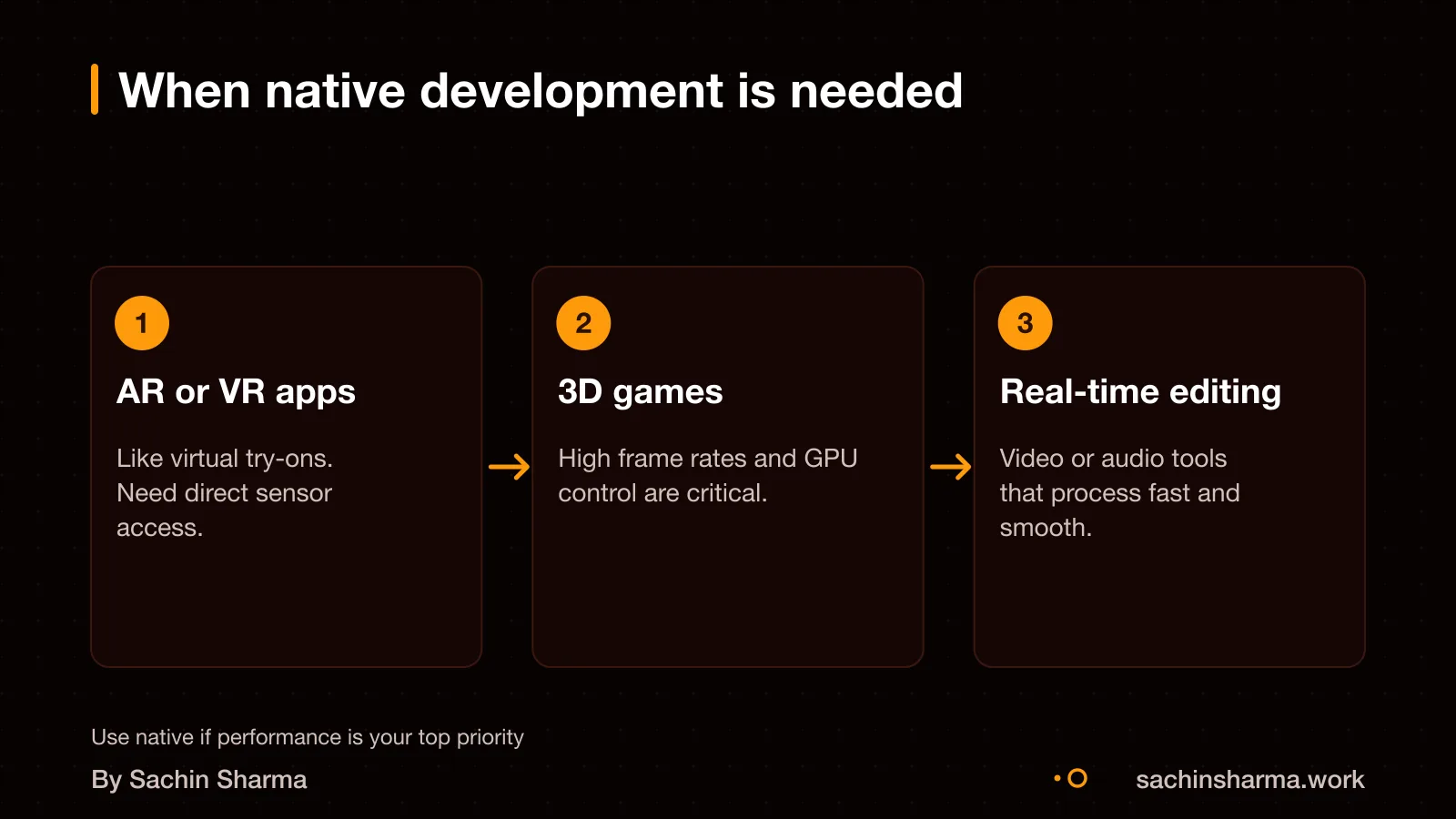
Assumptions behind the numbers
- Assumption: ₹50 lakh budget aligns with a $120,000 native baseline.
- Assumption: Business apps do not require real-time media or AR.
- Assumption: Launch time under 6 months is a priority.
- Assumption: Reader is not building a game or media studio app.
Pick your situation
I build apps in Flutter, so I benefit if you choose cross-platform. That is why the table also shows when native is the better pick.
Pick your situation
Cross-platform wins. Cross-platform cuts costs by 30 to 40 percent. A ₹50 lakh budget can cover more features this way.
The whole comparison
| Cross-platform | Native | |
|---|---|---|
| Codebases to manage | One shared codebase | Two separate apps |
| Cost | ₹30 to ₹40 lakh for a dual launch | ₹50 to ₹70 lakh for a dual launch |
| Time to launch | 4 to 6 months | 6 to 9 months |
| Device access | Good, via plugins | Full and instant |
| Performance | Very good for business apps | Best possible |
| Risk | Framework updates, plugin gaps | Higher cost, longer time |
Whichever you choose, ask these
- Can I switch from cross-platform to native later?
- Will my app feel 'native enough' to users?
- What happens if the framework stops being supported?
- Do I lose access to new OS features?
Questions people ask
For most startups and business apps, I recommend cross-platform using Flutter or React Native. It cuts development costs by 30 to 40 percent and launch time by up to 50 percent compared to native apps. This is the smarter starting point unless you need real-time media or advanced AR features.
There is no documented migration path from cross-platform to native. If your app later needs native performance, plan for a full rewrite. This means rebuilding the app from scratch for iOS or Android, which will take time and cost more than the initial build.
Hidden costs include annual maintenance, hosting, and framework dependency. Maintenance costs 15 to 20 percent of the build cost per year. Hosting runs $100 to $1,000 per month at startup scale. Framework dependency can lock you into updates or break features if the tool changes.
There is no reliable public method to verify the tools used. You can ask for code samples and check if the app detects device features at runtime, which is common in cross-platform apps. But full verification requires technical review of the source code.
App maintenance includes bug fixes, OS updates, security patches, and feature tweaks. It costs 15 to 20 percent of the original build cost per year. Hosting adds $100 to $1,000 per month. These costs keep your app running and secure.
Yes, cross-platform apps work well on most Indian mid-range phones if the app is under 50MB and uses less than 1GB RAM. Over 1.2 billion smartphone users in India include many in rural areas using budget devices. Keep the app light for wider reach.
Yes, Flutter is suitable for Indian startups when speed, cost, and small teams matter. It allows shipping on both platforms on day one. It is a strong choice for MVPs and fast iterations, especially with limited budgets and tight timelines.
Customised software development in India is taxed at 18% GST. If you export the software, it may be zero-rated. You can claim Input Tax Credit on business expenses like tools and rent if you have valid GST invoices. Check this for your case with a chartered accountant.
You, the client, must control both Google Play and Apple App Store accounts. I can help set them up, but ownership stays with you. This ensures you retain full access, updates, and revenue control. Amazon may restrict app availability on their store, and Google and Apple allow direct submissions for apps built with Expo.