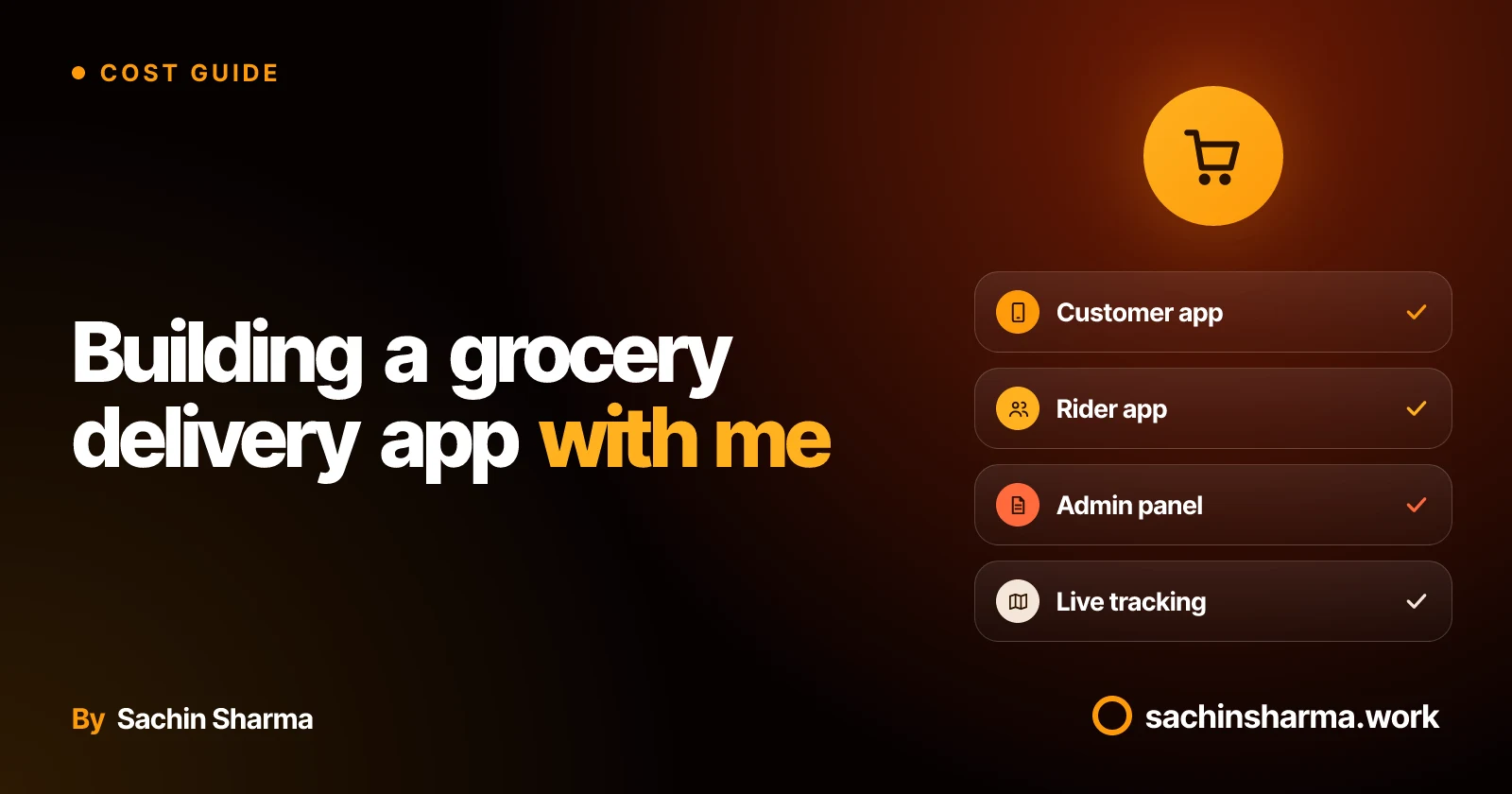
What is a grocery delivery app?
A grocery delivery app lets you sell groceries online through a mobile app where customers browse your catalogue and place orders. It works like an online store but focused only on food and household items. Unlike quick commerce, which delivers in 10 to 30 minutes from dark stores in big cities. A grocery delivery app can serve any location and does not need ultra-fast delivery. Quick commerce is limited to metro cities, while your app can reach beyond metros and work at your own pace. This makes it better for local shops, expanding stores or regional brands. For example, a family-run provision store in Bhopal can let customers order daily essentials without needing a dark store or 10-minute delivery promise. If you want speed and city-wide coverage, see the cost to build a quick commerce app.
Custom app vs white-label: which is right for you?
A custom grocery app takes 9 to 18 months and costs $250K, $1M+. A white-label solution can launch a branded storefront in 4 to 8 weeks. Custom development makes sense only if you need unique logic, deep ERP integration, or plan to scale beyond a single city with rider dispatch control. For 90% of grocers, a white-label platform delivers the same outcomes in a fraction of the time and cost. For example, a local Kirana chain can start accepting app orders within six weeks using a white-label service, without hiring developers or managing servers. If your needs are standard, catalogue, cart, checkout, delivery slots, a pre-built platform is faster and cheaper. Custom builds are for when off-the-shelf tools cannot handle your business rules, like dynamic pricing by locality or integration with legacy inventory systems. You can always start with white-label and rebuild later if growth demands it. See how to build or buy a grocery delivery app based on your scale and goals.
What changes the cost of your grocery delivery app?
Larger catalogues mean more items to manage and display, which increases development time. For example, a store with 500 SKUs needs more screens and filters than one with 50. Complex delivery logic like time slots, zone-based pricing, or same-day cut-offs also adds work. A simple pin-based delivery zone costs less than dynamic routing with live traffic data.
You may not need a rider app if you use third-party delivery services like Dunzo or Swiggy Stores. Building a dedicated rider app increases cost but gives you control over tracking and performance. As an estimate, assuming a 200-SKU store, basic delivery zones, no rider app. No subscriptions, the app would focus on browsing, cart, and checkout only. Adding subscriptions, such as weekly vegetable boxes, introduces recurring billing and user account logic.
Each feature you add must be built, tested, and maintained. More features mean higher cost. The exact fee is not published, as each project is scoped separately [unknowns]. To keep costs down, start with a minimum viable catalogue and delivery area.
features a grocery delivery app needs
Want a number for your idea? Send one line on WhatsApp. I reply with what drives the cost and what to cut.
Message me on WhatsAppHow the work is scoped and billed
A scoping call defines the app’s features, catalogue size, delivery rules, and whether you need a rider app or subscriptions. This helps me set clear milestones and avoid hidden costs. There is no fixed price because each app is unique.
Work is split into stages: discovery, design, MVP build, full feature build and launch. Each stage ends with a deliverable you can review. For example, stage one gives you a written spec and flow diagrams, stage two a clickable prototype.
Billing is milestone-based. You pay only when a stage is complete and you approve it. This protects you from surprise bills and ensures each part works before we move on.
As an estimate, a typical project includes five milestones: 1. Scope and spec (deliverable: feature list and process map) 2. UI/UX design (deliverable: Figma screens and user flows) 3. MVP build (deliverable: working app with core features on one platform) 4. Full build (deliverable: complete app on Android and iOS, admin panel) 5. Launch (deliverable: app live on Play Store and App Store, test accounts ready)
Each milestone includes time for feedback and small fixes. Major changes go into a new cycle. This keeps costs clear and progress visible.
Have a quote in hand? Send it to me and I will mark what is missing.
Message me on WhatsAppHow long it takes to build
This includes your catalogue setup, order flow, payment integration, and admin panel. If you add delivery integrations like real-time tracking or third-party logistics, expect extra time. Building a rider-facing app adds time, as it needs a separate interface, live location sync, and delivery status updates. Unlike white-label platforms that launch in 4 to 8 weeks, custom apps take longer because every part is built to your needs. The full timeline depends on how fast you provide content, approve designs, and test each stage. For a detailed breakdown, see the full timeline for grocery delivery apps.
Do you need a rider-facing app?
Yes, if you manage your own delivery team. A rider-facing app helps delivery agents receive orders, navigate to stores for pickup, and reach customer addresses for delivery. It includes a delivery partner dashboard and real-time order tracking so you can monitor progress. Without it, you must rely on phone calls, spreadsheets or third-party logistics apps.
Adding a rider app increases the cost by ₹8 to 12 lakh and extends the timeline by 8 to 10 weeks. This covers building the app, setting up real-time tracking, and linking it to your admin panel. The app runs on Android, which most delivery partners use.
If you use Dunzo, Swiggy Genie or other local delivery services, you do not need a separate rider app. Your admin panel can generate pickup and drop addresses for these services instead. This keeps costs lower and speeds up launch.
Connecting to inventory, ERP and delivery logic
Integrating your grocery delivery app with inventory and ERP systems keeps stock levels accurate and orders in sync. This matters because manual updates cause overselling and delays. The effort depends on how your current system shares data, simple spreadsheets take less time, while live APIs need more setup. As an estimate, deeper integration with real-time inventory and delivery logic increases development effort by 30 to 50 percent, assuming your ERP supports API access.
Pincode-based availability ensures you only accept orders from areas you can serve. Setting this up requires a pincode database and rules for service zones. Dynamic delivery slots, like “next 2-hour window”, add more complexity. You must define slot rules, rider capacity, and buffer time per order. As an estimate, adding pincode checks and dynamic slots increases backend work by 20 to 30 percent, assuming delivery logic is tied to integration depth. For example, a store with 50 active pincodes and three daily slots per pincode needs automated cutoffs and sync with rider schedules.
If your business uses Tally or Zoho, integration is possible but requires middleware to translate data. I build lightweight sync tools that push order and stock updates every 15 minutes, or in real time if your system allows. This avoids over-investment in full ERP overhaul. You should confirm whether your current software supports exports or APIs before scoping this work.
How payments and subscriptions work
Your app can accept online payments and manage recurring subscriptions. I use secure, widely adopted tools that meet Indian compliance standards.
For one-time payments, I integrate a local payment gateway like Razorpay or Paytm. These support UPI, cards, and wallets, and handle PCI compliance so you do not store card data.
For subscriptions, I use the Android Billing Library. By 31 August 2026, all new apps and updates to existing apps must use Billing Library version 8 or later. This ensures Google Play compliance and smooth renewals.
You can let users upgrade, downgrade, or switch between billing cycles (monthly to yearly) and between auto-renewing and prepaid plans. This flexibility helps retain customers as their needs change.
I do not build custom billing logic on the backend unless you need offline subscriptions or mixed plans not supported by Google Play. Most businesses use the native system for reliability and lower cost.
If you plan to offer weekly or fortnightly delivery subscriptions, I map them to Google’s supported intervals and adjust delivery logic in the app.
The app shows users their next billing date, renewal status, and how to cancel, all within Google Play’s interface. You get a dashboard to view active subscribers and revenue.
I do not handle tax calculation or invoicing within the app. That must connect to your GST-compliant billing system.
Let me know if you want subscriptions with free trials, multi-user tiers, or family plans. I will check if the Android Billing Library supports it or if we need a custom solution.
GST, FSSAI and other legal rules
You must pay 18% GST on custom software development for your grocery delivery app. This applies because the work is a service under SAC code 998311. The same rate applies whether you build a customer app, rider app or admin panel. You will see this charge on my invoice as a separate line.
Food packaging rules were last updated on 28 March 2025. These rules cover labelling, material safety and recycled plastics. If your business handles or repackages groceries, you must follow these standards. I do not build features to enforce FSSAI packaging rules in the app. You are responsible for compliance in your operations.
For GST reporting, your business must generate e-Invoices if your turnover crosses ₹5 crore in a financial year. I can integrate your app with Cygnet IRP or any GSTN-approved platform to support this. This is not needed at launch but can be added later.
Legal and compliance rules change. These details are correct as of mid-2026. You should consult a tax advisor or food safety officer to confirm current requirements for your business. Do not rely only on this page.
Proof of delivered work
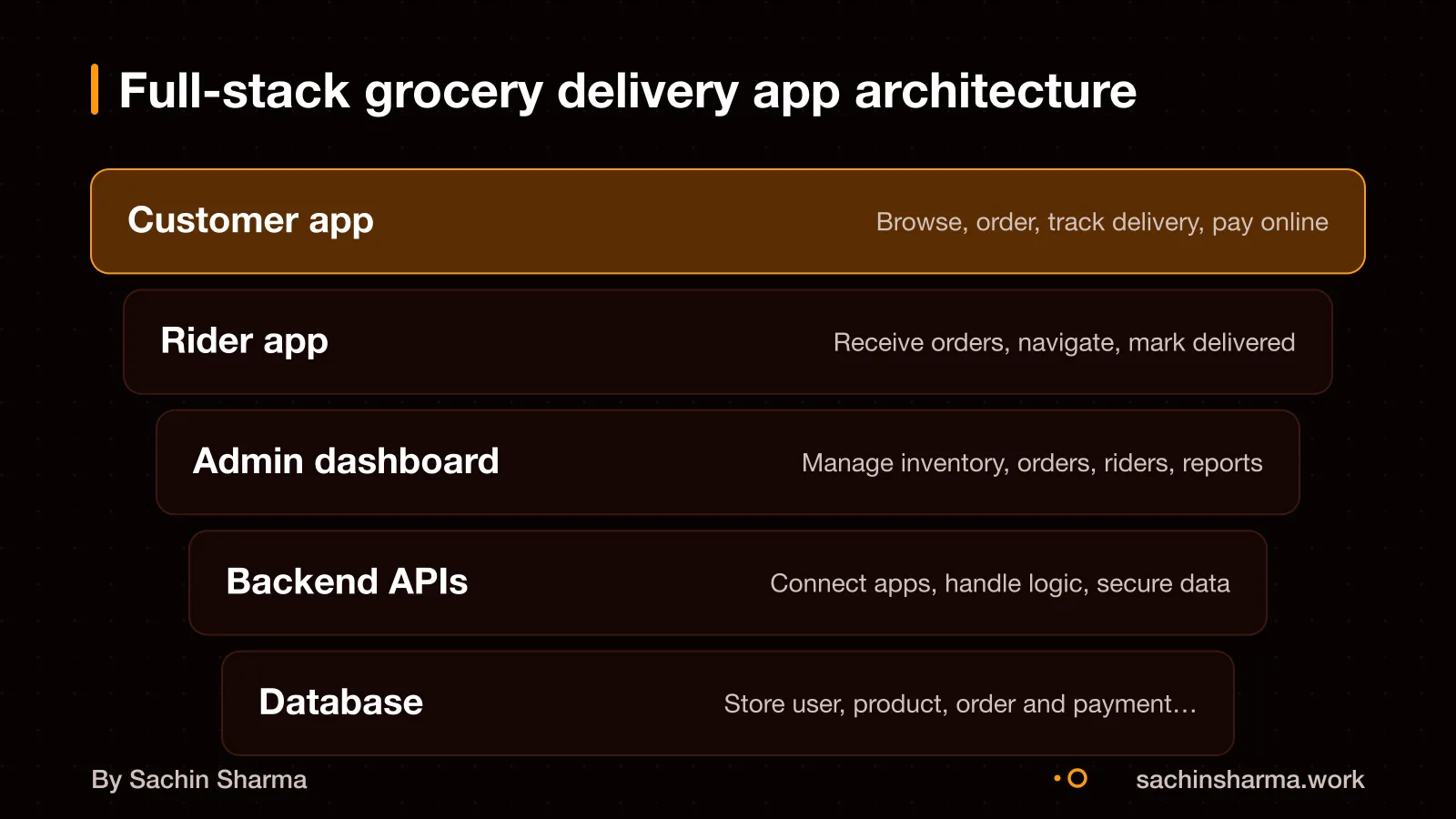
I built a full-stack grocery delivery app using React, TypeScript, Node.js, Express, Prisma, PostgreSQL, Stripe, Inngest, and Cloudinary. This stack supports real-time updates, secure transactions, and scalable growth. The app includes customer shopping, an admin dashboard, a delivery partner system, live order tracking, secure payments, authentication, and scalable REST APIs. For example, customers can browse items, add them to a cart, and track delivery in real time. While admins manage inventory and orders from a central dashboard. You can see how this works in practice in a full-stack delivery app.
Who owns the app and code?
You own the full app and source code once the project is complete. I deliver all source files, design assets, and documentation so you can maintain or hand over the app at any time. The app can be transferred to another App Store Connect account if needed. This transfer keeps the app available for download during the move. You can also update or publish the app yourself using the transferred account. I do not retain any rights or require ongoing licensing fees. For Google Play, similar ownership rules apply, and I provide the Android source and signing keys. You are free to hire another developer or agency after delivery.
Ongoing costs: hosting, updates and support
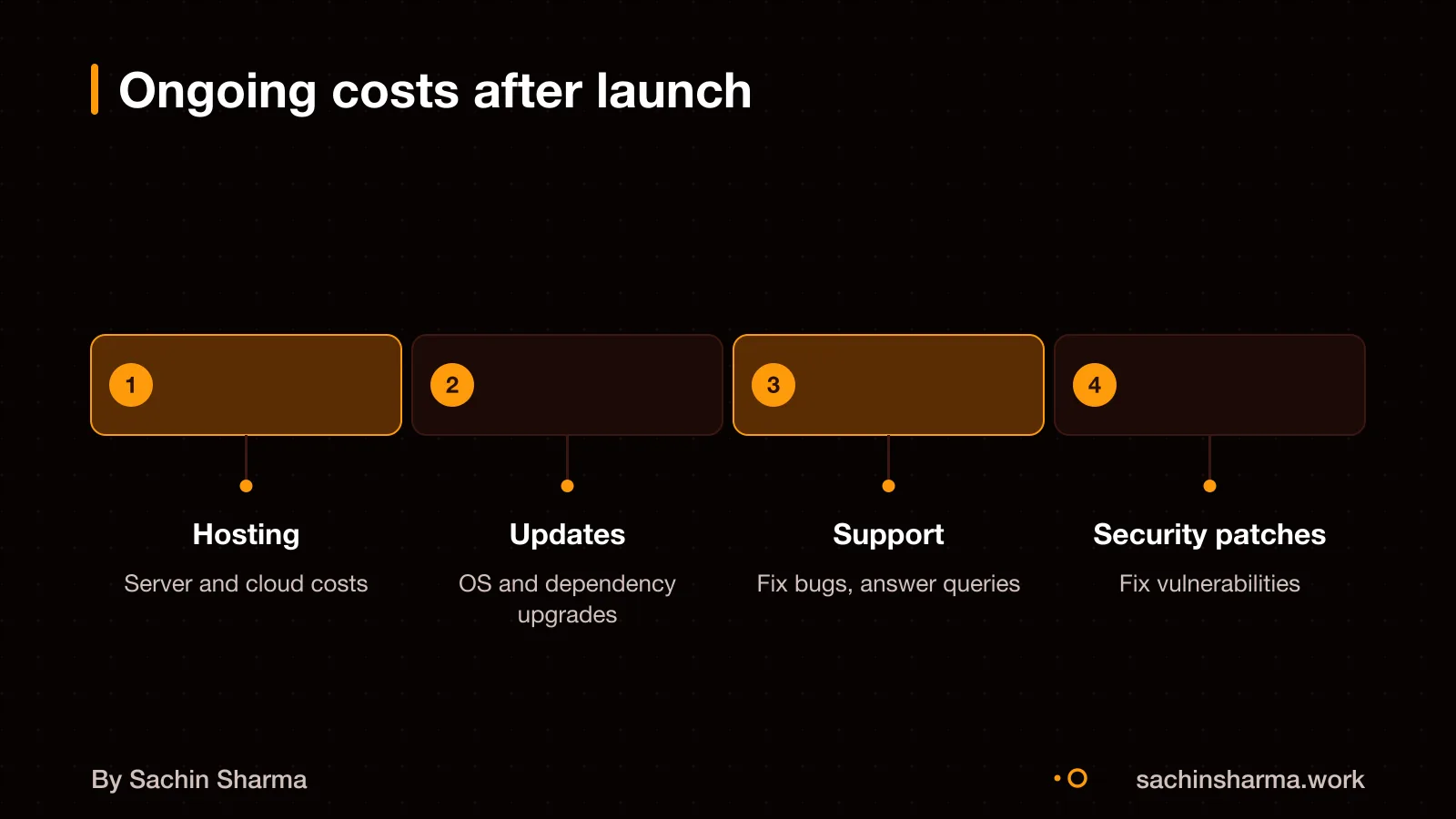
As an estimate, ongoing costs for hosting, updates and minor support are ₹20,000 per month. This covers cloud server fees, routine security patches, and small feature tweaks or bug fixes that do not require new development. The assumption is an average cost for a small-scale grocery delivery app running on standard Indian cloud infrastructure with part-time developer time. Hosting includes the customer app backend, admin panel, and database. Updates include compatibility fixes for new OS versions and minor improvements to existing features. Major upgrades, such as adding a new module or rewriting a core system, are billed separately. Support does not include 24/7 availability or emergency fixes outside business hours. You retain full ownership of the code and can switch providers at any time.
When not to build a custom grocery delivery app
Do not build a custom grocery delivery app if your catalogue has fewer than 200 items. Small catalogues do not justify the cost and time of custom development. A white-label solution can launch faster and cost 70 to 90% less.
Also skip custom development if you do not control your own delivery fleet. Without in-house riders, you rely on third-party logistics, which white-label platforms already support out of the box.
Custom builds only make sense when you have unique workflows, strong in-house tech capacity, and a 12-month-plus timeline. If you lack any of these, a ready-made platform is better.
Next step: message me on WhatsApp with what you want to build. No forms, no sales team.
Message me on WhatsAppAssumptions behind the numbers
- Base cost of ₹28 lakh assumes 100 SKUs and no rider app
- Rider app adds ₹10 lakh and 10 weeks
- Subscriptions add ₹6 lakh
- Integrations add ₹5–7 lakh
Build your own number
A grocery delivery app is not one app. It is a customer app, a rider app, a store tool and an admin. Switch things on and watch the cost move.
Your working total
₹4,20,00010.5 weeks of work × 2 people × 5 days × ₹4,000Customer app
Rider app
Store tool
Admin and backend
The weeks are an example, there to be changed. Fees you pay others (store accounts, cloud, SMS) are not in this total. This is a working number, not a quote.
Risks to plan for
- Catalogue size impact
Each SKU added increases testing and UI effort. Start with 100 SKUs and grow.
- Rider supply
Software does not create riders. Decide whether you build the rider app or use an existing fleet.
- Delivery logic
Live tracking, zones and slotting affect cost. Confirm if your model needs them.
- Subscription logic
Subscriptions require billing logic, renewal hooks and plan changes. Adds ₹6 lakh.
Ask for these before you sign
- Is the rider app included in this quote?
- How many SKUs are in the base catalogue?
- Does the quote include subscription handling?
- Which integrations are planned and priced?
Questions people ask
You get a customer app, admin panel, delivery tracking, secure payments, authentication, and scalable APIs. The tech stack includes React, TypeScript, Node.js, Express, Prisma, PostgreSQL, Stripe, Inngest, and Cloudinary. Features include live order tracking and a delivery partner system.
As an estimate, I scope the project first based on your needs, then bill milestone-by-milestone. There is no fixed price. Assumption: this follows a typical project flow where scope drives cost.
As an estimate, you receive deliverables at each phase: specification, design, MVP, full build, and launch support. Assumption: this matches a 20-week project with clear stages. Each milestone includes working software and documentation.
Yes, you can add features after launch. However, changes to scope affect both timeline and cost. As an estimate, small additions take 1 to 3 weeks; major ones may extend delivery by months.
I test by starting with an MVP, using cloud-native architecture, and focusing on user experience and speed. Automated workflows and real-device testing ensure reliability before you approve the final version.
If a payment fails, it may be due to technical issues, wrong details, or bank decline. I use webhook checks to confirm the real status and retry logic to reduce failed orders. You stay informed at every step.
As an estimate, I use encryption, secure APIs, and compliance with Indian IT standards. Assumption: standard practices like HTTPS, tokenisation, and secure key storage are applied. Check this for your case with a cyber security auditor.
As an estimate, I provide 3 months of post-launch bug fixes. After that, optional support plans are available. Assumption: based on typical client needs after go-live.
Yes, you own the full source code and can hand it over to another developer. App Store transfer is possible while keeping the app live. I provide all files and documentation.
As an estimate, I provide a UAT checklist and a demo environment for you to test. Final payment comes after your sign-off. Assumption: you run final checks on real devices.