What a clinic booking app actually does
A clinic booking app addresses long queues, paper records, and poor communication in clinics. It replaces manual work with digital tools that save time and reduce errors.
The app lets patients book and reschedule appointments online, cutting wait times. Staff can manage slots in real time and send automated reminders by SMS or WhatsApp. This reduces no-shows and frees up front-desk time.
Key features include appointment booking, electronic medical records, digital prescriptions, billing and invoicing, patient management, and an analytics dashboard. These tools help staff track visits, issue bills, and monitor clinic performance securely.
For patients, it means less time waiting and easier access to care. For clinics, it means smoother operations and better record-keeping.
What a clinic booking app costs covers the investment needed for such a system.
Custom app vs ready-made tools
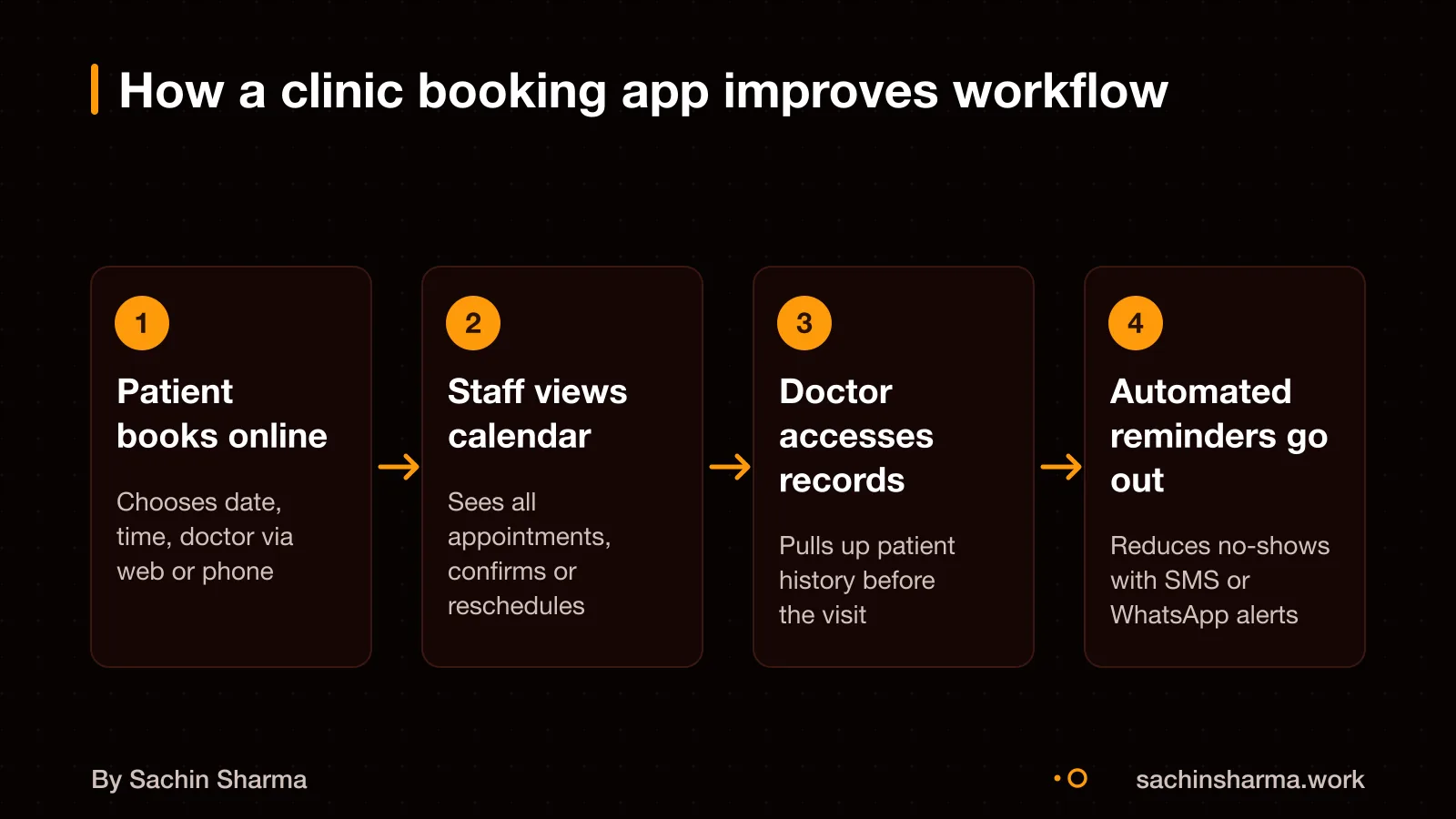
Choose a custom app when your clinic has unique workflows, needs private control of patient data. Or must integrate with lab systems or billing software. A custom app gives you full ownership of the code and lets you add features like appointment reminders, doctor availability sync, or teleconsultation later. You control updates, compliance, and where data is stored.
Ready-made tools can work if your needs are simple, such as basic online booking with no integrations. These tools limit customisation and may have compliance uncertainty. Some charge per booking or take control of your patient data, which can be risky long-term.
The trade-off is control versus speed. A custom app takes more time and budget but fits your clinic exactly and grows with you. A ready-made tool starts fast but may not adapt when your clinic expands or when rules change. For example, if you plan to offer home visits or link with diagnostic centres, a custom app is better.
When a developer beats an AI app builder
How much it costs to build with me
Based on similar clinic apps, expect $15,000 to $40,000. This is an estimate for a custom mobile app. GST is extra and applies as per Indian tax rules. I do not publish a fixed or hourly rate. Projects are scoped by outcome, not time, and I work directly with you to set clear milestones.
Want a number for your clinic? Send one line on WhatsApp. I reply with what drives the cost and what to cut.
Message me on WhatsAppWhat changes the price
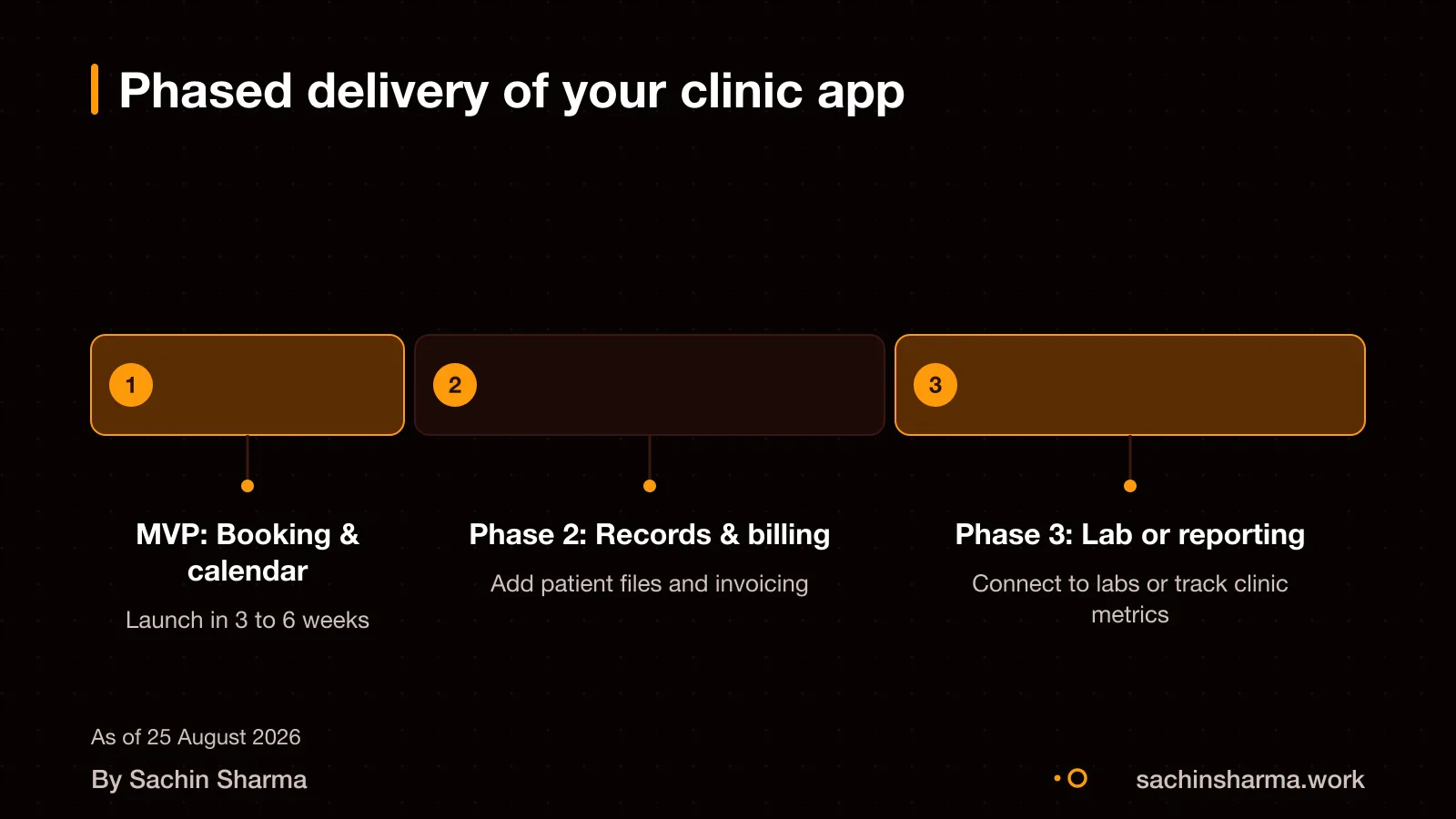
The price of your clinic booking app depends on which features you need and how complex they are. A basic app with just appointment scheduling for one clinic costs less than a multi-feature system with patient records, billing, or doctor availability sync. For example, adding teleconsultation, prescription sharing or lab integration will raise the cost. You can manage this by choosing a phased approach: start with core booking, launch fast, then add features later. This cuts initial cost and lets you test demand early. As an estimate, assuming a single clinic and no third-party integrations, a basic version may cost less than a full-scale platform. For a clear number, see the breakdown of clinic booking app costs.
How long it takes to build
You can launch a usable version of your clinic booking app in 3 to 4 months with a phased approach. This first version will let patients book and cancel appointments, view doctor availability, and get SMS or WhatsApp reminders. The full app, with patient records, billing, multi-clinic support and reporting, takes 5 to 9 months from start to launch. A phased build cuts wait time by focusing on core functions first. For example, a three-doctor clinic in Nagpur went live with booking and reminders in 14 weeks. Then added digital check-in and medical history forms in the next phase. Your timeline depends on how quickly you can review designs and approve test builds. Delays often come from slow feedback, not coding.
Typical phases in a clinic app project
An app project moves from idea to launch in phases. Each phase ends with a milestone you can review. You move to the next phase only when you approve the current one.
First, we define your clinic’s workflow and list the features you need. As an estimate, these features add time and cost, but you choose what to include.
Next, I create wireframes to show how patients and staff will use the app. You confirm the flow before any code is written. Then, development starts in small blocks. You get updates every week.
A working version of the app runs in a test environment during development. You try it with real staff and patient roles. Bugs and changes are logged and fixed.
Testing is part of the development process. Once you approve, the app deploys to your server or cloud.
The process used in building an appointment booking app includes a timeline from concept to launch. Your feedback at each stage keeps the project aligned with your clinic’s needs.
What you need to provide
You should share your clinic’s workflow and pain points to help build a tailored app. Understanding current appointment booking helps address clinic pain points. How you handle patient records and billing are areas where clinics often face inefficiencies. This helps build an app that fits your real work, not a generic one.
Set aside 30 to 60 minutes every week for updates and feedback. Major decisions, like approving the app design or enabling online payments, need your input within 3 working days to avoid delays. Delays in your feedback can push the launch date by weeks.
You will also need to provide content such as clinic name, address, doctor names, and service list. If you want patient data imported, you must supply it in a digital format. Since every clinic runs differently, the exact input needed will depend on your setup. For a clear list, message me with your clinic type and size.
I work directly with you
You talk to me directly, not a project manager or sales team. I work directly with clients, with no agency layers. This means you can share feedback, ask questions, and make changes without delays or miscommunication. If you need a decision or a fix, I handle it myself. If I am unavailable for a short time, I will let you know in advance and plan work around it. Working directly with a freelance app developer gives you greater control over the development process. For example, one clinic owner adjusted the appointment reminder flow twice during testing, and I updated it within hours.
8 checks to choose a developer in Raipur
Web app or mobile app for clinic bookings
ClinicFlow provides online appointment booking and other digital tools for clinics. You can set different roles for doctors, receptionists, and admins, and push updates instantly to all devices. Mobile apps need separate downloads and updates, which can delay adoption across your team.
You do not need to wait for staff to update an app on their phones.
Patients can use both web and mobile, but I recommend a responsive web app that works well on phones. It works well on phones and can be saved to the home screen. This makes it easier for patients to access booking without installation barriers. If needed later, we can build a native mobile app as an add-on.
Hire a Next.js developer for a web product if you want a fast, maintainable solution that works across all devices.
How to check if a developer is right for your clinic
Look for clear examples of past clinic or healthcare apps in their portfolio. Check if they document how the app works, not just what it looks like. A developer who understands clinic workflows may ask about patient check-in, doctor schedules, and staff roles before suggesting features.
To assess technical fit, review their code samples if shared. Open-source projects or public repositories let you see how they structure logic and handle data. Even if you cannot read code, a well-documented project shows discipline.
You can test their understanding by describing a real clinic day. For example, explain how you handle walk-ins, no-shows, or prescription updates. A skilled developer will map your steps to app features and point out gaps. Avoid those who jump to templates or push unneeded AI tools.
What happens after the app launches
Monitoring is not included unless agreed in your contract. If the app goes down, you must inform me right away so I can restore it. Healthcare organisations with large patient databases must have a tested breach response plan before an incident occurs. Maintenance like updates, security patches or feature changes is not part of the initial build unless specified. You will need to budget separately for ongoing costs like hosting, compliance audits, and support Ongoing costs of a clinic booking app. I can help plan these if needed.
Next step: message me on WhatsApp with what you want to build. No forms, no sales team.
Message me on WhatsAppWhen a clinic booking app is not right for you
A custom app may cost more than it saves for small clinics. Simple tools like WhatsApp or Google Forms can handle basic bookings at almost no cost.
When your needs are limited to appointment reminders and availability sharing, ready-made solutions often work better. No-code alternatives can enter the market at lower price points.
Stick with simpler systems if you do not need features like medical records, billing, or multi-doctor schedules. You can always upgrade later when patient volume grows.
For basic needs, a no-code tool is better than a custom app. It lets you start fast and test demand without a big commitment.
Your checklist
Before we talk price or timeline, here is what to check. Tick what you have verified; the page tells you where you stand.
Workflow Fit
Data Control
Compliance
Delivery
Walk away if
- Quotes a total without naming features
- Says the app works 'like Zocdoc' but shows no live project
- Does not explain how patient data is protected
- Asks for full payment before work starts
- Will not put the code or accounts in your name
Questions people ask
We communicate directly, with clarity and full documentation. As the developer, I stay in the loop for every discussion. You need to come into each meeting knowing what you want to discuss. This keeps decisions clear and progress fast.
You fully own the code, design, and all accounts once the project is delivered. With custom development, there is no vendor lock-in and you have full control over updates and changes.
You can switch developers at any time because you own the full codebase. The code is yours to take and hand over to another team. No lock-in means full freedom to pivot.
App development and patient adoption are separate. While I build the app, marketing and training are additional efforts you must plan for. I do not provide training as part of the build.
Yes, integration is possible if the lab or pharmacy system offers an API. ClinicFlow's roadmap includes pharmacy and lab test booking. For details on how APIs work, see the <a href="/glossary/api/">API glossary</a>.
The app will follow the DPDP Act by collecting free, specific, informed, and revocable consent from patients. We also plan for data breach response as required for organisations with large patient databases. Check this for your case with a data protection officer or lawyer.
Healthcare apps must have a tested breach response plan. Check your specific risk with a cybersecurity advisor.
You can review public case studies and check the scale of similar delivered work.
Ongoing maintenance is not included unless agreed in advance. Monitoring, updates, and support are separate from the initial build. You can choose to add them later.