What is a Next.js web product?
It is the leading React framework and powers companies like Walmart, Nike, Netflix, and OpenAI. With 60 million weekly npm downloads and 140,000 GitHub stars, it is widely used for production-grade apps.
A Next.js web product can handle complex workflows like user authentication, multi-language support. Backend logic using API routes and React Server Components. It supports databases like PostgreSQL, SQLite, and MySQL via DrizzleORM.
For Indian businesses, Next.js offers speed, scalability, and lower long-term costs. Its strong ecosystem reduces development time, and its server-side rendering improves SEO and performance on slower networks, a real advantage for users across India. Many global brands trust it, and your business can too.
Custom web product vs off-the-shelf tools
A custom web product makes sense when your business has unique workflows that off-the-shelf tools cannot support. You gain full control over features, data and design. Over time, this leads to better efficiency and lower costs. As of 2026, 70% of businesses report better workflow efficiency after switching to tailored solutions.
The long-term benefits include higher return on investment and faster revenue growth. Custom applications deliver a 55% ROI over five years, compared to 42% for off-the-shelf options. Businesses using custom software grow revenue 1.5 times faster than competitors. Every dollar invested can return up to four dollars. For teams, this can mean savings of about $1,500 per employee each year.
Use off-the-shelf software when your needs are common and well-served by existing tools. This is often true for email, accounting or basic project management. If you are just starting out and testing an idea, a ready-made tool can save time. But as your needs grow, subscription costs add up. Over five years, SaaS costs typically exceed custom development costs by 72%. When that happens, building your own solution becomes the smarter choice.
If you are unsure whether your workflow justifies a custom product, describe your daily operations in a message. I will help you spot where off-the-shelf tools fall short.
How long does it take to build?
A typical Next.js web product takes 2 to 3 months to build. This applies if you need authentication, a database, and live deployment. Smaller tools with fewer features may take less time. Larger systems, like multi-tenant platforms, may take longer.
The timeline can speed up if the goal is clear, content is ready, and feedback comes fast. It slows down if requirements change, third-party services are slow to integrate, or approvals take time. As of now, what slows down a Next.js project is not known.
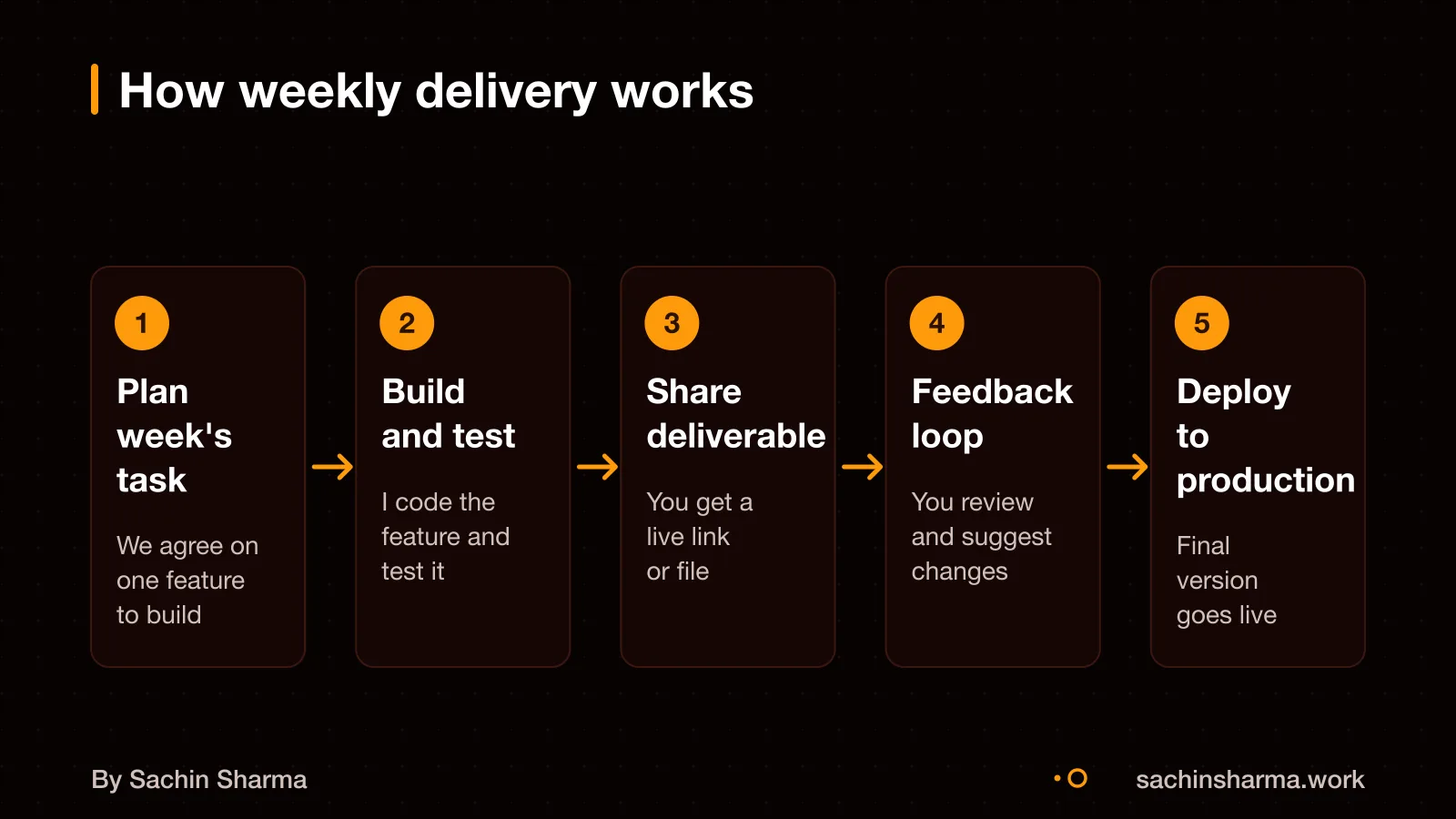
You can expect weekly progress. For example, week one may deliver the core layout and routing. Week two adds data fetching. Later weeks build forms, user accounts, and reports. Each week ends with a working update you can test.
Milestones depend on your product’s needs. A habit tracker like Loopin may focus on offline sync early. A legal platform like Legease may prioritise document security. You will see real code, not just status reports.
What are the steps in building it?
Each phase follows a clear weekly cycle. I start with planning the week’s tasks, then build features, test them, and share a live preview with you. You review and give feedback. I refine based on your input. This repeats until the product is complete. You get a working version every week, not just at the end.
Deliverables each week include one or more completed features. For example, a form with validation, a database schema, or an API route. These are built using a structured boilerplate. The boilerplate includes a local PostgreSQL database using PGlite, which requires no extra setup. If you want a fresh database, remove the `local.db` folder. For remote use, Neon provides a free PostgreSQL database.
To change the database, update the schema file at `./src/models/Schema.ts` using Drizzle ORM. Then run `npm run db:generate` to create a migration file. Apply it with `npm run db:migrate`. Security features like bot detection and rate limiting are built in via Arcjet. Code reviews happen automatically using CodeRabbit, an AI-powered tool.
Changes during development are handled through weekly feedback loops. You see progress early. If a feature needs adjustment, we fix it before moving on. This keeps the project on track and avoids big reworks later. A production build can be generated locally using `npm run build-local`, which uses a temporary in-memory Postgres database.
For example, in week three, you might get a working user registration form. It includes email validation, password strength check, and stores data securely in the database. The form connects to an API route that I built and tested. You can try it live, share it with your team, and suggest changes. This is how we ensure the product fits your needs.
How much does it cost? A worked example
As an estimate, a mid-sized Next.js web product costs about $13,900 per year through an EOR like Wisemonk for a mid-level developer on a ₹12 lakh salary. This is for a project that takes 2.5 to 3.5 months. Statutory costs like provident fund, ESI, and gratuity add about 12 to 15 percent to the developer's salary.
The cost rises if you need more complex features. These include real-time updates, third-party integrations, or admin panels with role-based access. The cost falls if you reuse components. It also falls if you limit user roles or use simpler data models. For example, a basic content portal with static pages and search may take only one month (₹1.15 lakh). A multi-tenant platform with billing, user dashboards, and audit logs can take five months or more (₹5.75 lakh+).
Here is how the cost breaks down by task for a typical 3-month project:
| Task | % of Time | Cost (₹) | Notes |
|---|---|---|---|
| Planning and setup | 10% | 34,500 | Includes tech stack, repo, CI/CD, and first deploy |
| Core features | 50% | 1,72,500 | User flows, database design, APIs, and UI |
| Admin and dashboards | 15% | 51,750 | Data views, exports, and moderation tools |
| Testing and fixes | 15% | 51,750 | Bug rounds, edge cases, and performance |
| Deployment and handover | 10% | 34,500 | Live deploy, docs, and source transfer |
This estimate does not include design, content migration, or third-party tools. These include SMS or payment gateways. You pay only for time spent. There are no hidden fees or agency markups.
Compare Next.js developer rates in India to benchmark this range.
Want a number for your idea? Send one line on WhatsApp. I reply with what drives the cost and what to cut.
Message me on WhatsApp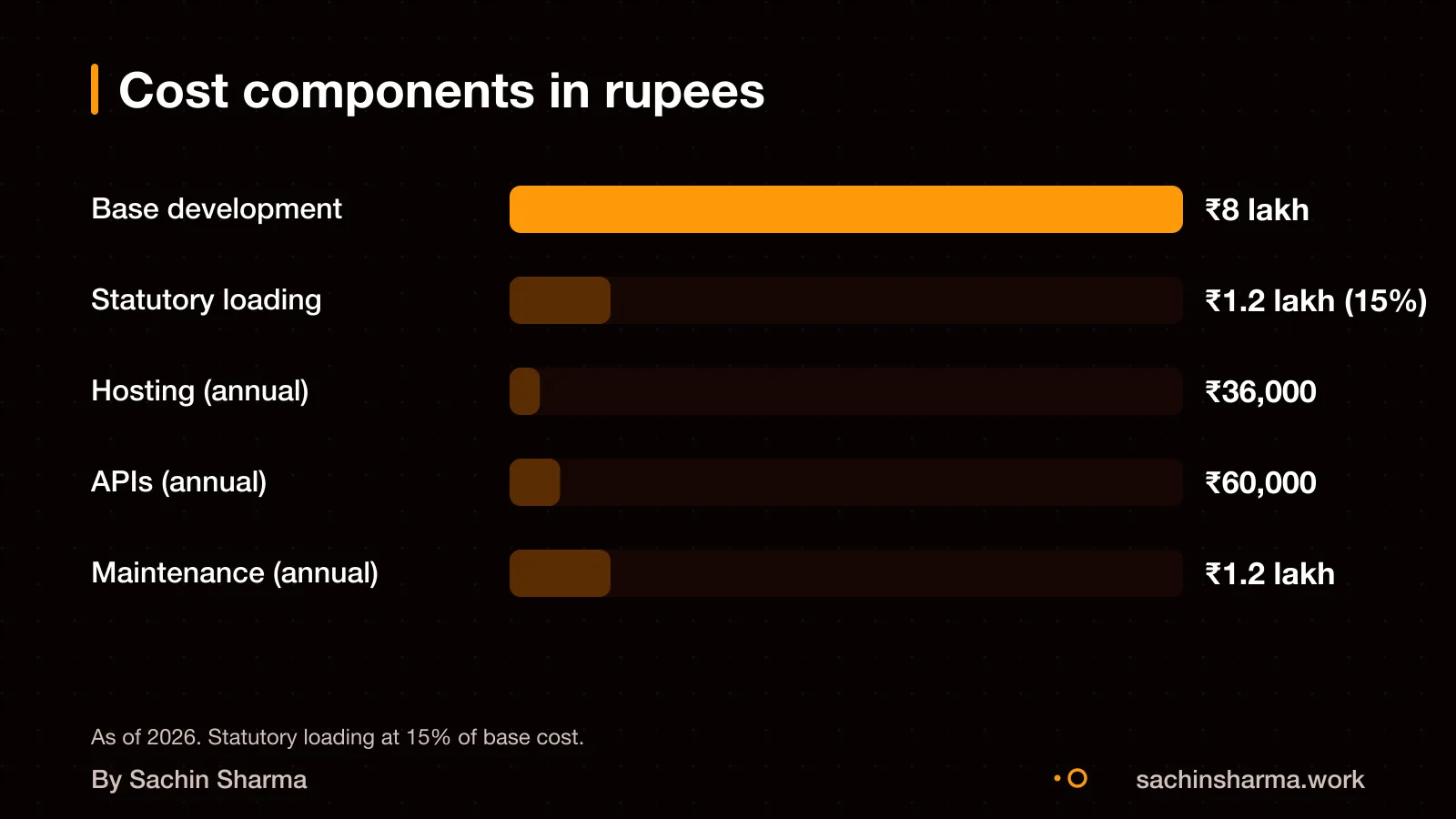
What are the risks and how are they managed?
The biggest risk in hiring a freelance developer is losing progress if the project stops or if quality slips. Freelancers in India may work with multiple clients and are not employees, which can affect IP assignment and knowledge retention. This makes clear contracts and regular oversight important.
To protect against poor quality or delays, I use a weekly cycle where you see working updates every Friday. Each week starts with a plan you approve, and I build only what is agreed. The code runs in a live preview link you can check anytime. I use a secure Next.js boilerplate with protections like bot detection and rate limiting. This keeps the base safe and stable.
If the project stops mid-way, you still own all code, designs, and data. I work in plain code with no lock-in tools, so any developer can take over. I deliver weekly updates in Git, so nothing is lost. You pay only for what is built, not for time or overhead. This means you always have control and can pause or stop with no penalty.
What the client needs to provide during the build is not known. The risks of hiring a freelancer beyond IP and retention are not known. How to verify a developer's skill is not known. Post-launch support options are not known. Whether this service suits small budgets is not known. When not to use Next.js is not known. How to start working together is not known.
Can I see examples of your work?
Yes, I have built several Next.js products, both for clients and as personal projects. You can see live demos or code samples for some of them. Quality is built in through testing, secure defaults, and clear architecture.
One example is EHR Copilot, a Next.js tool that turns psychiatric session transcripts into structured SOAP notes. It runs locally, does not upload data, and is designed for real clinical workflows. You can see a live demo and full case study EHR Copilot: a Next.js tool for psychiatric notes.
Another is Sameframe, a desktop app that finds exact duplicates with SHA-256. Shows visually similar media with DINOv3 and V-JEPA 2 for manual review only. It runs locally, with no accounts or telemetry. The app is built with Next.js and Electron.
FlashDrop is a secure, LAN-only file transfer tool where a phone sends files to a Mac via a local Next.js server. It uses QR codes, encrypts each chunk with ChaCha20-Poly1305, and supports resume and retry.
I also follow patterns used by companies like OpenAI and Nike, who use Next.js for composable commerce or AI applications. for composable commerce or AI applications. My work focuses on real use cases, not just tech for its own sake.
Related reading: Hire a Flutter developer for your first app, Hire a developer for a clinic booking app.
Next step: message me on WhatsApp with what you want to build. No forms, no sales team.
Message me on WhatsApp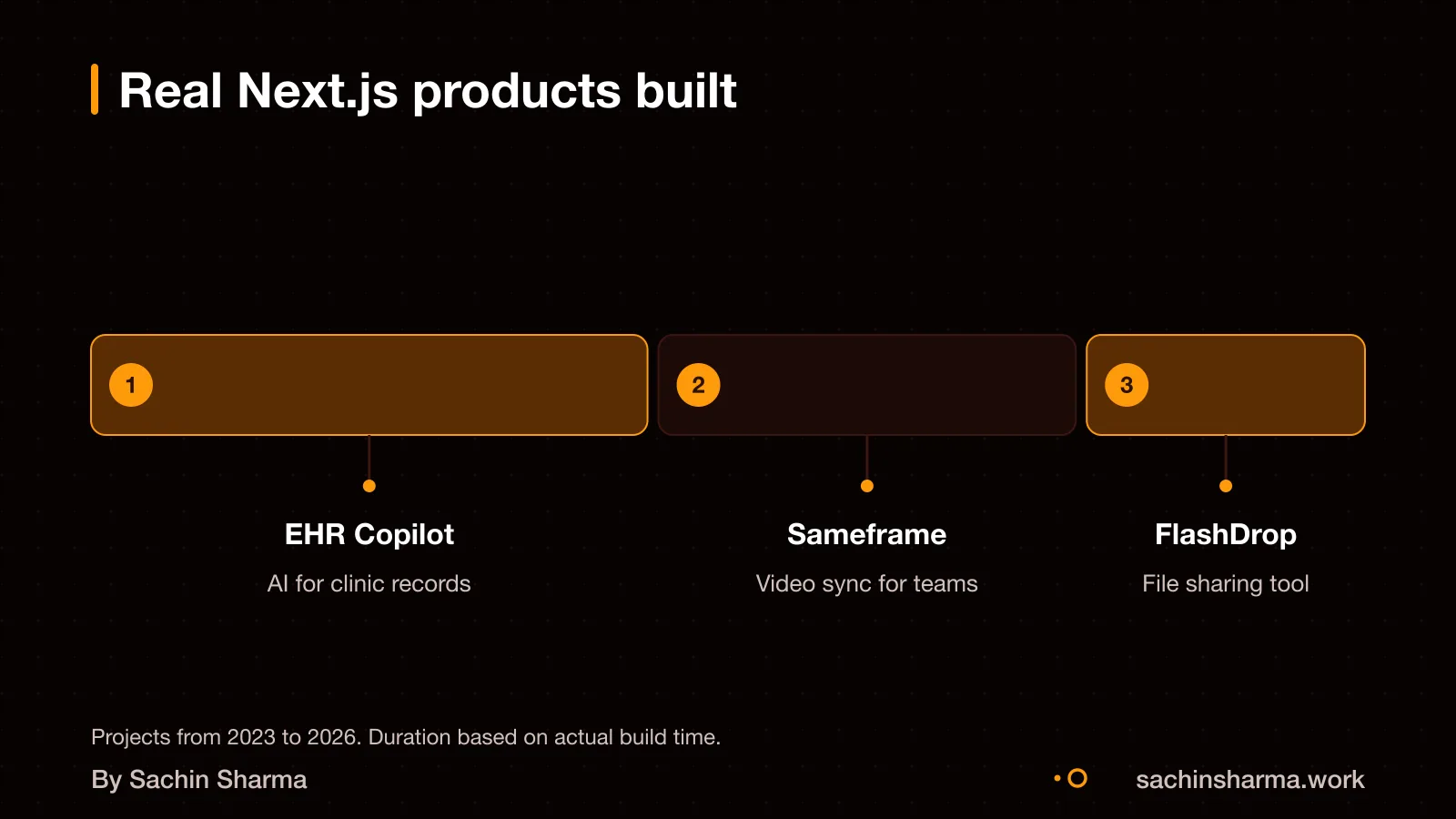
Assumptions behind the numbers
- Project duration is 2 to 3 months
- Weekly updates are standard practice
- Post-launch support needs separate pricing
- Code ownership must be in client’s account from start
- Privacy policy is needed if collecting user data
- GST records must be kept for 72 months
Your checklist
Before we talk rates, here is what to check. Tick what you have in place; the page tells you where you stand.
Scope
Design & Compliance
Delivery
Handover
Walk away if
- No written scope or budget
- Domain or accounts not in your name
- No privacy policy or GST plan
- Developer keeps repository access
- Support terms not clear
- No post-launch plan
- Changes not priced in advance
Questions people ask
You own the source code, design files, domain, and hosting accounts once I hand them over. I only retain rights to reusable templates or tools I developed before. For custom-built parts, you get full ownership as long as there is a clear agreement stating this.
Registered businesses must maintain records relating to production, inward and outward supply of goods or services, stock of goods, input tax credit availed. Output tax payable for 72 months from the due date of furnishing the Annual Return for the year relating to such accounts and records. If you hire me as a freelancer, I will issue a GST-compliant invoice, but you must verify my registration and maintain the records. Check this for your case with a chartered accountant.
I build apps that follow some obligations under the Information Technology (Intermediary Guidelines and Digital Media Ethics Code) Rules, 2021. This includes publishing a privacy policy, informing users about data use at least once every three months. Reporting cyber incidents to CERT-In. User data is stored securely, and I do not access it unless required for debugging with your permission.
Risks include inconsistent work quality, gaps in security practices, and unclear ownership of intellectual property. Since freelancers often work with multiple clients, knowledge retention can be low. I reduce these risks by using secure boilerplates, clear contracts, and regular updates.
Building production applications with authentication, databases, and deployment takes 2-3 months. This timeline assumes clear requirements and timely feedback from you. Delays usually come from scope changes or slow input, not technical issues.
Next.js builds web apps, but you can pair it with a Flutter mobile app for full coverage. Check if your developer has experience with both.
Ask for examples of their Next.js work and check if they explain technical choices clearly. A developer who shows past projects and listens to your needs is a good fit.
Yes, EHR Copilot is a Next.js app that turns psychiatric session transcripts into structured notes. You can review its purpose and tech stack.