What is a clinic booking app?
A clinic booking app helps patients book and manage appointments without phone calls or visits. It solves the problem of missed calls, double bookings, and lost appointment cards. Unlike Google Calendar, it is built for clinics, with patient profiles, automated reminders, and service-based booking slots. Compared to Practo, it is not a directory but a private system you own, where you control data, branding, and features. You decide who can book, when, and under what conditions. For example, you can block walk-ins or require a consultation deposit. The app becomes part of your clinic, not a third-party listing.
Custom app vs off-the-shelf tools
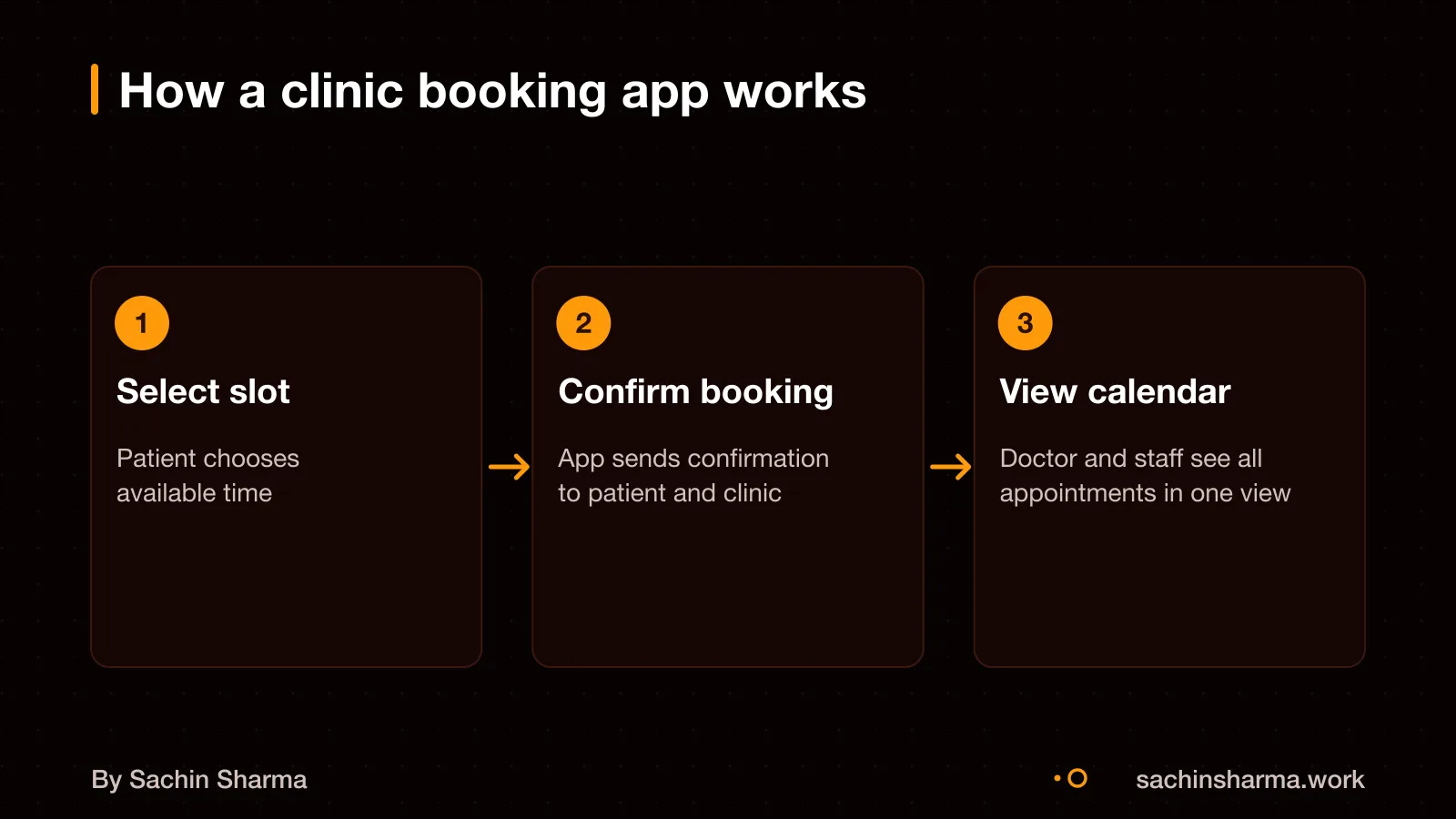
Choose a custom app when you need features that off-the-shelf tools do not offer, such as clinic-specific workflows or integration with existing systems. A custom app is built only for your needs and gives you full control over the design, data and updates. For example, if you want patients to book by doctor, service and time. Get automated follow-ups based on treatment type, a custom app can do that.
An off-the-shelf tool like Practo or Calendly is better when you want to start fast and your needs are common across clinics. These tools are cheaper at first and handle hosting, updates and support. But they charge monthly, limit customisation and keep your data on their platform.
If your clinic has unique rules, branding needs or wants to avoid recurring fees, a custom app makes sense. If you need basic booking and reminders quickly, an off-the-shelf tool may be enough. Compare the long-term cost of a custom app with the recurring fees of a SaaS tool. For a similar service app, see how coaching app cost breaks down one-time versus ongoing fees.
What’s in the base scope?
The base scope for a clinic booking app at ₹3 to ₹7 lakh includes online appointment booking. Electronic medical records, digital prescriptions, automated billing, and patient management. This is the minimum viable product for a small clinic to go digital with core functions. The system will not allow new appointments in past time slots. You can manage patient visits, store treatment history, issue prescriptions, and generate bills within the app. For example, a doctor can pull up a patient’s record during consultation, add notes. Send a prescription to the patient’s phone, and mark the visit as billed. Advanced features like SMS reminders, payment integration, or analytics are not part of this base and may increase cost. You can see what to prioritise using the must-have vs later features guide must-have vs later features.
How much more for payments or SMS?
Adding online payments to your clinic booking app can raise the cost by ₹50,000 to ₹1.5 lakh. This covers integrating a payment gateway like Razorpay or Stripe, testing transactions, and handling refunds or failed payments securely. As an estimate, this range assumes one-time setup, not recurring fees.
SMS reminders cost $149 per month if you use a third-party tool like Square Appointments’ Premium plan. You pay this monthly fee directly to the service, not as a development cost. The fee allows automated SMS alerts for appointments.
An admin dashboard may add cost depending on features like real-time analytics or staff management, but no evidence supports a direct comparison to payment integration.
For custom features like these, I build only what you need, so costs stay predictable.
Want a number for your idea? Send one line on WhatsApp. I reply with what drives the cost and what to cut.
Message me on WhatsAppIs GST charged on development?
Yes, 18% GST applies to custom software development services in India. This rate also covers IT consulting under SAC 998431. You should add 18% to the base development cost. For example, a ₹3 lakh project would have ₹54,000 in GST, making the total ₹3,54,000. This tax is charged on top of the development fee and must be included in your budget. The same rate applies if you hire under a consulting model. Always check with your accountant to confirm how this affects your input tax credit.
How long does it take to build?
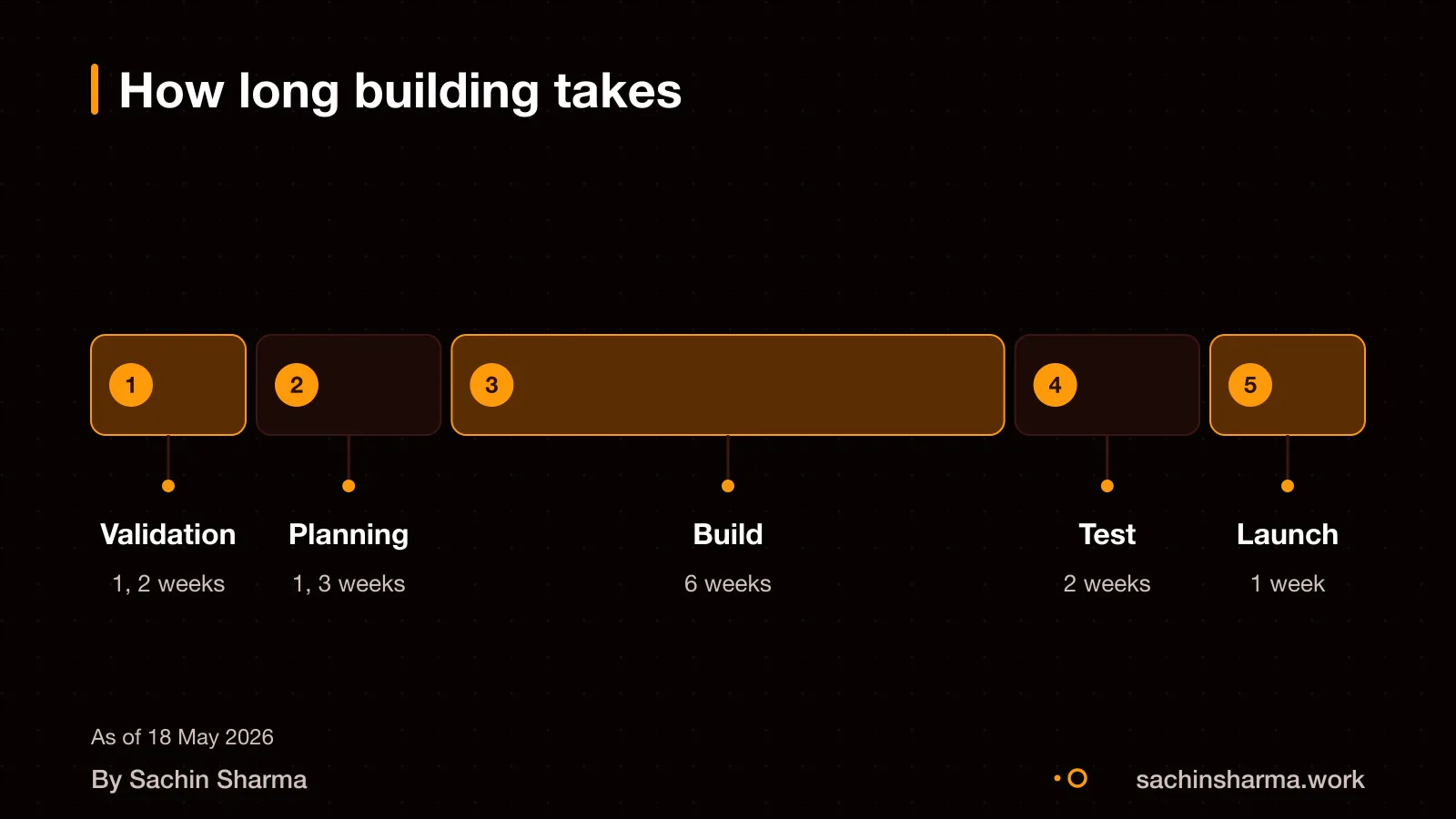
Idea validation takes 1 to 2 weeks and planning takes 1 to 3 weeks, based on typical timelines. Validation (1 to 2 weeks) checks if your clinic’s workflow fits an app and confirms patient needs. Planning (1 to 3 weeks) defines features, screens, and data flow with input from your team. These early phases reduce delays later by catching gaps early.
The build phase duration is not supported by available evidence. Testing duration is not supported by available evidence. Launch duration is not supported by available evidence. Your timeline may vary if you need integrations like lab reports or teleconsultations.
For a similar project, see how long to build a lab booking app.
What third-party fees will I pay?
You pay no monthly platform fee to host the app. Apple may charge a 10% commission on out-of-app payments if your clinic is in the App Store Small Business Program. Google Play has no ongoing fees for app distribution. SMS reminders are not included in the base app and would need a third-party service like Square Appointments. Which charges $149/month for this feature. These costs apply only if you choose to use those services. The app itself does not require any mandatory subscriptions or platform fees from you. Hosting and domain costs, if any, are one-time or minimal and will be shared upfront.
What legal and data rules apply?
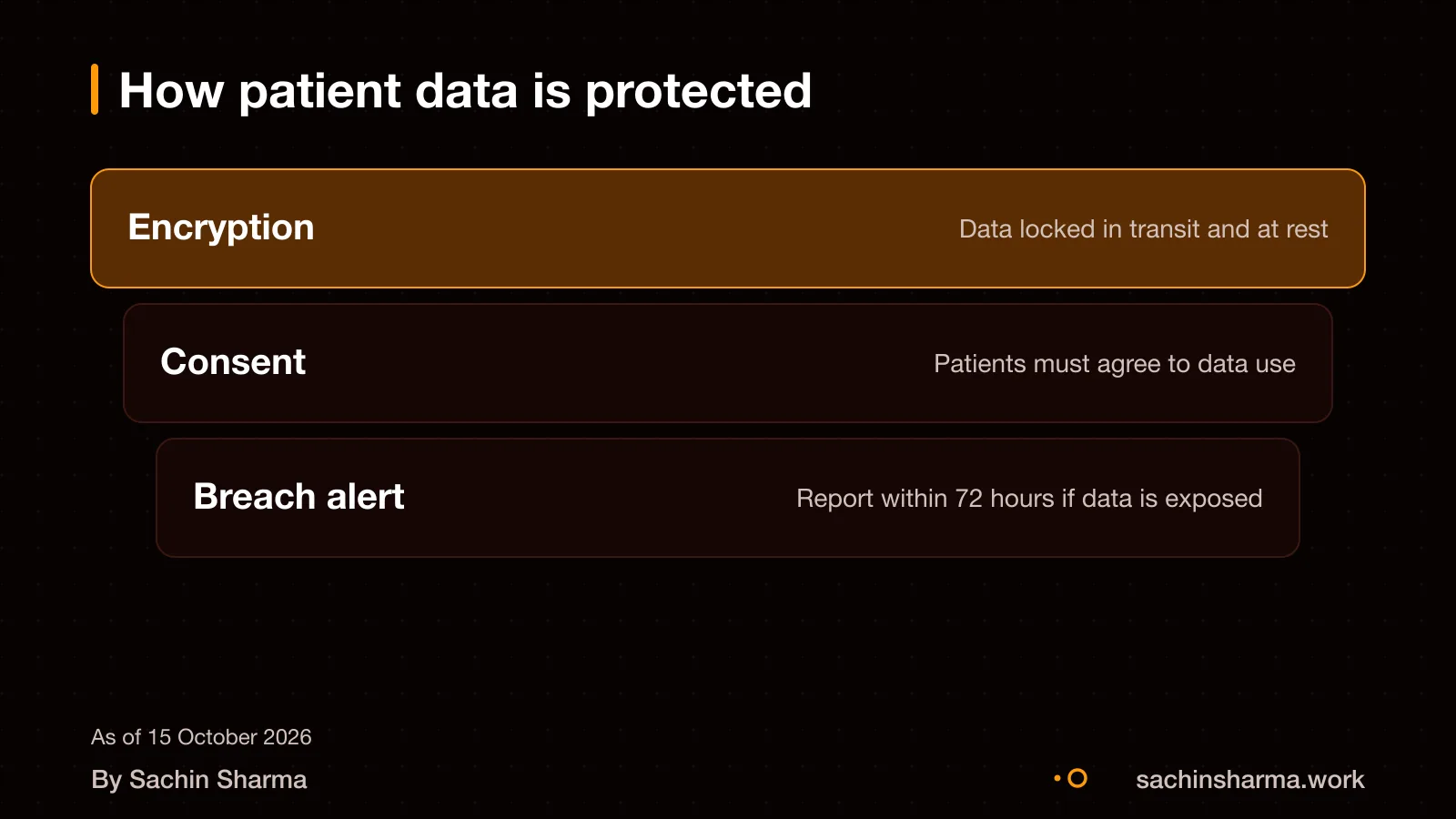
The DPDP Act applies to your clinic booking app because it collects personal and health data from patients. You must get clear consent before collecting or using their data. As the data fiduciary, you must report a breach to the DPBI within 72 hours if one occurs.
Patient data must be protected with strong safeguards like encryption, access controls and secure storage. Data backups and access logs must be retained for at least one year as per reasonable safeguards. Since health data is sensitive, extra care is needed in how it is stored, shared and deleted.
For example, when a patient books an appointment, their name, contact number and reason for visit are collected. You must inform them why each piece of data is needed and how it will be used. You should also let them withdraw consent or request data deletion later.
See how to design proper DPDP Act consent flows for your app.
What are the risks?
If the app fails after launch, you may lose bookings and patient trust. Downtime can happen due to server issues, poor internet, or bugs not caught in testing. Offline support and backup systems can reduce downtime risk, but no evidence confirms this is standard in Sachin's builds. Poor patient adoption is also possible if the app is hard to use or does not solve real problems.
You must also notify affected patients promptly with details of the breach, its impact, and steps they can take. To prevent breaches, I use encryption, access controls, and secure data storage as per India’s data protection rules. Still, no system is fully immune to attacks.
Low usage, technical failures, or data risks are more likely if the clinic staff are not trained. If testing is rushed, or if security steps are skipped. Work with a legal advisor to confirm your compliance plan for health data.
Can I see proof of your work?
However, I have built EHR Copilot, a Next.js tool that turns psychiatric session transcripts into structured SOAP notes. Which shows my ability to work with sensitive health data and clinical workflows. My other public projects include MojoCinema, a movie discovery app, and Daily, a current-affairs quiz app, both built in Flutter with backend support. These showcase my full-stack skills but are not in the healthcare domain. Since no client project in my portfolio is a clinic booking system, you cannot see a direct proof of past work in this exact area.
As for live demos, none of my healthcare-related projects are publicly available for testing. EHR Copilot and other client projects are private or under non-disclosure. You can review public repositories like Daily or MojoCinema on my GitHub, but source code is closed. I do not claim experience in building appointment systems for clinics, and this gap should be considered when evaluating my fit for your project.
Next step: message me on WhatsApp with what you want to build. No forms, no sales team.
Message me on WhatsAppProject Terms: What’s Not Documented
The billing model, whether fixed price, hourly, or milestone-based, is not yet documented. You should confirm this in the contract before starting.
You may own the code after delivery, but this is not confirmed. If full ownership is important, ask for it to be written into the agreement. You can switch developers later if you have the source code and no legal restrictions apply. For how to get your app's source code, see how to get your app's source code.
If you change your mind during development, the process for handling scope changes is not defined. This should be discussed and agreed upon early.
The cost and what is included in ongoing maintenance are not stated. These details must be clarified before project handover.
None of these terms are final until signed in a contract. Always review the agreement carefully and ask questions.
When this advice is wrong
When this advice is wrong A custom app may not suit your clinic if you see fewer than 10 patients a day or work mostly on walk-ins. For simple needs, a shared phone with WhatsApp or a Google Calendar link may be faster and cheaper to run.
Do not build custom software if your team resists digital tools. If your staff still use paper registers and you have no plan to train them, the app will not get used. Start with a digital first step, like a shared device for check-ins.
Avoid adding features you do not need today. A multi-location dashboard or AI chatbot adds cost and time if you run one clinic with steady patients. Build only what solves a clear, daily problem.
If your budget is under ₹3 lakh and you need something fast, an off-the-shelf tool may work better. You can switch to a custom app later when your patient load grows and your workflow is stable.
hire a developer for a clinic booking app only when you are ready to digitise fully. Have clear needs, and want full control over the app.
Next step: start the conversation
Next step: start the conversation Message me on WhatsApp with your clinic’s size, number of doctors, and the tools you use today. I will reply within 24 hours to set up a 15-minute call. We’ll discuss your workflow, what you want to improve, and whether a custom app fits your goals. There is no fee to talk. If we move forward, I’ll send a scope note and next steps.
Assumptions behind the numbers
- Single platform (Android or iOS)
- No legacy system integration
- Client provides content and assets
- One payment gateway
- Standard SMS volume
Work out your own number
Here's how the cost breaks down. Set the weeks, the people and the rate. See where the money goes.
Your working total
₹5,60,00014 weeks × 2 people × 5 days × ₹4,000- Validation14%
- Planning21%
- Build43%
- Test and fix14%
- Launch7%
The weeks shown are an example of a small app, there to be changed. Fees you pay others (store accounts, cloud, SMS) are not in this total.
What moves the price
- Add online payments
A payment gateway adds ₹50,000 to ₹1.5 lakh.
- Add SMS reminders
₹149/month via third-party service.
- Add admin dashboard
A web tool to manage data and users.
- Support iOS and Android
Almost doubles the build effort.
- Start with one platform
Cut the build to half the time.
- Use ready-made tools
For auth, push or storage saves weeks.
Fees that go to someone else
App store fees
One-time and yearly fees to Google and Apple. Check current amounts.
Cloud, SMS, maps, payments
Usage-based, paid by you to providers.
GST (18%)
On the development cost, added to the invoice.
Ask for these before you sign
- How many weeks per phase, and with how many people?
- What is not included?
- Which fees do I pay to others directly?
- What happens to the price when I change my mind?
- What does the first month after launch cost?
Questions people ask
A clinic booking app includes online appointment booking, electronic medical records, digital prescriptions, automated billing, and patient management. It rejects past date or time slots for new appointments. These features help digitise your clinic’s daily operations.
The billing model, whether fixed price, hourly, or milestone-based, is not yet documented. You should confirm the scoping and billing method in your contract before starting. This ensures clarity on cost, timeline, and changes.
The development process is broken into practical stages from idea validation to launch, as described by Deorwine Infotech. At each milestone, you receive clear deliverables such as a project specification, design mockups, working builds, test reports, and the final app ready for deployment.
Ownership of the source code is not confirmed in available records. You must agree on code ownership terms in the contract. Typically, full ownership is transferred after final payment, but this must be stated clearly.
Yes, you can add features after the initial build. However, changes during active development may cost extra. It is better to plan and phase new features separately to avoid delays and budget overruns.
Changing your mind during development increases the risk of cost overruns and timeline delays. Scope changes are possible but must be reviewed and priced separately. Clear agreements help manage such shifts without conflict.
The app uses encryption, access controls, and logs access to protect patient data. These safeguards help prevent data breaches and meet reasonable security standards under Indian law. Check this for your case with a data protection lawyer.
If the app fails after launch, downtime can affect bookings and trust. A maintenance plan is needed but not yet documented. You should agree on support terms, bug fixes, and updates before going live.
Yes, the app can work offline using an offline-first design. This lets users access data and book appointments without internet. However, this feature adds complexity and cost to the project.
I work directly with clients, with no agency markup or layers. This allows faster decisions and lower overhead. However, the exact pricing model is not documented. Confirm this in your contract to avoid surprises.