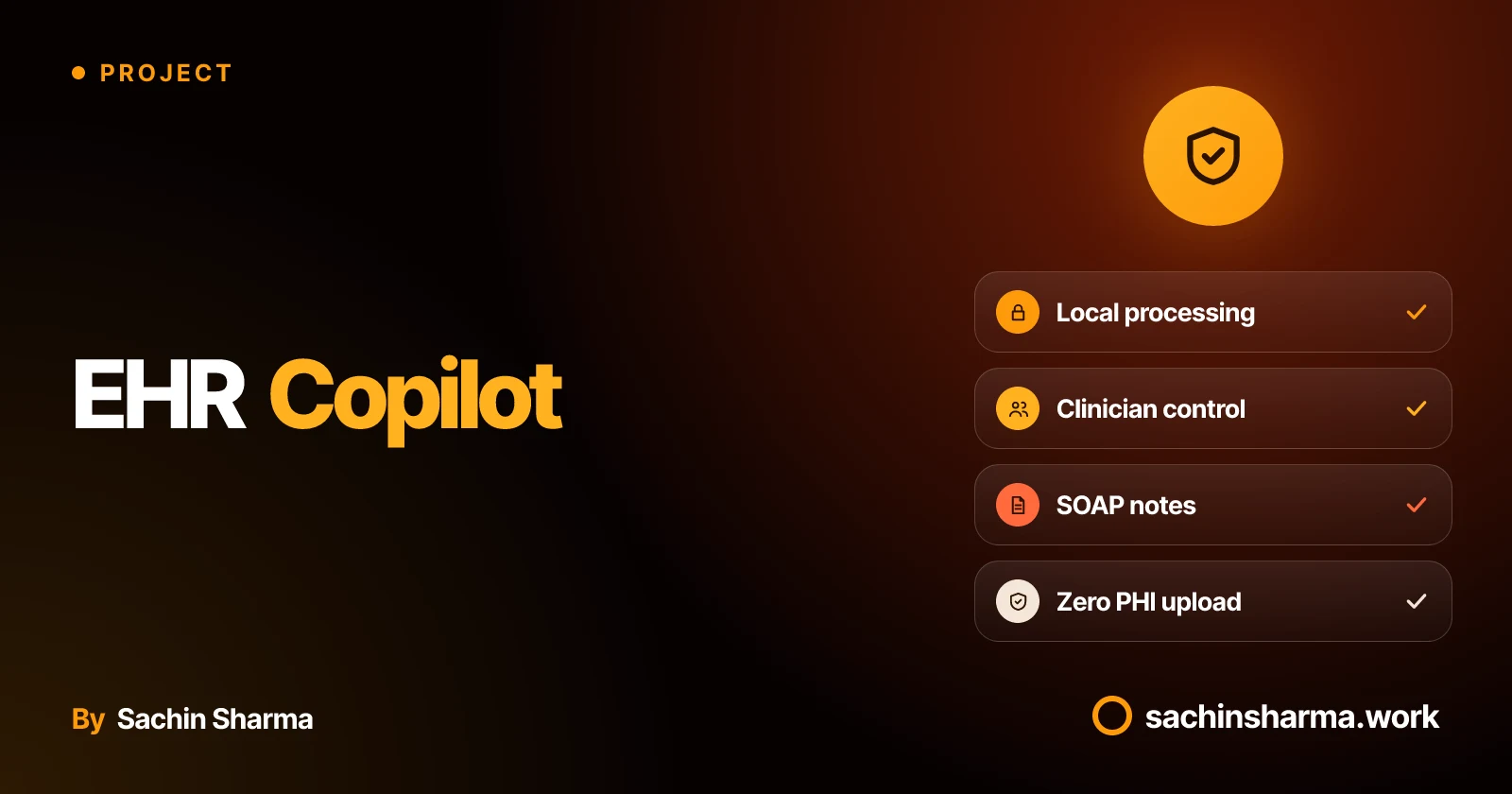
What EHR Copilot is and what it does
Does not process real patient health information (PHI). It helps clinicians by turning messy clinical text into structured SOAP notes, Subjective, Objective, Assessment, and Plan, which are standard in medical records. This saves time and reduces documentation errors. The tool uses a reviewer-first interface, meaning the clinician always checks and approves the output. Sample notes are hand-written with placeholder data to show how redaction and formatting work. The headline demo path uses precomputed fixtures, not live AI processing. For more on local data handling, see how MojoDocs runs tools locally (MojoDocs: 1,100+ tools running locally in WebAssembly).
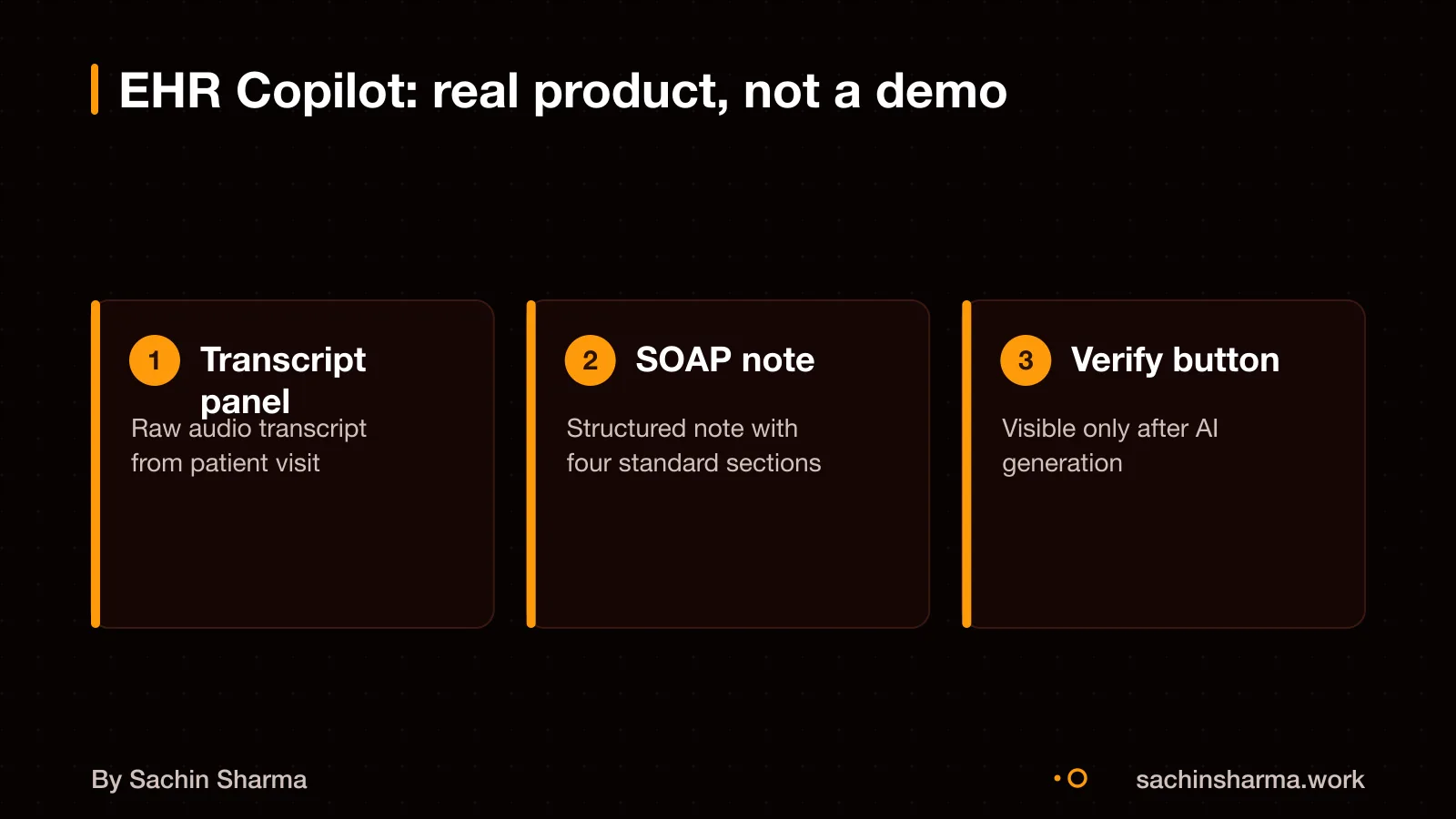
How EHR Copilot creates structured notes from transcripts
EHR Copilot uses a five-stage multi-agent RAG pipeline for clinical question answering over FHIR records. A RAG pipeline is a method where AI checks facts against a knowledge base to stay accurate.
The process starts with raw text from a session transcript. FHIR is a standard for sharing health data between systems.
Yes, EHR Copilot suggests ICD-10 codes for diagnoses. ICD-10 is the global medical coding system used to classify conditions. Each suggestion comes with a confidence indicator so clinicians can judge its strength. You can accept, edit or reject any code.
All outputs go to a verification screen where you can edit every field before signing off. No note is final until you approve it. This human-in-the-loop design ensures control stays with the clinician.
Whether EHR Copilot integrates with existing EHR systems is not known. You should confirm this with your provider. The time taken to generate a note from a transcript is also not published.
How clinicians stay in control of the final note
Clinicians can edit the AI-generated note before it becomes part of the record. You can review and refine it using available tools. This includes checking for accuracy, adding missing details, or removing incorrect ones. Once satisfied, you finalise and sign the note in your electronic health record (EHR) system to make it official.
For example, if the AI mislabels a patient's mood or misses a key symptom, you correct it directly. Signing the note in the EHR confirms your approval, just like with any manually written entry. This process ensures you remain responsible for the content.
How the verification screen reduces risk of errors
It verifies the activity to ensure it can be processed without business errors. Only users with the correct security privileges can see and click the Verify button. This ensures that only authorised staff can proceed with verification.
To verify an activity, you open a policy, click Add Activity, select the activity from the dropdown. This step confirms that all inputs are valid and the action can be completed safely.
The Verify button appears only on configured activities, so it is not shown where not needed. This reduces clutter and ensures verification is used only when required. By catching issues before final processing, the screen helps prevent incorrect or incomplete notes from being saved.
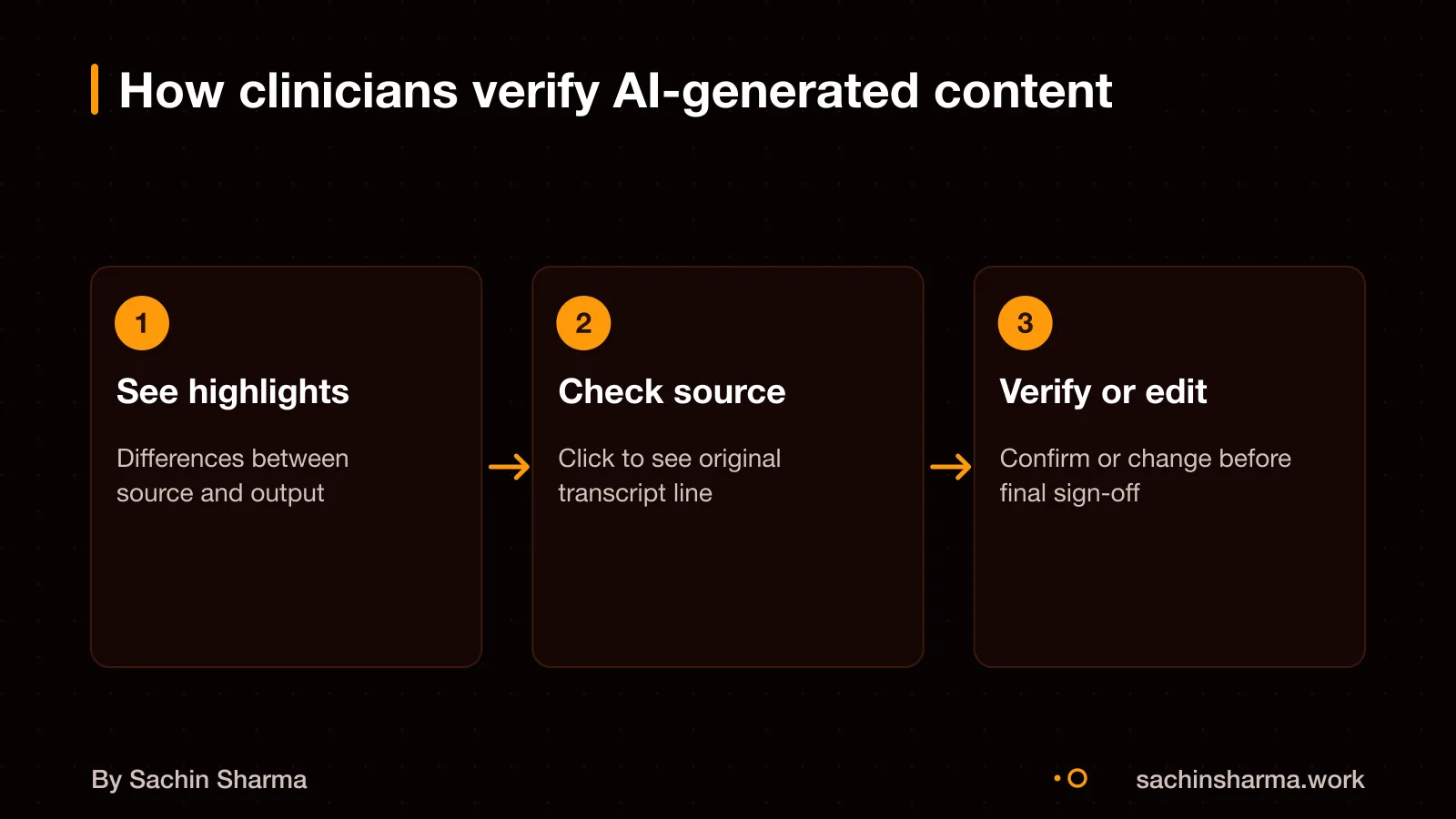
How Indian data laws and patient privacy are handled
It uses synthetic data only, so it cannot be used with actual patient records. The Digital Personal Data Protection Act (DPDPA) 2023 applies to personal data processing. A Data Fiduciary may process personal data for the specified purpose for which the Data Principal has voluntarily provided her personal data. If a Data Principal no longer needs help, the Data Fiduciary must stop processing that data.
The system must protect data with technical and organisational measures. In case of a data breach, the Data Fiduciary must notify the Data Protection Board and each affected person as soon as possible. Since EHR Copilot does not store or process real patient data, these rules apply in principle but not in active use. However, if adapted for real data, these duties would be required.
What happens to session recordings and transcripts after note finalisation is not clear. You should consult a legal expert to confirm compliance for your clinic’s use. For clinic owners considering a build, you can hire a developer for a clinic booking app.
Where data is processed and how long it is kept
Patient data is processed on hospital-controlled infrastructure without leaving the local environment. No protected health information (PHI) leaves the local environment during operation. This keeps control and compliance with privacy laws in the hands of the clinic. Synthetic data is used in the demo, not real patient records. For example, a demo note might use "Patient A" instead of a real name. You can see how local data handling works in practice in how Sameframe finds duplicates without uploading, another project that keeps sensitive data on-device.
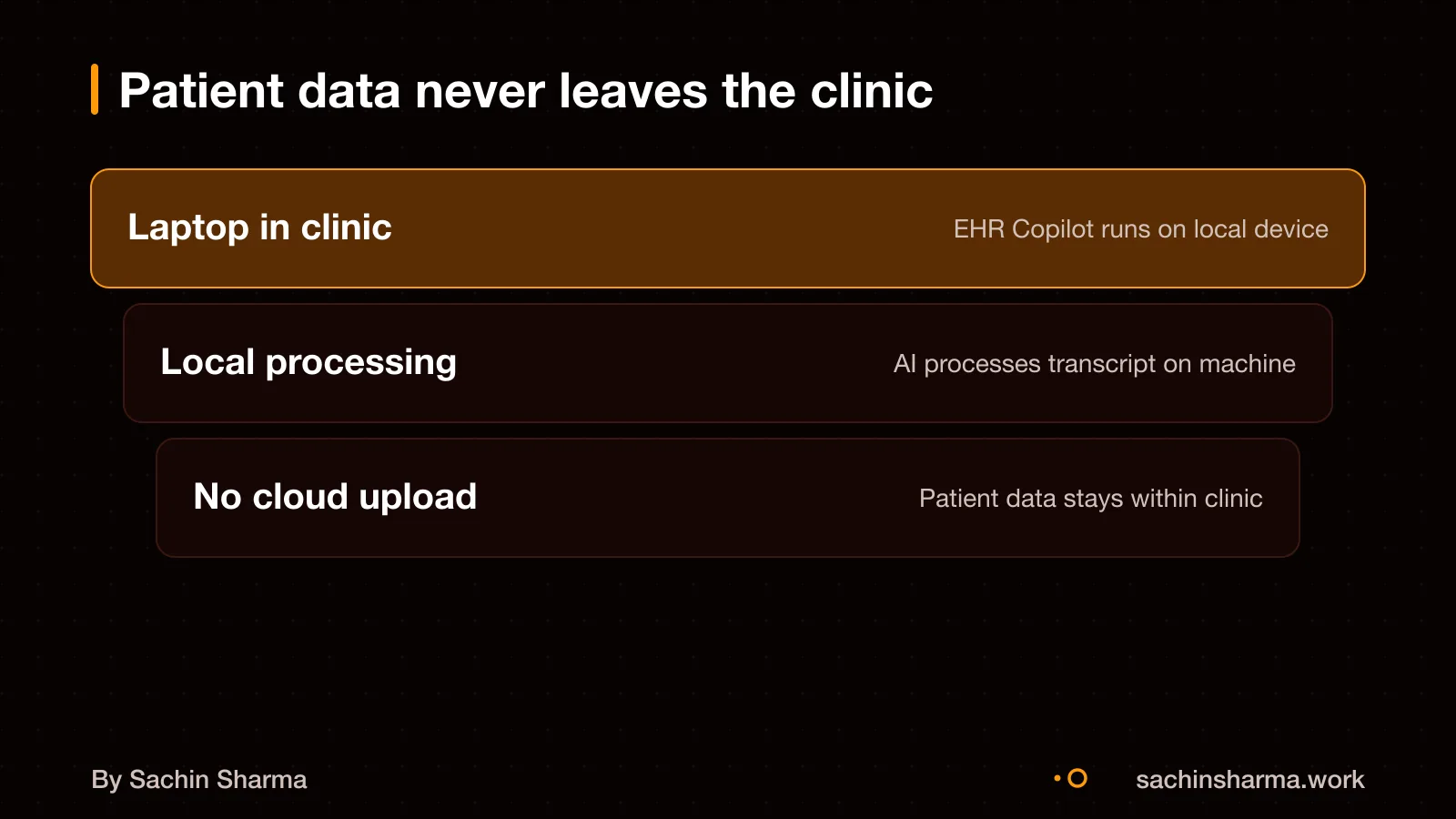
Can the output format be customised to match clinic templates?
DAX Copilot allows custom templates that match a clinic’s documentation style. DAX Copilot provides templates for Allergies and Physical Exam sections. Once created, templates can be set to auto-run or applied on demand, giving clinics control over when automation is used.
For example, a mental health clinic could build a template that always includes a risk-assessment section, while a general practice might use a different layout. The system treats each template as a reusable draft format, not a rigid rule. This keeps clinician input central.
Want this for your clinic? Send one line on WhatsApp. I reply with what you must decide on templates, consent and EHR fit.
Message me on WhatsAppHow the quality of generated notes was tested
EHR Copilot scored an Entity F1 of 0.752 and had an 8.2% hallucination rate. This means it correctly identified and classified clinical entities like symptoms and medications in most cases. It made up incorrect facts in only a small fraction of outputs. The test was run on an internal dataset of synthetic psychiatric session transcripts. Not real patient data was used. EHR Copilot outperformed leading large language models. These include GPT-5, Claude Sonnet 4.5, Gemini 3 Pro, and GLM 4.6. It did so on entity-level clinical question answering. These results show it is more accurate than general-purpose models when handling clinical content. The system also includes research into Multi-Agent Debate (MAD) and cooperative Multi-Agent Reinforcement Learning (MARL). This is to detect and reduce hallucinations. For example, multiple AI agents cross-check each other’s outputs. This happens before a final note is suggested. You can see how rigorous testing was also used in how Loopin handles offline data safely (How Loopin syncs offline data to Google Drive without losing a write).
When EHR Copilot should not be used
- EHR Copilot must not be used to diagnose or recommend treatment. It does not have the capability to make clinical decisions or suggest therapies. Its role is limited to structuring session notes, not guiding care.
- It should not be used without clinician review. The system generates draft notes only; a qualified clinician must review, edit and approve each note before it is final. No evidence confirms it is safe or accurate enough to run unsupervised.
- It is designed for psychiatric sessions and may not work reliably for other specialties. There is no evidence it has been tested in fields like cardiology or paediatrics. Adaptation to other use cases would require fresh validation.
- The limitations of EHR Copilot are not fully documented in available sources. You should assume it can make errors in context, timing or clinical detail. Always verify outputs against the original transcript.
Related reading: how MojoDocs runs tools locally, how Loopin handles offline data safely.
Next step: message me on WhatsApp with what you want to build. No forms, no sales team.
Message me on WhatsAppThe thinking
- 01
Problem
Psychiatric sessions are recorded manually, with notes written later from memory, leading to omissions and delays.
- 02
Decision
Use AI to draft SOAP notes from session transcripts, with mandatory clinician review and local verification before sign-off.
- 03
Why it holds
AI handles the drafting, but the clinician must verify and own the final note. Local processing keeps data safe and meets Indian compliance rules.
What it includes
- SOAP note generation from session transcripts
- Local verification screen for note accuracy
- Audit trail for all note edits and approvals
Questions people ask
EHR Copilot demonstrates a method for turning psychiatric session transcripts into structured SOAP notes. It turns psychiatric session transcripts into structured SOAP notes. EHR Copilot produces draft notes that require clinician review. See how MojoDocs runs tools locally.
EHR Copilot was built for psychiatric notes using specific templates. Share your current documentation flow to start.
A clinical AI tool may take longer due to compliance checks, audit trails, and clinician testing cycles. EHR Copilot requires clinician review of draft notes. Plan for iterative reviews with medical staff.
The time to generate a SOAP note from a transcript is not known from the evidence. The time to generate a SOAP note from a transcript is not known from the evidence. You will need to test it in your environment to get a reliable figure.
The input type for EHR Copilot, whether audio, live transcription, or text, is not specified in the evidence. The input type for EHR Copilot is not specified in the evidence. Your project will need to define this early based on clinician workflow and consent rules.
Integration with existing EHR systems is not confirmed in the evidence. EHR Copilot produces structured notes but how they enter a live EHR is not shown. You will need to plan the connection method, such as API sync or manual entry, for your setup.
The retention policy for recordings and transcripts after note finalisation is not documented. EHR Copilot uses synthetic data only, so real data handling is not tested. You must define storage, access, and deletion rules with your legal team before deployment.
Adaptation of EHR Copilot for other specialties is not documented in the evidence. It was built for psychiatric notes using specific templates. To use it in another field, you would need to rebuild the prompt logic and validation rules for that specialty’s documentation style.
Next.js was used for EHR Copilot to deliver a fast, full-stack web interface. The full stack is not documented, but Next.js supports server-side logic and local deployment. This fits clinics that want control over data and uptime. For local processing, see how Sameframe finds duplicates without uploading.
EHR Copilot produces draft notes that require clinician review. The AI output is treated as a draft, not a final record. If a mistake slips through, the clinician edits it before approval. Specific error handling steps are not documented, so define them with your team.