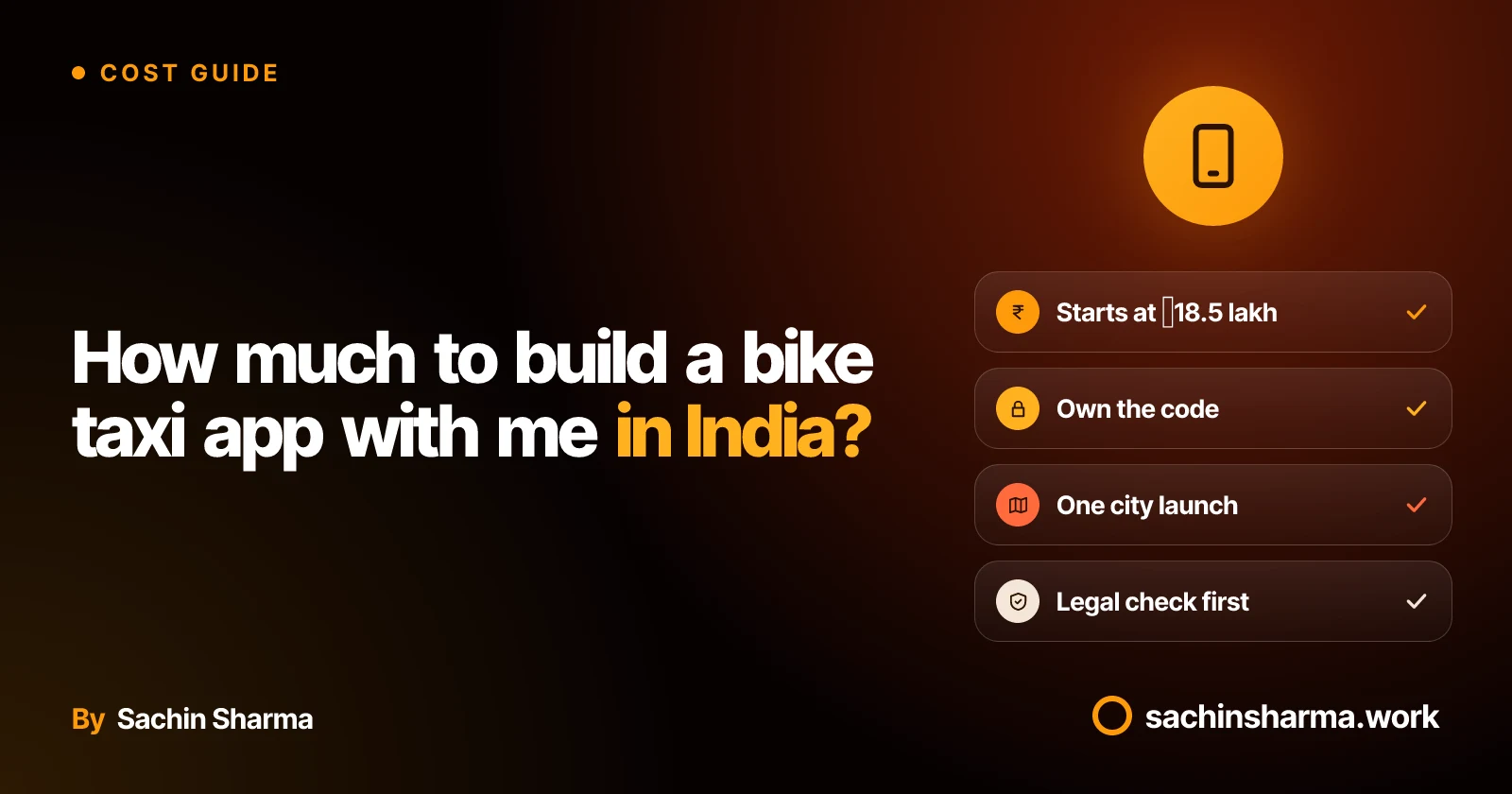
What is a bike taxi app and how is it different?
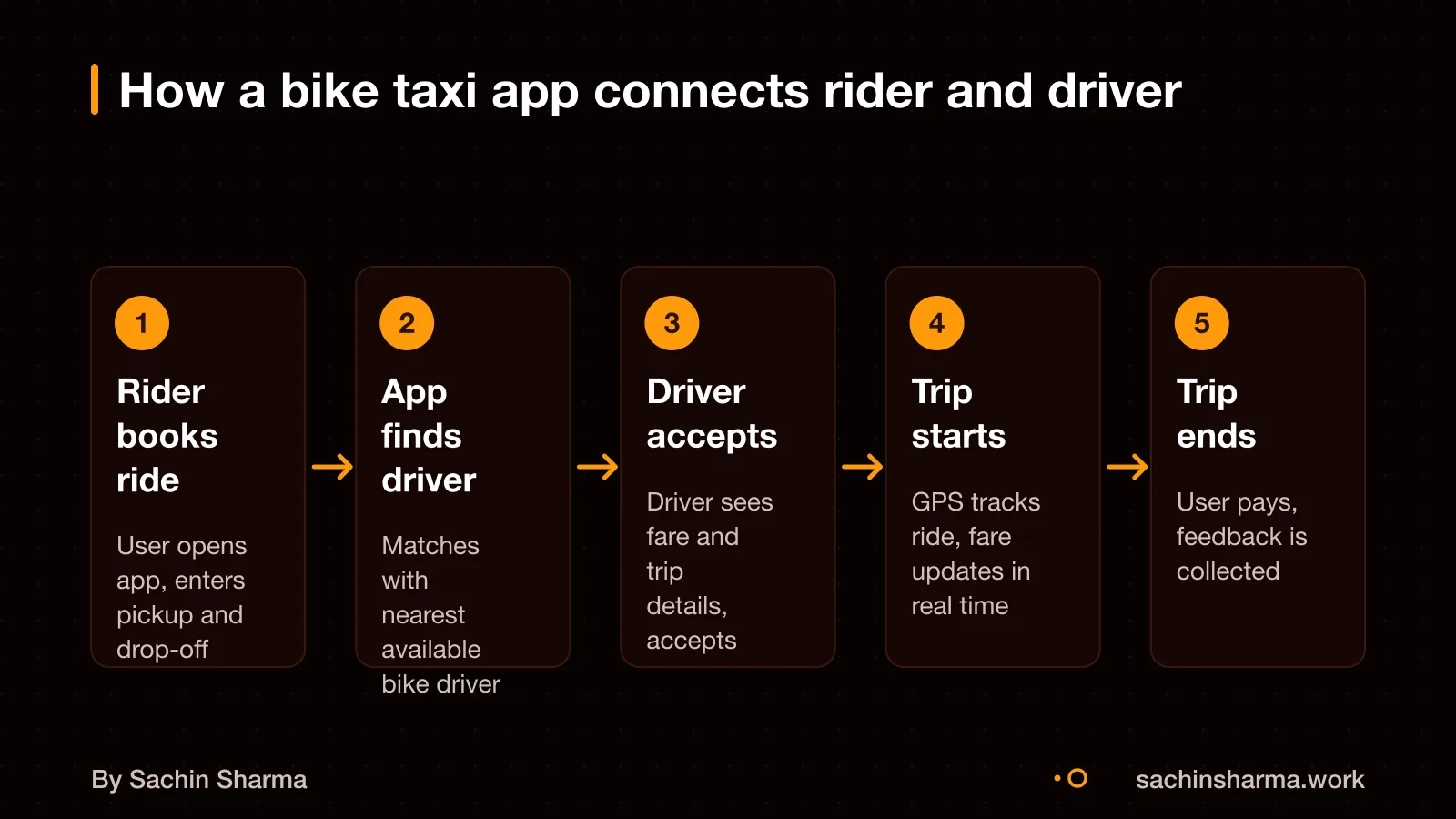
A bike taxi app lets riders book a two-wheeler ride on demand, just like a car taxi app but with motorcycles instead of cars. This makes rides cheaper and faster in heavy traffic. Bikes can move through jams more easily. Most users choose bike taxis for short, quick trips in cities. This is especially true during rush hours. Typical fares are ₹8 to ₹10 per kilometre. Bike taxi is one of the ride categories offered by some ride-hailing platforms. They offer different vehicle types for different needs. The main users are daily commuters. They also include people making urgent trips. They want to save time and money. Unlike car taxis, bike taxis often use standard 100 to 110 cc motorcycles. These make up about 46% of all two-wheeler sales in India.
If you are planning to launch your own service, you will also need to follow rules. You must display a Unique Licence Identification Number (ULIN) in your app. Bikes must show 'Bike-Taxi' stickers if not painted yellow.
How to build a bike taxi app: features, stack and timeline
What makes a bike taxi app more expensive?
The biggest cost drivers are complex features, custom design, platform choice, and third-party integrations like payments and maps. These raise the effort and time needed to build your app.
Advanced features like real-time ride tracking, dynamic pricing, or AI-based safety checks add more cost than basic booking and payment functions. Each extra feature needs testing, maintenance, and user support.
A clean, simple design is cheaper to build and keeps users happy. Fancy layouts, custom animations, or unique branding take more time and skill, which increases cost. You can start with a standard look and upgrade later.
Building for both Android and iOS doubles the work unless you use a cross-platform tool like Flutter, which I use. That cuts time and cost while giving a native feel on both phones.
Integrating third-party services also adds cost. You need a map provider (like Google Maps), a payment gateway (like Razorpay), and SMS or voice OTPs. Setup, API fees, and compliance checks all add up. Some services charge per transaction, which affects long-term cost.
Want a number for your idea? Send one line on WhatsApp. I reply with what drives the cost and what to cut.
Message me on WhatsAppFreelancer, agency or solo developer: which to hire?
A bike taxi app needs agency-level quality, speed and structure, so hire an agency or a solo developer who mimics one. Freelancers suit simple sites, not complex apps. A solo developer works linearly and may create knowledge silos. Agencies use teams to build frontend, backend and QA at once, which speeds up delivery. They also enforce code reviews and long-term design, reducing technical debt.
You can use a freelancer only if you need a basic website or a single feature. But a bike taxi app is a high-performance mobile product with real-time tracking, payments and safety rules, this needs a multidisciplinary team. If your app must sync with legacy systems or third-party tools, agency expertise is non-negotiable.
Hiring a solo developer to save money may increase the costs of management, testing, and future scaling. A solo coder’s work lacks peer review, increasing the risk of structural rot. Long projects suffer when one person holds all knowledge. You must decide: are you building a prototype or a permanent business foundation?
For a live, scalable bike taxi service, an agency’s workflow is safer. I work directly with clients, with no agency layers.
Freelancer or agency for a first app? Pick by situation
Still unsure between freelancer, agency or solo developer? Tell me your budget and timeline and I will say which fits.
Message me on WhatsAppWhat laws apply to bike taxi apps in India?
Yes, it is legal to run a bike taxi service in some states, but not all. The law depends on the state, and permits are required. You cannot operate without a valid commercial transport permit.
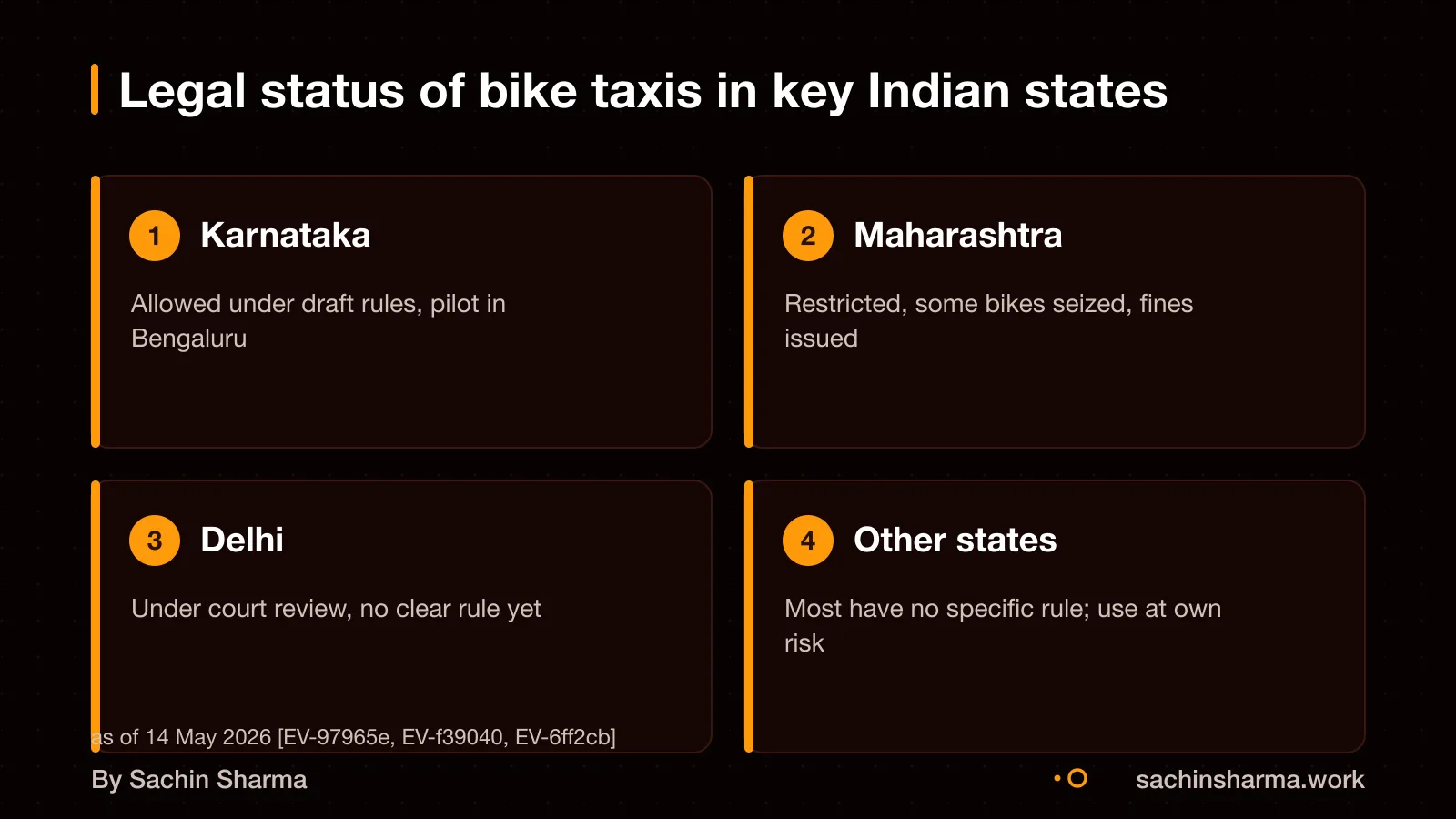
Karnataka allows bike taxis under the Motor Vehicles Act. The high court ruled in January 2026 that two-wheelers cannot be denied contract carriage permits merely because they are motorcycles. Authorities cannot refuse registration or permits when the Motor Vehicles Act allows two-wheelers to operate as contract carriages. The Karnataka government can still set additional conditions for licensing transport aggregators. However, the 2016 state rules for on-demand taxi aggregators apply only to four-wheelers, not bike taxis.
Maharashtra has not yet finalised rules for bike taxis. In 2025, it introduced draft rules for app-based aggregators of cabs and other vehicles, excluding motorcycle services. A new proposal in August 2026 seeks to amend the Maharashtra Bike-Taxi Rules, 2025, which currently apply to ride-hailing aggregators. The draft would apply to trips under 15 km and requires platforms to maintain electric vehicle fleets. It also proposes a 2 percent fare contribution to a driver welfare fund. This proposal is under review by the state’s Law and Judiciary department.
West Bengal was among the first states to recognise bike taxis in 2016, allowing two-wheelers to be registered as contract carriages. Other states may follow different paths. The central government has provided a framework, but states retain regulatory control over operations. This means a permit valid in one state may not work in another.
Operating without a permit is illegal in Karnataka. Before launching, check with your state’s transport department for current rules. Laws are changing, and what is allowed today may change tomorrow.
What safety features are required by law?
You must ensure your app does not flash more than 3 times per second to avoid seizure risks. This is a legal requirement under India’s mobile app accessibility standards. Notifications must also be audible and readable by screen readers for accessibility compliance.
A panic button is not yet mandated by law, but courts are pushing for stronger safety measures. The Delhi High Court has issued notices to Uber, Ola, and Rapido on women’s safety. Is holding private operators accountable for passenger safety mechanisms. This means safety features could become enforceable soon.
You must verify driver documents and ensure the driver and vehicle match app details. The Public Interest Litigation (PIL) before the Delhi High Court demands checks on driver verification and criminal antecedents. Automated alerts for unexplained route deviations are also sought by the PIL.
A dedicated pool of verified female drivers for women riders has been proposed but is not yet law. Time-bound grievance redressal for harassment complaints is also under review. You should monitor compliance reporting requirements, as uniform safety enforcement across platforms in Delhi may be mandated.
For data privacy, see the DPDP Act: consent flows an Indian app actually needs.
Can AI tools like helmet detection help?
Yes, AI tools can detect helmets and child passengers on bikes, and they can reduce false alarms for Sikh riders wearing turbans. These tools are used in real systems like BikeGuard, but they are optional extras, not legal requirements for your app.
AI safety tools use computer vision to check if riders are wearing helmets in real time. They can also detect if a child is riding pillion, using size and shape clues. The system flags unsafe cases, like a child without a helmet or wearing a construction helmet.
BikeGuard avoids false alarms for Sikh riders by using colour analysis to recognise turbans as legal headwear. It checks for real motorcycle helmets by testing shape, colour, and rib patterns, since construction helmets are not safe for bikes.
These tools run on live video and are built for Indian roads. BikeGuard, for example, is a working C++20 app using DirectML for fast AI processing. You can add such features to your app if safety monitoring is a goal, but they are not mandatory for launch.
How does real-time pricing work and is it legal?
You can use real-time pricing, but you must show the fare to the rider before they book. You must follow government-approved fare rules in cities like Pune. Surge pricing is not banned everywhere, but some platforms like Bharat Taxi use a surge-free model to stay fair and predictable. This means you can adjust prices based on demand, but not in a way that feels exploitative to riders.
You must display the estimated fare upfront so riders know the cost before confirming the trip. In Pune, all app-based bike taxi services must follow fare regulations set by the government. If you break these rules, the local transport authority may suspend your service or block your vehicles from operating.
For example, if your app increases fares during rain without approval in a regulated city, it could be seen as violating the rules. The transport commissioner may monitor your platform through a state-run portal for compliance. Always check the latest rules in your city before launching.
Do I own the app and code after it's built?
By default, I, the developer, own the copyright to the code I write, even if you pay for it. Payment alone does not transfer ownership of the source code or intellectual property. To get full ownership, we must sign a written agreement that assigns the copyright and all rights to you. A handshake, invoice marked "paid in full", or trust does not count, only a written assignment works.
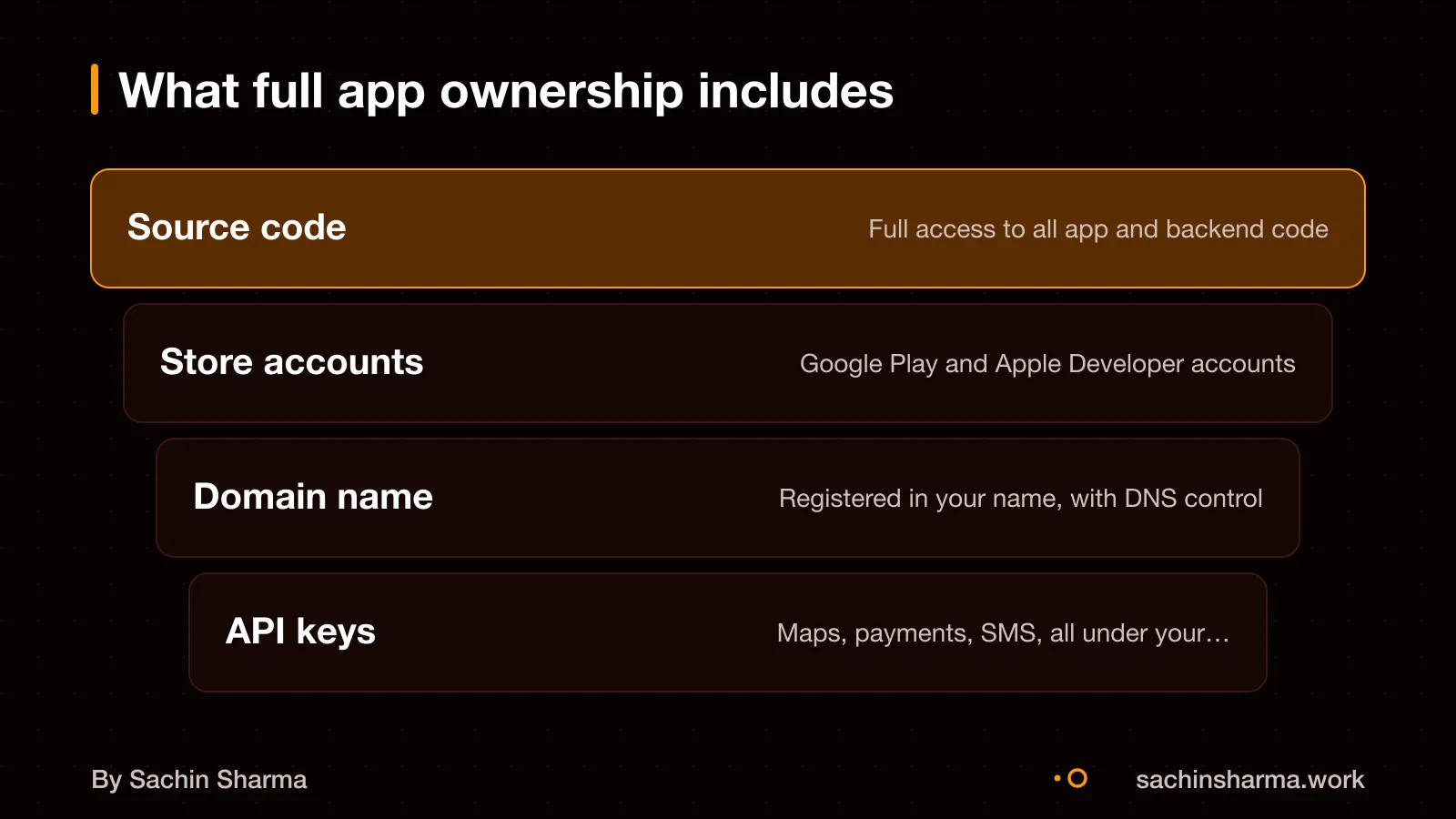
Owning the app means controlling seven key parts: the source code, Google Play and Apple developer accounts. The domain name, backend servers and database, third-party service accounts, API keys, and the copyright itself. You do not need to own all of these from day one, but you must have a clear. Written plan for when and how you will take control. For a business you are betting your livelihood on, you should own your accounts, data, and code from the start.
A real handover includes access to the code repository, not just a one-time zip file, so you can rebuild and re-publish the app. It also includes all passwords, API keys, and a short window where I answer your questions. One major trap is when the developer keeps control of the app store account, which can block updates or transfers later. Note that an iOS app using 'Sign in with Apple' cannot be transferred between Apple Developer accounts at all.
If I hesitate to put ownership terms in writing, that is a warning sign. A developer who plans to hand everything over has no reason to avoid a clear agreement. The real mistake is not deciding early, and only finding out the answer when our relationship breaks down.
When is a bike taxi app not worth it?
Do not build a bike taxi app if your city bans or cracks down on such services. Maharashtra Transport Minister Pratap Sarnaik has called for the immediate shutdown of Ola, Uber and Rapido bike taxis. Even with provisional licences, 14 FIRs were filed in 2026 against platforms for illegal operations. Fines in Maharashtra totalled over ₹11.85 lakh between April 1, 2025, and March 31, 2026.
A legal, functional app needs safety checks, real-time tracking and compliance features that raise costs. A low-budget app may skip these and risk penalties or rider harm.
Do not build if you want quick returns. With high legal risk and slow permit approvals, safer alternatives exist. Consider a white-label app or a partnership with an existing platform. These cut development cost and time. You can test demand without the full risk.
For a full comparison of custom, white-label and platform options, see Build or buy a bike taxi app: custom, white-label or platform?.
Next step: talk to me about your project
Next step: message me on WhatsApp with what you want to build. No forms, no sales team. I will reply within 24 hours. We can then set up a 15-minute call to discuss your idea, check if we’re a fit, and I’ll share what comes next. There is no charge to talk or scope your project. You only pay if we start building.
Related reading: What features does a bike taxi app need? Must-have vs later, DPDP Act: consent flows an Indian app actually needs.
Next step: message me on WhatsApp with what you want to build. No forms, no sales team.
Message me on WhatsAppAssumptions behind the numbers
- Base scope includes rider and driver apps, admin panel, one city.
- Team size: 1 designer, 2 developers, 1 tester.
- Rate used: ₹1,25,000 per week for a senior team.
- No major compliance changes mid-project.
- Third-party tools are used for maps, auth, payments.
Work out your own number
I won't hand you a number that pretends to be the market. Instead, here is the working: set the weeks, the people and the rate, and see where the money goes.
Your working total
₹6,40,00016 weeks × 2 people × 5 days × ₹4,000- Needs and solution design19%
- App and backend build63%
- Testing and fixes13%
- Launch and store approval6%
The weeks shown are an example of a small app, there to be changed. Fees you pay others (store accounts, cloud, SMS) are not in this total.
What moves the price
- More user roles or vehicle types
Each extra role (admin, fleet manager) adds design and logic.
- Real-time tracking or chat
Needs persistent connections and extra testing.
- City-specific rules or fares
Each region adds compliance checks and logic branches.
- One platform first (Android or iOS)
Reduces design, build and testing effort by half.
- Use ready-made maps and auth tools
Pre-built SDKs save weeks over custom solutions.
- Fixed scope with no mid-way changes
Avoids costly revisions and keeps timelines tight.
Fees that go to someone else
Google Play developer account
A one-time fee of $25. Check the current amount.
Apple Developer Program
A yearly fee of $99. Check the current amount.
Maps, SMS, cloud, payments
Usage-based fees billed by providers like Razorpay or Twilio.
Ask for these before you sign
- How many weeks per phase, and with how many people?
- What is not included in your base quote?
- Which fees do I pay to third parties directly?
- What happens to the price if I add features later?
- Do you offer fixed-price contracts or time & materials?
Questions people ask
Yes, I built Aashwasan, a gig and contract management app using Flutter and Firebase. It handles worker onboarding, shift tracking and payout coordination for contract staff. This was a full build from concept to deployment.
You can view Aashwasan, a public gig-economy app I built with Flutter and Firebase. It manages contracts and shifts for freelance workers. I have not built a transport or bike taxi app, so this is the closest example.
Check if bike taxis are legal in your state, whether permits are required, and if local transport authorities or driver unions oppose your service. For example, Rapido was told to stop in Pune for operating without a permit. Confirm with your local transport office before launch.
You could face fines, vehicle seizures, shutdown orders or FIRs. In Maharashtra, over ₹11.85 lakh in fines were collected and 14 FIRs filed in 2026 for illegal bike taxi operations. The Karnataka RTO seized 263 bikes in one operation. Check this for your case with a transport lawyer.
Yes, starting in one city is common and practical. State transport rules still apply, and permits may be city-specific. Legal actions, like in Pune, show local approval matters. Phased rollouts are valid, as terms of use survive company mergers.
Your app will likely need maps (Google or Mapbox), payments (Razorpay or Stripe), hosting (AWS or Firebase) and SMS (Twilio). These add recurring costs. For example, Google Play charges $25 and Apple $99 yearly to publish. Plan for these fees in your budget.
Ask for full code access, test coverage reports, peer review logs and audit trails. You can hire a third party to audit the code. Check that accessibility rules, like no flashing above 3 Hz, and DPDP data consent are built in. Use the /guides/dpdp-act-consent-for-apps guide to verify compliance.