What is a cloud kitchen app?
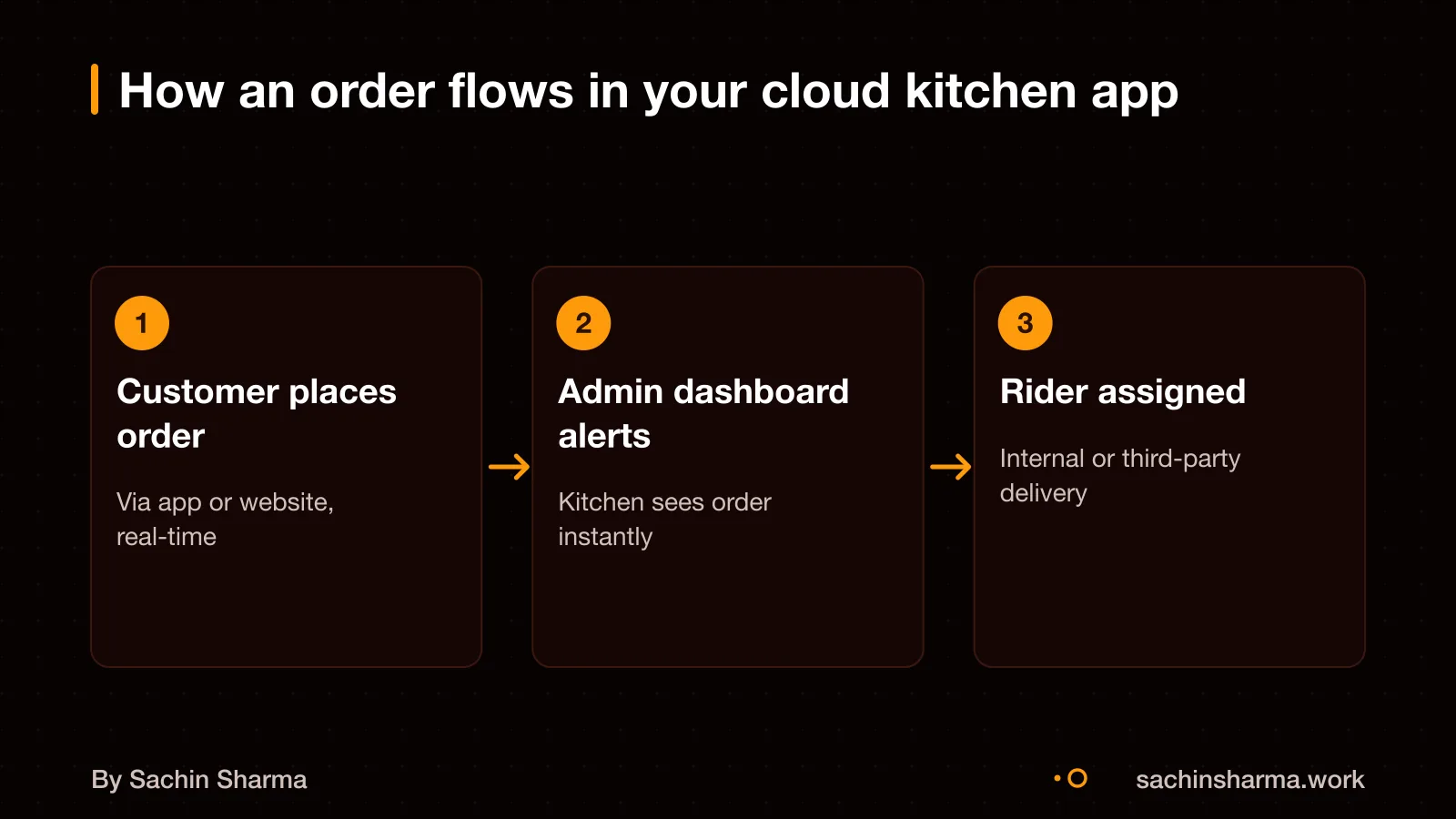
A cloud kitchen app lets your customers order food directly from your brand, not through Swiggy or Zomato. On Swiggy or Zomato, you are one of many restaurants and have little control over how your menu or brand appears. With your own app, you own the customer experience. It handles user registration so customers can save preferences and order again. Core features include a menu browser, cart, checkout, payment processing, and order tracking. It also connects to your kitchen operations through a point of sale (POS) system that pulls in orders from multiple channels. This integration ensures orders from your app, as well as from delivery platforms, reach the kitchen in real time. For example, when a customer places an order, it goes straight to the kitchen display system and triggers preparation.
Why build your own app instead of relying on Swiggy or Zomato?
You pay 18% to 28% of each order to Swiggy or Zomato. Only 0.1% of restaurant orders come through their own apps or websites. That means nearly all orders go through platforms, which take a big cut and leave you with little control.
Owning your app helps you keep more of each sale. You avoid the 18% to 28% commission on every order. Over time, this improves your margins. You also own the customer relationship. You can send updates, offers and reminders directly. This builds loyalty and repeat sales.
Most restaurants get almost no orders from their own channels. That shows how hard it is to break away. But if you want to grow without paying high fees, a custom app is a proven way to start. It puts you in control of costs and customer data.
As the evidence says, restaurants that track their numbers, control costs and build direct relationships stay ahead. A custom app supports all three. It is not just a tool, it is a way to protect your profits.
Build or buy a cloud kitchen app: custom, white-label or platform? helps you decide between a custom app, a white-label product or staying on platforms. Each has trade-offs in cost, control and speed.
What features drive the cost of a cloud kitchen app?
The most expensive features in a cloud kitchen app are AI-powered personalization, real-time order tracking, and multi-platform native support. These require complex code, more testing, and higher maintenance. Simpler features like menu display, cart management, and basic payment flow add less cost and are faster to build.
Platform choice affects price. Building separate native apps for iOS and Android costs more than using a cross-platform tool like Flutter. Flutter lets us write code once and run it on both platforms, cutting time and effort. I use Flutter for most apps, which helps control cost.
App complexity directly drives cost. A minimal version with only core features, menu, order flow, payment, and admin access, is cheaper and faster to launch. You can start simple and add features later, such as loyalty programs or delivery tracking, once you have customers and revenue.
Yes, you can start with a simple version and expand later. As an estimate, this modular approach works if the backend is designed to support new features without rework. Assumption: proper planning at the start allows safe, low-cost additions later.
What features does a cloud kitchen app need? explains which ones to include now and which to delay.
Want a number for your idea? Send one line on WhatsApp. I reply with what drives the cost and what to cut.
Message me on WhatsApp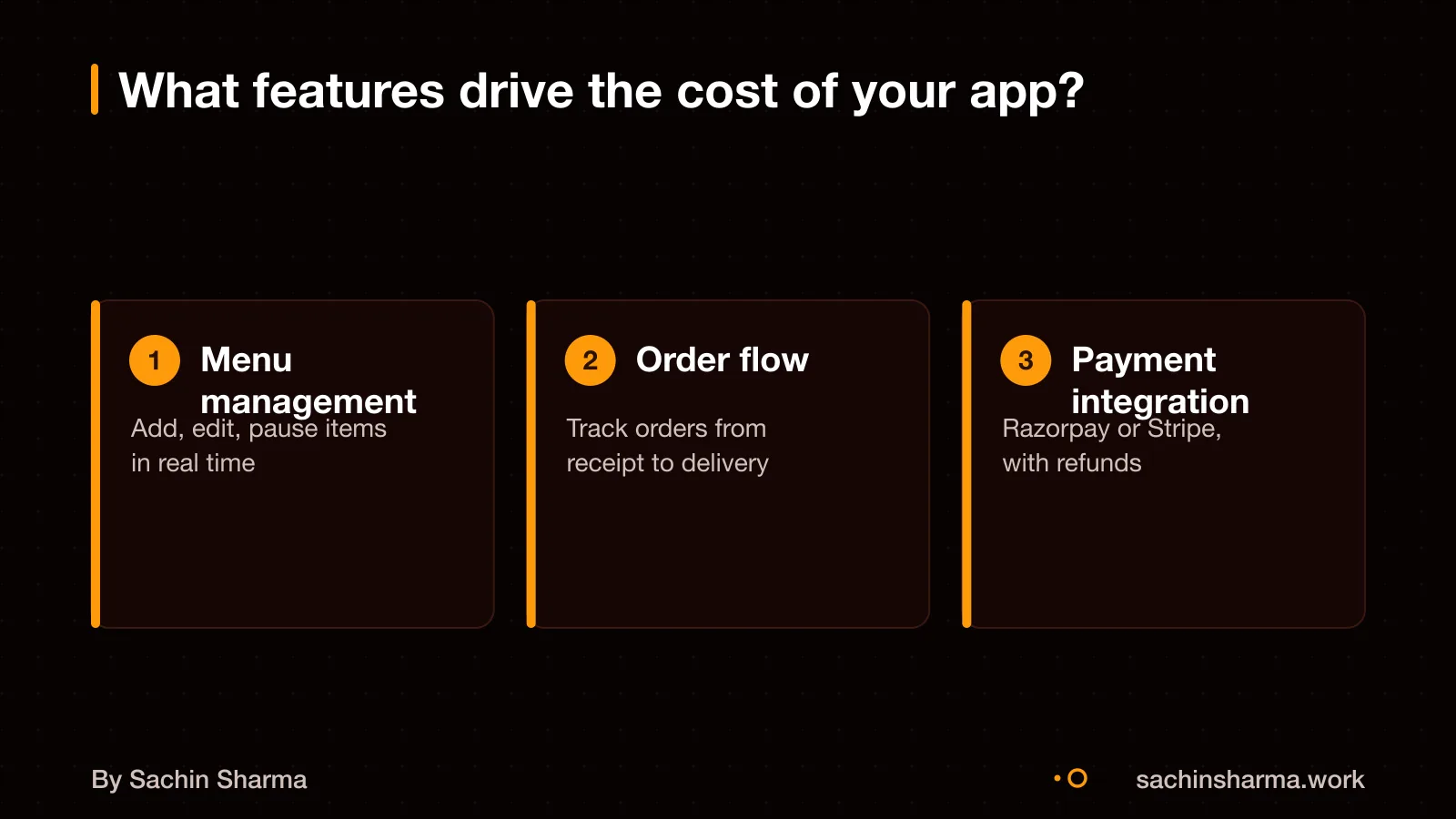
App or website: which is better for your cloud kitchen?
A website is enough for most cloud kitchens to start taking direct orders. You need an app only if you want features like offline access, push notifications or deep personalisation. Websites cost less and are faster to build because they work across devices without extra coding.
A custom mobile app makes sense when you plan to build a strong brand and keep customers coming back without relying on delivery platforms. Apps can store user preferences, send alerts for new dishes and work even with poor internet. But they take longer to build and cost more than a website.
A website is the cheapest way to start. It lets you accept orders, show your menu and collect payments without paying 25% to 30% commissions on Swiggy or Zomato. You can always add an app later.
If you are testing demand or running a single-brand kitchen, begin with a website. Use the savings to fund marketing or improve food quality. Once you have steady orders, consider an app to boost loyalty.
For help choosing the right tech, see the Best tech stack for a cloud kitchen app in India.
Does GST apply to app development? Can I claim input tax credit?
Yes, 18% GST applies to custom software development under SAC code 998311. You can claim input tax credit (ITC) on this cost if your business is GST-registered and the app is used for furtherance of business. This helps reduce your overall tax burden when you file returns.
You must pay the full invoice to the supplier within 180 days from the date of the invoice to keep the ITC. If you do not, the credit you claimed will be added back to your tax liability, along with interest.
ITC is also available if you export the service, for example, if a foreign client pays you in foreign currency for app development. But for domestic purchases like your cloud kitchen app, timely payment is key.
For your specific case, consult a GST practitioner to confirm eligibility and filing rules. Tax rules depend on your registration type, business model and how the app is used.
What are the risks of building a cloud kitchen app?
The high commission paid to the app can impact the restaurant’s profits. To reduce this risk, work only with developers who sign an agreement that includes code handover and use a trusted escrow for source code access.
Tech failures can impact operations. Servers can crash, payment gateways can fail, and apps can freeze during peak hours. Choose a developer who tests under real load and has a rollback plan.
The restaurant has limited control over how its brand looks on the app, which can impact its image. Start with a clear reason why customers should use your app, like exclusive deals or faster delivery.
Have a quote in hand? Send it to me and I will mark what is missing.
Message me on WhatsAppWhat legal and compliance rules apply to a cloud kitchen app?
FSSAI license fees in India range from ₹100 to ₹7,500 per year based on business size and category. You must renew it at least 30 days before expiry to avoid penalties. Without a valid license, you cannot legally operate or list your food business.
The DPDP Act requires you to get clear consent before collecting customer data like phone numbers, addresses or order history. You must explain what data you collect and why. For example, if you save a customer’s address for faster checkout, you must state that at the time of input. Link to DPDP Act: consent flows an Indian app actually needs for how to design compliant flows.
Cybersecurity rules focus on protecting customer data and keeping systems available. Under India’s National Cyber Security Policy, you must preserve the confidentiality of information. This means storing customer data securely, using encryption, and not exposing databases. Even if your app is small, a breach can damage trust and lead to legal action. Start with basics: encrypt stored data, use secure APIs, and avoid saving unnecessary details.
Is it worth it for a small business?
For a small cloud kitchen in India, building your own app can improve margins. But only if you get enough direct orders to cover the cost. You need to break even on ₹3 to ₹18 lakh in development cost, but the exact number of orders required is not known. This depends on your average order value, delivery cost and how much you save by avoiding Swiggy or Zomato’s 18% to 28% commission.
Margin gains come from keeping that commission. For example, if you get 100 orders a day at ₹300 each. Swiggy takes 25%, that is ₹7,500 a day or ₹2.25 lakh a month. Over a year, that is ₹27 lakh. If your app costs ₹6 lakh, you could break even in under six months, but only if the app brings in enough direct orders.
Can small kitchens afford it? As an estimate, assuming a focused app with core features like menu, cart, and payment, the cost starts at ₹3 lakh. Smaller kitchens may prefer a website first, which is cheaper and faster to build. You can add an app later when direct orders grow.
The cost of app maintenance after launch is not known, and the average monthly maintenance cost is not known. You should ask your developer for a support plan. The break-even number of direct orders is not known, track your own data once live.
When should you not build a cloud kitchen app?
When should you not build a cloud kitchen app?
A third-party platform is enough if your monthly order volume is below 200 and your team is not ready to handle delivery logistics. Swiggy and Zomato bring reach and trust; use them while you test your menu and location.
A website suffices if you only need online orders and updates. Most customers order through mobile browsers anyway. Add WhatsApp ordering and a simple admin panel first.
You should wait if your kitchen is not yet profitable or if you lack staff to manage app support and delivery tracking. Build the app only when direct orders can save you more than ₹15,000 a month in platform fees.
How do you start working with me to build your app?
How do you start working with me to build your app? To get a quote, send a one-line idea of what you want to build. As an estimate, this is enough to start a conversation about scope and budget fit. I will ask about your kitchen, your goals and what features matter most.
You can contact me directly with no forms or sales team. I work one-on-one with clients, so your message reaches me.
Next step: message me on WhatsApp with what you want to build. No forms, no sales team.
Message me on WhatsAppAssumptions behind the numbers
- Assumed one developer at ₹3,000/day.
- Assumed 5 working days per week.
- Assumed no scope changes or added features.
Work out your own number
Here is a sample cost breakdown based on a worked example. This is not a quote, but one way to think about effort and cost.
Your working total
₹10,40,00026 weeks × 2 people × 5 days × ₹4,000- Discovery15%
- Design23%
- Development46%
- Testing15%
The weeks shown are an example of a small app, there to be changed. Fees you pay others (store accounts, cloud, SMS) are not in this total.
What moves the price
- Adding user roles
Each extra role like admin or rider adds effort.
- Real-time features
Live tracking or chat needs more design and testing.
- Multiple integrations
Each payment, SMS or ERP link is extra work.
- One platform first
Starting with Android or iOS alone cuts time.
- Using ready-made tools
Managed backends reduce weeks of setup.
- Clear scope upfront
Avoiding changes mid-way keeps cost stable.
Fees that go to someone else
App store fees
Google Play and Apple charge separately. Check their current rates.
Cloud, SMS, maps, payments
Usage-based fees billed by providers like Razorpay or Twilio.
Ask for these before you sign
- How many weeks per phase, and with how many people?
- What is not included?
- Which fees do I pay to others directly?
- What happens to the price when I change my mind?
- What does the first month after launch cost?
Questions people ask
A cloud kitchen app includes a menu browser, cart and checkout, order history, and an admin panel to manage items and orders. Push notifications and offline access are possible with a mobile app. For full feature planning, see what features a cloud kitchen app needs.
Work is scoped by feature and delivered in fixed milestones, with pricing set per milestone. This avoids open-ended costs and keeps progress clear. Each milestone includes design, development, and testing of a specific set of features.
At design, you get wireframes and a clickable prototype. At development, you get a working build with core features. At testing, you get a bug-free version ready for launch. You review and approve each stage before we move on.
Customer data is protected with encryption in transit and at rest, regular security audits, and compliance with India's DPDP Act. The National Cyber Security Policy also mandates best practices for data integrity and availability.
Yes, integration with Dunzo or Porter is possible if they offer public APIs. It adds development time and cost. You must confirm API access and terms with the partner directly before we begin.
Yes, one app can manage multiple brands, as I did for a family-run conglomerate with five brands and eight outlets. This increases backend complexity and cost, but lets you run promotions and track performance per brand.
You must own the source code and have it transferred in writing. I include code ownership and handover in every contract. For extra safety, use a trusted escrow to hold the code until final payment.