What is a meat and fish delivery app?
A meat and fish delivery app sells fresh, chilled or frozen meat and seafood directly to customers. It differs from a regular food delivery app because it deals with *Meat Food Products*. Defined by FSSAI as any food prepared from meat by drying, curing, smoking or freezing. These apps typically offer chicken, mutton, fish and seafood, often cut to order and packed hygienically.
Freshness and hygiene are more critical because meat and fish spoil quickly. Unlike packaged groceries, they need a full cold chain, from source to storage to delivery, and fast turnaround times. Apps like Licious and Good to Go build trust by sourcing directly from farms and coasts, ensuring traceability and quality.
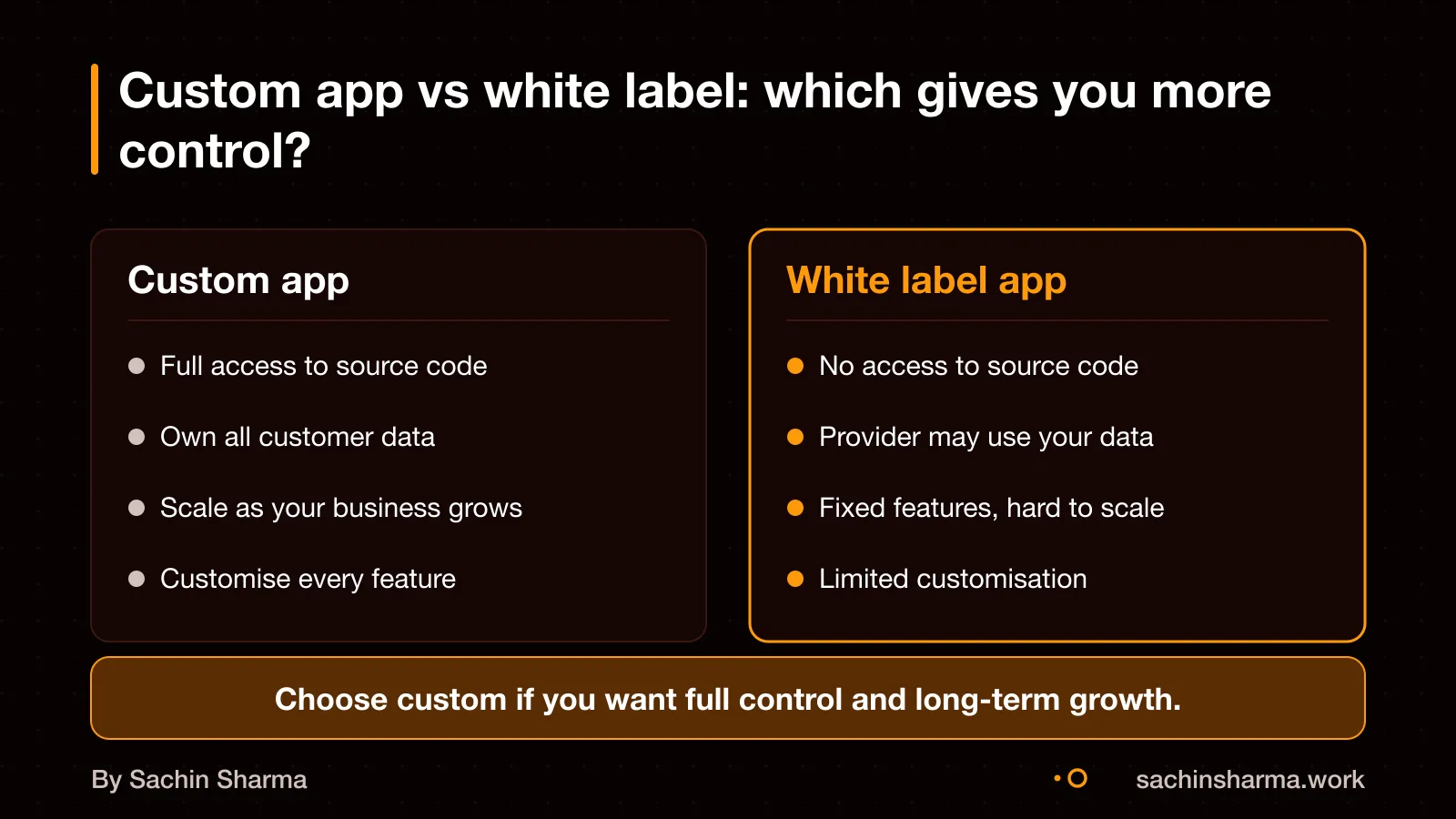
Such apps must support features like cut selection, weight-based pricing, and delivery slots within hours. A regular food app may not need this urgency or handling rules. For a full list of features, see Must-have features for a meat and fish delivery app.
Custom app vs white label: which is right for you?
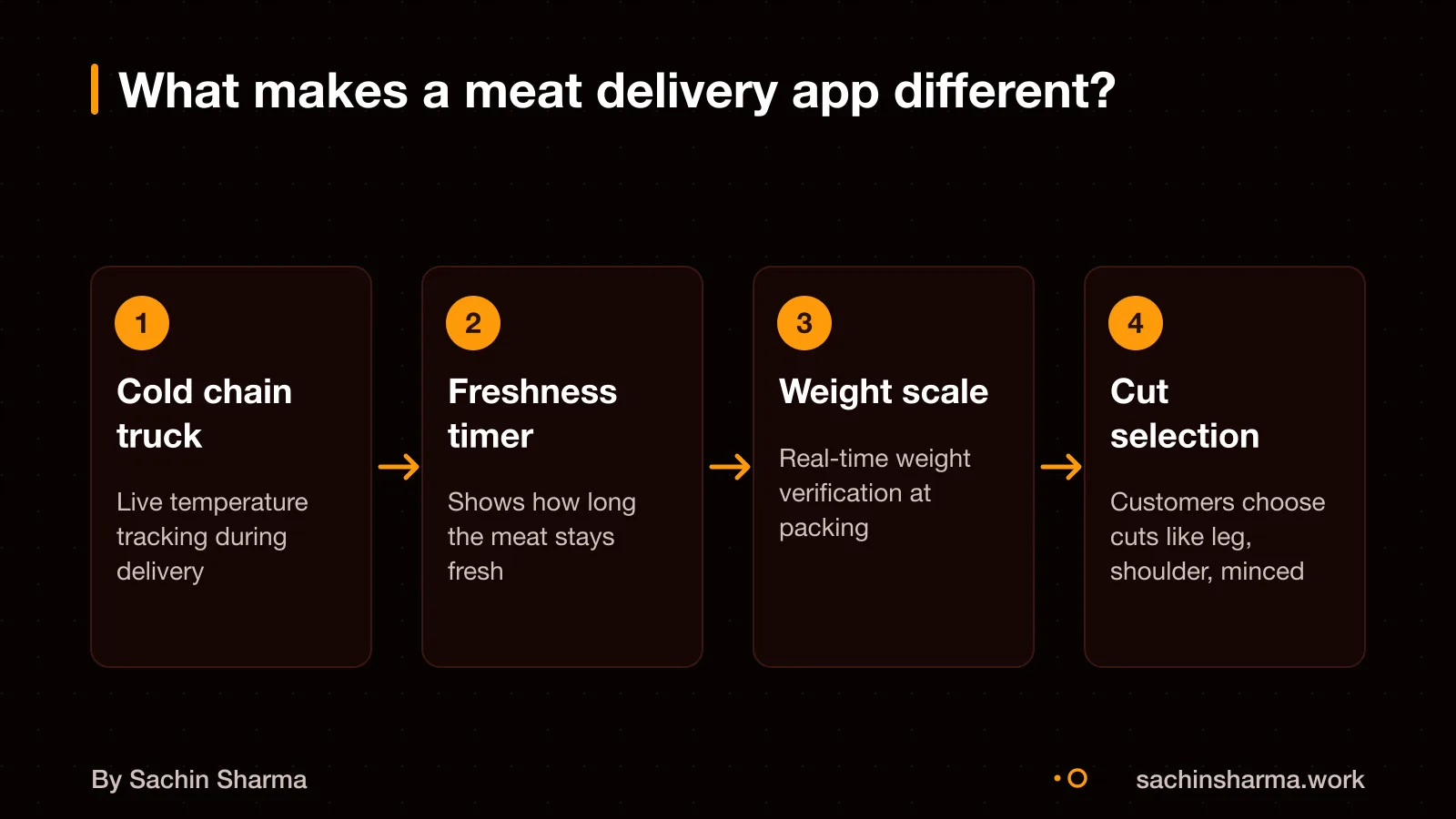
A white label app is a pre-built platform you rebrand with your logo and colours, but you lose control over core features and data. You can change the look, but not the workflow, payment setup or security rules. For example, Zomato Whitelabel lets you launch fast, but you cannot add custom freshness timers or cut-specific pricing logic.
With a custom app, you own the code and control every detail: the user flow, payment gateways, data storage and security setup. You can enforce FSSAI compliance logs, build cold-chain tracking, or tie in your own inventory system. This matters if you plan to scale, protect customer data, or offer unique services like live cut selection.
Choose white label if you are a small shop testing demand and want to go live in weeks, not months. Choose custom development if you need full control, long-term scalability, or want to own your customer data and app logic.
For a full breakdown of trade-offs, see Build or buy a meat and fish delivery app: custom, white-label or platform?.
Why meat and fish apps cost more than grocery apps
A meat and fish delivery app costs more than a grocery app because it needs custom features like cut selection, weight-based pricing and freshness tracking. These require complex backend logic, real-time updates and compliance checks. For example, letting customers choose between boneless and bone-in cuts means the app must show different prices, prep steps and delivery timelines. Weight-based pricing needs the app to calculate cost per gram or kilo, sync with digital scales in the shop and update the cart instantly. This is harder than fixed-price grocery items. Cold chain tracking adds more complexity. You must log temperature at prep, dispatch and delivery to meet food safety rules. The app may need to alert staff if a freezer fails or a delivery is delayed. These features increase development time and testing. Advanced features like cut selection and freshness timers require more screens, database fields and validation rules. As of 2026, cloud hosting alone can cost $100 to $800 per month depending on order volume. The exact cost to add each feature is not known.
Base price for a minimum viable app
This includes a customer app, a vendor panel, and basic order tracking. As an estimate, this cost assumes a simple feature set built with Flutter for both Android and iOS. You can launch with just these features if your operation is small and you use WhatsApp for customer updates. The app lets you take orders, manage inventory, and assign deliveries, but does not include advanced tools like cut selection, weight-based pricing, or freshness timers. These add to the cost and can be added later. The cost of a minimum viable app in India ranges from ₹3 lakh to ₹15 lakh.
Want a number for your idea? Send one line on WhatsApp. I reply with what drives the cost and what to cut.
Message me on WhatsAppHow long to build and launch
A basic meat and fish delivery app takes 2 to 4 months to build. A mid-range app with more features takes 4 to 7 months. The timeline depends on how many cuts you offer, whether you need weight-based pricing, and if freshness timers are built in. For example, a shop selling 10 cuts of chicken and mutton with variable weights will take longer than one selling pre-packed boxes. If you already have a product catalogue and images, the work can start faster. Custom features like live delivery tracking or integration with cold-chain partners add time. The fastest builds are for vendors who finalise all menu options and workflows before coding starts.
How the work runs: from idea to launch
The work runs in six phases: requirement analysis, design, development, testing, launch, and post-launch support. We start with a clear review of your business needs and customer flow. This shapes the app’s design and features.
We meet once a week to review progress and decide on next steps. Meetings are short and focused on decisions, not updates. You see working builds every two weeks.
Changes are handled in two ways. Small tweaks, like text or layout fixes, are made during development at no extra cost. Big changes, like adding a new feature after approval, are treated as a separate scope with a new estimate.
Design comes before coding. You approve the app’s look and flow before we build it. Testing happens in the final two weeks, using real devices and sample orders. After launch, I provide basic monitoring and support to fix any early issues.
For a full walkthrough of each step, see the Step-by-step guide to building a meat and fish delivery app.
How you are billed and what you get
I charge a fixed price per scope, not by the hour. This means you know the total cost upfront, and there are no surprise invoices. A fixed price contract is best when your requirements are stable. Though it may cost 15 to 25% more than a time-and-material deal for the same work.
You pay in milestones, tied to clear deliverables. At the start, we agree on a scope and a timeline. Then, payments are due when each major phase is complete. These phases include: a finalised specification document, approved design mockups, a test-ready build, and the final launch version.
Each milestone gives you something real to review. For example, after the design phase, you get mockups showing how the app will look and work. After development, you get a test build to try on your phone. You must approve each stage before we move on.
This model protects both of us. You only pay for work that matches what we agreed. I get fair payment for completed work. It keeps the project on track and avoids scope creep.
Next step: message me on WhatsApp with what you want to build. No forms, no sales team.
Message me on WhatsApp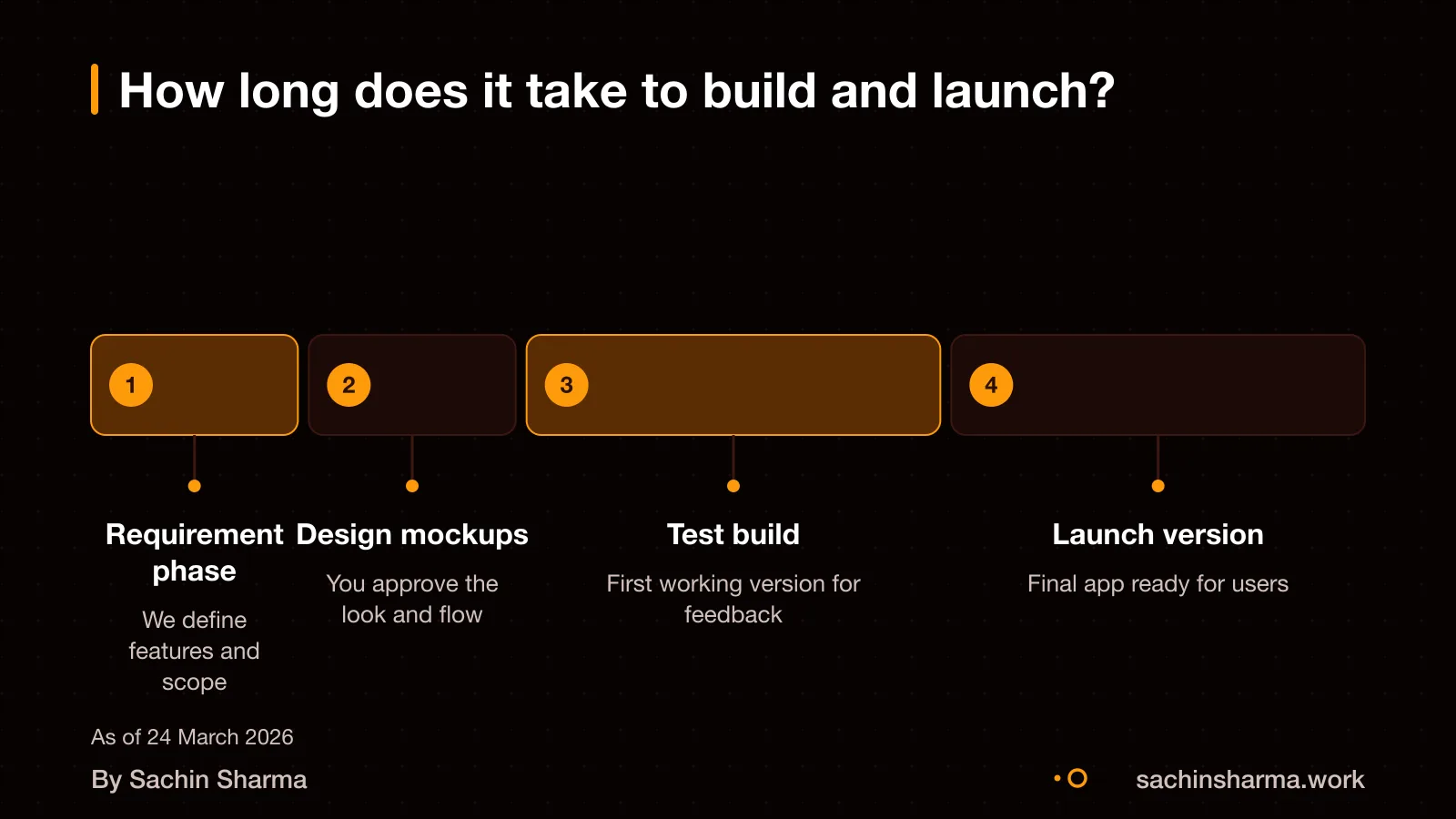
FSSAI and legal rules for meat and fish
Yes, you need an FSSAI license to run a meat and fish delivery app. This applies to all food businesses in India, including online delivery of fresh and frozen meat products. Without it, you risk penalties and shutdown.
You likely need an FSSAI State License if your annual turnover is between ₹12 lakh and ₹20 crore. This is the most common license for medium-sized meat and fish sellers operating in one state.
Fees depend on your production type. If you process more than 150 tons of meat per year, the fee is ₹5,000 (Category A). If you produce meat exclusively from poultry and/or pig meat, the fee is ₹1,000 (Category C).
Selling sub-standard or unsafe meat can lead to a fine of up to ₹5 lakh. This includes expired, contaminated or mislabelled products. The amount depends on the severity and harm caused.
These fees are as of 2009 and may have changed. The rules are complex and depend on your location, scale and sourcing. For your exact case, consult a legal professional or visit fssai.gov.in.
Who owns the app after it is built?
You own the code once I sign a written assignment clause. By default, under Indian copyright law, the developer who writes the code is its first owner. Paying the invoice lets you use the app but does not transfer ownership of the source code or intellectual property. To truly own the code, your agreement must include a written clause signed by me. As required under Section 19 of the Copyright Act, 1957.
I include this clause in every project. On full payment, all source code, copyright and IP in the app transfer to you, worldwide and in perpetuity. This means you can update, rebrand or move the app to another developer at any time. You also control the app store accounts, I set them up under your business name so you retain full access. If you ever want to switch developers, you can hand over the code and continue without legal or technical blocks.
Support and maintenance after launch
Yes, support is included after launch. You also get help with small improvements based on customer feedback. This keeps your app stable and secure as Android and iOS change over time.
Annual maintenance costs 15 to 20% of the build cost. For a ₹8 lakh app, that is ₹1.2 lakh to ₹1.6 lakh per year. For a ₹25 lakh app, it is ₹3.75 lakh to ₹5 lakh per year. This budget covers hosting, routine updates, and minor feature tweaks.
As an estimate, this assumes you will need regular security updates and two to three small feature changes per year. It does not include major new features like adding live tracking or loyalty programs, which are scoped and priced separately.
The exact scope of support is defined in your contract. Some clients choose monthly check-ins, while others prefer on-demand support. You decide the level that fits your business.
Is this for small shops or big brands?
A custom meat and fish delivery app suits businesses with high order volume and unique needs, not small shops on a tight budget. Small shops can afford a white label app, which launches in 2 to 6 weeks. These are ideal if you want to go live fast with standard features and no large development cost. Delivered a multi-tenant platform for a family-run conglomerate (5 brands, 8 outlets), reported at ₹150 Cr+ revenue.
If your monthly orders are under 500, WhatsApp with Google Sheets may be enough. It cuts costs and works well when orders are few and communication is direct. But when order volume grows, manual tracking becomes slow and error-prone. A custom app justifies its cost only when you need automation, real-time inventory, or branded customer experience.
White label apps are a practical start. You get an iOS and Android app in as little as 3 weeks. You can rebrand it and accept orders fast. But you cannot change core features like delivery logic or payment splits. For small shops testing demand, this is smart. For growing brands, it becomes a limit.
White label options for tight budgets let you start small and shift to custom later. The move makes sense when customer retention, delivery speed or menu complexity needs more than the template allows.
When this advice is wrong
When this advice is wrong
You should not build a custom app if you are testing demand with fewer than 10 orders per day. A white label app may be better for startups or small businesses with standard needs and tighter budgets. These platforms let you go live quickly for ₹3 to 5 lakh and handle basic delivery workflows.
Stick to WhatsApp if your order volume is low and your process fits in messages and spreadsheets. Many small meat shops start this way to validate customer interest without upfront tech costs. Custom apps make sense only when manual tracking slows you down.
A white label solution is also a better fit if you do not need unique features like cut selection, weight-based pricing, or cold-chain tracking. You trade control for speed and lower cost, but you cannot change core workflows or access raw data easily.
Assumptions behind the numbers
- Each feature adds 1.5 to 3 weeks; base features are pre-selected
- Total weeks convert to cost at ₹4,000 per week
- GST at 18% is applied on top of development cost
- Flutter cross-platform tech stack is used
- India-based team handles the build
- 4-month timeline for MVP with all toggles off
Build your own number
A meat and fish delivery app is not one app. It is a customer app, a vendor panel, delivery tracking and cold storage alerts. Switch things on and watch the weeks move.
Your working total
₹4,20,00010.5 weeks of work × 2 people × 5 days × ₹4,000Customer app
Vendor panel
Cold chain
Admin and backend
The weeks are an example, there to be changed. Fees you pay others (store accounts, cloud, SMS) are not in this total. This is a working number, not a quote.
Risks to plan for
- Perishable inventory sync
The app is only as good as the real-time stock feed. Plan how inventory reaches the system before building screens.
- Delivery partner supply
Software does not create delivery partners. Decide whether you build the rider app or integrate with an existing fleet.
- Cold chain reliability
Temperature logs mean nothing if the hardware fails. Test the sensors and backup plans before launch.
Ask for these before you sign
- Are the customer, vendor and delivery apps all in this quote?
- Which area and how many vendors does the first version serve?
- Who owns the inventory data feed?
- How is cold chain data validated?
Questions people ask
You get a customer app, vendor panel, delivery tracking, FSSAI-compliant labels, full source code, and handover. These are built in Flutter and Next.js, with real-time updates and offline support. I include post-launch monitoring and maintenance as part of the engagement.
I charge a fixed price based on the scope, with payments tied to milestones. This means no hourly billing and no surprise invoices. Fixed-price contracts in India run 15 to 25% above the equivalent time-and-material cost for the same work.
At each milestone, you receive a clear deliverable: a detailed spec, design mockups, a test build, the launch version, and final handover with documentation. This ensures you see progress and can give feedback early.
I have not built a meat and fish delivery app yet. But I have delivered complex multi-panel platforms like Ralas One, a dealership management system, and Aashwasan, a contract management app. You can review my case studies to see my work.
You can check my public repositories for apps like Daily, MojoCinema and Sameframe. These are live projects with detailed READMEs. I do not hide my work, and all code is available for review.
I use Flutter for the customer and vendor apps, Next.js for the backend, and Firebase or Supabase for real-time data. This stack is fast, works well in India's network conditions, and supports offline use.
I set up monitoring tools like Sentry and UptimeRobot to catch errors early. Silent API failures, such as expired keys or service outages, are the most common post-launch issue. Alerts go to you and me so we can act fast.
Yes, if you own the code and accounts. Under Indian law, the developer owns the code by default unless a written assignment clause transfers it. My contract includes this clause so you can move the app later.
No, I build the app. You must get your FSSAI license and GSTIN separately. For turnover between ₹12 lakh and ₹20 crore, you need an FSSAI State License. I can list what documents you need to apply.