What is a courier and parcel app, and how is it different?
A courier and parcel app lets you book a pickup, track a parcel in real time, and manage deliveries from start to finish. It connects customers, drivers, and your admin team in one system. Core features include booking a pickup, assigning drivers, scanning parcels at each hub, and giving live tracking updates to customers. You can also handle cash on delivery (COD), generate waybills, and reconcile payments.
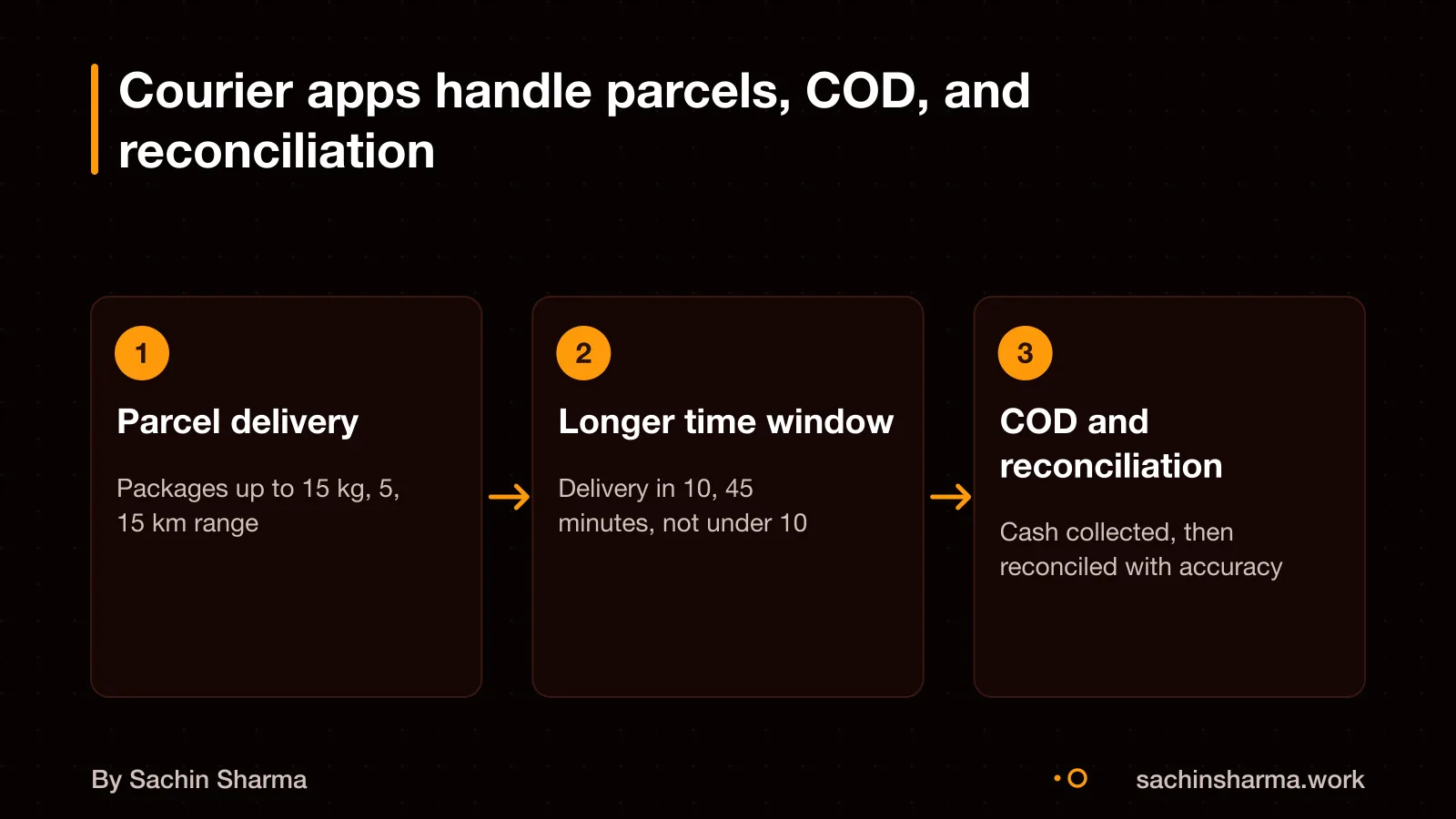
This is different from food or grocery delivery apps. Those focus on speed within a small area. Hyperlocal delivery usually covers 5 to 15 km and takes 10 to 45 minutes. Courier apps handle heavier parcels, longer distances, and more complex logistics like multi-stop routing, warehouse scanning, and multi-leg transit. They also support business clients who ship in bulk and need invoicing, not just one-off users.
For a full list of courier app features, see the full list of courier app features.
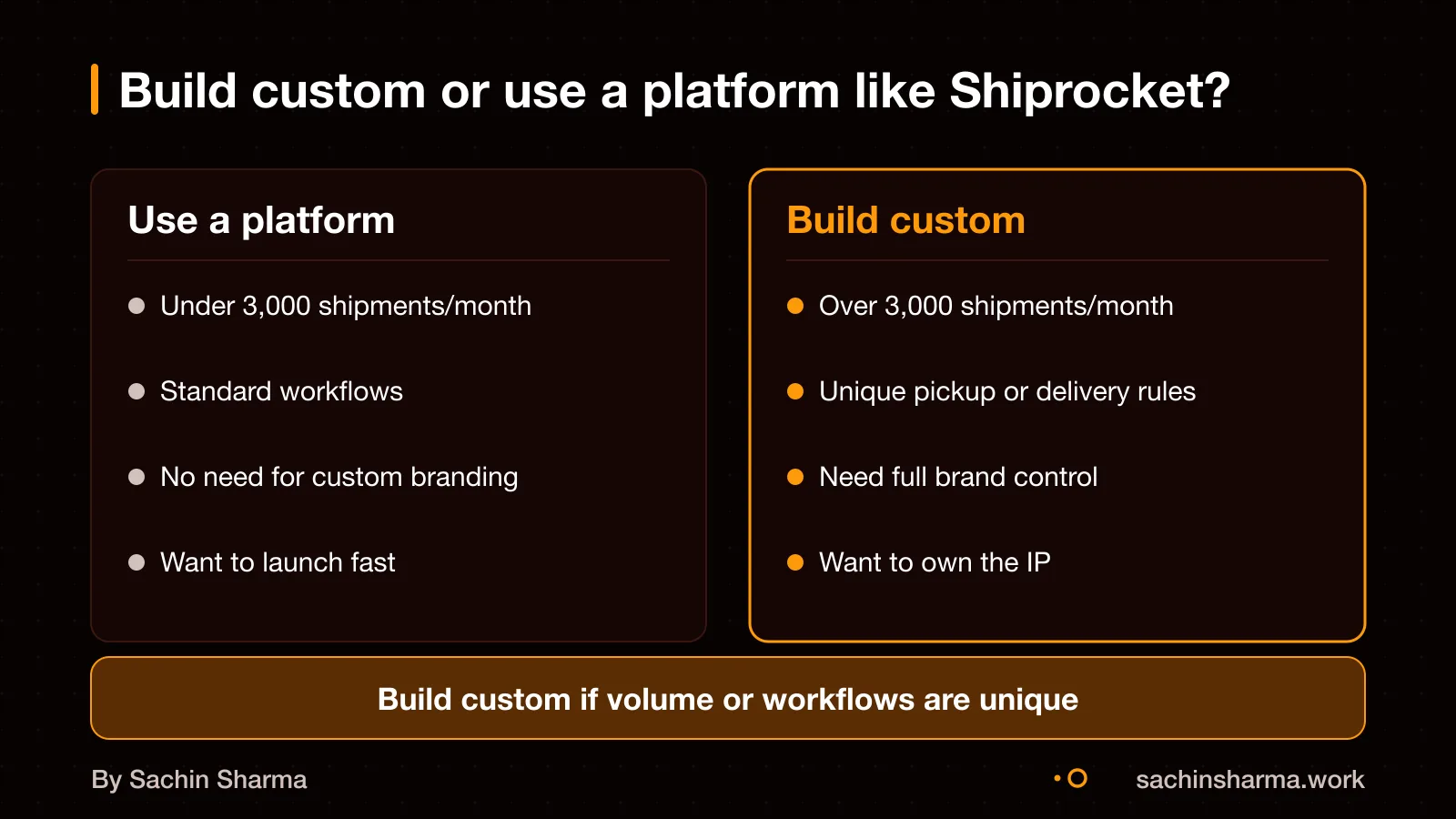
Should you build custom or use a platform like Shiprocket?
A custom app makes sense if you have unique workflows that off-the-shelf platforms cannot support. White-label solutions are better when you need to launch fast to test demand and are not ready to raise capital. You should consider a white-label platform if you handle fewer than 3,000 shipments per day. As the return on a custom build is slower at this scale.
Custom software gives you full control over features like cold chain tracking, B2B credit terms. Or multi-currency hub operations that most SaaS platforms do not allow. This is valuable if your business model depends on differentiation. You also own the code, can modify it anytime, and avoid per-shipment fees that grow with volume.
White-label services like Shiprocket or Shipsy save time and reduce technical risk. But they charge recurring fees that add up. Over five years, a white-label solution costs between ₹84 lakh and ₹1.32 crore. A custom build costs slightly more upfront but ranges from ₹85 lakh to ₹1.23 crore over the same period. The long-term cost is similar, but with custom software, you own the asset.
If your volume is low and your workflows are standard, a platform is a practical start. If you plan to scale or need tailored logic, custom development is worth the investment. For a detailed breakdown of trade-offs, see the full build vs buy a courier app guide.
How much does it cost to build a basic courier app?
The base app covers core functions like booking, tracking, and delivery confirmation. Advanced features like pickup scheduling, label printing, or hub scanning are not included, as their current cost is not known.
Complexity increases cost. For example, adding features such as COD reconciliation or multi-hub routing will raise the total. The evidence shows an MVP range of ₹30 to 70 lakh. Your final cost depends on the exact scope, team size, and tech choices.
GST is charged separately at 18% on all custom software development. This is a service under SAC 998311 and applies to both intra-state and inter-state supplies. For intra-state, it splits into 9% CGST and 9% SGST.
As an estimate, assuming a base app at ₹25 lakh, adding pickup scheduling (₹3 lakh) gives ₹28 lakh. Adding COD reconciliation (₹2.5 lakh) brings the subtotal to ₹30.5 lakh. With 18% GST (₹5.49 lakh), the total is about ₹36 lakh. This estimate assumes a React Native stack, two developers, one backend engineer, and one designer.
Want a number for your idea? Send one line on WhatsApp. I reply with what drives the cost and what to cut.
Message me on WhatsAppWhat features drive the cost up?
As an estimate, pickup scheduling adds ₹1.5 to 4 lakh and 1 to 3 weeks, based on partial project data. This includes time slots, address validation, and SMS alerts to customers. Label printing support adds ₹1 to 3 lakh, as it needs template design, printer pairing, and offline fallbacks. Hub scanning, where staff scan parcels at each stop, adds ₹2 to 5 lakh due to barcode logic, staff login, and sync when offline.
COD reconciliation adds ₹3 to 6 lakh. It must match cash collected, bank deposits, and delivery proofs. This needs photo capture, admin dashboards, and audit trails. As an estimate, route optimisation adds ₹4 to 8 lakh. It uses live traffic, delivery windows, and courier availability to group stops. This relies on Google Maps or OpenStreetMap with custom routing logic.
Costs are estimated per feature by breaking down screens, logic, and third-party tools. Simple screens like profiles or settings add ₹10,000 to ₹25,000. User authentication with email and social login adds ₹15,000 to ₹35,000. Push notifications via Firebase add ₹15,000 to ₹30,000. Complex features cost more due to testing, edge cases, and admin tools.
Each feature also adds time. Building a custom courier app takes 10 to 16 weeks from start to launch. Integration with GST billing, vehicle tracking, or franchisee portals adds further cost. You only pay for what you need. I help you prioritise must-have vs later features so you control the budget.
Have a quote in hand? Send it to me and I will mark what is missing.
Message me on WhatsAppHow long does it take to build a courier app?
This includes the customer app, delivery partner app, and your admin panel. The timeline depends on how many features you need and how fast you can review each step.
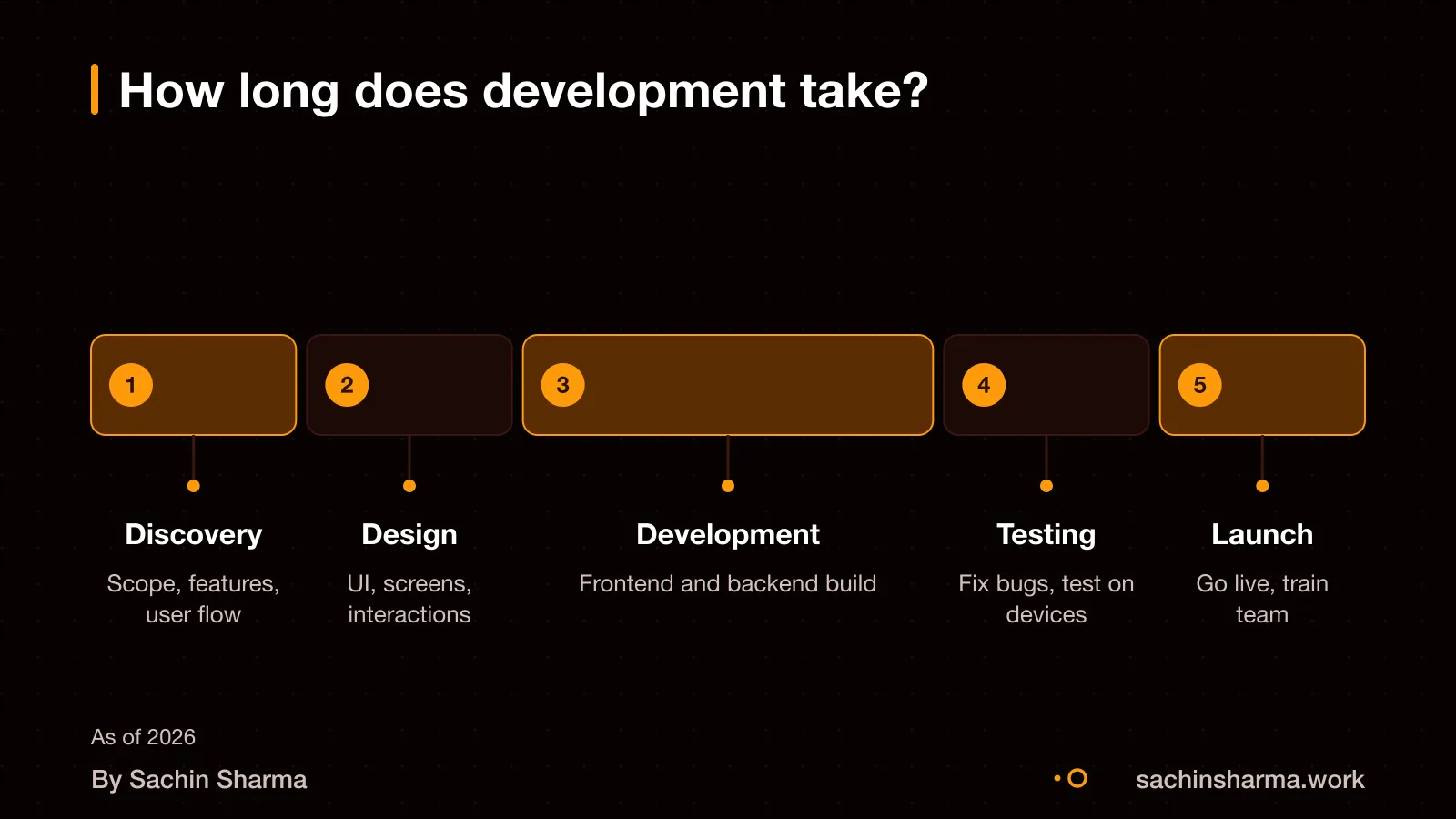
The process has four phases: Discovery & Requirement Call, Planning, Sitemap & Proposal, Design, Development & Testing, and Launch & Ongoing Support. We start with a call to map your workflow. Then I share a sitemap and proposal. Once you approve, I design key screens, build the app, test it, and launch it with you.
Yes, it can be faster. If you have a clear workflow, reuse parts of existing apps, and give quick feedback, we may finish in 10 weeks. Complex features like hub scanning or multi-warehouse routing will add time.
For a detailed breakdown of each phase and what you can do to speed things up, see the timeline for courier app development.
How is the work scoped and billed?
I use milestone billing, where you pay only as each part of your app is completed and shown to you. This keeps risk low and progress clear. We start with a discovery call to understand your business, then agree on a scope, timeline and fixed price for each milestone.
Milestones are tied to working parts of your app, like a completed driver app or a live tracking dashboard. Each one ends with a demo and a payment step. This ensures you see real progress before paying more.
Payment terms are simple: 30% upfront to start, then 35% after design and planning, 30% after development and testing, and 5% on launch. No hidden fees, no hourly rates. Payments are due within 7 days of each milestone delivery.
This method improves cash flow for both of us and keeps the project moving without delays. It works best when you have a clear idea of your core features and can make quick decisions during the process.
Do I own the code and can I move it later?
Yes, you own the full source code once the project is delivered and paid for. This means you can take it to any other developer or team for future updates or hosting. I do not retain any rights to the code or charge fees for access.
You can transfer the app to another developer at any time. The process keeps your app live on the stores, and users will keep their data, reviews, ratings and update access.
After the transfer, I will no longer have access to sales or payment details that come in under the new owner. But I can still help with future work if you choose to hire me again. Everything, design files, documentation, and backend setup, is handed over to you unless we agree otherwise in writing.
How much does app maintenance cost per year?
App maintenance costs 15 to 20% of the build cost each year. This covers updates, bug fixes, security patches, and compatibility with new OS versions. Some of this work is automated, but regular checks keep your app stable and secure.
The first year can cost more, up to 50% of the build price. This happens when early user feedback reveals needed fixes or improvements not caught during testing. You may also add small features or refine workflows based on real use.
Maintenance includes monitoring performance, updating third-party services like maps or SMS, and ensuring data backups run correctly. It does not include major new features or redesigns, which are billed separately. Hosting and API costs are also extra, as they depend on your usage.
As an estimate, assuming ₹20 lakh build cost and 15 to 20% annual rate, yearly maintenance is ₹3 to 4 lakh. This assumes normal usage and no major incidents. If your app handles high volume or integrates with many services, costs may rise. You should budget for this every year to keep your app running well.
When should you not build a custom courier app?
When should you not build a custom courier app?
You should not build a custom courier app if your volume is below 3,000 shipments per day. The payback from a custom build is too slow at this scale. A white-label SaaS platform will launch faster, which makes sense when you are testing demand before raising capital.
Do not build custom if your business lacks unique workflows that off-the-shelf platforms cannot handle. If your delivery process is standard, a ready-made solution will save time and money.
Avoid a custom app if your team cannot manage ongoing updates, rider onboarding, or app maintenance. You need staff who can coordinate releases, fix issues, and train drivers. Without this, even a well-built app will underperform.
Related reading: Best tech stack for a courier and parcel app in India, How to build a Courier and parcel app: features, stack and timeline.
Not sure if your project has this risk? Tell me the plan in two lines and I will say yes or no.
Message me on WhatsAppAssumptions behind the numbers
- Base build: 12 weeks, ₹25 lakh (React Native, 2 devs, 1 backend, 1 designer)
- Each feature adds 1–3 weeks and ₹1.5–4 lakh
- GST toggle adds 18%
- All feature costs are estimates based on partial data
Build your own number
A courier app isn't just one app. It's a customer app, a rider app, a hub tool and an admin panel. Toggle features below to see how cost and time change.
Your working total
₹4,80,00012 weeks of work × 2 people × 5 days × ₹4,000Core Build
Pickup & Delivery
Hub Operations
Routing & Tracking
The weeks are an example, there to be changed. Fees you pay others (store accounts, cloud, SMS) are not in this total. This is a working number, not a quote.
Risks to plan for
- Rider supply
Software does not create riders. Decide whether you build the rider app or use an existing fleet.
- Inventory accuracy
The app is only as good as the item data. Plan for how stock reaches the system before you plan screens.
- Peak load
Evening rush is a different test from a demo. Ask how it is tested.
Ask for these before you sign
- Are the customer, rider and hub apps all in this quote?
- Which areas and how many hubs does the first version serve?
- Who owns the inventory and rider data feeds?
- How is peak load tested?
Questions people ask
I build the customer app, delivery partner app, and admin panel. These are made in Flutter or React Native.
We start with a discovery call to define your needs. Then, I break the project into milestones and bill only when each is completed. This keeps cost and progress clear for you.
At each milestone, you get a clear deliverable: first a proposal, then design mockups. Followed by working app builds, testing reports, and finally launch support. Each step is reviewed before we move on.
I built a multi-tenant platform for a family-run group with delivery tracking, scheduling, and driver management. Lead-to-delivery time fell from 2 weeks to 4 days.
Each rider has a digital cash ledger that logs every COD collection at the time it happens. Mismatches are flagged automatically.
The Digital Personal Data Protection (DPDP) Act applies to how customer and rider data is stored and used. Other rules may apply based on your business model. Check this for your case with a chartered accountant or lawyer.
My estimates are based on past courier app projects, like builds that took 10 to 16 weeks and cost ₹25 to 35 lakh. Scope changes can affect both, so we review them at each milestone.
If new features or changes are requested, they are treated as change requests. We agree on added cost and time before work starts. Milestone billing ensures you only pay for what is delivered.
I use Flutter for mobile apps and Next.js for full-stack projects. For a full comparison of tech options, see the build vs buy guide.