What is an outstation cab booking app?
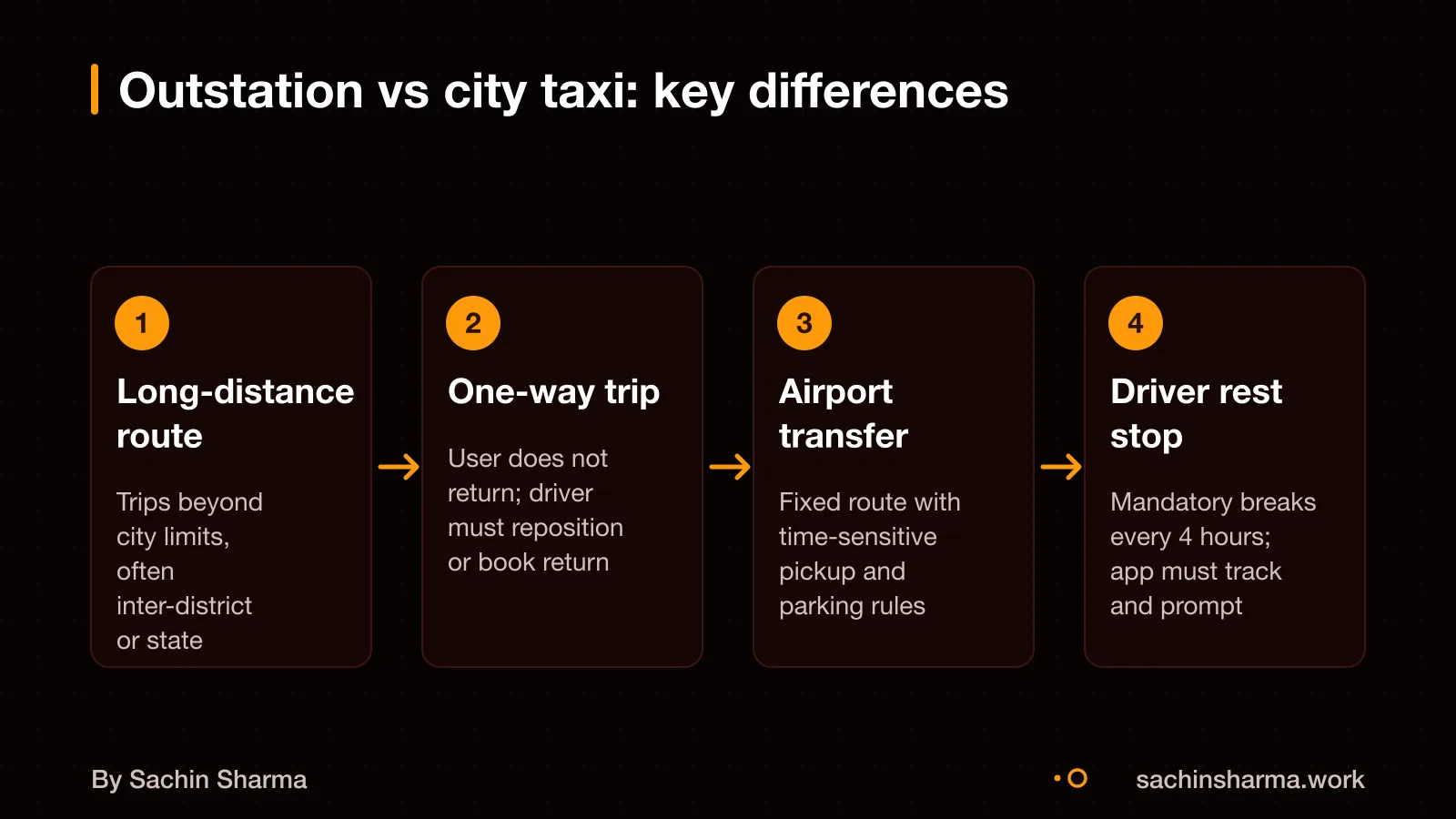
An outstation cab booking app helps you book long-distance car travel with a driver, unlike city taxi apps that focus on short, daily trips. It is built for one-way trips, airport transfers, intercity travel and local rentals over several hours or days. For example, Savaari, Gozo Cabs and MakeMyTrip Cabs offer these services across India. These apps work better for longer journeys than quick city hops. They need special features like route-based pricing, multi-day billing and driver rest planning, which city apps like Uber or Rapido do not handle well. This focus on planned, long-distance travel makes them different from ride-hailing apps for daily commutes.
Custom app vs white-label: which do you need?
With custom development, you get full control over the product, data and architecture. You can shape the app for your fleet, routes and customer base. This matters because one app may not work equally well in every Indian city. You own the code and can change it anytime.
White-label solutions launch faster because the base app already exists. But they limit differentiation. Most offer fixed features, branding and pricing. You cannot tweak core logic or add unique services. If you want to stand out beyond colour and logo, custom is better.
The trade-off is time versus control. Custom takes longer but lets you adapt to real-world needs like multi-city routing, local compliance or fleet rules. White-label gets you live fast but locks you into what the vendor allows. For example, if you later need AI-based pricing for outstation drops, a white-label app may not support it.
Compare your options in depth: Build or buy: custom, white-label or platform?
Must-have features for an outstation cab app
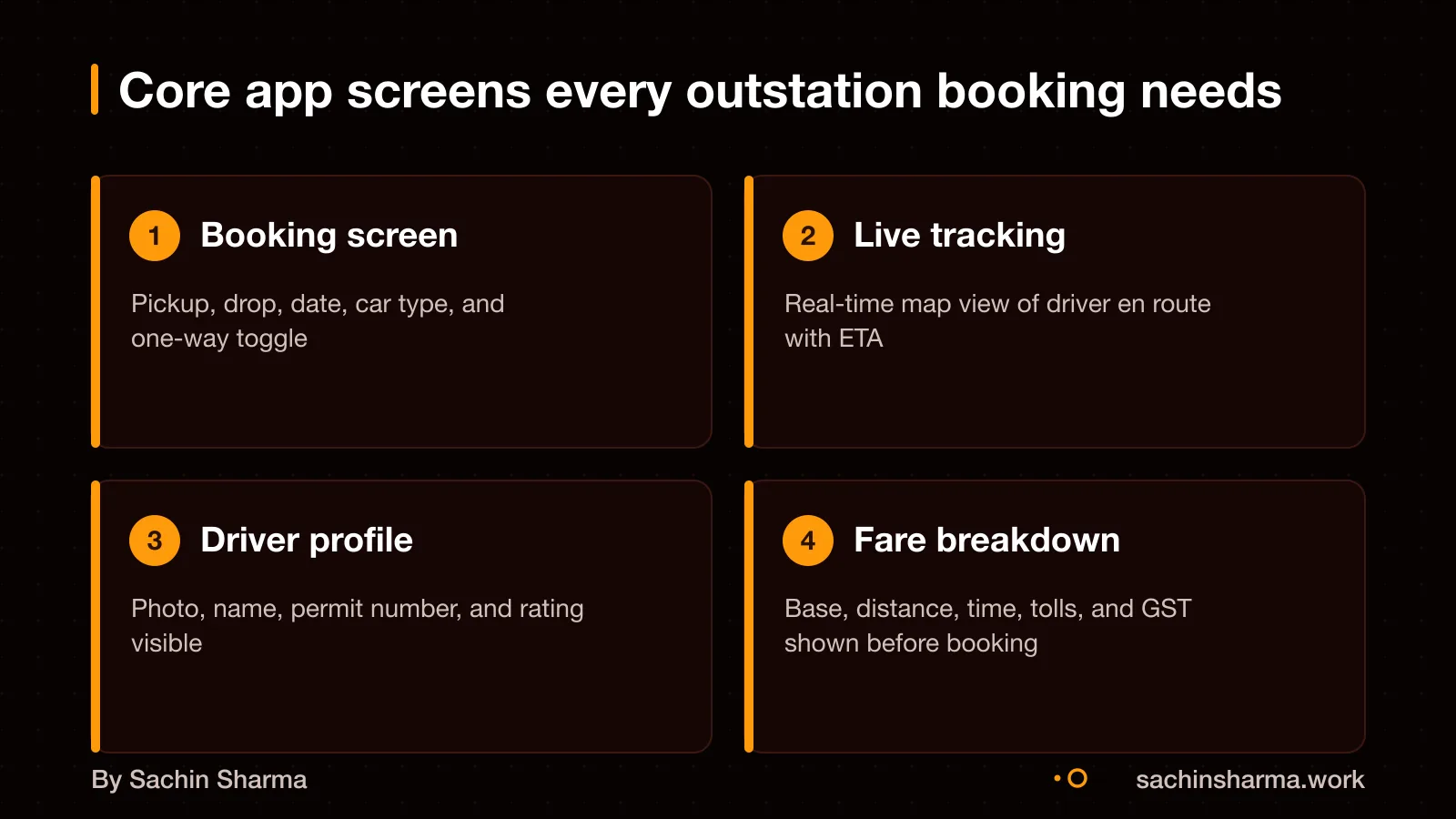
Your app must include live location sharing until ride end, a high-resolution driver photo, and travel insurance up to ₹5 lakh. These are required by law in Maharashtra.
Features like AI dispatch and dynamic pricing improve efficiency and are seen as critical in 2026, but they are advanced. You can delay them until version two if needed. The admin dashboard must support driver and user management, ride monitoring, and compliance tracking to run operations.
Basic features such as ride booking, vehicle selection, and trip history are table stakes. You can skip AI and dynamic pricing at first. But do not skip legal requirements like insurance and driver photos.
For a full breakdown of what to build now versus later, see Must-have vs later features.
What makes the cost go up or down?
Real-time features raise costs because they need live data pipelines and constant server updates. For example, live tracking of cabs on a map requires WebSockets and background location sync on phones, which increases cloud and bandwidth use. These systems are harder to test and scale, so development takes longer.
AI and dynamic pricing add cost because they need extra logic and data sources. Simple fare calculation uses fixed rates, but dynamic pricing must pull in traffic, weather and demand data, then adjust prices in real time. Training or integrating AI models for demand forecasts or driver matching also adds complexity and developer time.
Team size and location affect cost, but not as much as skill and focus. A dedicated team of 4 to 6 developers can build an MVP in 10 to 16 weeks. Indian developers often cost less than US or European teams, but rates vary by city and tech stack. However, a small, experienced team can be faster and cheaper than a large, junior one. What matters most is clear scope and no rework.
How long does it take to build the app?
An MVP for an outstation cab booking app takes 10 to 16 weeks. A basic full version takes 3 to 4 months. You can launch faster by starting with an MVP and adding features later. This keeps cost low and lets you test demand early.
Development slows down when features are not clearly defined or change during the build. Complex real-time systems, like live tracking across long distances, also add time. Third-party integrations, such as payment gateways or GPS services, can cause delays if their documentation is poor or support is slow.
Yes, you can launch faster with fewer features. Focus on what lets you book a ride and complete a trip safely. Skip extras like loyalty programs or advanced analytics at first. Add them after you have real users and feedback. Starting small means you ship sooner and learn faster.
Timeline for building an outstation cab booking app
Costs after launch: hosting, services and maintenance
Your app will have ongoing costs for cloud hosting, third-party services and maintenance. These are not one-time fees and must be budgeted for year one and beyond.
Monthly cloud hosting costs ₹3,000 to ₹50,000, depending on traffic, storage and server load. This covers platforms like AWS, GCP or DigitalOcean and includes compute, bandwidth and database resources. A small fleet with 50 daily rides may stay near ₹5,000, while 500+ rides a day can push costs toward ₹50,000.
Third-party services cost ₹5,000 to ₹50,000 per month. This includes SMS for OTPs, WhatsApp for booking updates, email for receipts, and monitoring tools for uptime. Costs scale with usage. For example, 10,000 WhatsApp messages per month at ₹0.50 each adds ₹5,000.
Annual maintenance costs 15% to 25% of the build cost. This covers bug fixes, OS updates, security patches and small feature tweaks. For a ₹15 lakh app, expect ₹2.25 to ₹3.75 lakh per year. Major upgrades or new features cost extra.
App store fees are recurring. Apple charges ₹9,900 per year for the Developer Program. Google charges a one-time ₹2,500 fee for the Play Console. Both are required to publish and update your app.
You should budget 15% to 25% above the initial build cost for all post-launch expenses in year one. This includes hosting, services, maintenance and app store fees.
For a full breakdown of tools and integrations, see the Best tech stack for an outstation cab booking app.
How does GST apply to development costs?
You pay 18% GST on custom software development services in India. This is split as 9% CGST and 9% SGST if the developer is in the same state as your business. Or 18% IGST if they are in a different state. As a GST-registered business, you can claim this 18% as input tax credit if you have a valid tax invoice. This means the GST is not a final cost but a cash-flow expense, you pay it upfront and claim it back later. For example, if the development cost is ₹10 lakh, you pay ₹1.8 lakh extra as GST. But can reclaim that ₹1.8 lakh through your GST returns. Always keep the invoice with the GST breakdown to claim credit.
Legal and compliance rules
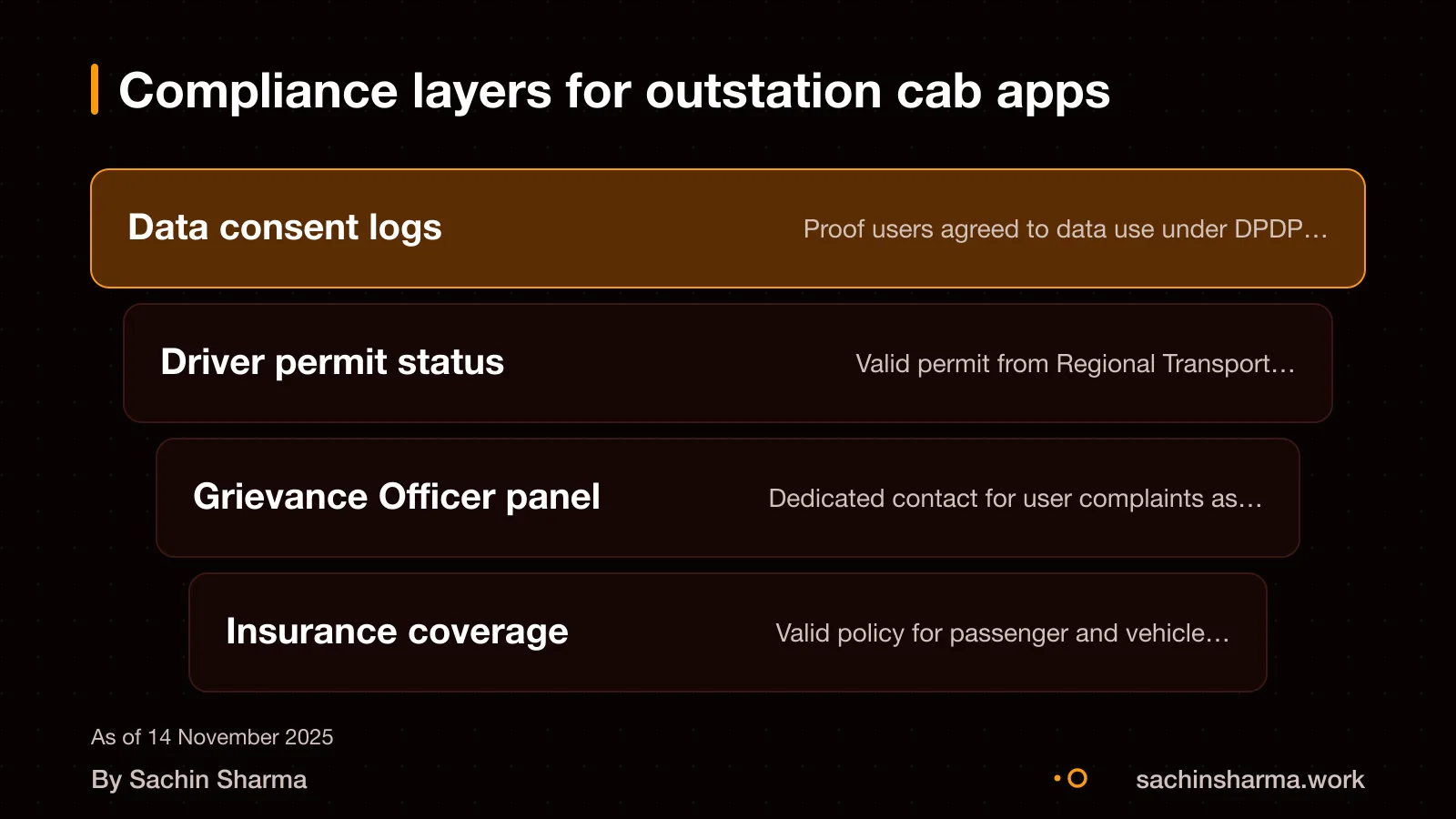
You need a transport aggregator licence to operate in Maharashtra. You must comply with the DPDP Act 2025 and appoint a Grievance Officer.
Yes, you need a transport aggregator licence to run an outstation cab booking app in Maharashtra. The licence comes from either the State Transport Authority (STA) or a Regional Transport Authority (RTA). A licence from the STA costs ₹10 lakh, while an RTA licence costs ₹2 lakh per district. The permit, once issued, is valid across India. You must also pay a security deposit of ₹10,00,000 if you operate up to 1,000 other motor vehicles.
The DPDP Act 2025 requires you to obtain clear consent before collecting user data, protect that data with reasonable safeguards, and report any breach quickly. Failure to maintain security safeguards can lead to a penalty of up to ₹250 crore. Other violations, such as non-compliance with user consent rules, can result in fines up to ₹50 crore. You have an 18-month phased period to meet full compliance.
You must appoint a Grievance Officer to handle user complaints. This role is mandatory under Maharashtra’s aggregator rules. The officer should respond within a reasonable time and keep records of all resolutions.
If you operate in multiple districts, you may need separate RTA licences. You must pay a security deposit, appoint a Grievance Officer, and meet DPDP compliance within 18 months.
Note: Whether you need this licence outside Maharashtra is not known. Check with your local transport authority. Legal advice is recommended for your specific case.
How development works: process and example
I run development in four clear phases: discovery, design, build, and test and launch. In discovery, we define your business goals, map how drivers and passengers will use the app, and list must-have features. You get a written scope and user journey diagrams. In design, I create wireframes and app flows. You get clickable prototypes to review. During build, I develop the app, connect it to services like payments and SMS, and set up your admin panel. You get an alpha version and a beta version during build; exact timelines depend on scope and effort. In test and launch, I fix issues, run security checks, and help you go live. You get the full source code and deployment guides.
As an estimate, a ₹25 lakh app includes a passenger app, driver app, admin dashboard. Real-time tracking, fare engine, payment gateway, and three integrations (SMS, insurance, and cloud storage). The base cost is ₹21 lakh. GST at 18% adds ₹3.78 lakh, based on 18% of ₹21 lakh. Year one hidden costs, hosting, third-party services, and maintenance, add ₹3.15 lakh to ₹5.25 lakh, based on 15-25% of the build cost. Assumptions: a 6-month timeline, a 5-person effort, moderate design, and three integrations. Cloud hosting ranges from ₹3,000 to ₹50,000 per month. These are not one-time costs.
Want a number for your idea? Send one line on WhatsApp. I reply with what drives the cost and what to cut.
Message me on WhatsAppWhen this advice is wrong for you
- Do not build this app if you do not have access to vehicles or drivers. Without a fleet, the app cannot serve bookings, no matter how good the software is. Instead, start with a manual booking system and grow your network first.
- This advice is not for you if your region has low demand for outstation travel. Routes with few passengers or where people prefer trains or buses will not support a cab service. Check if existing operators are active and profitable on your routes.
- If you cannot verify a developer’s past work or confirm that you will own the source code, this path is too risky. You could lose money and have no legal claim over the app. Always ask for proof of completed projects and a clear contract.
- Building is also wrong if you lack funds for marketing and driver incentives. Even a perfect app needs visibility and supply. Without budget for both, the app will not gain users.
Next step: message me on WhatsApp with what you want to build. No forms, no sales team.
Message me on WhatsAppNext step: get your number
Next step: message me on WhatsApp with what you want to build. No forms, no sales team. I will reply with the key features you need, what might raise the cost, and a rough estimate based on past projects like yours. You can then decide if you want a full scope.
Assumptions behind the numbers
- Design complexity is assumed to be moderate.
- Integration count is assumed to be 3.
- Hourly rate is assumed to be ₹1,500.
- Team size is assumed to be 5 people.
- Weeks per phase are assumed as per standard timelines.
Work out your own number
I won't hand you a number that pretends to be the market. Instead, here is the working: set the weeks, the people and the rate, and see where the money goes.
Your working total
₹6,80,00017 weeks × 2 people × 5 days × ₹4,000- Scope and design12%
- Build71%
- Testing and fixes12%
- Launch and stores6%
The weeks shown are an example of a small app, there to be changed. Fees you pay others (store accounts, cloud, SMS) are not in this total.
What moves the price
- More screens or roles
Each extra user type (customer, admin, rider) is close to another app.
- Real-time features
Live tracking and chat need more design and more testing.
- Many integrations
Every payment, SMS, maps or ERP link is its own piece of work.
- Cutting to one platform first
Starting with one clear flow can be half the work.
- Using managed services
A managed backend for login and data removes weeks.
- A clear scope up front
Changes mid-build are the most expensive weeks.
Fees that go to someone else
Google Play developer account
A one-time registration fee, paid to Google. Check the current amount.
Apple Developer Program
A yearly fee paid to Apple. Check the current amount.
Cloud, SMS, maps, payments
Usage-based, billed by the provider to you.
Ask for these before you sign
- How many weeks per phase, and with how many people?
- What is not included?
- Which fees do I pay to others directly?
- What happens to the price when I change my mind?
- What does the first month after launch cost?
Questions people ask
Your app includes real-time GPS tracking, fare estimation, secure payments, an admin dashboard, a driver app, and tools to meet compliance rules. Passengers must be able to share live location, and the app must display a high-resolution photo of the driver. These features support safety and legal needs in Maharashtra.
This is not known from available evidence. You must confirm directly with the developer whether the project follows a fixed-price or time-and-materials model. Each has trade-offs in predictability and flexibility. Ask for a written agreement that defines scope, payment terms, and change management.
This is not known from available evidence. Ask the developer for a clear breakdown of deliverables at each stage, such as wireframes, alpha build, beta version, and launch-ready app. A milestone plan helps you track progress and approve work before the next phase begins.
Yes, if you operate in Maharashtra. You must get a licence from either the State Transport Authority (STA) or Regional Transport Authority (RTA). The fee is ₹10 lakh (STA) or ₹2 lakh (RTA per district). A security deposit of ₹10,00,000, ₹25,00,000, or ₹50,00,000 applies based on fleet size. Check this for your case with a transport lawyer.
The DPDP Act 2025 requires clear consent notices, breach reporting, and data fiduciary duties. Penalties can go up to ₹250 crore for failing to protect data. You have 18 months from notification to comply. Check this for your case with a data protection consultant.
Socket.io with Redis is recommended for real-time tracking in a taxi app. Google Maps is recommended for accurate global data and Mapbox is suggested for cost optimization as you scale. Stripe or Razorpay is recommended for secure and reliable payment integration. This stack is proven for performance and scalability in Indian conditions.
This is not known from available evidence. However, starting with Android may reach more users in India, where Android holds over 90% market share. You can add iOS later. Consider your target customers' devices before deciding.
This is not known from available evidence. Potential risks include scope creep, poor testing of edge cases like network loss. Routing logic errors, non-compliance with transport or data laws, and unreliable driver availability systems. Test each risk early with real users.
This is not known from available evidence. You must confirm in writing that you own the source code and receive full documentation. Without this, moving to another developer may be hard or costly. Ask for code handover terms before starting.
This is not known from available evidence. Ask the developer about their change management process and whether they include timeline buffers. Delays can come from scope changes, third-party delays, or testing issues. Agree on how delays are tracked and resolved.