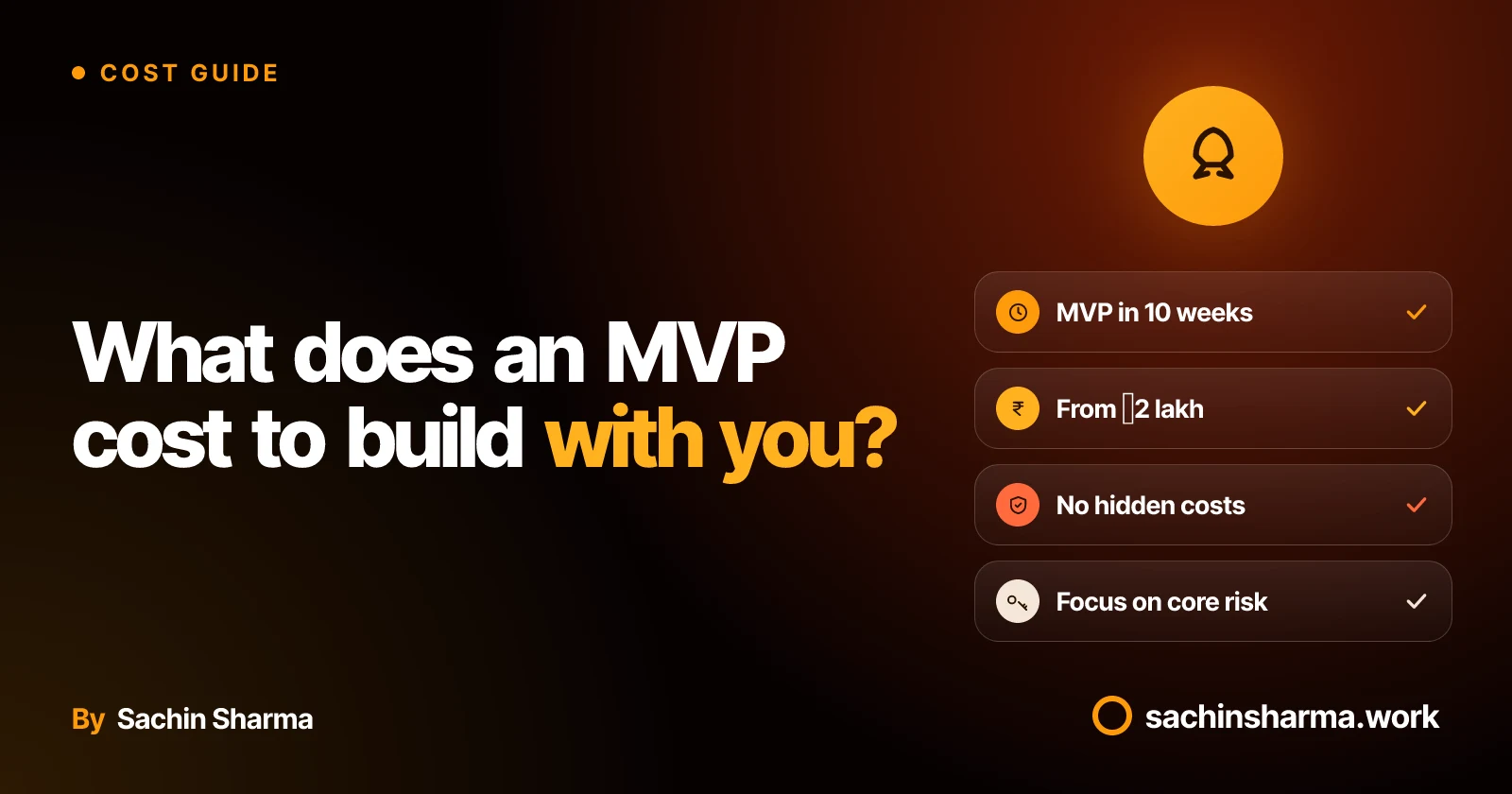
What is an MVP, and how is it different?
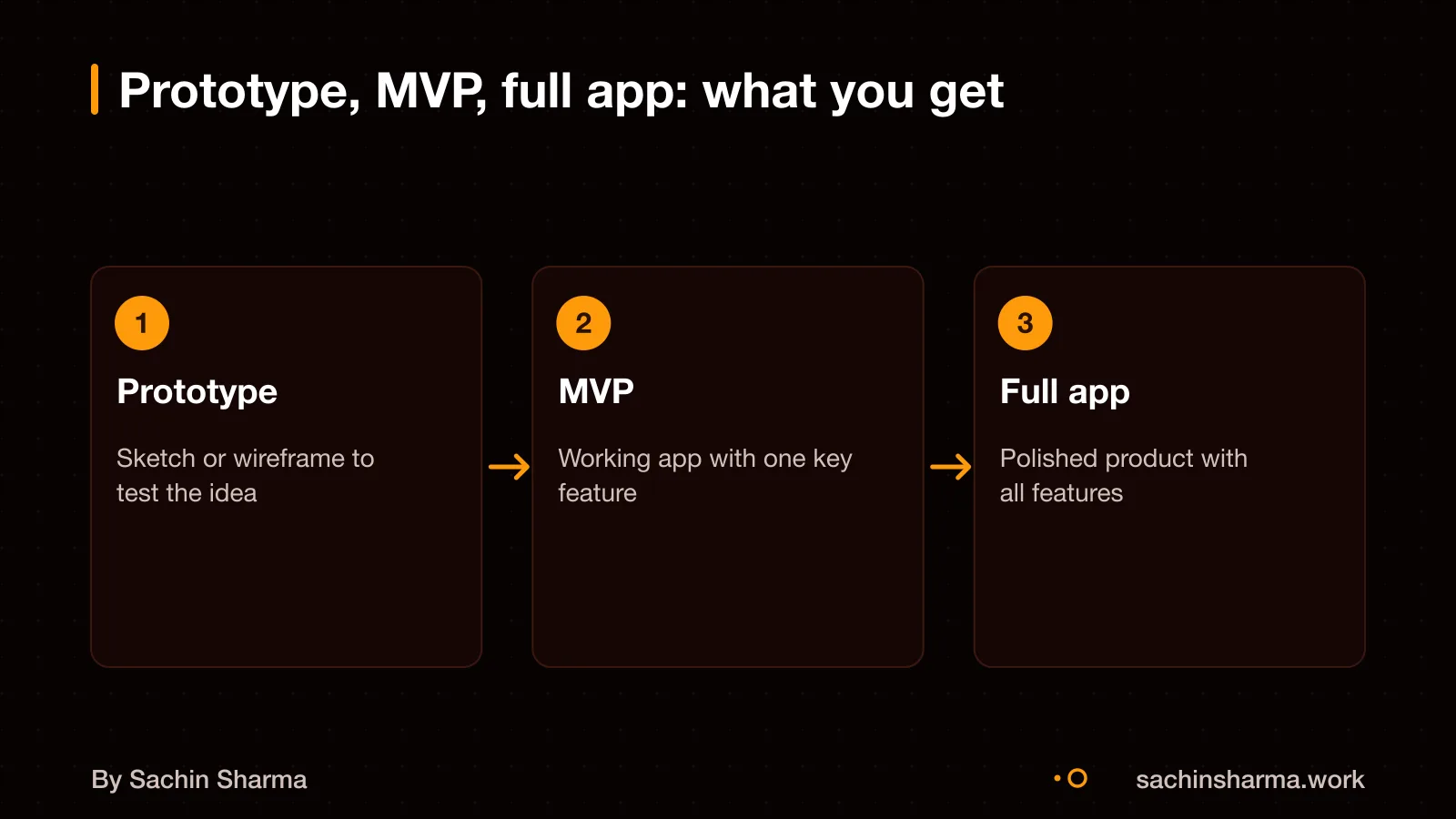
An MVP is a working version of your app with only the core features needed to solve one key problem for early users. It is not a sketch or a demo but a real product you can test in the market. A prototype, by contrast, is a visual model or mock-up that shows how the app might look or work but does not function. Think of a prototype as a storyboard, while an MVP is the first playable episode.
An MVP differs from a full app because it leaves out secondary features like advanced settings, admin panels, or integrations. A full app is polished, complete, and built for all users, not just early adopters. For example, a clinic booking MVP may let patients pick a doctor and book a slot. But the full app could include billing, prescriptions, staff shifts, and reports.
You need an MVP when you want to test demand with real users, not just opinions. It helps you learn fast and spend less. If you only need to show an idea to investors, a prototype may be enough. If you are ready to scale, then build the full app.
What MVP means in plain words
When you don’t need an MVP
You can skip an MVP if your idea solves a simple problem with standard features like listings, forms or content pages. In that case, use no-code tools like Glide or Softr to build it yourself. These are cheaper and faster for basic apps.
An MVP makes sense when you need custom logic, secure user data, or advanced features like AI. For example, if your app must process payments safely, sync offline data, or give smart recommendations, a custom build is better.
Simpler alternatives include no-code websites for brochures or directories, or adding AI to a no-code tool. Add AI to a no-code tool if you only need smart text or image generation on top of simple workflows.
MVP cost tiers in India (2026)
A basic MVP costs ₹2,00,000 to ₹5,00,000, a standard MVP costs ₹5,00,000 to ₹12,00,000. An advanced MVP costs ₹12,00,000 to ₹25,00,000 or more in India as of 2026. These tiers depend on features, tech complexity and third-party tools. A basic MVP has one core function, minimal design and no payments, like a note-taking app with save and sync. A standard MVP adds user accounts, notifications and one integration, such as a payment gateway or calendar booking, which most startups choose for scalability. An advanced MVP includes AI, real-time sync, multi-user workflows or compliance needs, like a clinic management tool with e-prescriptions and HIPAA-like safeguards. A focused web MVP alone may cost ₹4 to 8 lakh and take 4 to 6 weeks, based on a separate estimate.
Want a number for your idea? Send one line on WhatsApp. I reply with what drives the cost and what to cut.
Message me on WhatsApp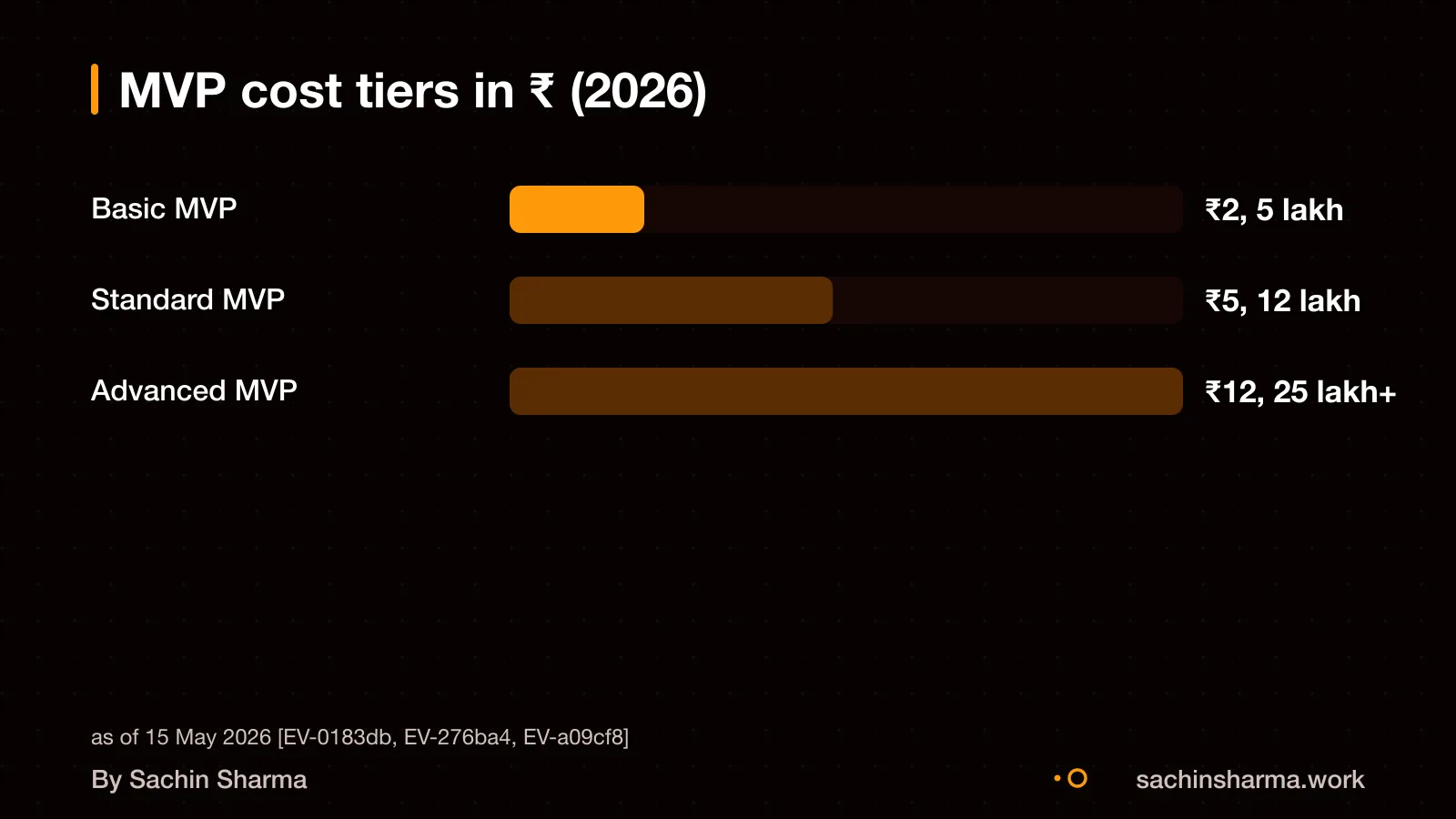
What makes an MVP cost more or less?
The main things that change an MVP’s cost are how many features it has, which platform you choose, and the tech tools used. A larger scope with complex features takes more time and raises cost. Building for both Android and iOS at once usually costs less than making two separate apps, especially with cross-platform tools like Flutter. I use Flutter and Next.js, which may help reduce time and cost through code sharing. Simple features like login or forms are low cost, but custom logic, real-time sync, or AI features add more. The tech stack also affects price, using modern, well-supported tools speeds up work and reduces bugs. Compliance needs, like storing medical or financial data, may require extra security steps and audits, which add to cost. You save more when the team works directly without agency layers. For full savings, a modular design lets you add features later without rebuilding.
How long does it take to build an MVP?
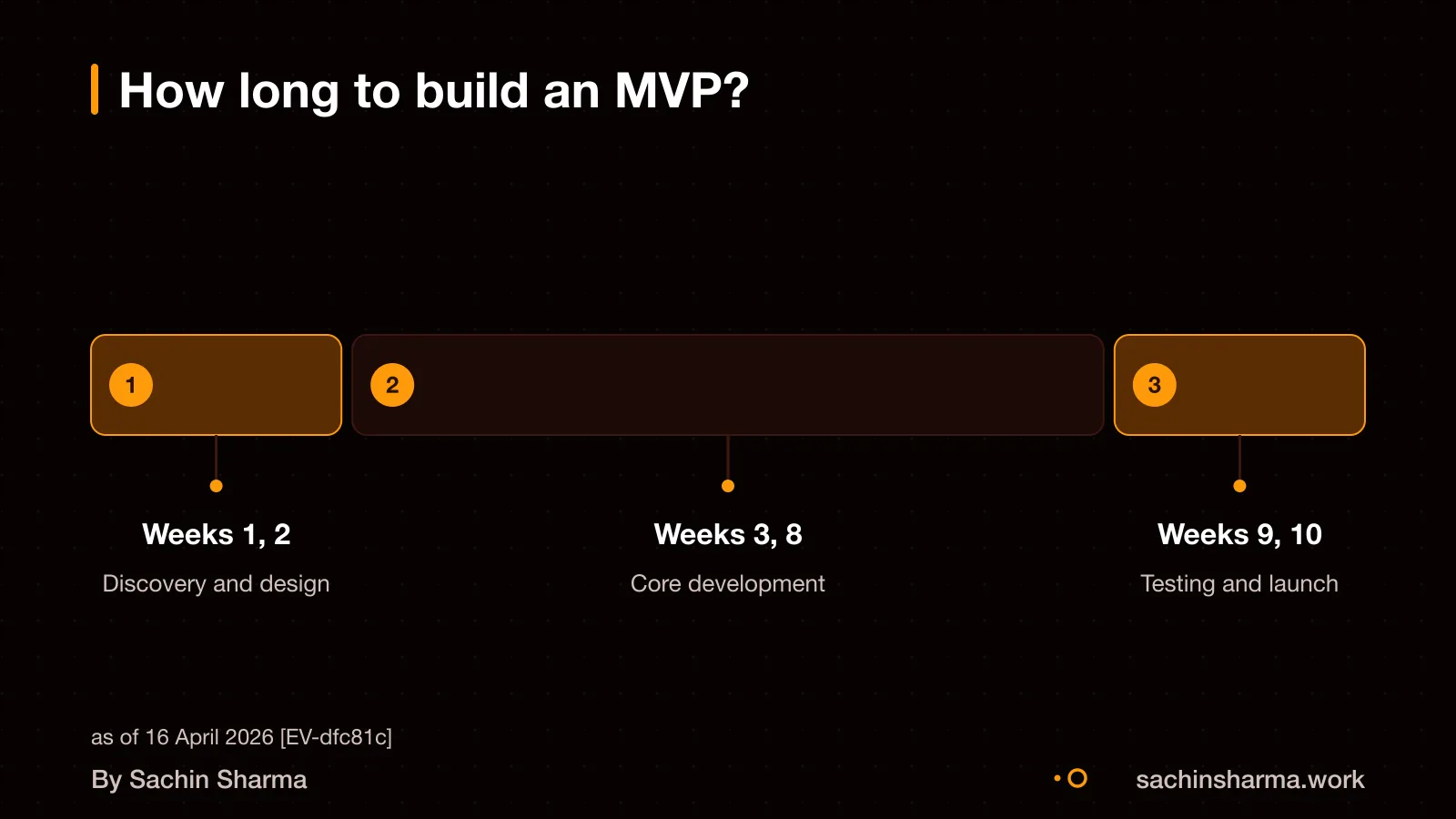
A focused MVP takes 6 to 12 weeks to build. If you need user authentication and payment processing, add more time: such MVPs take 10 to 14 weeks in India as of April 2026. A simple marketplace or SaaS MVP falls in between, at 8 to 10 weeks. The timeline depends on how many features you include and how complex they are. For example, a clinic booking app with doctor profiles, slot selection and SMS alerts can be built in 10 weeks. But if you add online payments and patient login, it moves to 13 weeks. Delays often come from unclear requirements or late feedback. You can speed it up by finalising the core flow early and reviewing builds every week.
Risks of building an MVP and how to avoid them
Most MVPs fail after launch because they scale too soon, before proving demand or fixing core issues. This premature scaling wastes time and money. Another big risk is technical debt, which means quick coding choices that seem fast now but cause bugs, slow updates, and high costs later. As a result, developers lose 17.3 hours a week on average to fix bad code. Weak architecture from rushed work can make your app crash under real users.
To reduce risk, focus only on the one problem your MVP must solve. Build it well, with clean code and room to grow. Test with real users early. Fix flaws before adding features or users. Plan for long-term stability by setting aside time and budget for updates and fixes.
A maintenance contract helps you stay on track without surprises. It covers routine checks, security updates, and small fixes so your app stays reliable.
Not sure if your project has this risk? Tell me the plan in two lines and I will say yes or no.
Message me on WhatsAppProof I’ve built working MVPs
Yes, I have built working MVPs that are live and solving real problems. For example, EHR Copilot is a Next.js tool that turns psychiatric session transcripts into structured SOAP notes, helping clinics save time on documentation. Another is Legease, a Flutter app that uses AI to simplify legal document review, reducing manual errors and search time. These were built as focused solutions to test one core risk each.
MojoDocs runs over 1,100 file-processing tools locally using WebAssembly, allowing users to edit files without uploading them. This solved privacy and latency issues common in cloud tools. Daily, a current-affairs app for exam aspirants, supports daily streaks and quizzes through a custom Next.js API. Proving engagement can be sustained with simple, reliable features.
A recent tech startup MVP in a related domain saw 150% growth in user acquisition within six months of launch. This kind of result depends on the problem, market and execution, not just the build. Each of my projects starts with a clear problem to solve, not just a list of features.
GST and legal rules when hiring a developer
The GST rate on custom software development is 18% under SAC code 998311. This applies to all IT services in India under the standard rate. You will pay either CGST and SGST or IGST, depending on your location and the developer's. If both you and the developer are in the same state, you pay 9% CGST. 9% SGST, which adds up to 18% total GST. If you are in different states, you pay 18% IGST instead. For exports of software services, GST is zero-rated with proper documentation. Always ask for a tax-compliant invoice with the SAC code and GST split shown. This helps you claim input tax credit if your business is registered. If you are hiring me and we are in different states, you will pay IGST at 18%. If we are in the same state, CGST and SGST will apply at 9% each.
What happens after the MVP launches?
Post-launch maintenance keeps your MVP running smoothly. It includes bug fixes, security updates, performance monitoring, and compatibility checks for new devices or OS versions. As an estimate, this costs 15 to 25% of the original build cost each year. This ensures your app remains stable and secure as it gains users.
You will also need to renew subscriptions for third-party tools like cloud hosting, SMS gateways or payment processors. These are separate monthly costs and are not included in maintenance. For a detailed breakdown of what affects yearly upkeep, see What app maintenance costs per year.
Third-party tools you’ll pay for
You pay separately for third-party tools like hosting, APIs, payment gateways and messaging services. These are not part of the build cost but are needed to run your MVP.
Common tools include cloud hosting (like AWS or Vercel), SMS or email services (like Twilio or SendGrid). Payment gateways (like Razorpay or Stripe), and APIs for maps, AI or data. WhatsApp Business API is also used for customer alerts and support.
Free tiers are available for some tools, such as Vercel for hosting or Firebase for basic backend needs. You can use them to cut costs during testing. But they have usage limits and may not support scaling. For example, free-tier SMS credits often run out fast with real user traffic.
As an estimate, expect ₹10,000 to ₹25,000 per month for third-party subscriptions in a standard MVP, depending on user load and services used. You choose which tools to use, and I will guide you to keep costs low without sacrificing reliability.
Worked example: cost of a clinic booking MVP
Worked example: cost of a clinic booking MVP
As an estimate, a clinic booking MVP costs ₹6 lakh to build. This base cost covers the core app features like patient registration, doctor profiles, slot booking and confirmation. It does not include third-party tools, post-launch changes or legal setup.
You must pay 18% GST on the build cost as it is a standard rate for IT services in India. For a ₹6 lakh build, 18% GST adds ₹1.08 lakh. These are not part of the build cost and are billed separately.
This estimate assumes no major changes during development and that you provide clear requirements and content. If your app needs more screens, real-time updates or multi-role access, the cost will rise.
When this advice is wrong
You should not build an MVP if your idea solves a simple problem that standard tools can handle. For example, if you only need a form, a listing or a content site, use no-code platforms like Glide or Softr instead. This cost range does not apply if your budget is under ₹3 lakh. As even a basic MVP typically requires a minimum investment to be functional and tested.
Skip this path if you cannot access real users to test the app. An MVP only works when you can collect feedback from actual use. If your target customers are hard to reach or you are building in a closed network without pilot sites. The build may not teach you enough to justify the cost.
Also, do not start an MVP if no-code tools already meet your needs. Many small businesses can launch faster and cheaper with tools like Bubble or WordPress. Especially when the app does not need custom logic or offline use. Build only when off-the-shelf options fall short.
Next step: message me on WhatsApp with what you want to build. No forms, no sales team.
Message me on WhatsAppAssumptions behind the numbers
- GST is applied at 18% as per law.
- Third-party costs like hosting and APIs are paid directly by the client.
- Development time is estimated based on standard MVP scope tiers.
Work out your own number
I won't hand you a number that pretends to be the market. Instead, here is the working: set the weeks, the people and the rate, and see where the money goes.
Your working total
₹4,40,00011 weeks × 2 people × 5 days × ₹4,000- Scope and design18%
- Build55%
- Testing and fixes18%
- Launch and stores9%
The weeks shown are an example of a small app, there to be changed. Fees you pay others (store accounts, cloud, SMS) are not in this total.
What moves the price
- More screens or roles
Each extra user type (customer, admin, rider) is close to another app.
- Real-time features
Live tracking and chat need more design and more testing.
- Many integrations
Every payment, SMS, maps or ERP link is its own piece of work.
- Cutting to one platform first
Starting with one clear flow can be half the work.
- Using managed services
A managed backend for login and data removes weeks.
- A clear scope up front
Changes mid-build are the most expensive weeks.
Fees that go to someone else
Google Play developer account
A one-time registration fee, paid to Google. Check the current amount.
Apple Developer Program
A yearly fee paid to Apple. Check the current amount.
Cloud, SMS, maps, payments
Usage-based, billed by the provider to you.
Ask for these before you sign
- How many weeks per phase, and with how many people?
- What is not included?
- Which fees do I pay to others directly?
- What happens to the price when I change my mind?
- What does the first month after launch cost?
Questions people ask
A lean MVP includes one core workflow, one user type, a basic admin panel, and up to two integrations like payment or email. A standard MVP adds polished UX, user dashboards, role-based admin access, and a CI/CD pipeline. Web-only delivery is standard unless mobile apps are needed.
Scoping and billing are agreed before work starts. I do not use fixed hourly or milestone billing without a clear scope. We will define what is included, the timeline, and how changes are handled. This ensures no surprises for either side.
While exact milestones depend on your project, typical phases include discovery, design, build, and launch. At each stage, you get a clear output: a scope doc, design mockups, a working prototype, and finally a live MVP. We align on deliverables upfront.
Yes, if the AI feature is core to your product risk. For example, EHR Copilot uses AI to turn therapy notes into structured records, and Legease helps draft legal documents. Custom AI components need professional engineering to work reliably.
I build with secure architecture to avoid technical debt that can prevent the product from handling real-world demands. This means encryption, minimal data collection, and no unnecessary access.
Before launch, your MVP should be tested with unit tests, integration tests, and user acceptance testing. If it still doesn’t work, we gather real user feedback and iterate.
Access during development depends on our agreement. Some clients get early access to test features or review progress. We can set up a staging environment for you to try the app before it goes live.
I work directly with clients, with no agency layers. For larger projects, I may bring in trusted specialists, but I lead the build and stay your main point of contact throughout the project.
Testing your MVP with real users can help validate your idea and gather feedback. If it attracts interest, retains users, and solves their core problem, it is working. I help you set up ways to track this from day one.