How a parking app works for drivers and operators
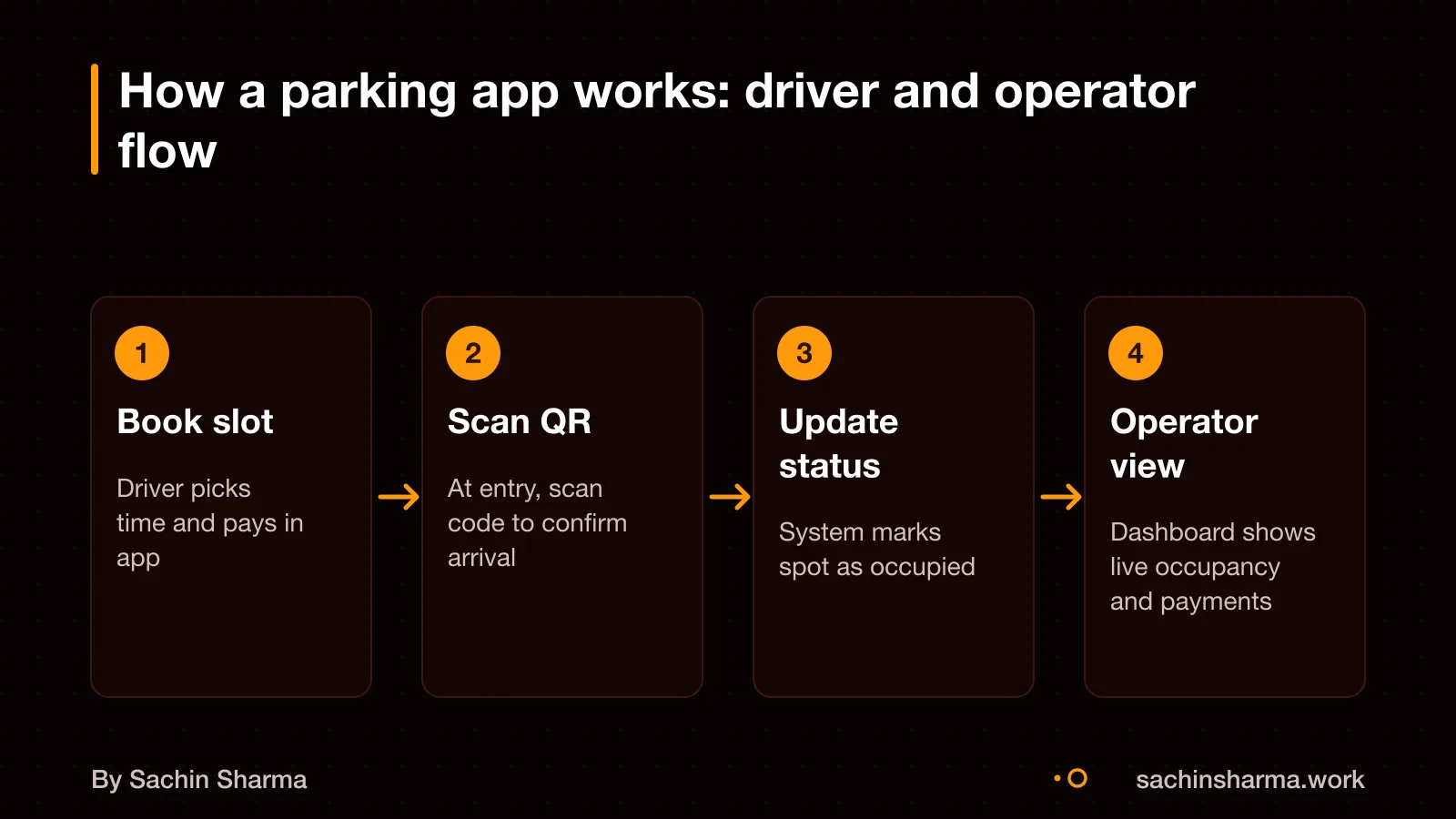
Drivers can find free slots, book a spot, and pay in advance using the app. This means they arrive to a promised space and skip queues at entry. Booking confirmation comes with a QR code or reference number for check-in.
Operators use a dashboard to manage bookings, view live occupancy, and track payments. They get real-time data on demand patterns, helping them adjust availability and staffing.
Users check in by scanning their QR code or entering their booking number at the entry terminal. Some systems use number plate recognition to match the car to the booking. Check-out is automatic when the session ends, or the driver taps out in the app.
For a full list of features that make parking apps work smoothly, see Must-have features in a parking app.
Custom app vs ready-made solution: which is right?
A custom app gives you full control but costs more, while a ready-made solution saves time and money but limits your features and branding. Choose ready-made if you need a basic booking system fast and have a tight budget. These platforms cut setup time and let you start with lower upfront costs, which suits small businesses testing the idea.
Go for a custom app if you need unique features like integration with your hotel’s PMS or a branded driver experience. You own the code, design, and data, and can add features later without relying on a third party. For example, if you run a multi-brand parking group, a custom app can link all sites under one dashboard.
Ready-made apps work well when your needs are simple and standard. But if you plan to scale, add sensors, or connect to accounting systems, a custom build makes sense. Some platforms allow limited API access, but you may hit walls when customising.
You can learn more about the trade-offs in our detailed guide on Build or buy a parking app: custom, white-label or platform?.
Basic tier: ₹8 lakh for core booking and payment
The basic tier costs up to ₹8 lakh. This is for small parking lots with one entry and exit point who want drivers to book and pay via app. You get a mobile app where users sign up, see available slots, select one, and pay securely. Payments go to your account, and you get a simple dashboard to view bookings. As an estimate, this cost assumes a single operator, no sensors, and fixed pricing.
It does not include dynamic pricing, sensor integration, QR-code entry, or support for multiple parking zones. There is no real-time occupancy tracking or automated gate control. This tier suits small businesses with under 50 slots and no plans to scale across locations. If you need advanced features later, they can be added, but the cost to do so is not known.
The time to build from scratch is not known [unknowns]. What the client must provide to start is not known [unknowns]. This tier works if you want a low-cost entry into digital parking management without custom hardware.
Want a number for your idea? Send one line on WhatsApp. I reply with what drives the cost and what to cut.
Message me on WhatsAppWhat features increase the cost the most?
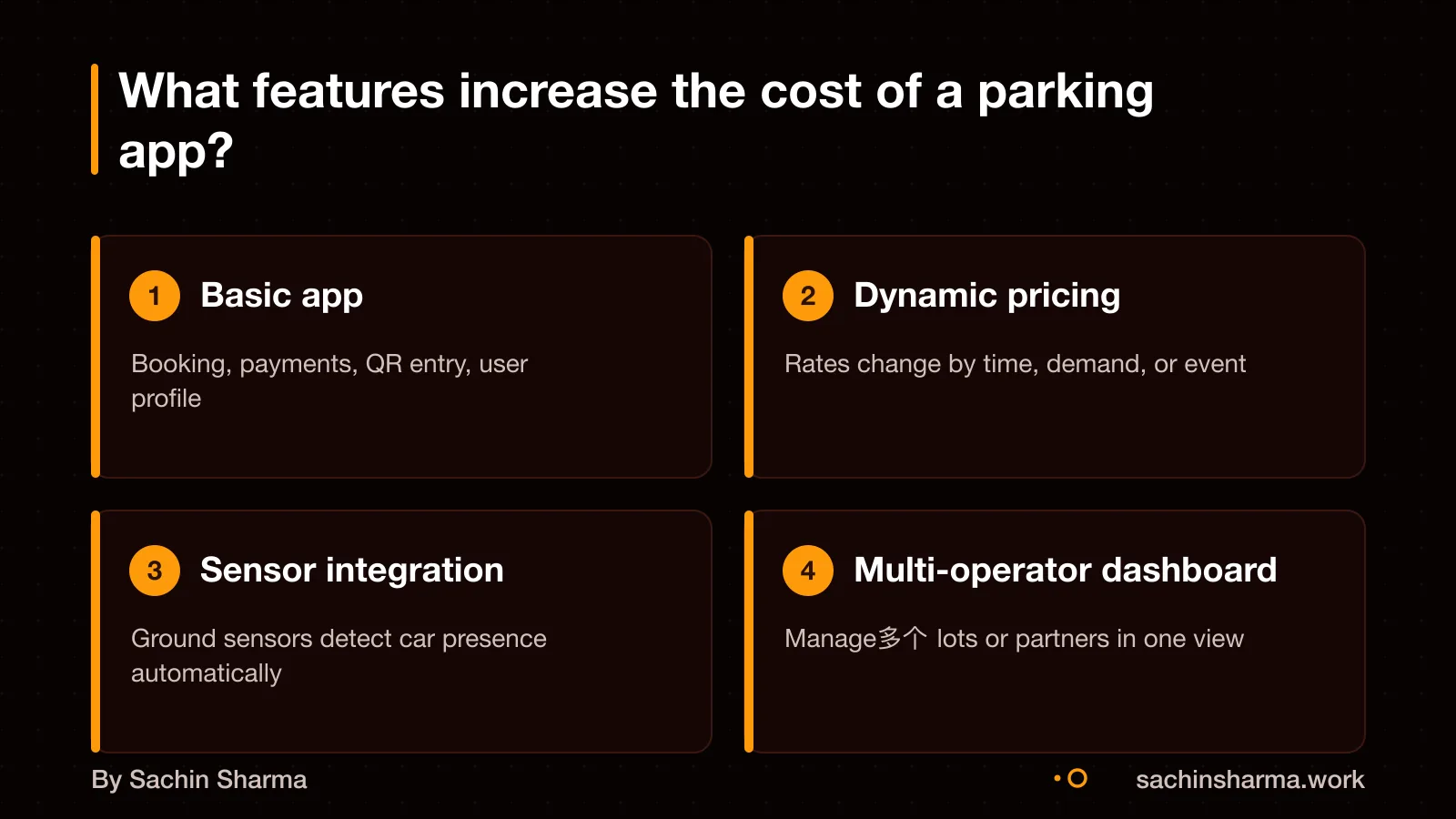
Advanced features like dynamic pricing, real-time sensor integration, and multi-operator dashboards add the most time and cost to a parking app. These require complex logic, live data feeds, and secure backend systems, which increase development effort.
AI-powered features, such as demand forecasting or smart recommendations, also raise the budget when added. They need training data, model tuning, and extra testing to work reliably in real-world conditions.
IoT-based systems, like sensors that detect slot occupancy, add complexity because they must sync with the app in real time and handle offline fallbacks. This means more code, more testing, and more coordination between hardware and software teams.
The exact cost of adding dynamic pricing or sensor integration is not known from the available evidence. However, based on standard app architecture, each integrated system multiplies the testing and debugging workload.
For example, a basic booking app only needs user accounts, a map view, and payment. But with live sensors, the app must constantly update slot status, handle false readings, and manage communication with gate hardware.
As an estimate, assuming one new integrated system (like sensors or AI), development time could increase by 30% to 50% over a basic build. This would add ₹2.4 lakh to ₹14 lakh to the base cost of ₹8 lakh.
Complexity also comes from rules: what happens when a sensor fails, how prices change at peak hours, or how disputes are resolved. These edge cases take time to map and code.
You can reduce cost by using QR-code check-in instead of sensors, or fixed pricing instead of dynamic models. Simpler rules mean fewer bugs and faster delivery.
Sensor or QR-based entry: what it costs to integrate
The build cost of sensor-based slot detection is not known. I have not built a parking app with physical sensors, so I cannot give a reliable price for integrating them. You will need to talk to a hardware vendor or IoT specialist to get a quote for sensors, installation, and software links.
A QR-code entry system uses off-the-shelf tools that cost between $0 and $100 per month. Depending on how many codes you need and whether you use a free or paid plan. If you only need one or two dynamic QR codes, the cost is between $1 and $3 per code. As an estimate, assuming you generate 10 dynamic codes per month, this adds about ₹7,500 per month at current rates.
Which is better for your lot? QR codes work well for small to medium lots with low traffic and one entry point. They are cheaper to set up and do not need extra wiring or maintenance. Sensors give real-time accuracy and work in high-traffic or large lots, but they are costlier and harder to install. The choice depends on your lot size, traffic volume, and budget.
Still unsure between QR and sensors? Tell me your lot size and traffic and I will say which fits.
Message me on WhatsApp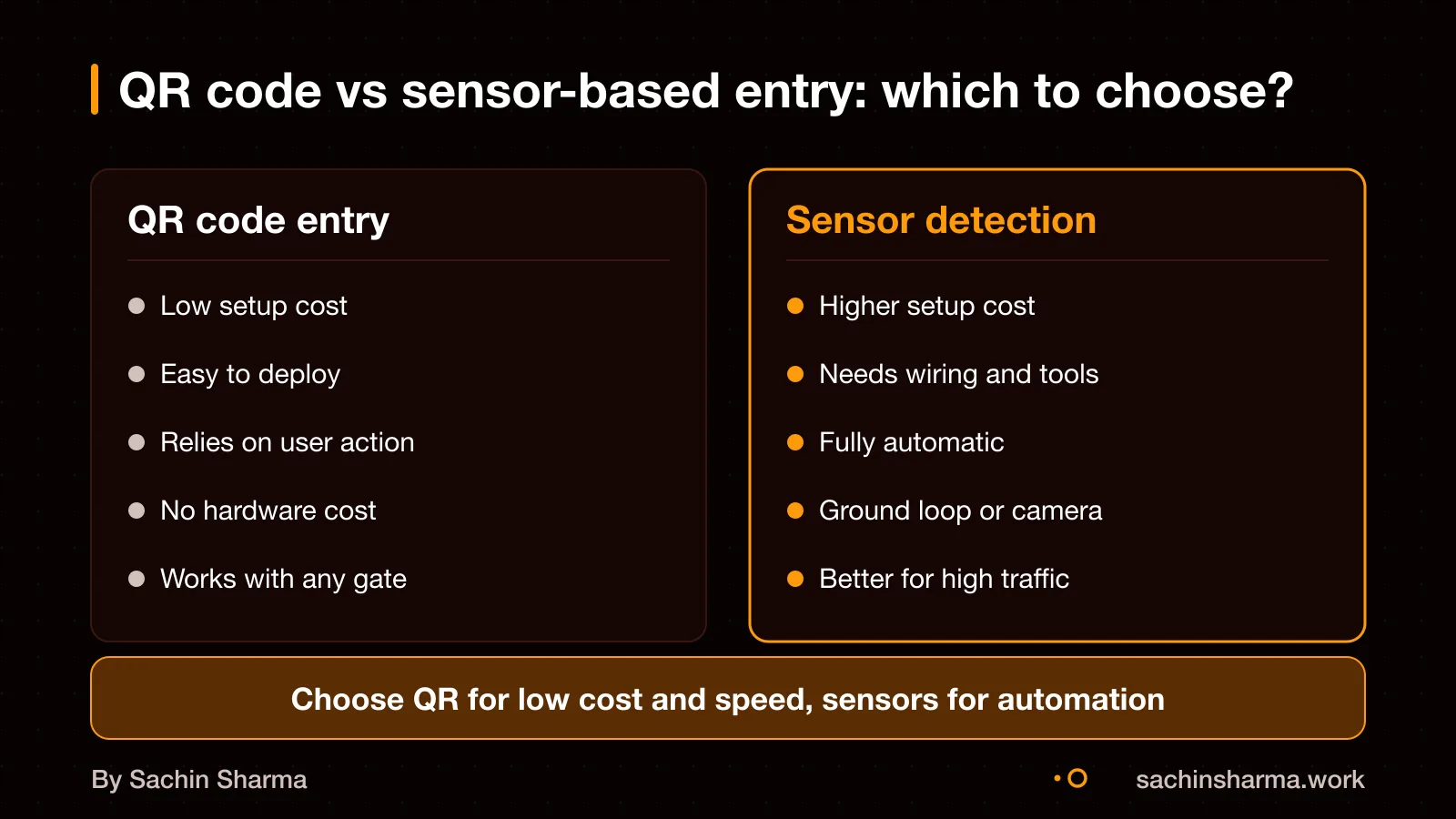
GST on app development: can I claim input credit?
Yes, you can claim input tax credit (ITC) on custom app development, provided your supplier gives you a GST-compliant invoice and you file returns correctly. The development is a taxable service, so GST will be charged on the total fee.
You can claim ITC on this inward supply of service, as long as your accounts are properly maintained. The invoice details should appear in your GSTR-2A and must be declared in your GSTR-3B return to claim credit.
The invoice must include my GSTIN, your GSTIN, a description of the service ("custom mobile app development"). The total amount, and the GST rate and amount charged. Keep these records for audits.
As this affects your tax position, please consult your chartered accountant to confirm your eligibility and process. Rules apply as of October 2026.
Who owns the app code after it is built?
You do not automatically own the app code just because you paid for it. Indian law treats software created by an independent developer as their intellectual property unless a contract says otherwise. To own the code, your agreement must clearly transfer all rights to you.
The contract should explicitly state that you own the source code, design files, graphics, and all other assets. This prevents disputes later and allows you to update, resubmit, or hand off the app to another team. Without this clause, you may need fresh permission or payment to make changes.
I provide all code and assets in a private GitHub repository, shared with you from day one. At project end, I transfer full ownership so you can download everything or move it to your own account. This includes documentation, API keys (if any), and build files needed to publish or maintain the app.
Make sure your contract includes a clause on IP ownership before work starts. I include this by default in my agreements, but you should confirm it is written and signed. If you already have a legal team, share the draft early to avoid delays.
App maintenance cost after launch
You should budget 15 to 20% of the initial build cost per year for app maintenance. This covers updates, bug fixes, server costs, and security patches. For a ₹8 lakh app, that is ₹1.2 lakh to ₹1.6 lakh per year.
Without this, your app may stop working or become unsafe.
When this advice is wrong: who should not build a parking app
A parking app may not be worth it if your lot has fewer than 20 slots or turnover is low. As the cost may not pay back in time saved or tickets sold. For small lots, a manual QR-based log or a shared spreadsheet with time slots may be simpler and cheaper to run.
Ready-made solutions like Park+ or QPark are better if you want fast setup and do not need custom branding or unique features. These platforms charge a monthly fee but include support, updates, and payment handling.
Building an app is a bad fit if you lack staff to manage digital bookings or resolve user issues. Without a team to monitor bookings, handle disputes, or maintain hardware, the app may frustrate users and harm your reputation.
If your site has poor internet or power, an offline-first app may help, but full automation with sensors or automatic gates will not work reliably. In such cases, stick to basic digital tools or manual systems.
Related reading: How long does it take to build a parking app?. Best tech stack for a parking app in India, How to build a Parking app: features, stack and timeline.
Next step: message me on WhatsApp with what you want to build. No forms, no sales team.
Message me on WhatsAppAssumptions behind the numbers
- Base cost assumes 40 screens and one payment gateway
- Testing cost is 20% of build cost
- Flutter is used for cross-platform development
- Advanced feature costs are not yet available
Build your own number
A parking app is not one app. It is a customer app, an operator dashboard, maybe sensors and dynamic pricing. Switch things on and watch the cost move.
Your working total
₹4,20,00010.5 weeks of work × 2 people × 5 days × ₹4,000Customer app
Operator dashboard
Sensor integration
Admin and backend
The weeks are an example, there to be changed. Fees you pay others (store accounts, cloud, SMS) are not in this total. This is a working number, not a quote.
Risks to plan for
- Sensor reliability
Physical sensors fail. Plan for manual overrides and fallback check-in methods.
- Data sync lag
Real-time data is only as fast as the network. Test delays during peak traffic.
- Dynamic pricing adoption
Users may resist surge pricing. Test acceptance before launch.
Ask for these before you sign
- Does the quote include both customer and operator apps?
- Is sensor integration handled in-house or by a third party?
- Who manages dynamic pricing rules and how often do they change?
- Is testing time and cost included in the quote?
Questions people ask
A basic app includes login, profiles, and static content. You get login and profiles. This fits small lots with one entry and exit. For full features and limits, see the scope document we agree on.
We agree on fixed milestones and pre-fund an escrow account for each. You pay only when a milestone is met. There is no hourly billing. This keeps costs clear and work on track.
You get a clear deliverable at each stage: first a written spec. Then a clickable prototype, followed by a testable build, and finally the live app. Each step is reviewed before we move on.
I cannot share public examples. I can discuss past scopes and outcomes under a non-disclosure agreement. This protects client data and IP while giving you confidence in the process.
You test each build on real devices using TestFlight or a signed APK. I provide testable versions at every milestone. Apple and Google also review apps before listing.
The Motor Vehicles Act and state rules like the Delhi Motor Vehicle Rules 1993 apply. City-level permits may be needed for digital parking services. Check this for your case with a transport lawyer.
Some cities require a permit to operate a digital parking service. This depends on local transport rules. You must check with your city authority before launching.
Yes, if you own the source code and have full access. I use private GitHub repos and hand over all code, docs, and tools at the end. Your contract must confirm ownership.
A simple single-platform app with login, profiles, and static content takes 6 to 10 weeks.