What does a typical engagement look like?
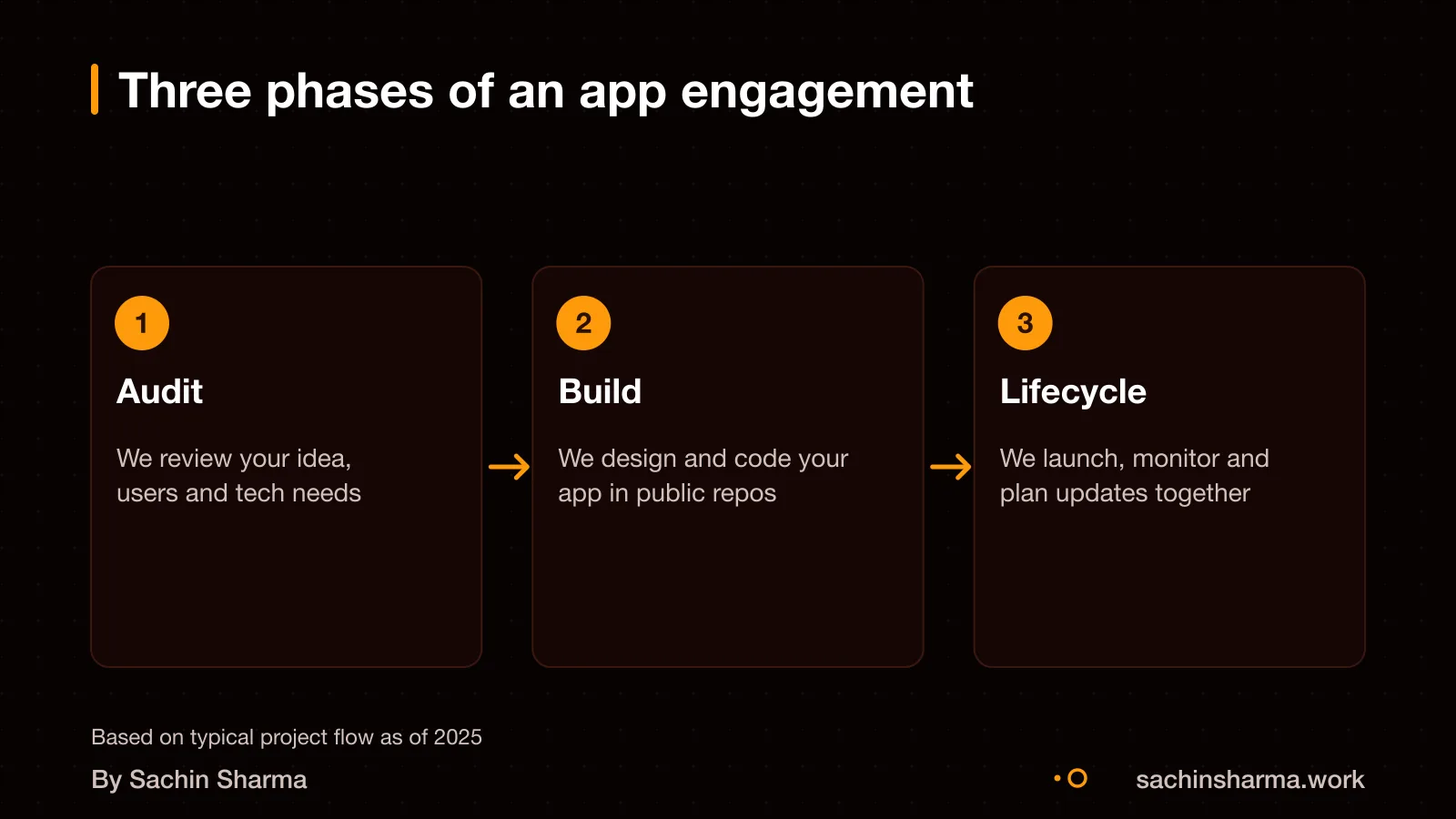
A typical engagement runs in four phases: audit, build, lifecycle, and attribution. Each phase is milestone-driven and allows you to review progress before moving forward. As a client, you provide input at each stage, and changes to features can be made without renegotiating the entire project.
The audit phase reviews your target audience, competitors, creative assets, and tracking needs specific to your market. This takes 1 to 2 weeks. You are expected to share access to existing materials and clarify your goals.
Next, the build phase starts. For apps, this means developing core features in weekly sprints. You receive working versions every few days. The channel build for real estate includes Meta Ads, Google Ads, and WhatsApp Marketing with local context. Creative production includes 20 to 50 variants per month at scale.
Lifecycle management follows, where email, WhatsApp, and retargeting are set up to match your customer journey. Attribution is enabled from day one using server-side tracking to measure what works.
Unlike fixed-price contracts, a dedicated team model supports flexible scope. You can adjust priorities as you learn, without delays or renegotiation. This works best when you are available for short weekly check-ins.
For apps beyond real estate, the same structure applies, audit, build, lifecycle, and tracking, but with features tailored to your business. You stay in control throughout.
Local, remote or hybrid: what works in Chhattisgarh
Do you need to meet in person?
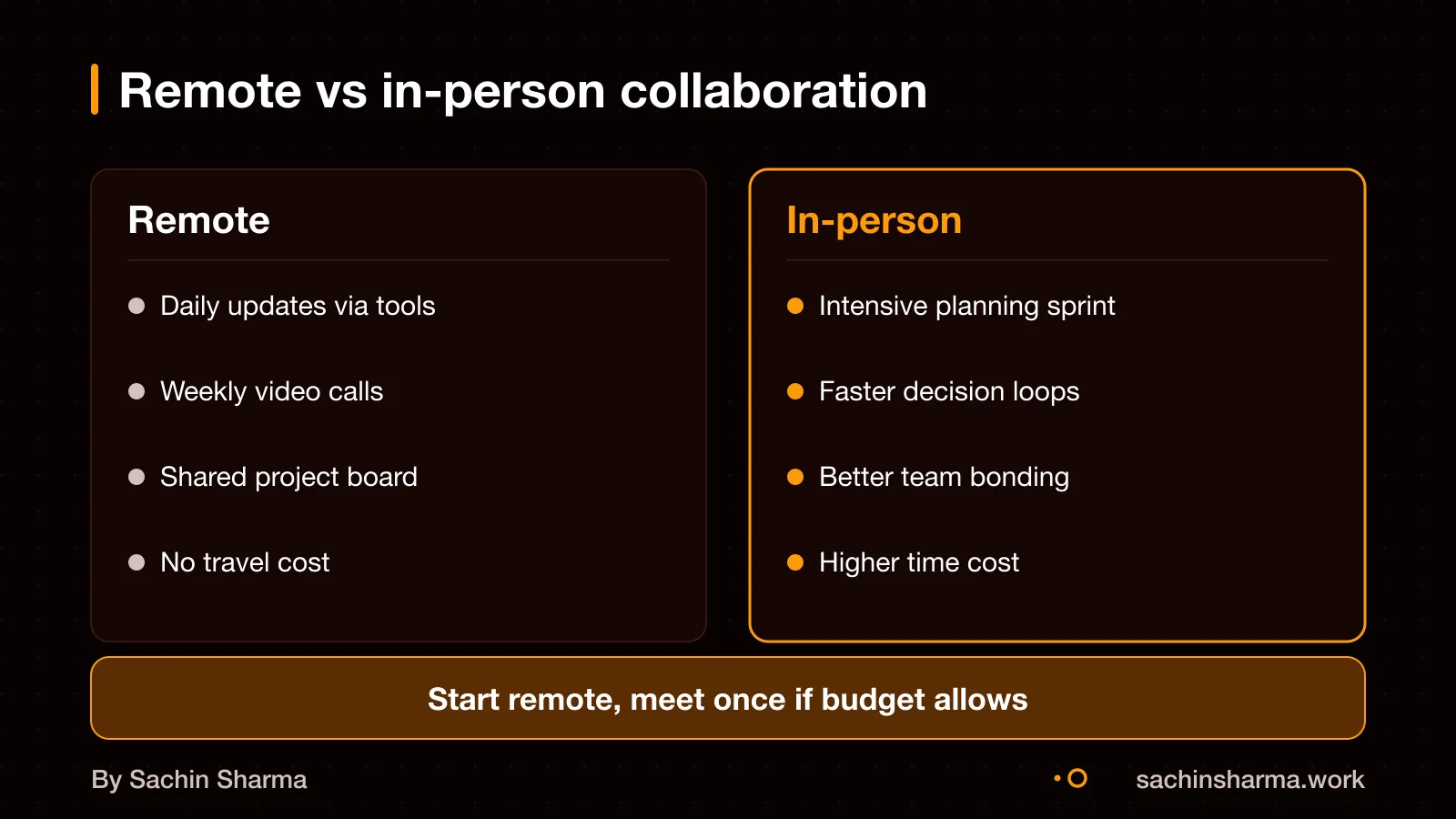
You can run the entire project remotely from start to finish. I work directly with clients across India using digital tools for communication, planning and code sharing. Regular in-person meetings are not needed. Remote work keeps costs lower and schedules flexible. Most updates happen over WhatsApp, email or video calls.
An in-person meeting might help at the start to build trust, especially if you are based in Raipur or Chhattisgarh. Meeting face to face can make it easier to explain your business needs. But it is not required. Many clients never meet in person and still deliver great apps.
Requiring in-person attendance adds risk. It limits your choice of developers. It can delay work if travel is needed. It may increase costs. Some firms use local presence as use, but that is not how I work. The evidence shows institutions like NIT Raipur require attendance for staff, but client projects do not follow the same rule. You get full access to progress and code from day one, so trust comes from transparency, not location.
How are payments structured?
This gives you full budget control and lets you pause or stop at any milestone. There are no large upfront payments. Research from IEEE shows that developer turnover can reduce team productivity by up to 20% due to onboarding and knowledge transfer overhead. That loss comes from time spent onboarding and transferring knowledge. Milestone billing reduces this risk by keeping work visible and progress clear. Long-term support can be discussed, but initial builds follow milestones. This way, you know what you are paying for.
Want a number for your idea? Send one line on WhatsApp. I reply with what drives the cost and what to cut.
Message me on WhatsAppWho actually writes the code?
I work directly with clients and write code myself. If a project needs more people, the team is built based on your technical needs and business domain.
You can interview team members before they join. This helps you check their skills and fit. Team composition is not fixed. It changes as your product grows. If you start with a simple app and later add AI features, we bring in the right experts.
Some software firms offer custom development using tools like Flutter. But I do not run a firm. I work solo, so there are no handovers or miscommunication. You get one point of contact who codes, tests and delivers.
Hire a Flutter developer in Raipur if you want focused expertise.
Can you see the code during development?
Yes, you can see and review the code at any time during development. The team behaves like an extension of your company. This open workflow means you are never locked in. Even if we stop working together, you keep full access to the code and can hand it to another developer. Using your tools and sharing code early prevents vendor lock-in. For example, if you use Jira or Trello, I work inside those systems so nothing happens in the dark.
To verify real progress, check the code commits and test reports yourself. A checklist on another page shows how to verify proof of work How to verify proof of work.
What happens at final handoff?
You receive access to accounts and tools used in the project, as per the contract. This includes the code repositories, hosting accounts, domain registrar, and any third-party services like analytics or payment gateways. You own everything built for you.
Basic documentation may be included, depending on the contract. Full technical documentation depends on the contract and can be added as a milestone. One project delivered a multi-tenant platform for a family-run conglomerate.
Deployment support means I help you go live, including final testing, server setup, and launch checks. You are present during deployment so you learn how to manage updates. Post-launch support options are not described.
shows that keeping the same team helps long-term decisions, which is why I stay available for follow-up work if you want it.
Have a quote in hand? Send it to me and I will mark what is missing.
Message me on WhatsAppHow is data kept secure?
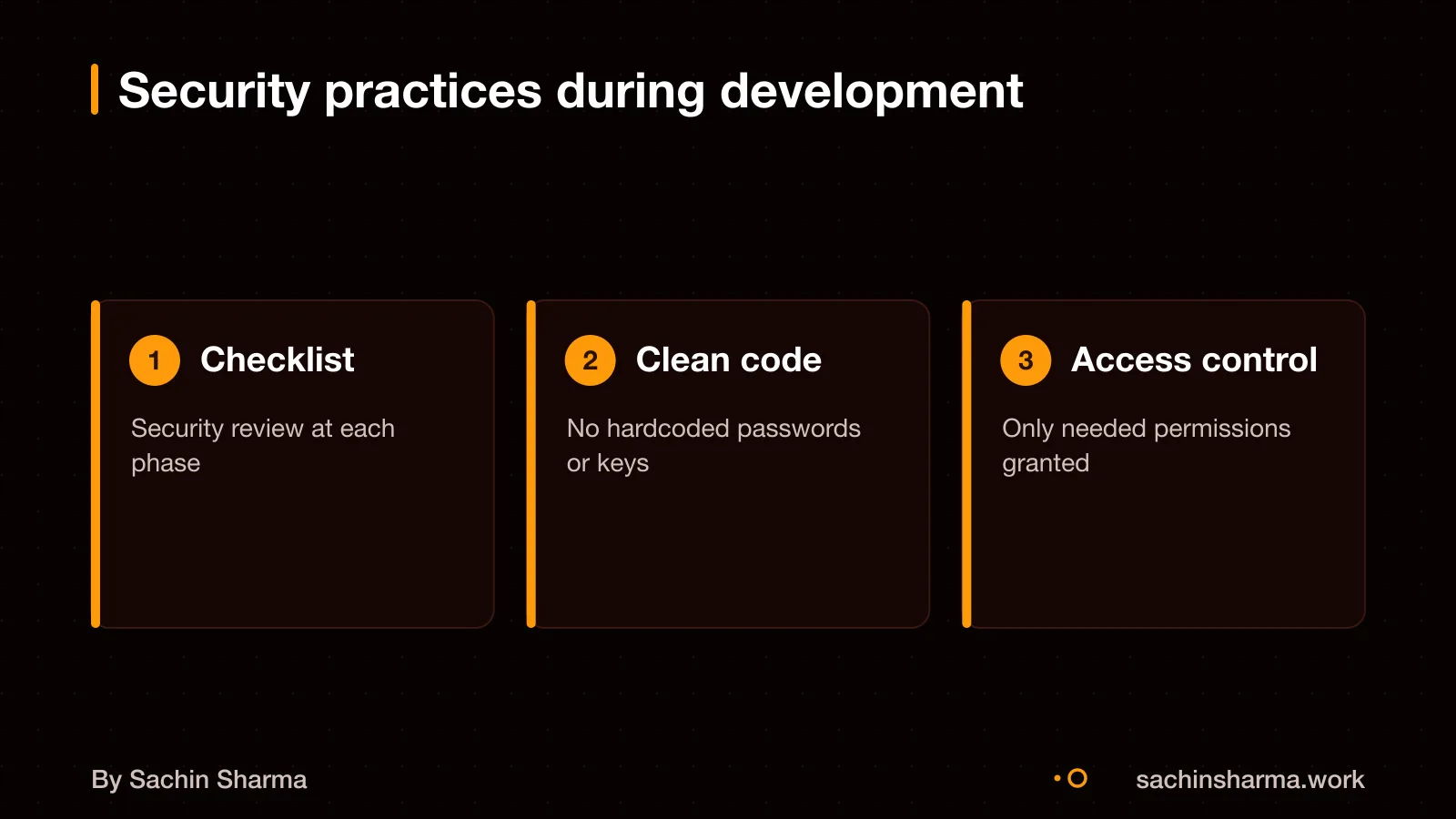
Good practice is to encrypt data at rest and in transit and manage keys securely. You should verify this by asking for proof of encryption methods used. Checking that secrets are stored in secure vaults, not in the codebase. Developers should follow secure coding in every stage of development, including access controls for authentication and authorisation.
Data should be encrypted at rest and in transit. Secrets should be securely stored and not hardcoded into application code.
To check if data is encrypted, ask your developer: - Whether data is encrypted on the device (at rest) and over the network (in transit). - How cryptographic keys are generated, stored, and rotated. - For a short report showing where secrets are kept, it should not include filenames like `config.json` or `secrets.env` in version control.
Hardcoded secrets can be found by scanning the code for keywords like 'password', 'API key', or 'secret'. Tools like GitGuardian or pre-commit hooks can catch these before launch. As a client, you can request a scan report from your developer to confirm no secrets were left behind.
Secure coding should not be an afterthought. It must be part of the build process from day one, with regular code reviews and automated checks. Secure coding should be integrated into every stage of the secure software development lifecycle as part of a DevSecOps program.
What legal agreements are needed?
A contract should cover data rights, delivery milestones, and responsibilities. Sector rules apply if you are in real estate in Raipur, including DPDP Act 2023, ASCI, and RERA. The contract sets out data rights, delivery milestones, and who is responsible if something goes wrong.
Before launch, public-facing parts of your app or website may be checked for compliance risks. For example, if you are in real estate in Raipur, your project may follow compliance layers relevant to real estate marketing. DPDP Act 2023 applies to user data handling in real estate developer engagements in Raipur.
Compliance risks are reduced by building checks into the development process. I review designs and features early for legal fit, not just technical fit. For instance, user consent flows are built to meet DPDP requirements before coding starts. If your sector has a regulator, we will map their rules early.
Ask your developer to provide a copy of the signed agreement and any compliance checklists used.
Related reading: Ten warning signs, collected, DPDP Act: consent flows an Indian app actually needs.
Next step: message me on WhatsApp with what you want to build. No forms, no sales team.
Message me on WhatsAppAssumptions behind the numbers
- Developer works remotely using standard collaboration tools
- Project follows agile delivery with visible milestones
- Client prefers monthly billing over large upfront payments
- Security practices are verified, not assumed
- Handoff includes usable code and documentation
Six clauses, in plain words
In Raipur, working with a developer means choosing clarity in writing, access to code and fair payment terms. Here is what a solid agreement says, clause by clause.
Raipur has fewer large agencies than Delhi, so vetting happens through shipped work and references. Remote collaboration tools make daily sync easy even without a local office.
Whether GST is included in the quoted price or added later, stated clearly.
Why it matters: It avoids surprises at payment time and helps compare quotes fairly.
The clauses above explain intent in plain words. They are not legal text, so have a lawyer read the real agreement.
Read the quote with these
- Is the quoted price inclusive of GST?
- Who owns the code and design files once paid?
- Can I talk to the developers directly?
- How is payment linked to working software?
- Do they follow secure coding practices?
- What do I get if we stop mid-way?
Questions people ask
An engagement for a real estate developer in Raipur includes deliverables such as audit, channel build, creative production, lifecycle management, and attribution setup.
I work as an extension of your company.
Most engagements settle at 6 to 12 month retainers, which may include maintenance.
Common support models include monthly retainers for ongoing work or per-incident billing for specific fixes. Retainers typically last 6 to 12 months. Choose based on how often you expect changes.
Exact payment patterns for Raipur businesses are not known. Milestone-based payments are common in Indian tech projects. You pay only when a clear block of work is delivered and approved.
Confirm exact availability with your developer.
It means remote delivery with direct collaboration. I work directly with clients across India, with no agency layers. <a href="/locations/hire-app-developer-in-chhattisgarh/">Local, remote or hybrid: what works in Chhattisgarh</a>.