What is a coaching or test-prep app?
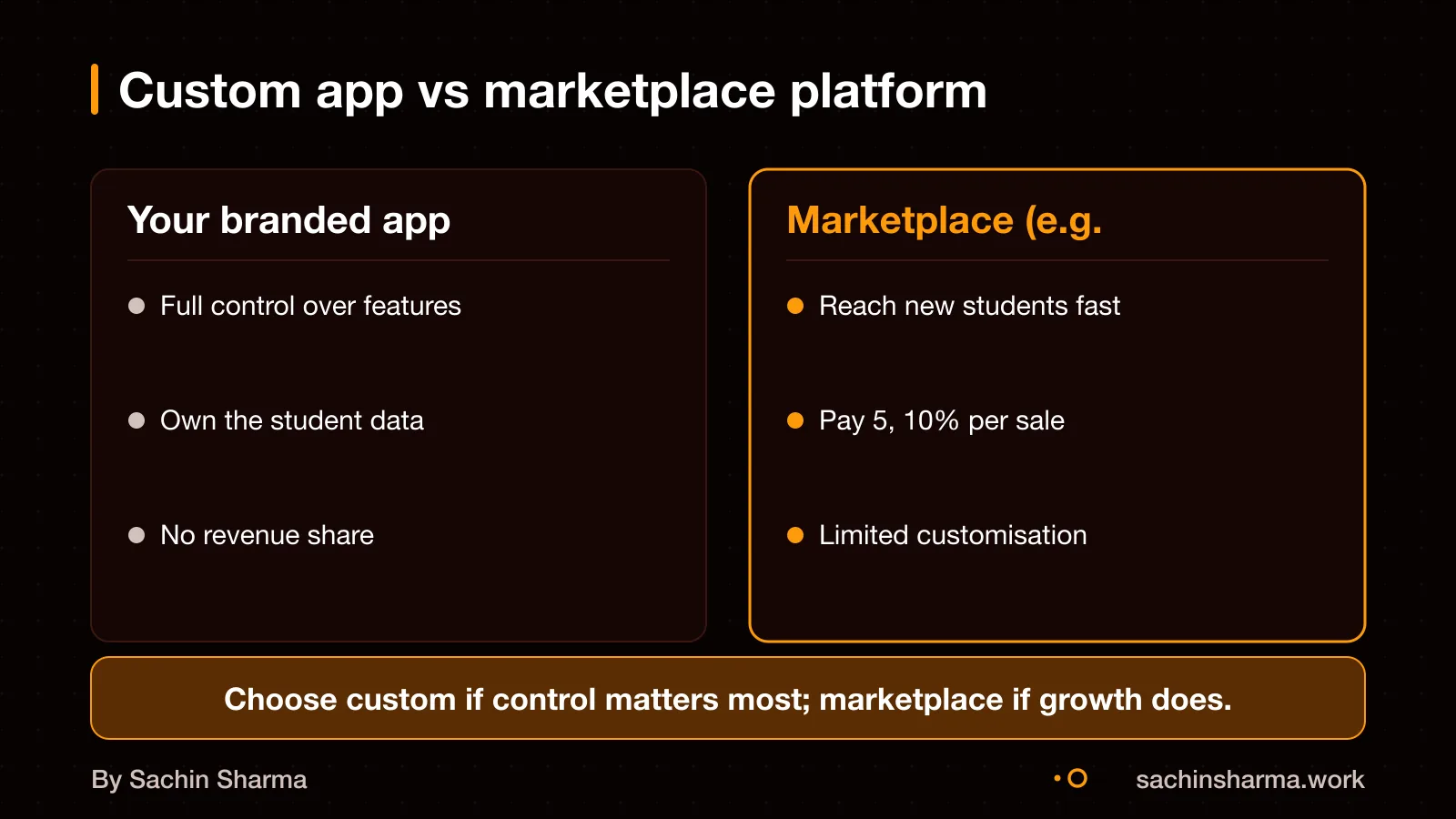
A custom coaching or test-prep app is built for one institute and gives you full control. Unlike Unacademy which is a marketplace for many tutors. You own the data, design the learning path, and set the rules. These apps usually include video lessons, quizzes, doubt-solving chats, progress tracking, and offline access. They help students prepare for exams or learn new skills on a platform branded as yours. SaaS tools like Learnyst or Classplus offer similar features but run on shared infrastructure with limits on customisation. A custom app makes sense only if your teaching model needs unique workflows.
For example, a test-prep startup might need AI-based mock tests that adapt to each student’s weak areas, something off-the-shelf platforms may not allow.
If you are deciding between building your own or using a platform. See how to build or buy a quick commerce app, the same trade-offs apply.
Start with a website or mobile app?
You can start without a website by using WhatsApp payment links to collect fees. This works if your coaching is personal and you manage classes over calls or video. A website helps when you want to list courses, share materials, or let students sign up on their own.
Build a native mobile app only when you need features that websites cannot offer, like offline video access, push reminders, or background tracking. For most coaching businesses, a responsive website or a SaaS platform is faster and cheaper.
If you later decide to build, Flutter lets one codebase run on both Android and iOS, cutting development time and cost. This means lower effort to maintain two apps. Some SaaS tools like Edmingle also offer white-labeled mobile apps along with web access.
What does a custom coaching app cost?
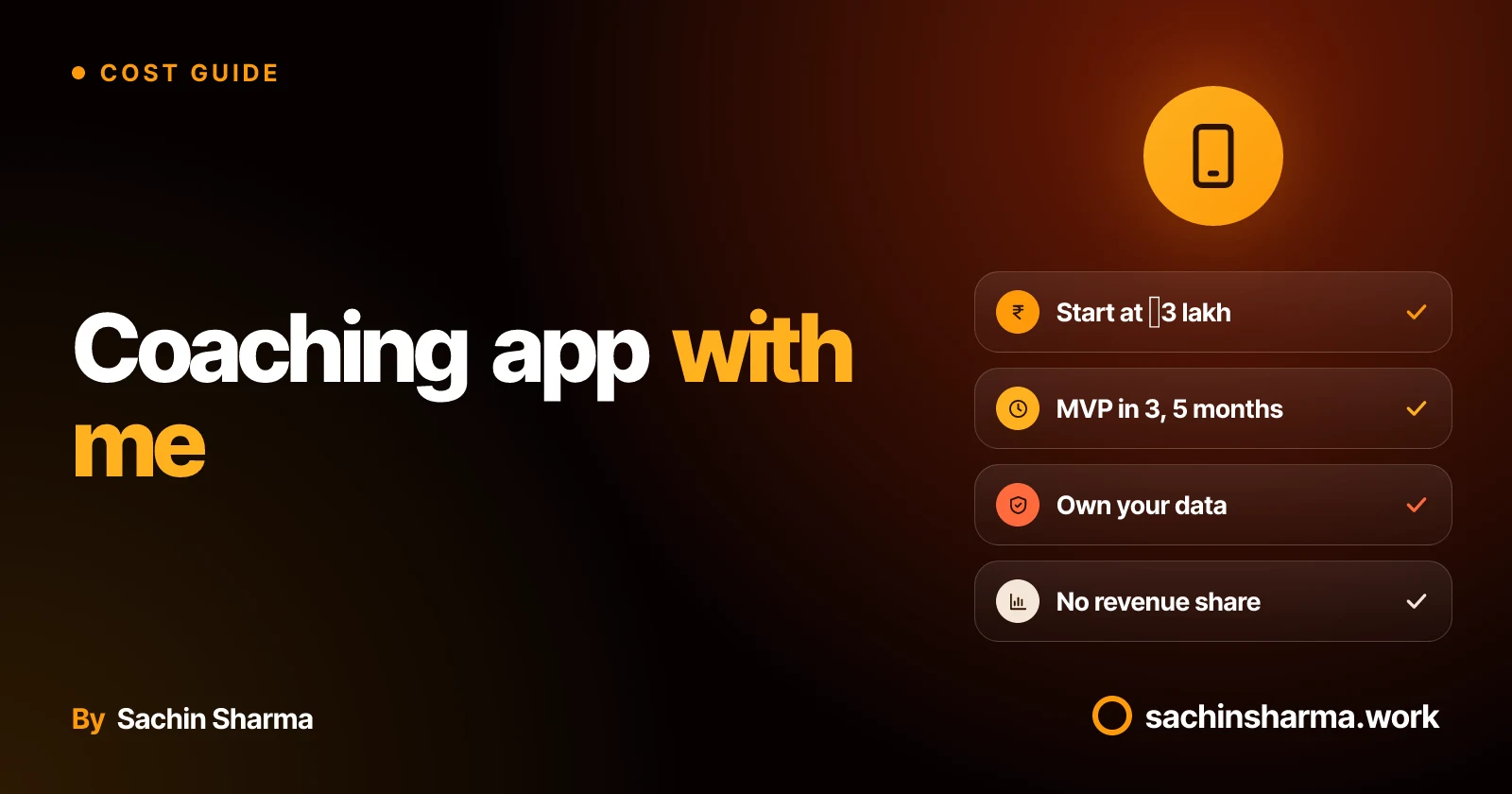
A simple custom coaching app costs ₹4 to 8 lakh. This is for a basic app with user login, course listings, video playback and progress tracking. As complexity grows, so does cost.
A simple app costs ₹4 to 8 lakh. It includes core features only, built for one user type, with no third-party tools. Think of a single-screen course player with quiz support.
A moderate app costs ₹8 to 15 lakh. It adds admin panels, payment integration, notifications and multi-role access. For example, a test-prep app with daily quizzes, leaderboards and subscription billing.
An enterprise app costs ₹15 to 25 lakh or more. It supports multiple brands, offline sync, advanced analytics and custom AI features. An example is a chain of coaching centres sharing content but managing students separately.
SaaS platforms like Learnyst or Classplus cost ₹15,000 to 1,00,000 per year. They cut initial cost but limit design and data control.
Want a number for your idea? Send one line on WhatsApp. I reply with what drives the cost and what to cut.
Message me on WhatsAppSaaS platforms: Learnyst, Edmingle, Classplus
SaaS platforms for coaching apps cost ₹3,149/month for Learnyst, ₹7,499/month for Edmingle, or ₹19,999/year for Classplus. Most platforms lock you in for 12 months with no refund, and some may take 5% to 10% of your course revenue. Learnyst starts at ₹3,149 per month and suits exam-prep academies best. Edmingle starts at ₹7,499 per month and includes SCORM support, APIs, and multi-batch management, with no transaction fees. Classplus charges ₹19,999 per year no matter which plan you choose.
Hidden fees are common. Most platforms take a 5% to 10% share of your course sales. You also risk losing access to your content if you cancel late or miss renewal, as many enforce non-refundable 12-month contracts. Always read the fine print on data export, revenue share, and contract length before signing.
Timeline and phased build: MVP first
A custom coaching app takes 3 to 5 months for an MVP and 6 to 9+ months for a full LMS. You can start with core features and add more after launch. This reduces risk and lets real user feedback guide what to build next.
Work is scoped by fixing the feature list in writing before development starts. Payments are tied to milestones like design approval, MVP delivery, and final launch. Any new request after signing is handled through a change process to avoid cost leaks.
For example, an exam-prep app MVP might include student sign-up, course videos, quizzes, and progress tracking. After launch, you could add live classes, doubt-solving chats, or AI summaries based on what users need most.
This phased approach works well if you want to test demand without spending ₹10+ lakh upfront. It also avoids building features no one uses.
The steps to build a coaching app are not known. What the client must provide is not known. Support after launch is not known.
how long to build an exam prep app
Have a quote in hand? Send it to me and I will mark what is missing.
Message me on WhatsApp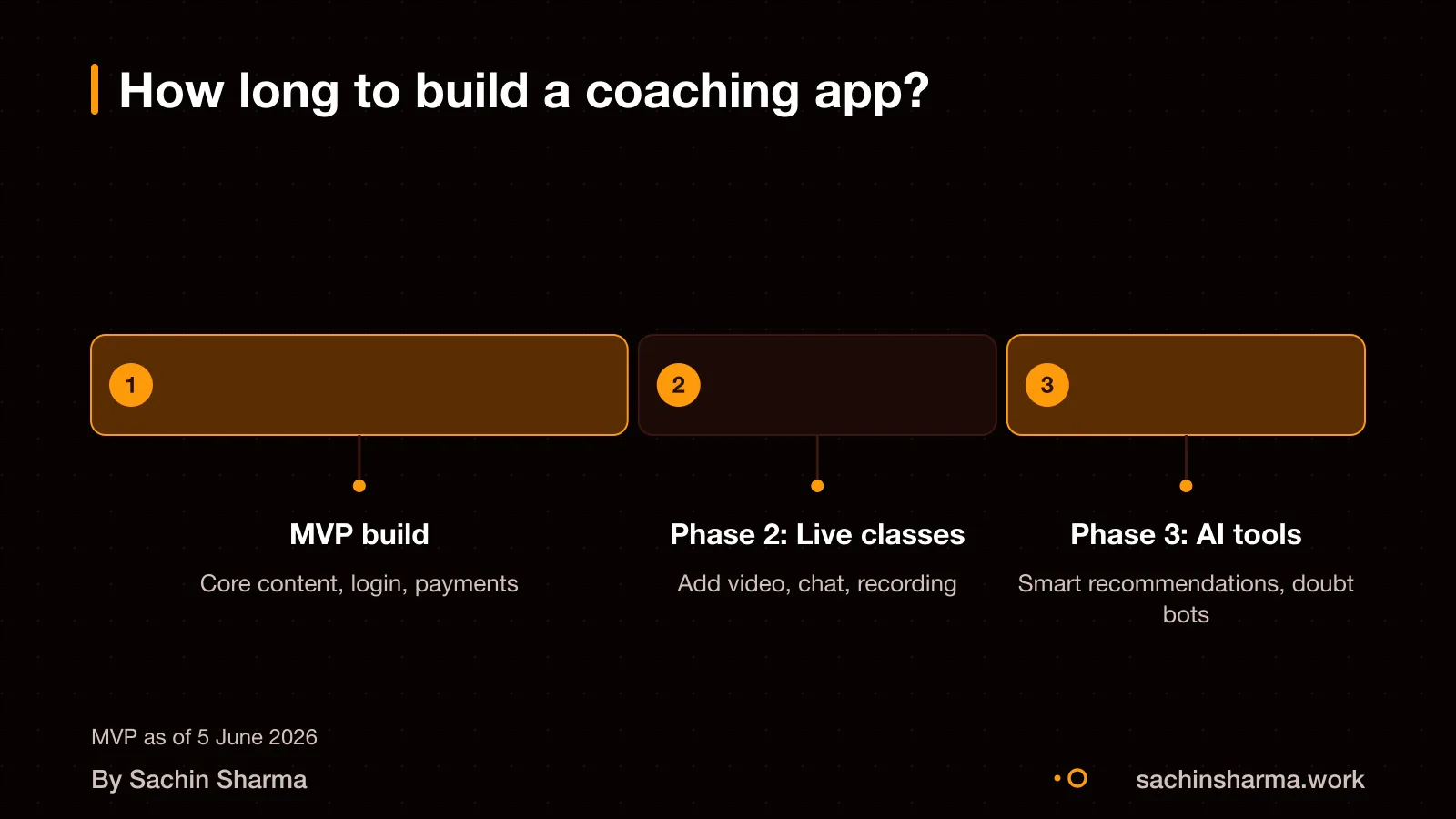
Who owns the code and data?
The developer who writes the code owns it by default under Indian law. You do not automatically own the code just because you paid for it. To gain full ownership, you must get a written assignment of intellectual property. The safest way is to include this clause in your contract: "On full payment, all source code. Copyright and intellectual property pass to the client, worldwide and in perpetuity". Without this, the developer can legally block updates or charge extra later. I include this transfer in every agreement I sign. You should confirm the clause is in your contract before any work begins. Ownership of your user data always stays with you, as long as the app is set up correctly.
Legal and data privacy rules
You must follow the Digital Personal Data Protection Act, 2023 (DPDP Act) if your coaching app collects personal data from users.
You need to provide a notice that describes the personal data and the purpose of its processing. This notice must appear before or at the time you ask for any personal data, such as name, phone number or email. The policy must be easy to read and available in the user’s preferred language.
If there is a data breach, you must inform the Data Protection Board and affected users without delay. This includes unauthorised access, loss or leakage of personal data. How you report it will depend on rules yet to be issued by the government.
You only need to appoint a Data Protection Officer (DPO) if you are classified as a Significant Data Fiduciary. Most small coaching apps will not meet this threshold. However, if you do, the DPO must be based in India and report to your top management.
Until then, you should design your app to be privacy-safe by default. Store only what you need, encrypt sensitive data, and never share it without clear consent.
Legal compliance is not optional, but you do not need a lawyer on retainer to start. Use a standard privacy policy template for Indian edtech apps and update it once the DPDP rules are published. For high-risk or large-scale apps, consult a data protection expert before launch.
When this advice is wrong
When this advice is wrong
- Do not build a custom app if you are just starting out and have fewer than 50 students. Use a simple website or WhatsApp to take payments and share materials. This saves money and time while you test demand.
- A SaaS platform like Learnyst or Classplus is better if you want to launch fast and do not need unique features. These give you course hosting, payments and student tracking without coding.
- Choose a mobile app only if your teaching method relies on offline access, gamified learning or heavy interactivity. Otherwise, a responsive website works for most coaching needs.
- If your main goal is to sell recorded courses to a wide audience. A marketplace like Unacademy or Physics Wallah may bring more reach than a custom app.
Assumptions behind the numbers
- Base app includes core features like login, course list and basic profile.
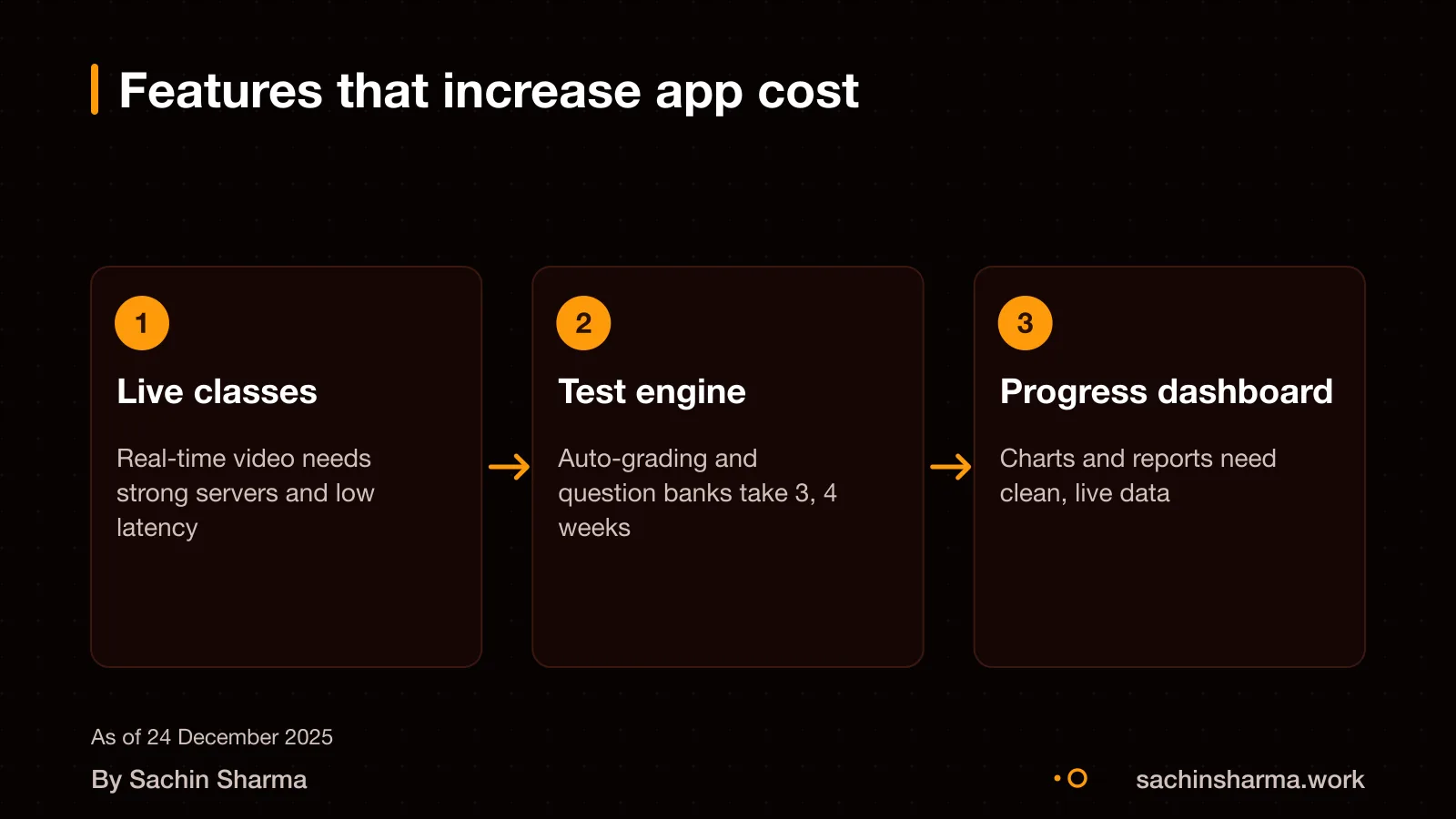
- Adding live classes increases backend and QA effort significantly.
- Test engine requires auto-grading logic and timer controls.
- Progress tracking implies charts, reports and data exports.
- Third-party integrations include at least one payment gateway and SMS service.
- App publishing fee is optional and varies by vendor.
- Yearly maintenance is 15–20% of build cost as per industry norms.
Work out your own number
Here's how the cost of a coaching app breaks down with me. Adjust the features and see what moves the price.
Your working total
₹4,40,00011 weeks × 2 people × 5 days × ₹4,000- Scope and design18%
- Build55%
- Testing and fixes18%
- Publish and go live9%
The weeks shown are an example of a small app, there to be changed. Fees you pay others (store accounts, cloud, SMS) are not in this total.
What moves the price
- Add live classes
Real-time streaming adds backend load and QA effort.
- Add test engine
Quizzes, timers and auto-grading need careful logic.
- Add progress tracking
Charts and reports mean more data handling and views.
- Add third-party integrations
Payment gateways, SMS and cloud tools add setup time.
- Start with one platform
Android or iOS only cuts design and testing effort.
- Use ready-made modules
Managed auth, CMS or media tools save weeks.
- Lock scope early
Fewer changes mean fewer surprise weeks mid-build.
Fees that go to someone else
App store registrations
Google Play (₹1,850 one-time) and Apple Developer Program (₹6,500/year approx).
Cloud, SMS, payments
Usage-based fees paid directly to providers like Razorpay or AWS.
App publishing fee
One-time fee of ₹10,000–50,000 charged by some platforms for branded app submission.
Ask for these before you sign
- What features are in the base version?
- How much does each add-on raise the cost?
- Are there hidden fees I pay later?
- Can I reduce cost by cutting scope?
- What’s the yearly cost to run it?
Questions people ask
Work is fixed in scope with milestone-based payments and a defined change-request process. This keeps costs clear and changes managed. If new features are needed, they go through a written request and approval step.
Yes, if you own the source code and all access, and another developer can deploy an update without help from the original developer. The real test is whether a new developer can make and release a small change using only what you have. Check this at handover.
AI features need phased delivery because of data prep, model validation, and extra testing. Start with core functions, then add AI in steps. This reduces risk and lets you test each part. See how an AI feature was built for a legal app [link].
Use login with mobile OTP, profile photos, or manual roll calls during sessions. These are simple, low-cost methods that work well for most coaching apps. Avoid biometric claims unless you have tested them. For secure access, combine OTP with a verified mobile number.
An offline-first design is possible, but not confirmed for coaching apps. Some apps cache videos, quizzes and progress data so students can keep learning without a live connection. The key is syncing data when back online. Check if your target users need this and test early.
Flutter allows one codebase for both Android and iOS, saving time and cost. Native apps may be better if you need deep hardware access like advanced camera use. For most coaching apps with videos, tests and messaging, Flutter works well. Test performance on low-end devices.
Ask for a breakdown of past timelines and costs. Request a short demo of their process and tools.
WhatsApp payment gateway support is available in India, but you must verify payment status via the payment lookup API before fulfilling orders. Discuss this with your developer during the planning phase.