What are the three main ways to build an e-commerce app?
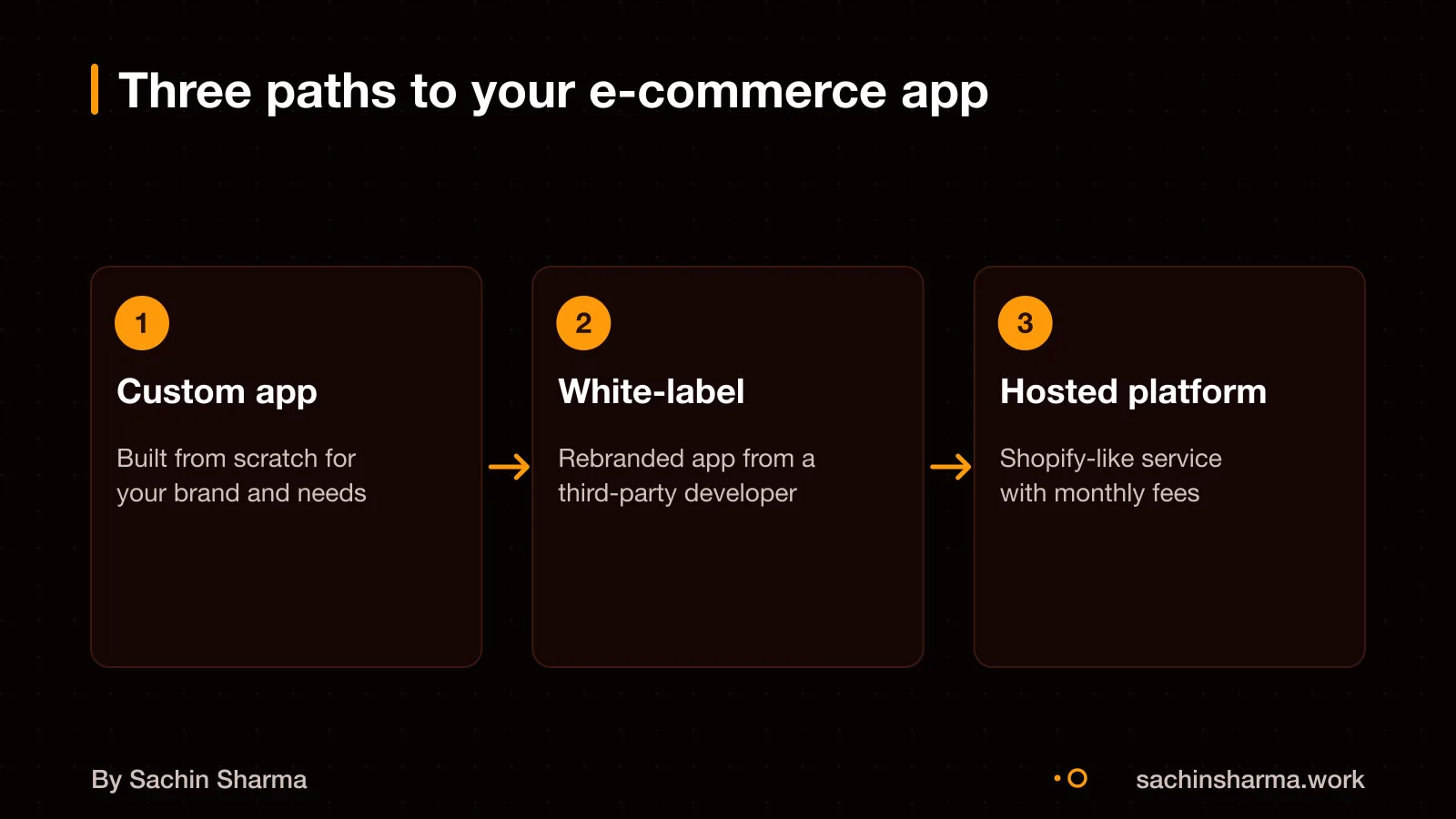
A custom e-commerce app is built from scratch for your business, giving you full control over features, design, and backend logic. It can adapt to how your customers actually behave and integrate with local tools like UPI, DigiLocker, or regional delivery partners. For example, a custom app for a Raipur-based two-wheeler dealership manages bookings, inventory, and service logs in one system.
A white-label e-commerce app is a pre-built product rebranded as your own. You get faster launch times but limited customisation. These apps are often used by small businesses that want an app presence without heavy tech investment. Instamojo is an Indian platform that supports such models for small sellers and startups.
A hosted e-commerce platform runs your store on someone else’s infrastructure. You pay a monthly fee and use tools like website builders, payment gateways, and inventory management. Shopify is widely used globally, while Zoho Commerce is a local option with website creation and stock tracking built in. You trade ownership for speed and simplicity.
When does a custom e-commerce app make sense for your business?
A custom e-commerce app makes sense when your business has proven demand and steady monthly sales. This shows you have product-market fit, and it is time to scale on your own. At this stage, a custom app helps you take full control of your brand and customer experience.
Marketplaces like Flipkart or Amazon limit how much brand identity you can build. A custom app lets you design every screen, from logo placement to checkout flow, to reflect your brand. You can add local touches, like regional language support or festival-themed layouts, that platforms do not allow.
Long-term profitability improves because you avoid recurring commission fees. Hosted platforms charge 5 to 15 percent per sale, which eats into margins over time. A one-time development cost for a custom app, even if higher upfront, often costs less over three years. See the cost to build a fashion e-commerce app for a real-world estimate.
What does each e-commerce app option really cost?
As an estimate, a custom e-commerce app costs ₹18 lakh upfront for a 6-month build with two mid-level developers. Hosted platforms charge a 2% fee on each sale, plus 18% GST on that fee. Annual maintenance for a custom app is 15% of the build cost, or ₹2.7 lakh per year.
For a business doing ₹1.2 crore in annual sales: - Custom app (3-year total): ₹18 lakh (build) + ₹8.1 lakh (3 years maintenance) = ₹26.1 lakh - Hosted platform (3-year total): 2% of ₹3.6 crore sales = ₹72 lakh, plus 18% GST on fees = ₹12.96 lakh, total = ₹84.96 lakh
These numbers assume: - A 6-month development timeline - ₹18 lakh build cost based on $80,500 for two mid-level developers over 12 months. Prorated to 6 months and converted to ₹ at 83 per $ - 15% annual maintenance based on the mid-range of $500 to $2,000 monthly retainer. Converted to ₹ and applied to the build cost - - No hidden team overheads like ramp-up or attrition, which can add 40% to 80% to developer costs
A custom app has higher upfront cost but avoids recurring transaction fees that add up over time.
Want a number for your idea? Send one line on WhatsApp. I reply with what drives the cost and what to cut.
Message me on WhatsApp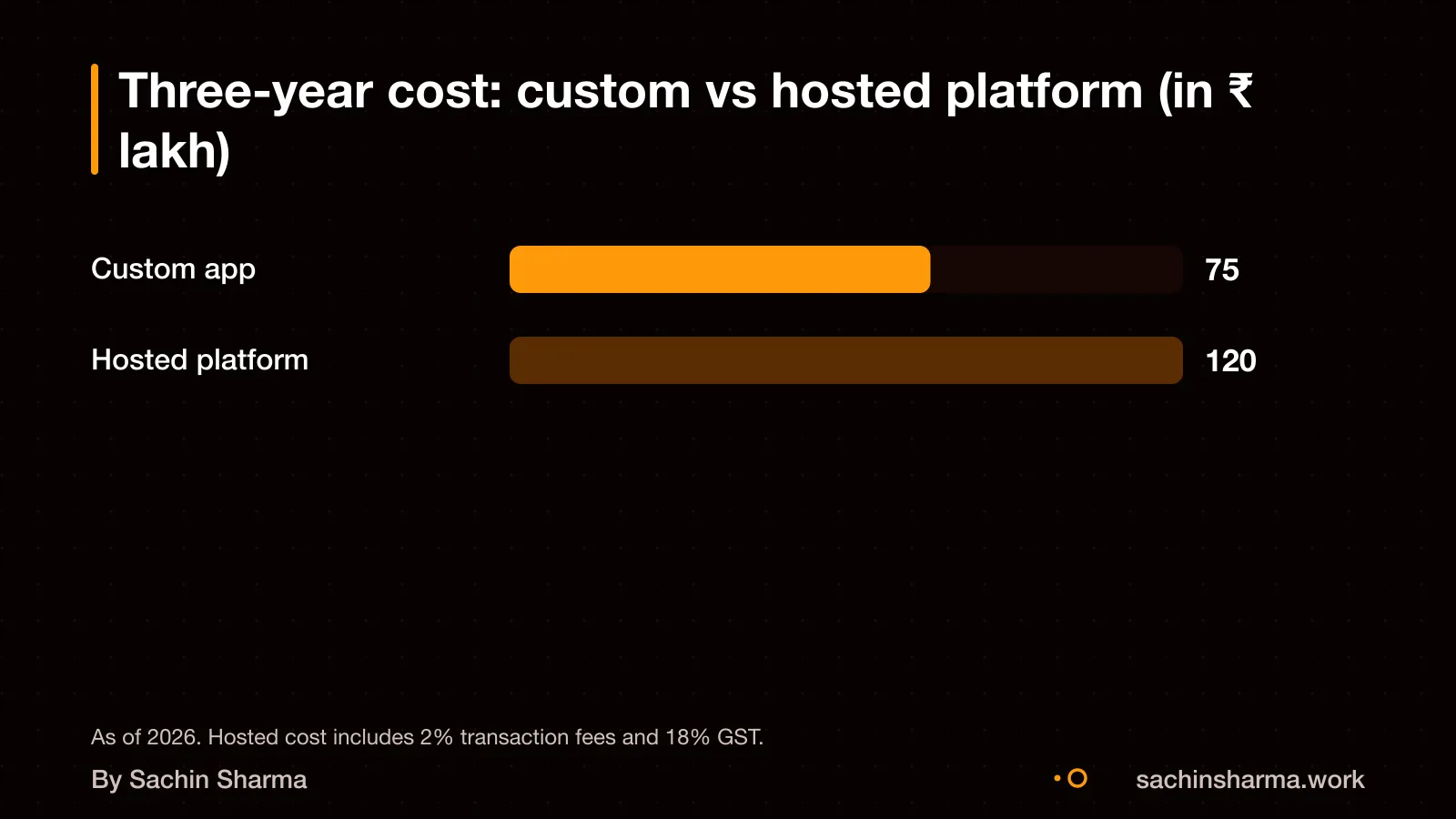
How do UPI and cash on delivery affect your app design?
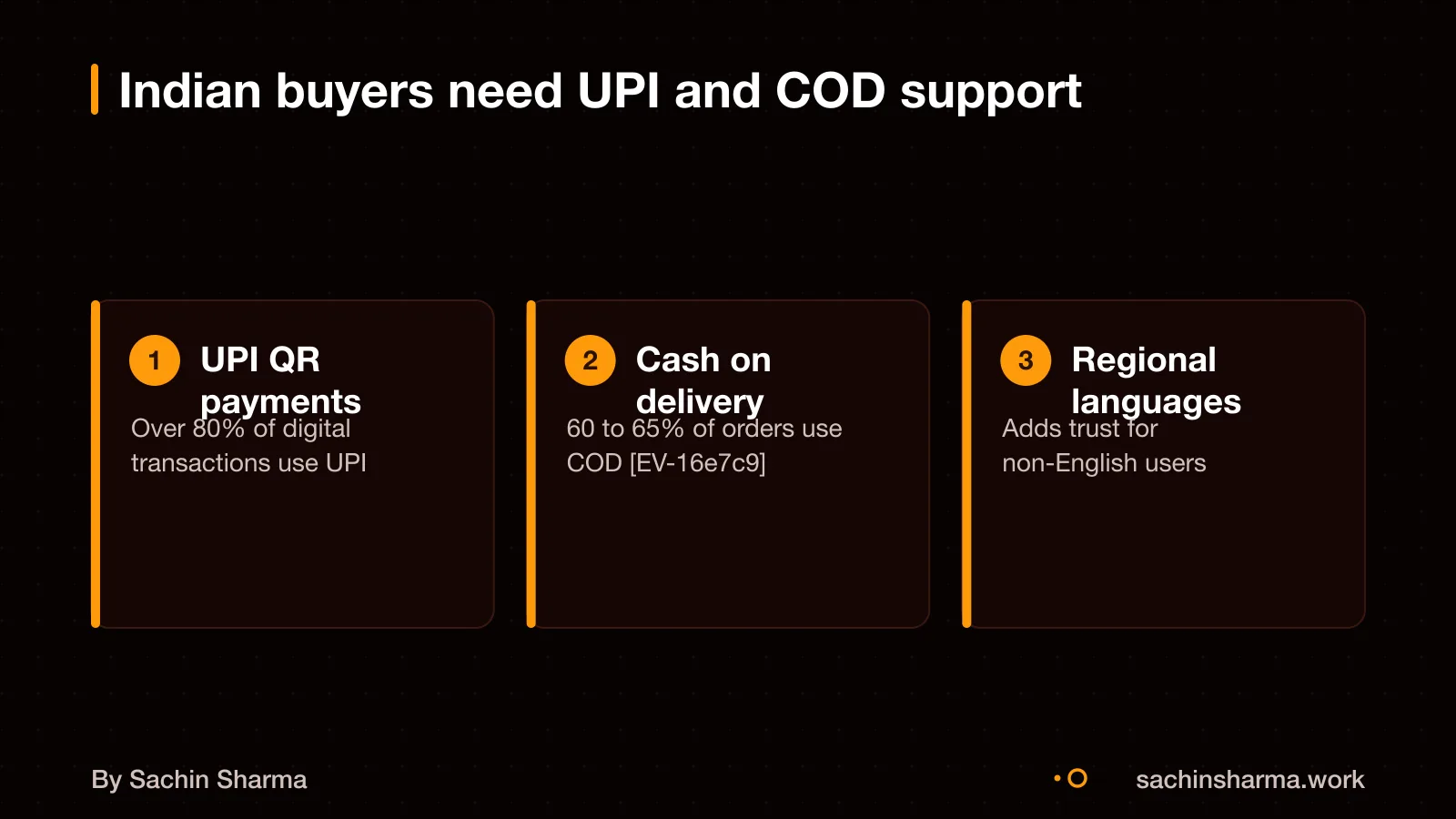
Your app should support UPI and regional languages to serve Indian buyers. Your payment screen can offer Hindi and English, as UPI supports both. This is part of RBI’s two-factor authentication rule for UPI.
High COD usage increases your risk and cost because 60 to 65% of e-commerce orders in India are paid for on delivery. Unlike prepaid orders, you ship first and only get paid if the customer accepts the package. This ties up your cash in inventory and logistics.
RTO rate cuts your profits because 25 to 30% of COD orders are returned to origin. Compared to just 2 to 3% for prepaid orders. Each RTO means you lose shipping costs and may have restocking or resale issues. For example, if you ship 100 COD orders, 25 to 30 come back, raising your effective cost per delivered order.
To reduce this, your app can offer small discounts or loyalty points for prepaid orders. This shifts behaviour without blocking COD. You can also use UPI’s built-in features to send payment reminders or request partial prepayment.
For faster delivery in local markets, consider linking your app to quick commerce platforms quick commerce app.
What can go wrong with each approach and how to check?
Marketplace platforms like Flipkart rarely let sellers build ownership because you do not control the customer journey. You cannot personalise follow-ups, track user behaviour, or offer loyalty rewards. Over time, this restricts growth, profitability, and brand reputation. You are also at risk of sudden policy changes or account suspensions without appeal.
IP disputes in offshore development can cost $200,000 to over $1 million before settlement. This happens when contracts do not clearly assign code ownership or when developers reuse templates across clients. In India, such disputes can last years and cost over ₹1 crore when legal fees, lost sales, and downtime add up. To avoid this, ensure your contract states that all code, design, and IP are yours by default.
To verify a developer is not reselling a template, ask for a commit history showing custom work over time. Check that the codebase has no ties to known white-label products. A truly custom app will have unique folder structures, custom API integrations, and no generic branding in the code. If the developer refuses to share even a partial repo, consider it a red flag.
A poorly managed developer replacement can cost 3 to 5 weeks of lost output, equal to $4,200 to $7,000 in unbilled value. This happens when code is undocumented or tightly coupled to one person. To reduce risk, insist on weekly code reviews and version control access from day one.
For more on how risks shape decisions, see how a telemedicine app handles compliance and control.
Who owns the app and code after development?
You may not own the app code and accounts even after payment, unless your contract states so. Payment does not automatically give you full ownership. Your development agreement must include clear intellectual property (IP) clauses stating that all custom-built code, design, and deliverables are yours. This protects you if you want to switch developers later.
The developer may keep rights to tools, templates, or reusable libraries they used to build your app. These are called background IP. But your business-specific logic, data flow, and user interface should belong to you. The Aashwasan app was a Flutter + Firebase gig and contract management app delivered by Sachin.
You can move your app to another developer later. To do this, you need access to the source code, backend servers, and app store accounts. Google Play allows app transfers, but both your current and new developer accounts must be active before the move. You submit a transfer request after checking the rules.
Have a quote in hand? Send it to me and I will mark what is missing.
Message me on WhatsAppWhat legal rules apply to e-commerce apps in India?
Yes, you need GST registration for your e-commerce app from the first sale, no matter how small your income. Under Section 24 of the CGST Act, any seller using an e-commerce platform must register for GST. Even if total earnings are below ₹10,000 a month. Once registered, you must display your GSTIN on every invoice and product page.
You must collect 1% TCS (Tax Collected at Source) on the net value of all taxable supplies made through your platform. This 1% TCS is split equally into 0.5% CGST and 0.5% SGST or UTGST. You are responsible for depositing this tax with the government and filing TCS returns.
Dark pattern rules affect your design by banning misleading or manipulative interfaces. Under the Guidelines for Prevention and Regulation of Dark Patterns, 2023, e-commerce apps must not trick users into purchases. E-commerce entities must comply with the Guidelines for Prevention and Regulation of Dark Patterns, 2023, which ban misleading or manipulative interfaces. You must conduct a yearly self-audit as per compliance guidelines. For example, a "Buy Now" button cannot be made to look like the only choice, and price comparisons must be accurate.
Legal compliance depends on your business model and scale. For your specific case, consult a tax or legal professional before launch.
When this advice does not apply to your business
- You should not build a custom e-commerce app if you are still testing your idea or have not reached steady monthly sales. A hosted platform lets you launch fast and validate demand with less risk. Use it to learn what customers want before committing to custom development.
- A hosted platform is the better choice when your budget is under ₹5 lakh and you need to go live in under 8 weeks. These platforms offer ready-made templates, payment integration, and support. They work well for single-city launches or niche products with simple delivery rules.
- Start with a white-label solution only if you need to brand an existing app fast for a pilot launch. Plan to replace it later. White-label apps are quick to deploy but limit how much you can change the user flow. They also make it hard to add local features like regional language support or UPI auto-fill.
Next step: message me on WhatsApp with what you want to build. No forms, no sales team.
Message me on WhatsAppNext step: start a conversation
Next step: message me on WhatsApp with what you want to build. No forms, no sales team. We will discuss your business needs, review the scope, and agree on a clear next step. You can ask about timelines, budget, or how we would work together. I reply to every message.
Related reading: app development cost in India, Aashwasan gig app.
Assumptions behind the numbers
- White-label cost is estimated based on market averages.
- Custom app cost assumes two mid-level developers for 12 months.
- Maintenance cost is based on USD range converted to INR at ₹80 per dollar.
Pick your situation
I build custom apps, so I benefit from the first answer. That is why the table also shows when a hosted platform is the better pick.
Pick your situation
Custom App wins. Only custom apps let you change anything in the code and layout. White-label skins are limited. Platforms lock you in.
The whole comparison
| Custom App | White-label | |
|---|---|---|
| Upfront cost | ₹80,500 ($1,000) for two developers over 12 months | ₹1.5 lakh to ₹3 lakh (estimate) |
| Recurring fees | $500 to $2,000 monthly for maintenance | ₹10,000 to ₹25,000 annually |
| Control over design | Full control over code and design | Limited to theme options |
| Best for | Businesses with proven demand and steady sales | Brands wanting a quick branded app |
Whichever you choose, ask these
- Will I own the code after launch?
- Can I switch developers later?
- What happens if we stop mid-way?
- Do you handle UPI and COD integration?
Questions people ask
I recommend a custom e-commerce app once you have proven demand and steady monthly sales. It gives you full control over the customer journey, branding, and data, unlike marketplaces.
With a hosted platform like Flipkart, you gain instant access to buyers and logistics support.
Apps can be transferred between Google Play Developer accounts if both are active.
The time to build a custom e-commerce app is not known from available data. It depends on team size, feature scope, and review cycles. For a 6-month development estimate with two developers, see the cost breakdown.
Yes, you can add subscriptions or rentals later in your app. Ensure your app follows store guidelines for billing and user notifications.
You own the code only if your development contract says so. Payment does not automatically transfer intellectual property. Always sign a contract that clearly states IP ownership passes to you.
Post-launch support details are not available in the evidence. Ongoing maintenance typically includes updates, security patches, and backups. A monthly retainer of $500 to $2,000 is common for such services.
Cash on delivery (COD) affects profits because 25 to 30% of COD orders result in Return to Origin (RTO), versus 2 to 3% for prepaid. High RTO raises delivery costs and lowers margins. Encourage prepaid with discounts.
Yes, you can use your own domain with a custom e-commerce app. Domain ownership is standard and gives you brand control. However, specific setup steps depend on your hosting and app architecture. Check this for your case with your developer.