What is a ride-hailing app?
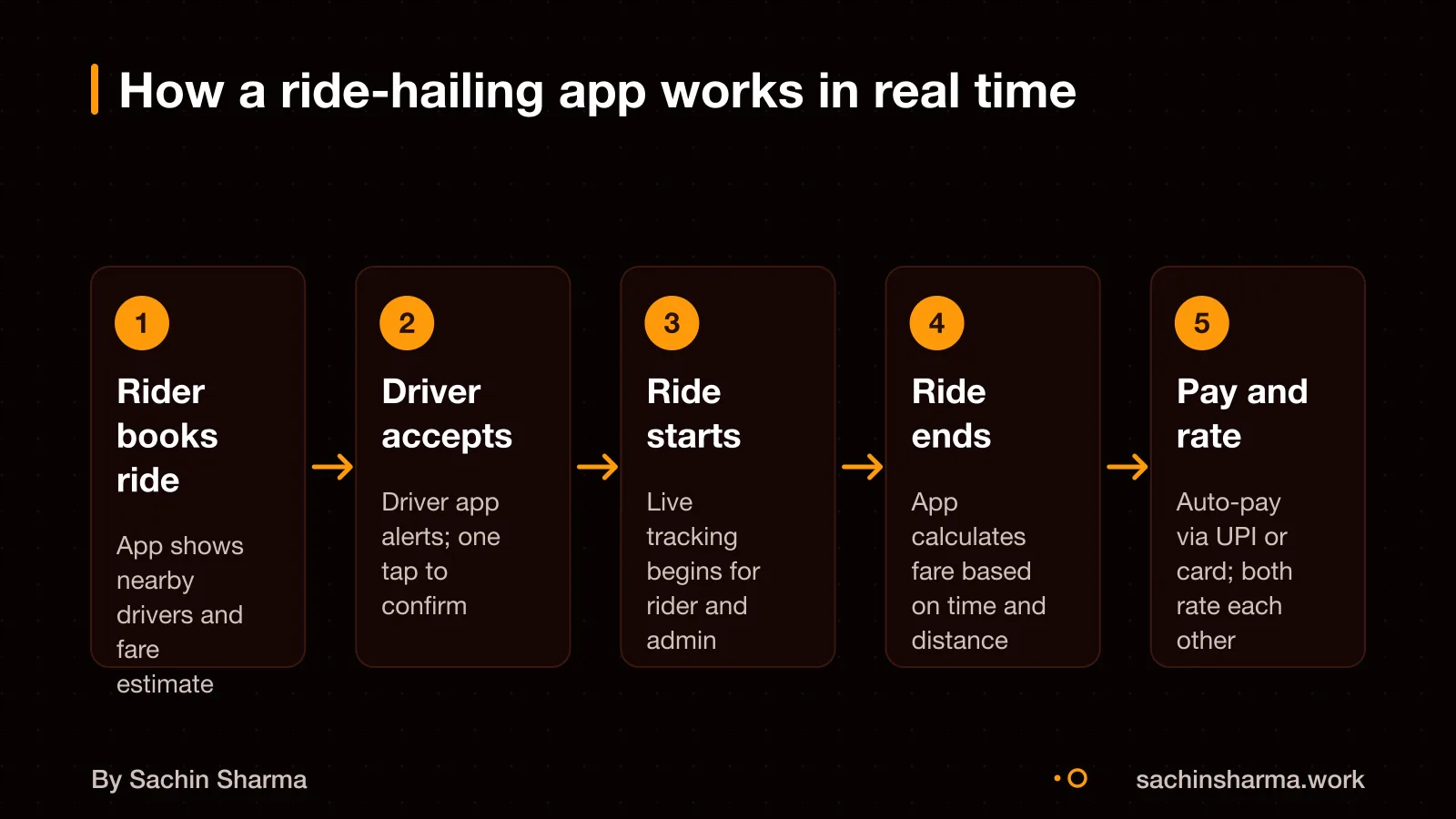
A ride-hailing app connects passengers with drivers in real time using GPS tracking and on-demand booking. It differs from traditional taxi booking apps by using dynamic pricing and real-time matching instead of fixed rates and scheduled pickups. Bike taxi apps are a subset, linking riders with motorcycle drivers for faster trips in heavy traffic, especially in crowded cities. Real-time matching means the system finds the nearest available driver at the moment you book. Dynamic pricing adjusts fares based on demand, time, and traffic, unlike fixed-rate services. These apps often include a rider app, driver app, admin dashboard, and payment integration. Multi-service platforms combine cars, bikes, and other transport in one app. For a full list of features, see Must-have features for a ride-hailing app.
Do you really need to build your own app?
Most ride-hailing startups fail to get enough drivers or riders to stay alive. You may not need to build your own app at all. Instead, start by testing demand on Uber or Rapido for six weeks. Run a small promo: offer ₹50 off for new users and track how many rides happen in your target area. If rides grow by 15% each week, you have real demand.
A white-label solution like RideWyze can get you a fully functional equivalent for a fraction of that cost. These cost $500 to $5,000 per month. This is far cheaper than building from scratch.
For food delivery founders, the smarter move is to test demand first, before writing any code How food delivery founders test demand first. The same logic applies here. If you cannot fill rides on an existing network, a custom app will not fix that.
How much does a custom ride-hailing app cost?
A custom ride-hailing app costs between $30,000 and $300,000 as an estimate, based on global data from 2026. This range includes core features like user and driver apps, a dispatch system, payment integration, GPS tracking, and admin panels. Costs rise with advanced features such as AI-based pricing, multi-city support, or custom analytics dashboards. The estimate does not include ongoing maintenance, marketing, or compliance costs. This data is not specific to India, as local cost figures are not published. For a more accurate number based on your city, fleet size, and feature set, see a detailed cost breakdown for a ride-hailing app (How much does it cost to build a ride-hailing app with you?).
Want a number for your idea? Send one line on WhatsApp. I reply with what drives the cost and what to cut.
Message me on WhatsAppHow long does it take to build?
A custom ride-hailing app takes 8 to 18 months to build a complete app ecosystem. This includes planning, design, development, testing and launch. The timeline varies based on features, team size and approval cycles. In South Asia, one source reports 8 to 14 months. A white-label solution can go live in 2 to 6 weeks from signup to launch. These platforms come pre-built with core features. You only need to customise the branding, set up drivers and run tests. This speed makes white-label ideal if you want to start fast and validate your service. For a full step-by-step breakdown, see the Step-by-step timeline to build a ride-hailing app.
What are the monthly costs after launch?
Your ride-hailing app will have ongoing costs for servers, APIs, and support. As an estimate, server and infrastructure costs range from $500 to $3,000 per month. Third-party API fees, such as for maps, payments, or SMS, can add $1,000 to $5,000 more per month. These costs depend on your number of trips, data usage, and service providers.
Annual maintenance is typically 15 to 25 per cent of the original build cost. This covers updates, bug fixes, security patches, and minor feature improvements. For example, if your app cost $50,000 to build, expect to spend ₹6.6 lakh to ₹11 lakh per year on upkeep. This is at ₹88 per dollar. This percentage is a standard benchmark in 2026.
For a broader view of app upkeep in India, see What app maintenance costs in India.
Custom vs white-label vs platform: which is best?
Choose a custom build only if you have deep pockets and a long-term vision. A white-label solution may suit most startups because it is faster and cheaper. Joining an existing platform like Uber or Ola works if you want to drive or ride without building anything.
A white-label platform gives you a working app in 1 to 4 weeks. This is a fraction of the cost of a custom build. You trade full control for speed and lower cost.
| Option | Best for | Cost | Time to launch | Control |
|---|---|---|---|---|
| Custom build | Serious operators with $50,000+ budget and 12+ months of runway | ₹3 to 30 crore (estimate) | 8 to 18 months | Full |
| White-label | Most early-stage founders who need speed and lower risk | $500 to $5,000/month | 1 to 4 weeks | Medium |
| Existing platform | Drivers or riders, not builders | Free to join | Immediate | None |
White-label may let you test your idea with lower upfront cost. I can set it up and customise it to match your brand. You own your data and can switch later.
For deeper trade-offs, see the full comparison on Build or buy a ride-hailing app: full comparison.
Still unsure between custom and white-label? Tell me your budget and timeline and I will say which fits.
Message me on WhatsApp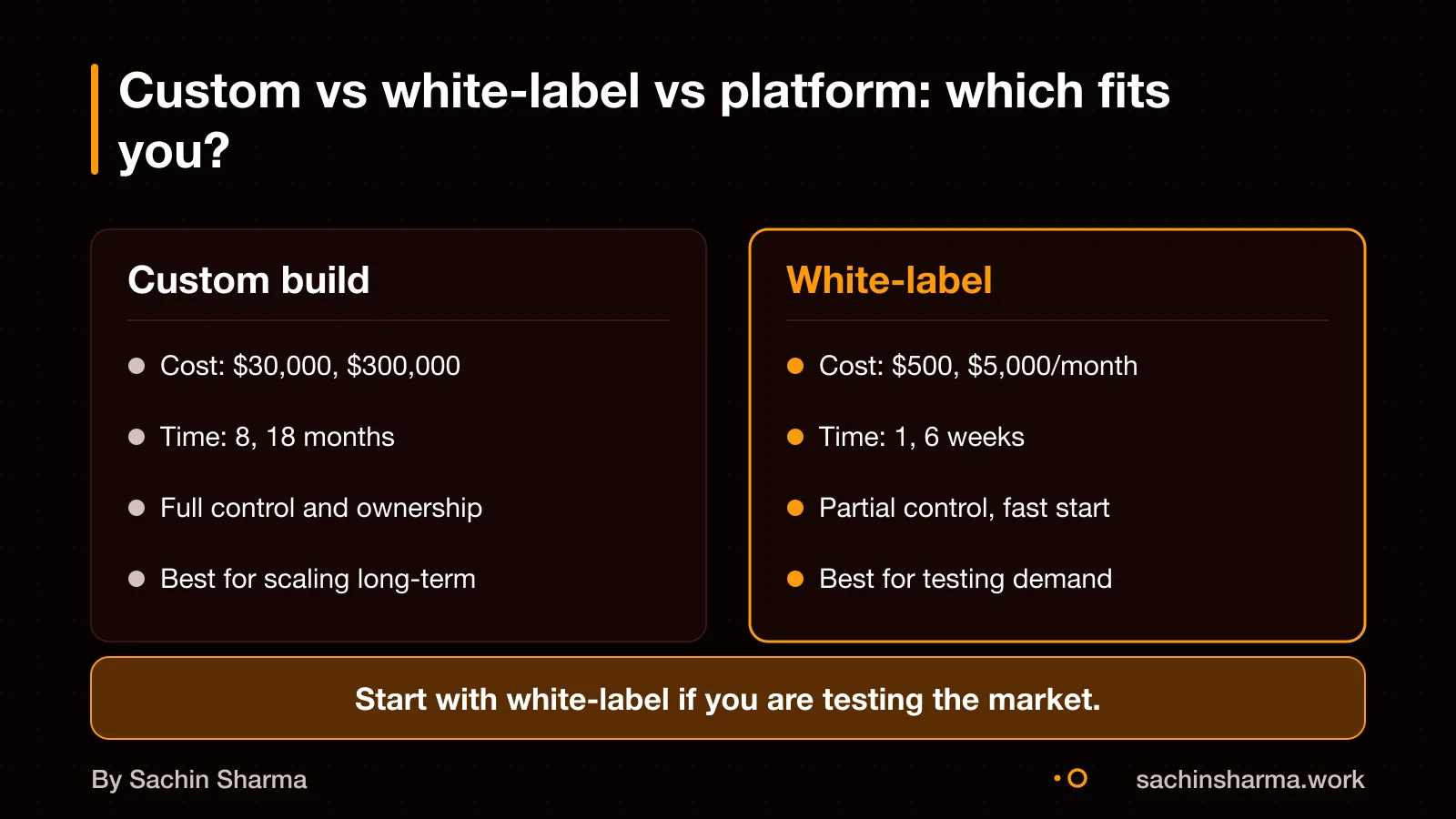
What laws apply to ride-hailing in India?
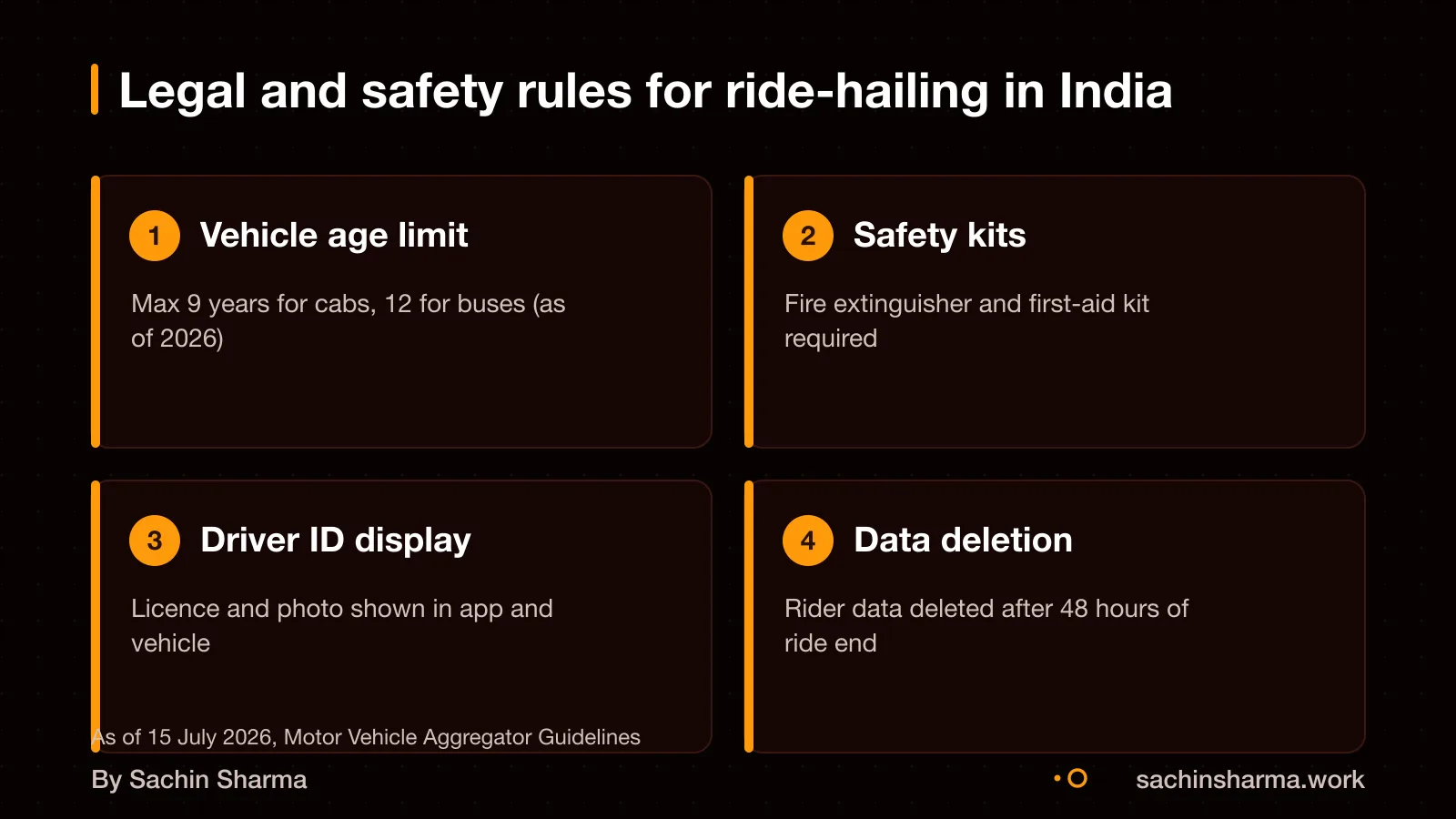
The Motor Vehicle Aggregator Guidelines, 2025, set the rules for ride-hailing platforms in India. These were issued under the Motor Vehicles Act. They cover licensing, safety, data management, fare rules and service standards. All operators must follow them. For example, you must verify driver documents and maintain insurance.
The Digital Personal Data Protection Act, 2023 (DPDP Act) applies to entities processing personal data. The Digital Personal Data Protection Act, 2023 may require data fiduciaries to delete personal data when certain conditions are met. Consult a legal expert for compliance. This applies to both rider and driver data.
Some states have extra rules. Maharashtra, for instance, caps fleet size at 50 vehicles per operator. You must check local transport department rules where you plan to run.
These laws are new. Their enforcement is still evolving. As of now, there is no public compliance guide. You should consult a legal expert who knows transport and data laws in India. Do not rely only on this summary.
Who owns the app and data?
Paying for an app does not mean you own it. Under Indian law, the developer who writes the code is the first owner of the copyright, not the person who paid for it. To gain ownership, you must have a written agreement that assigns the rights to you. Without this, you risk losing control of your app even after full payment.
Owning the app means owning several separate assets. Missing any one of these can lock you out of updates or user access.
You can transfer an app from one developer account to another on both Apple App Store Connect and Google Play. On Apple’s platform, you can transfer an app while keeping it available for download. During and after the transfer, the app keeps its reviews, ratings and update history. Google Play allows similar transfers with proper account verification.
Always sign a contract that clearly assigns all ownership rights to you. For more, see What to ask in a developer contract.
Can you build a ride-hailing app?
Yes, I can build a ride-hailing app. I have built apps with real-time features using live sockets, such as MojoPlay, which supports real-time "Listen Together" music sessions. I also built Daily, a current-affairs app with real-time updates for exam aspirants. These use Flutter and Next.js, the same stack suitable for ride-hailing apps. Payment and GPS systems in such apps rely on standard APIs like Stripe and Google Maps, which I have integrated before. However, I recommend starting with a white-label solution. Because it cuts your time to launch from over a year to a few weeks and reduces cost significantly. You still get custom branding and key feature tweaks. How I built a real-time clinical note tool shows how I handle real-time data flows securely.
When this advice does not apply
When this advice does not apply
You should consider a custom build if you already have a strong base of drivers and riders. In that case, you need full control to scale and differentiate. A white-label app may not let you add the features your users expect.
This advice also does not apply if you operate in a city with low competition. When there is no dominant player, being first with a branded, full-featured app can lock in market share. Custom development lets you tailor the experience to local needs and grow without platform limits.
Next step: message me on WhatsApp with what you want to build. No forms, no sales team.
Message me on WhatsAppAssumptions behind the numbers
- ₹50 lakh is the threshold for considering a custom app
- Launching in under 30 days means no time for custom development
- Having drivers ready makes white-label viable
Pick your situation
I do not build white-label or custom ride-hailing apps as a standard service. My recommendation is based on market data and your stated constraints, not on what I offer.
Pick your situation
White-label wins. A white-label solution lets you test demand without overspending. Custom builds need higher budgets to avoid half-built features.
The whole comparison
| Platform | White-label | |
|---|---|---|
| Who runs the app | Platform operator | You, on a vendor’s base |
| Upfront cost | None | $500–$5,000/month |
| Time to launch | Immediate | 1–6 weeks |
| Main risk | No control over pricing or data | Vendor lock-in, limited features |
| Growth path | Stuck on platform rules | Move to custom later |
Whichever you choose, ask these
- Can I switch from white-label to custom later?
- What happens if I stop paying for the white-label app?
- Will I own customer data on a white-label platform?
- Does the platform support local payment methods like UPI?
Questions people ask
I recommend a white-label platform for most startups. It costs $500 to $5,000 per month and launches in 1 to 4 weeks. Choose custom build only if you have $50,000+ and 12+ months of runway.
A custom build needs a larger team and a budget of $50,000+ with 12+ months of runway. A white-label launch takes 1 to 4 weeks and needs minimal technical input. The timeline and team size change drastically between options.
You likely need a GST number to issue tax-compliant invoices and claim input credit. Ride-hailing is a digital service subject to GST in India. Check this for your case with a chartered accountant.
Yes, you can integrate UPI and other Indian payment methods using NPCI's APIs. NPCI processes over 882 million transactions daily. This is standard in modern ride-hailing apps.
You need at least one person who can manage servers, apply updates and monitor performance. Even with a white-label app, backend access and basic DevOps knowledge are essential. See what goes inside a ride-hailing app [link: /guides/what-features-does-a-ride-hailing-app-need/].
The app keeps its Bundle ID after transfer, and it cannot be changed once a build has been uploaded.
Yes, you should back up all app information before transfer because it is removed from your account after the process.
Turn off TestFlight beta testing for all beta versions of the app before initiating the transfer.