What are the three ways to build a food delivery app?
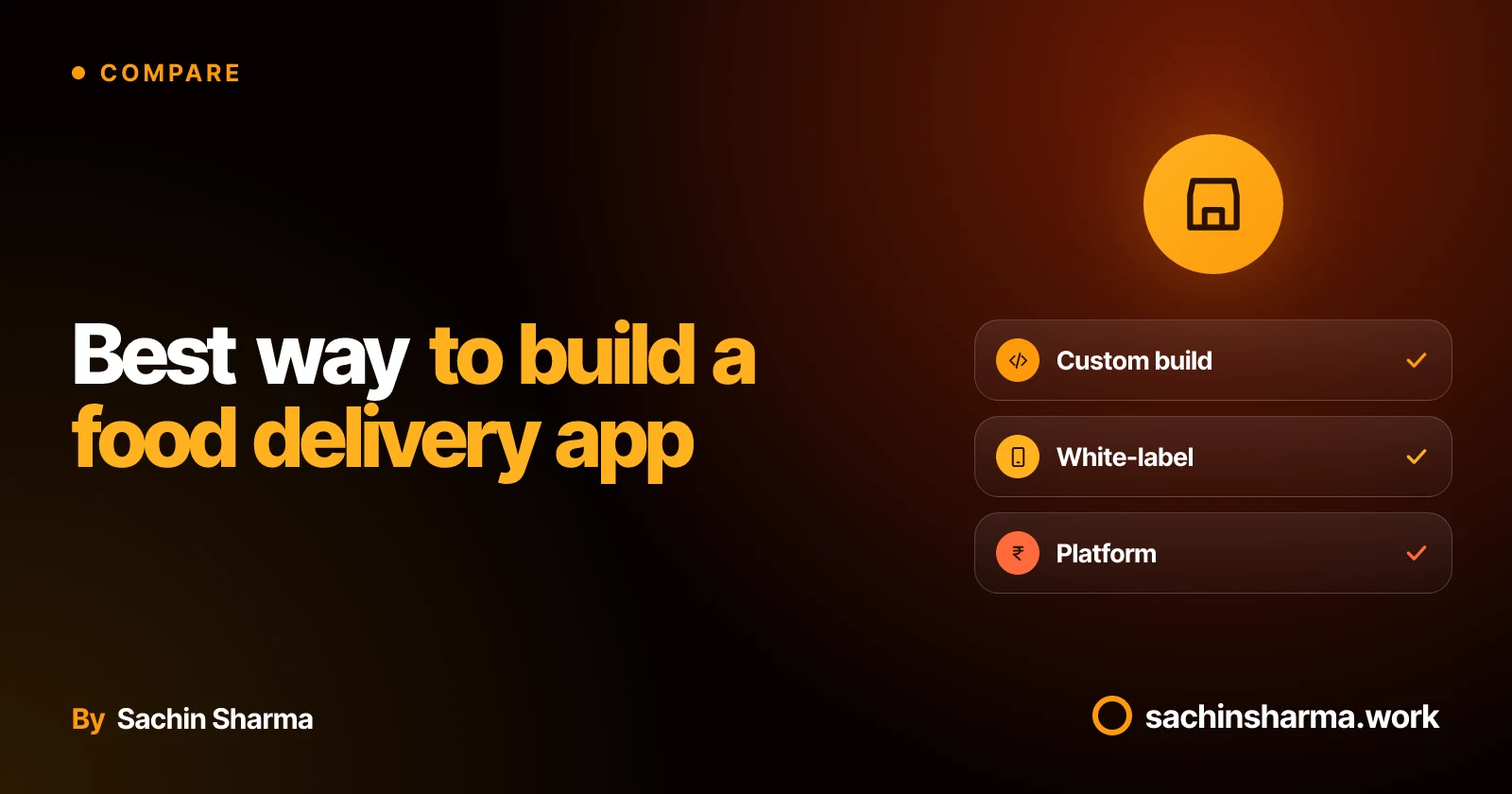
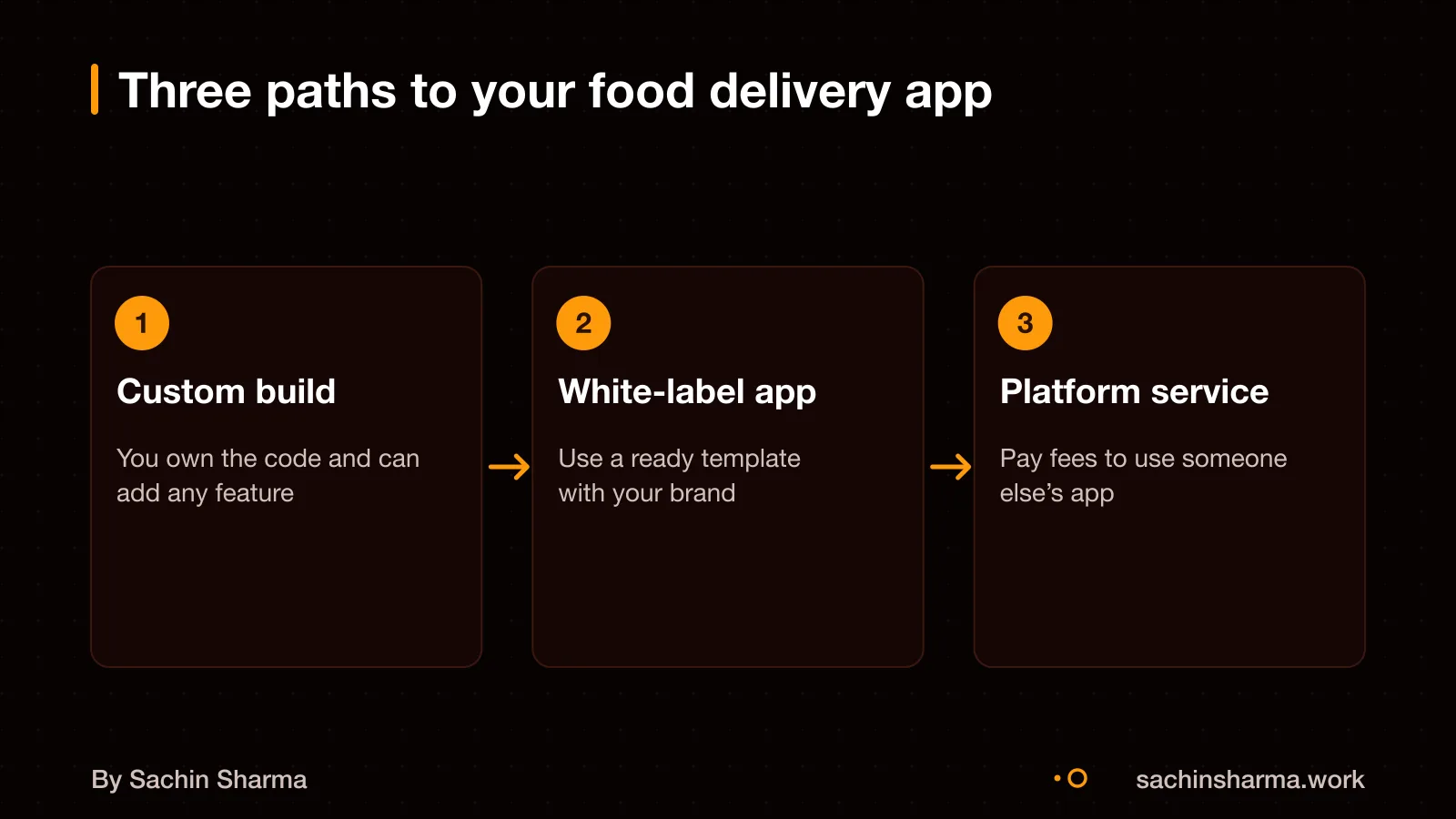
You can build a custom app, use a white-label app, or run on an existing platform.
A custom build means writing code from scratch for your app, giving you full control over features, design and data. You own the source code and can change it anytime. This path suits businesses that want a unique brand and long-term flexibility.
A white-label app is pre-built software rebranded as yours. The vendor owns the code, and you pay a fee to use it. You can launch fast, but custom changes are limited and ongoing costs apply. It works for quick launches with tight budgets.
A platform-based solution means listing your service on Swiggy, Zomato or Dunzo. You do not build an app at all. These platforms handle delivery, tech and customers, but take a commission and you have no brand control. This suits restaurants testing demand.
Cross-platform tools like Flutter can speed up development for Android and iOS from one codebase.
How much does each type cost to build?
A ₹15 to 30 lakh MVP typically covers four core panels. This assumes one payment gateway (like Razorpay or Stripe) and integration with two third-party APIs. As an estimate, this scope does not include AI features or advanced analytics.
A full platform costs ₹50 to 90 lakhs because it adds complex features like AI-based recommendation engines. Multi-restaurant ordering, subscription programs, and real-time dispatch logic. These systems require deeper backend architecture, more API integrations, and rigorous testing across cities or regions. The higher end of the range applies when building for high availability, multi-language support, or compliance-heavy markets.
As an estimate, adding a loyalty program or dynamic pricing module can add ₹3 to 5 lakhs to development.
For a worked example: - 4 panels (user, restaurant, delivery, admin): base cost ₹15 to 30 lakhs - 1 payment gateway: included in base -
This estimate assumes no AI features, single-city launch, and standard UI components. Costs rise with scalability needs or regulatory compliance.
Want a number for your idea? Send one line on WhatsApp. I reply with what drives the cost and what to cut.
Message me on WhatsAppHow long does it take to launch each option?
A custom MVP takes 4 to 6 months because it includes four core panels: customer, restaurant, delivery partner, and admin. Each panel needs design, development, testing, and integration. As an estimate, assuming a stable team and clear scope, this timeline starts after sign-off on requirements.
Adding advanced features like dynamic pricing, loyalty programs, AI-based recommendations. Or third-party integrations (such as Swiggy Access or Zomato Marketplace) extends the timeline to 8 to 12 months. Custom admin tooling, multi-city rollouts, or compliance-heavy modules (GST invoicing per order, FSSAI checks) also add time.
Can it be faster? As an estimate, a minimal version with core ordering and delivery functionality typically takes three to four months. But this often lacks scalability and key legal safeguards. A four-panel MVP takes 4 to 6 months with an experienced team.
For a detailed timeline with weekly milestones, see the timeline for building a food delivery app.
What features must your food delivery app have?
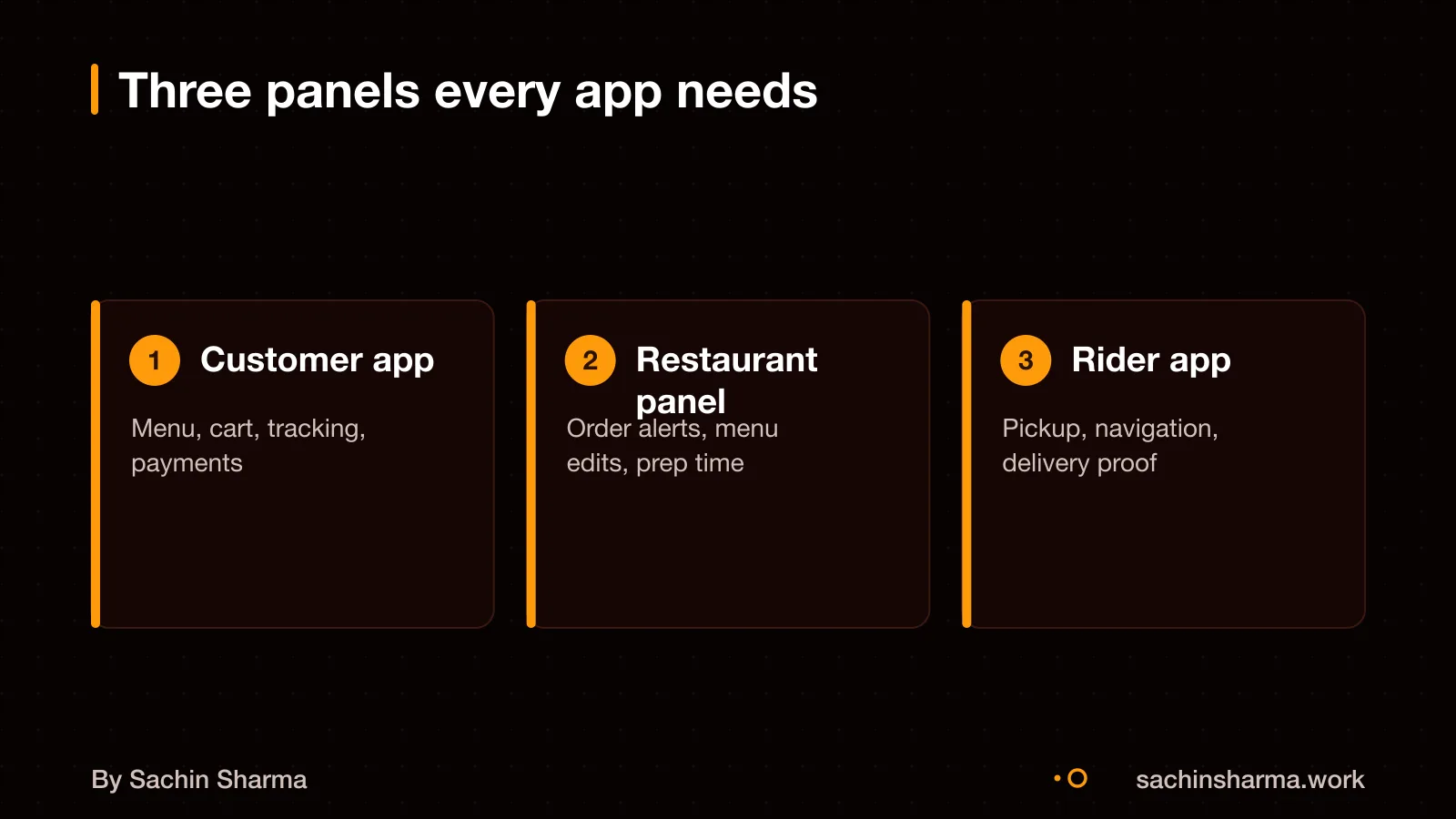
Your food delivery app must let customers browse menus, place orders, track deliveries in real time, and pay securely. It must also support in-app customer support to fix issues like wrong items or late delivery. Prompt users to rate food quality and delivery after each order.
The restaurant panel needs full control over menu items, prices, photos, and real-time availability, including turning items off when they sell out. It must also show a live view of every open order, with customisations, estimated delivery time, and assigned delivery partner.
The delivery partner app should let riders accept or reject orders, navigate to pickup and drop-off points, mark deliveries as complete, and view earnings.
What legal rules apply to your food delivery app?
You need FSSAI registration if your annual turnover is up to ₹1.5 crore. This applies to all food delivery businesses, even if you only connect restaurants and customers. The registration is done online through the FSSAI portal and must be renewed periodically.
If your turnover is above ₹1.5 crore but up to ₹50 crore, you need a State FSSAI License. As of 1 April 2026, all new FSSAI licenses and registrations have perpetual validity, so you will not need to renew them.
GST registration is required for food delivery apps that collect payments and issue invoices, as per standard compliance. You must register on the GST portal with your PAN, business name, email, mobile number, and a Temporary Reference Number (TRN). This allows you to collect GST from customers and claim input tax credit on your expenses.
For full compliance, also follow state-level food safety rules and ensure partner restaurants have their own FSSAI registration. You can find a full checklist for food delivery apps here.
Who owns the app, code and customer data?
You own the app only if you control all seven assets: source code, copyright, Google Play. Apple developer accounts, domain name, backend and database, and third-party API keys. Paying for development does not give you ownership. Under Indian law, the developer is the first owner of the copyright unless a contract says otherwise. This means you could pay for the app but not be allowed to modify or redistribute it.
To get full ownership, you must sign a copyright assignment. You must also receive access to every account used in the build.
A real handover means you can rebuild and re-publish the app yourself. It includes login access to the code repository (not just a one-time zip file). It also includes all passwords and API keys. The developer helps you verify everything works for a short period. Without this, you remain dependent on the developer, even if you paid for the build.
What are the hidden costs after launch?
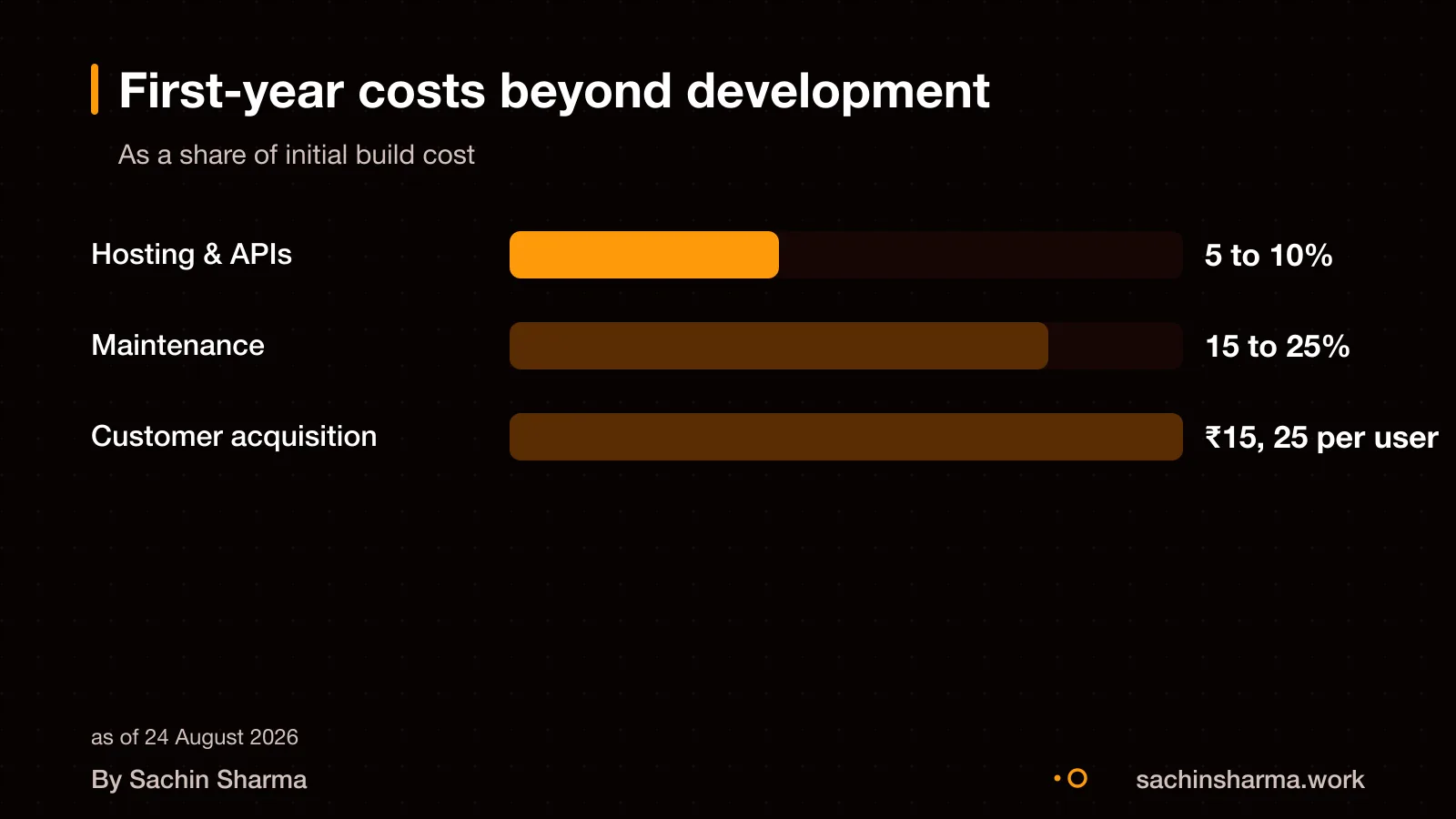
Hidden costs often add 25 to 40 percent to your first-year costs beyond the initial build. These include hosting, third-party API fees, compliance updates, and customer acquisition. For example, if your app cost ₹20 lakh to build, expect ₹3 to 5 lakh yearly for updates, monitoring, and server bills.
Customer acquisition is another major cost. In food delivery, it commonly costs $15 to $25 per user. These costs add up fast if you are targeting thousands of users. You must budget for ongoing spend on Google Ads, influencer promotions, or referral bonuses.
Some costs are not yet known, such as exact support charges or contract renewal fees with restaurants. You should ask your developer for a full breakdown of post-launch line items. Plan for at least a quarter of your build cost to be spent in the first year on hidden expenses.
What tech stack is best for each option?
Use React Native and Appwrite for a custom food delivery app because they support cross-platform development. React Native lets you write code once and run it on both platforms. This saving comes from shared logic, UI components, and testing efforts.
Appwrite provides backend services like user authentication, database storage, and file handling out of the box. It reduces the need to build and maintain custom servers, making it ideal for startups that want to launch fast without heavy infrastructure.
A cloud kitchen needs more than just an app. It requires integration with POS systems, inventory software, kitchen display systems, and delivery platforms. These tools help track orders, manage stock, display tickets in the kitchen, and sync with delivery partners like Dunzo or Zepto. Analytics dashboards also help you monitor peak hours, popular items, and delivery times.
For example, a cloud kitchen using your app can connect its POS to automatically update menu availability and push orders to the kitchen display. Inventory tools can alert when stock runs low, and delivery integrations ensure orders go straight to the nearest available rider.
best tech stack for a food delivery app
Can you switch from white-label to custom later?
You can switch from a white-label app to a custom build later, but you may not take all your data or features with you. This depends on your provider’s contract and export tools. With limited evidence, here is what typically happens.
You can usually export customer lists, order history and restaurant details if the provider allows data exports. But you must check the contract for data ownership and format support. Some providers lock data in proprietary formats.
You must rebuild the admin console, delivery tracking logic, and any custom workflows from scratch. The new custom app needs its own backend, APIs and security setup. You also need new app store listings under your name.
Migration risks include downtime during data transfer, broken integrations, and temporary loss of service. You depend on the white-label provider to give full, clean data before you leave. Some providers delay or charge for this. There is no standard exit process.
Because contracts vary, review your provider’s terms on data portability, ownership and termination. Ask for a data export clause before signing. Without it, you may lose access or face high exit fees.
What are the risks of building custom?
Skipping market research means you may build for the wrong audience or solve a problem no one has. You could spend ₹15 lakh or more on a custom app that customers do not want or understand. This risk is highest when you assume demand without testing it.
Adding too many features at once delays launch and increases cost. Each extra feature needs design, code, testing and fixes. A cluttered app also confuses users, making it harder to order or track food. Focus on the core flow: browse, order, pay, track.
Poor UX drives users away because food delivery is time-sensitive. If the app is slow, hard to navigate or crashes during checkout, customers switch to a rival. A complicated interface can lose users in seconds. Test your design with real users before launch.
When I would not recommend this path
When I would not recommend this path
- If you do not have at least ₹15 lakh or cannot assign a technical lead, a custom build may not be feasible. Without funds or oversight, the project may stall or deliver poor quality. A white-label solution starting at ₹3 to 5 lakh may be more realistic.
- A white-label app is better when you need to launch in under 8 weeks and cannot manage a long development cycle. These apps come pre-built with core features and can go live faster, though they offer less control over branding and data.
- Custom development is too risky if you have not validated demand with real orders. If your restaurant partners are not confirmed or customers are not pre-committed. Start with a platform-based model to test the market before investing in custom code.
- If your team lacks experience in managing software projects, custom builds can lead to delays and cost overruns. In such cases, a managed white-label service with ongoing support may reduce stress and improve reliability.
Related reading: detailed cost breakdown for a food delivery app.
Next step: message me on WhatsApp with what you want to build. No forms, no sales team.
Message me on WhatsAppAssumptions behind the numbers
- White-label cost is estimated at ₹5–15 lakhs based on market norms.
- Custom build maintenance is 15–25% annually.
- White-label maintenance is assumed at 10–20% of setup cost.
Pick your situation
I build custom apps from scratch, so I benefit from the recommendation. But this comparison uses published price and time ranges so you can decide based on your priorities.
Pick your situation
Custom Build wins. Only a custom build lets you own the code, change anything at any time, and integrate with your own systems.
The whole comparison
| Custom Build | White-Label | |
|---|---|---|
| Upfront Cost | ₹15–30 lakhs | ₹5–15 lakhs |
| Time to Launch | 4–6 months | 2–4 weeks |
| Own the Code | Yes, with proper contract | No, vendor-owned |
| Scalability | High, built for growth | Low to medium |
| Compliance Control | Full control | Depends on vendor |
| Monthly Running Cost | 15–25% of build cost | 10–20% of setup |
Whichever you choose, ask these
- Can I see a demo of the white-label version?
- What exactly do I get in a custom build?
- Is the white-label option compliant with Indian laws?
- Who will support the app after launch?
Questions people ask
I recommend starting with an MVP to solve one core problem well. This avoids overbuilding and lets you test your idea with real users. Start with only the features you need to validate demand.
You can choose between a white-label solution or a custom app for a food delivery platform. The choice depends on your needs for control, scalability, and budget.
Plan your exit before you start.
You need FSSAI registration if your annual turnover is up to ₹1.5 crore.
The app supports UPI, cards, and digital wallets.
Some platforms deliver groceries and food items within minutes.
I do not handle restaurant onboarding contracts or operations.
We test functionality, performance, security, payments, and order tracking using test cases. Tests include real-world order volumes, peak loads, and edge cases like failed payments or lost GPS.
Yes, I work with startups and focus on MVP builds to reduce risk and cost. The goal is to launch fast with core features, learn from users, and scale only when demand is proven. This approach saves time and money.