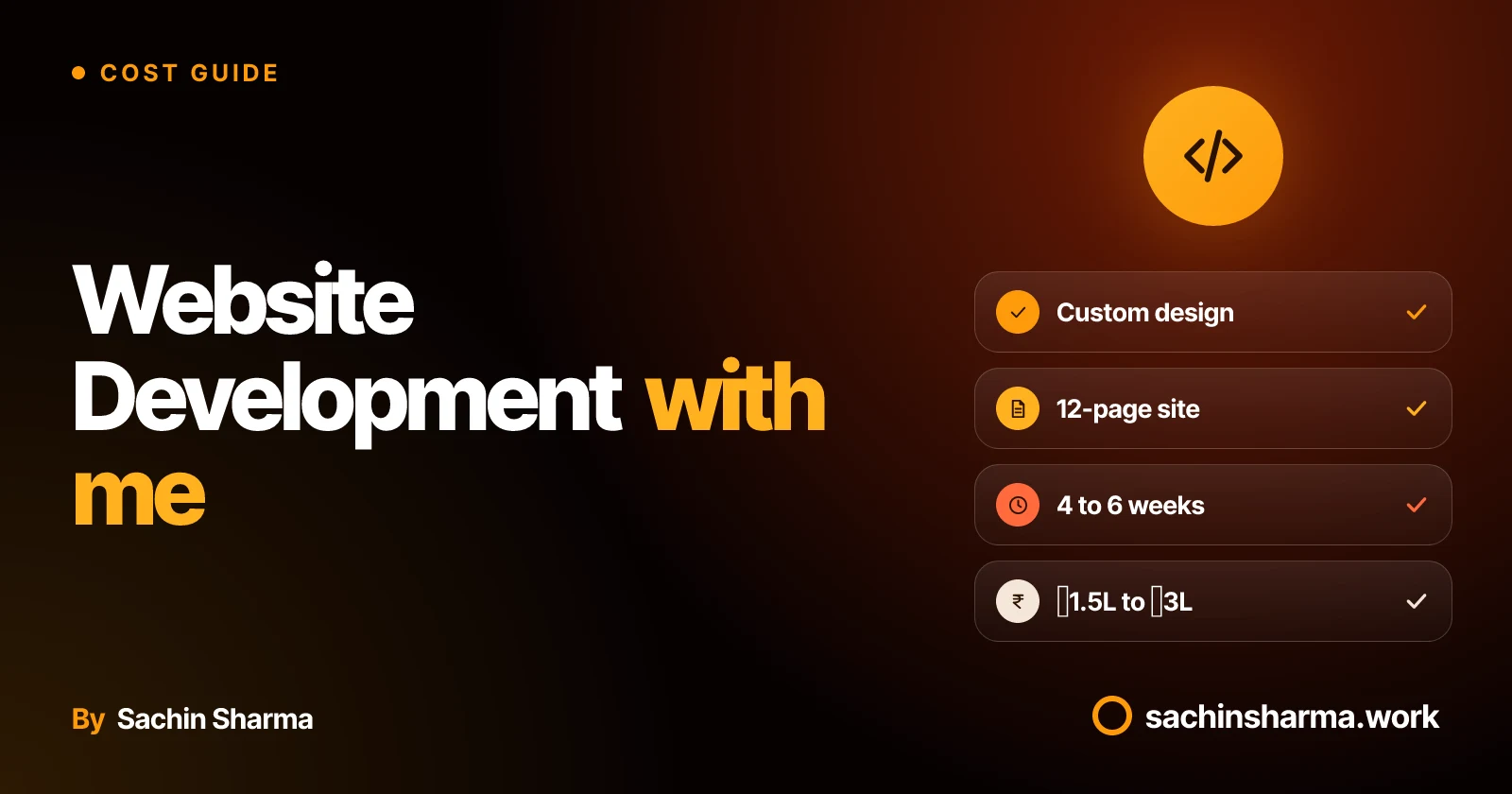
What is a small business website?
A small business website is an online page where customers can find your services, contact you, and learn about what you offer. It is for startups, small businesses, or individual projects that need a professional online presence. Such websites work well for growing businesses, consultants, and educational services.
Most include a home page, service list, contact form, and location or map. Some add a blog, photo gallery, or booking button. You do not need technical skills to update content if the site uses a simple editor. The goal is to help local customers find you and trust your business.
For example, a clinic might list its doctors, show opening hours, and let patients book appointments online. A bakery might show its menu, prices, and a form to order a custom cake. These sites are built to work fast on mobile phones and search engines.
This advice is for business owners in India who want to start small and grow online. It does not cover e-commerce stores that take payments or large catalogues with hundreds of items.
Template or custom: which do you really need?
A website builder is enough if you need a simple site with standard pages like Home, About, and Contact. These tools work well for small businesses that want a clean, fast-to-launch online presence without custom features.
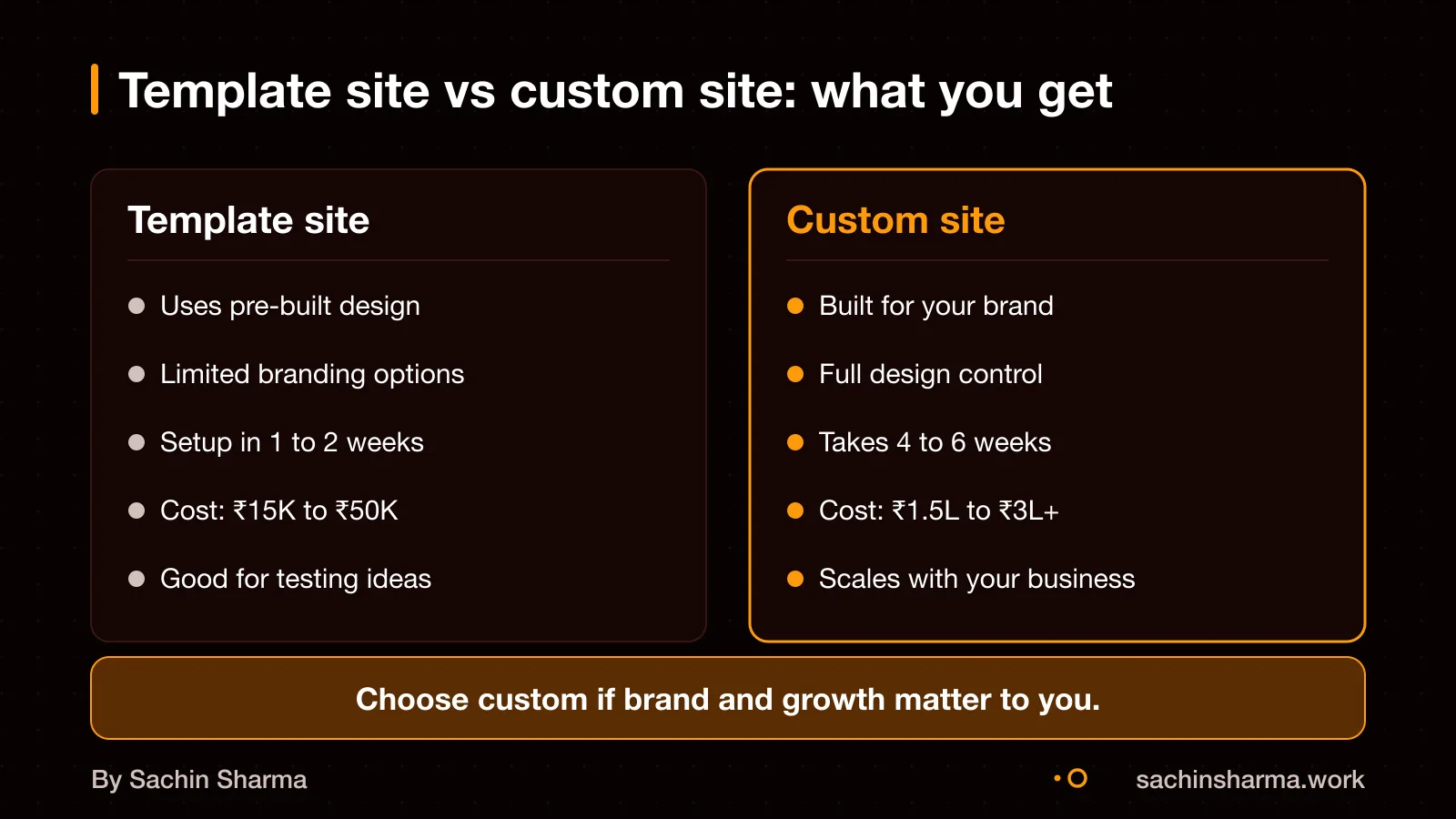
You need custom development when your business requires unique functions, such as client logins, booking systems, or integration with other software. A custom site lets you control the design, performance, and growth path.
For example, a local salon can use a builder for a portfolio and contact form. But if you run a training institute that needs course sign-ups, payment plans, and student progress tracking, a custom site is the right choice.
Many quotes bundle template and custom work without clarity. Be cautious if a proposal does not separate these costs or explain what is built from scratch.
If you are comparing options, know that a web app or MVP in Next.js can grow with your business. Handle complex tasks better than a template Web apps and MVPs in Next.js.
What makes a website cost more?
More pages raise the cost of a website. Custom design adds ₹10,000 to ₹50,000 to the total. A 5-page site costs less than a 50-page site.
Backend features also increase cost. The price goes up with the complexity of business logic, database structure, third-party integrations, user roles and security needs. For example, a simple contact form has low backend cost. But a booking system with user logins, calendar sync and payment processing needs more work and costs more.
A restaurant website with a menu, gallery, location map and online reservation will cost more than a basic 4-page site. The reservation system requires user input handling, date validation, and possibly integration with a calendar or payment gateway. Each of these components adds to development time and testing.
Pricing: what you pay for and when
You may pay ₹1.5 lakh to ₹3 lakh for a custom small business website with a CMS, based on mid-level developer rates in India. This is based on mid-level developer rates in India. It assumes a 10 to 15 page site with standard functionality. Complex tools like user accounts or bookings are not included.
Payments are structured in milestones to match progress and reduce risk. A common split is 30% at start, 40% after design and core setup, and 30% on delivery. This works for projects where some details emerge during work. Each milestone has a clear goal. Examples are “homepage design approved” or “all pages built and tested”.
The exact stages depend on your needs. You only pay the next part when the prior one is done and accepted.
Want a number for your idea? Send one line on WhatsApp. I reply with what drives the cost and what to cut.
Message me on WhatsAppGST on website development: what you need to know
GST is charged on website development services in India at 18% under SAC code 998311. This 18% is split into 9% CGST and 9% SGST for intra-state supplies, where both you and I are in the same state. For inter-state supplies, where we are in different states, 18% IGST applies instead. If you are outside India and hire me, reverse charge applies and you may need to self-declare the tax. The 18% GST rate may apply to exports, but input credit rules depend on registration and use; confirm with your tax advisor. You should confirm the correct code with your tax advisor based on your location and business type.
How long it takes to build your website
A 10 to 15 page business site with a CMS ships in 4 to 6 weeks. This timeline includes design, development, content integration, and testing. It assumes you provide text, images, and feedback on time. Delays usually happen when inputs like content or approvals are late. Some agencies promise websites in 10 days, especially for e-commerce, but such timelines are unrealistic for a quality site. For example, if you take a week to review the design, the project will extend by a week. The 4 to 6 week range is typical for a 10 to 15 page business site with a CMS in India.
How building a website with me works
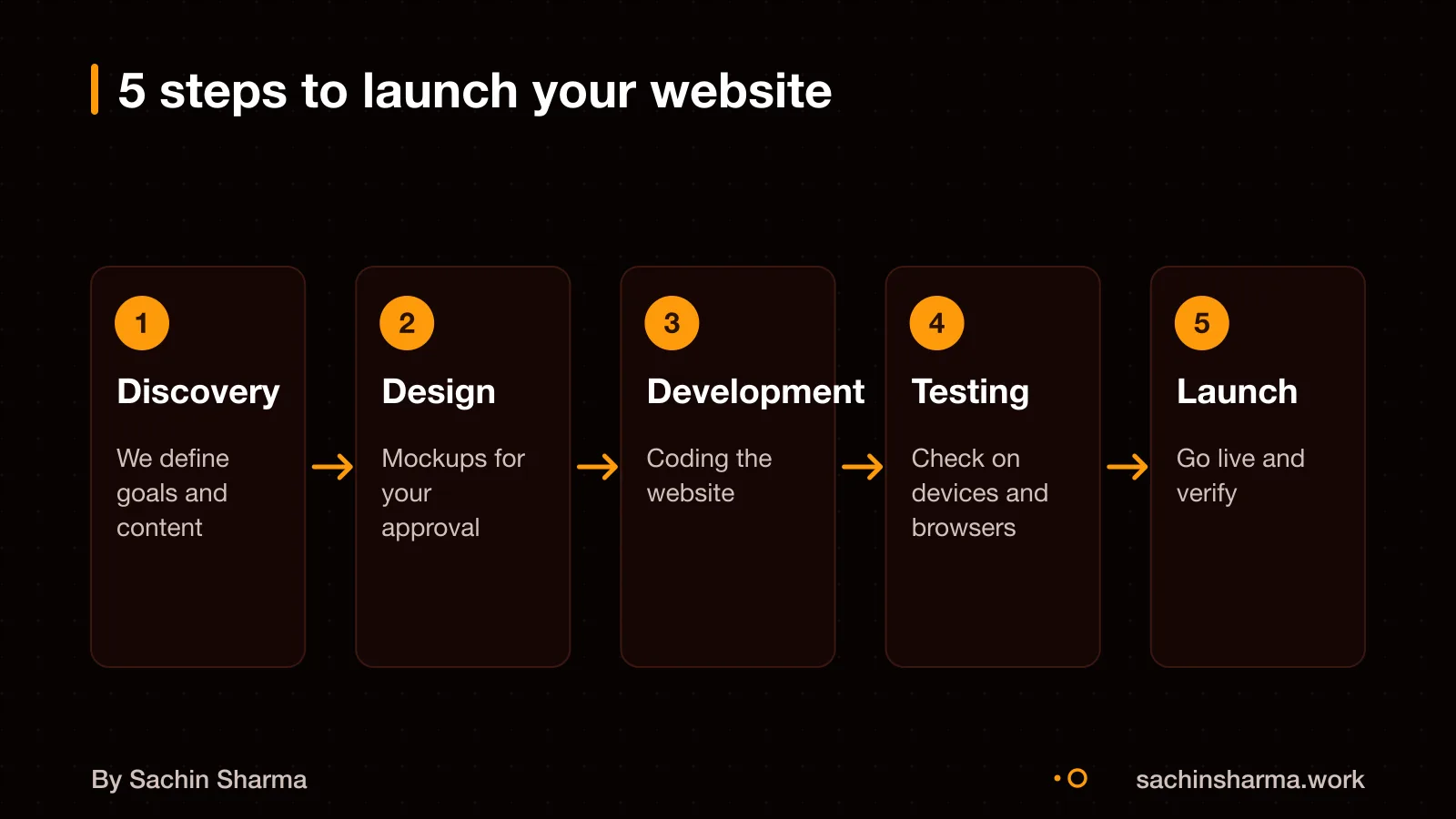
The process starts when you share your business goals and ends with your live website. I follow seven steps: information gathering, planning, design, content, coding, testing and launch, and maintenance. Each step builds on the last, so your input at the start shapes the final site.
You need to provide input early and at key points. At the start, share your business purpose, target customers, and must-have features. This helps in the information gathering phase. Later, you review design mockups and approve content before coding begins.
Planning turns your input into a site map and feature list. This avoids scope creep and keeps costs under control. Design follows with a mobile-first layout, so your site looks good on phones and desktops.
Content is added next, either by you or with my help. Then coding begins, using Next.js for fast, secure pages. I test the site on real devices for speed, mobile fit, and form functionality.
Launch comes after you approve the final version. I deploy the site, set up monitoring, and hand over admin access. Maintenance keeps your site secure and up to date after launch.
Good planning at the start reduces delays later. Since your timely feedback is needed at each stage, delays often come from missed reviews or late content. I cannot state what causes delays as it is not published.
For legal clarity, consult a professional on contracts and IP rights.
Worked example: cost of a 12-page business website
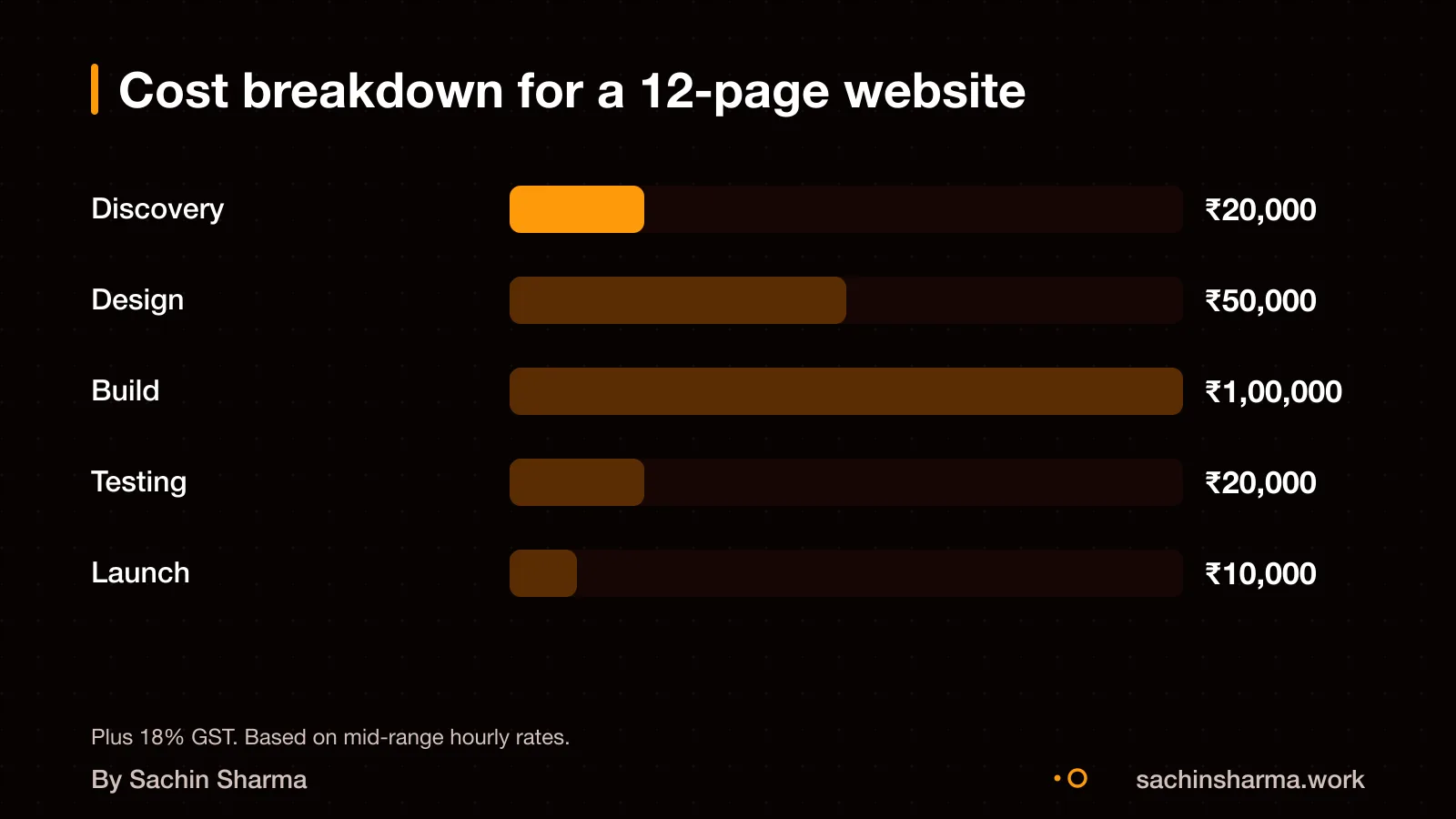
As an estimate, a 12-page business website with a CMS and no custom design costs ₹1.5 lakh to ₹3 lakh. This assumes 120 to 200 hours of work at ₹1,500 to ₹3,000 per hour, based on mid-level solo developer rates in India. The build takes 4 to 6 weeks. GST at 18% may be added to the final price.
This range depends on how many unique layouts and brand elements are needed. Using a pre-built template keeps costs lower and speeds up delivery.
This estimate assumes your content is ready, you respond to reviews in 2 working days, and no major feature changes happen mid-build. Delays or extra features will affect time and cost. What causes delays is not published.
When this advice is wrong for you
When this advice is wrong for you You should not build a custom website if you only need a basic online presence with standard pages like Home, About, and Contact. A website builder such as Wix or WordPress with a pre-made template may be faster and cheaper for simple needs.
Before signing a contract, confirm in writing that you will fully own the website code and domain after build. Also confirm whether you can move the website to another developer later and what post-launch support is included.
Check if mobile-friendliness and fast loading are promised. These affect user experience and search ranking.
Ask about annual maintenance cost. As an estimate, it can reach up to 80% of the initial build cost each year. This is assuming regular updates and security patches.
If your business needs regional language support or local payment integration, ensure these are included in scope.
Related reading: What does a clinic booking app cost?, What does a coaching or test-prep app cost?, Hire a developer for a small business website.
Next step: message me on WhatsApp with what you want to build. No forms, no sales team.
Message me on WhatsAppAssumptions behind the numbers
- A 12-page CMS site takes 100 to 180 hours
- Hourly rate is ₹1,500 to ₹3,000
- Custom design adds ₹10,000 to ₹50,000
- GST is 18%
- No major integrations or role-based access
Work out your own number
Here's how a 12-page CMS website breaks down in cost and time. Adjust the sliders to see how hours, rate and extras affect the price.
Your working total
₹4,40,00011 weeks × 2 people × 5 days × ₹4,000- Discovery and planning9%
- Design18%
- Development55%
- Testing9%
- Launch9%
The weeks shown are an example of a small app, there to be changed. Fees you pay others (store accounts, cloud, SMS) are not in this total.
What moves the price
- Adding custom design
A unique look and feel adds ₹10,000 to ₹50,000.
- More than 15 pages
Each extra page adds time and cost.
- CMS with role-based access
Admin, editor and guest views mean more logic.
- Using a starter theme
Pre-built themes cut design time.
- Content and images ready
No delays from missing copy or assets.
- Fewer integrations
No payment or CRM links means less work.
Fees that go to someone else
Domain registration
Paid yearly to a registrar like GoDaddy or Namecheap.
Hosting
Monthly or annual fee paid to a provider like Hostinger or AWS.
Third-party tools
Like analytics, forms or email — usage-based or flat.
Ask for these before you sign
- How many hours go into each phase?
- Is custom design worth it for my brand?
- What ongoing costs should I budget for?
- Do I need a CMS or will static pages do?
- What happens if I add pages mid-project?
Questions people ask
You get a mobile-friendly website with custom design, a content management system (CMS), testing, launch, and handover. The site will include core features like contact forms. It will be optimised for speed. As part of the handover, you receive full access to content editing and admin tools.
We start with a written scope document that defines what the website will do, who edits content, what it connects to, and the launch date. Billing is milestone-based, which works well for projects where some details emerge during development.
At discovery, you get a project plan. At design, a full visual mockup. During build, working pages. At review, a test-ready version. At launch, your live site. Each phase ends with your approval before we move forward.
Check your contract to confirm you own the website code and domain outright after payment. This lets you move or update the site later without dependency. Always get this in writing before starting work.
Ask what is included in support and what costs extra. Ongoing costs over two years can match or exceed the initial build cost, with updates. New features accounting for 80% of the original build cost annually. Check what response times and update frequency you get for that cost.
Ask for test results from tools like Google PageSpeed Insights or Lighthouse. Test the site on real phones and slow networks. Ask for test results from tools like Google PageSpeed Insights or Lighthouse to verify mobile-friendliness and speed.
Yes, regional language support and UPI payments can be added. But they increase cost and time. Confirm both are in the written scope before work starts.
I work remotely with clients across India, from metros to tier-2 and tier-3 cities. Delivery is the same for all.
Compare the quote with market rates for freelancers and agencies. A 5-page website costs ₹15,000 to ₹35,000 from a freelancer. Also check if the scope is clear and matches what you need.