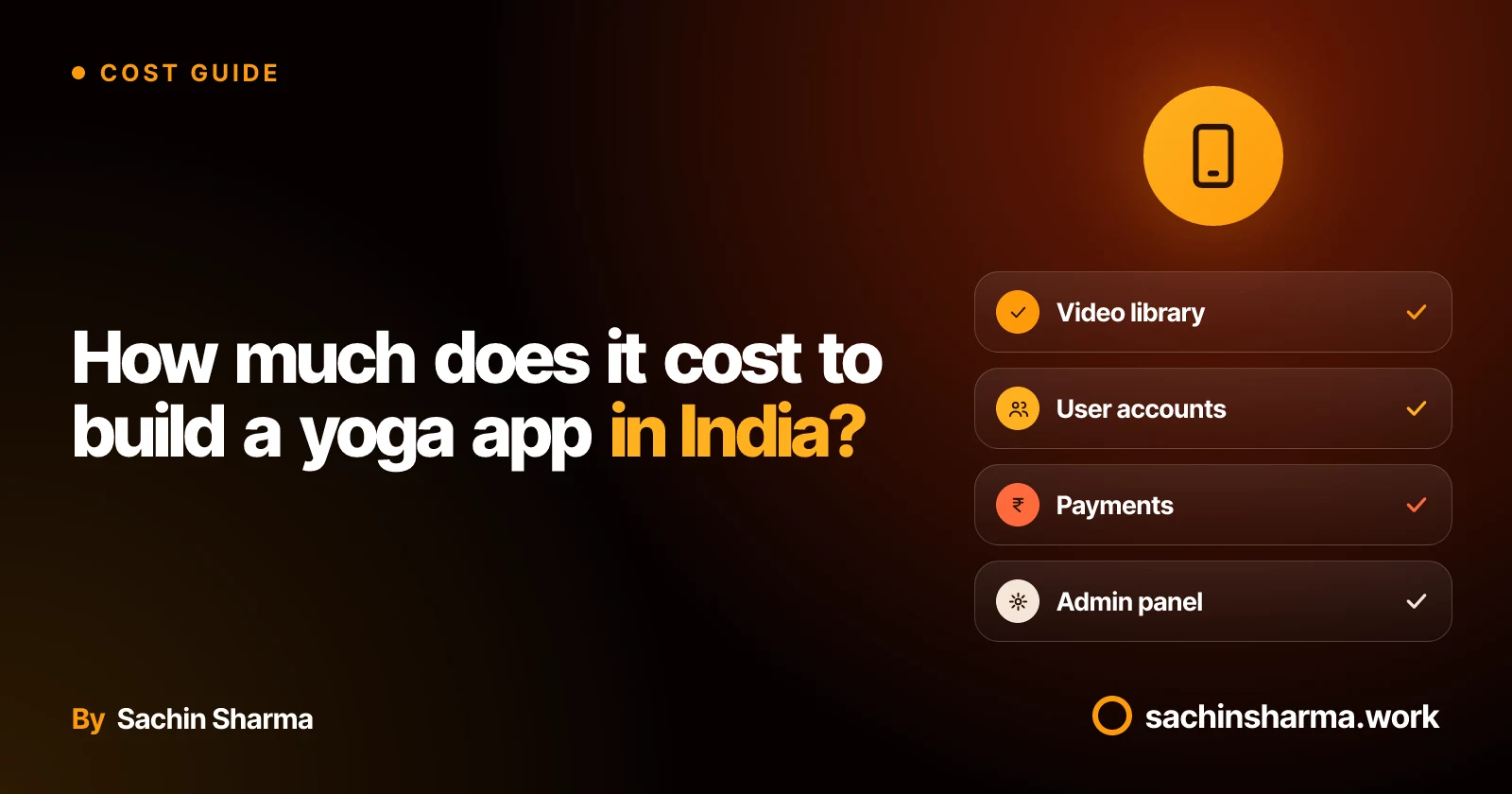
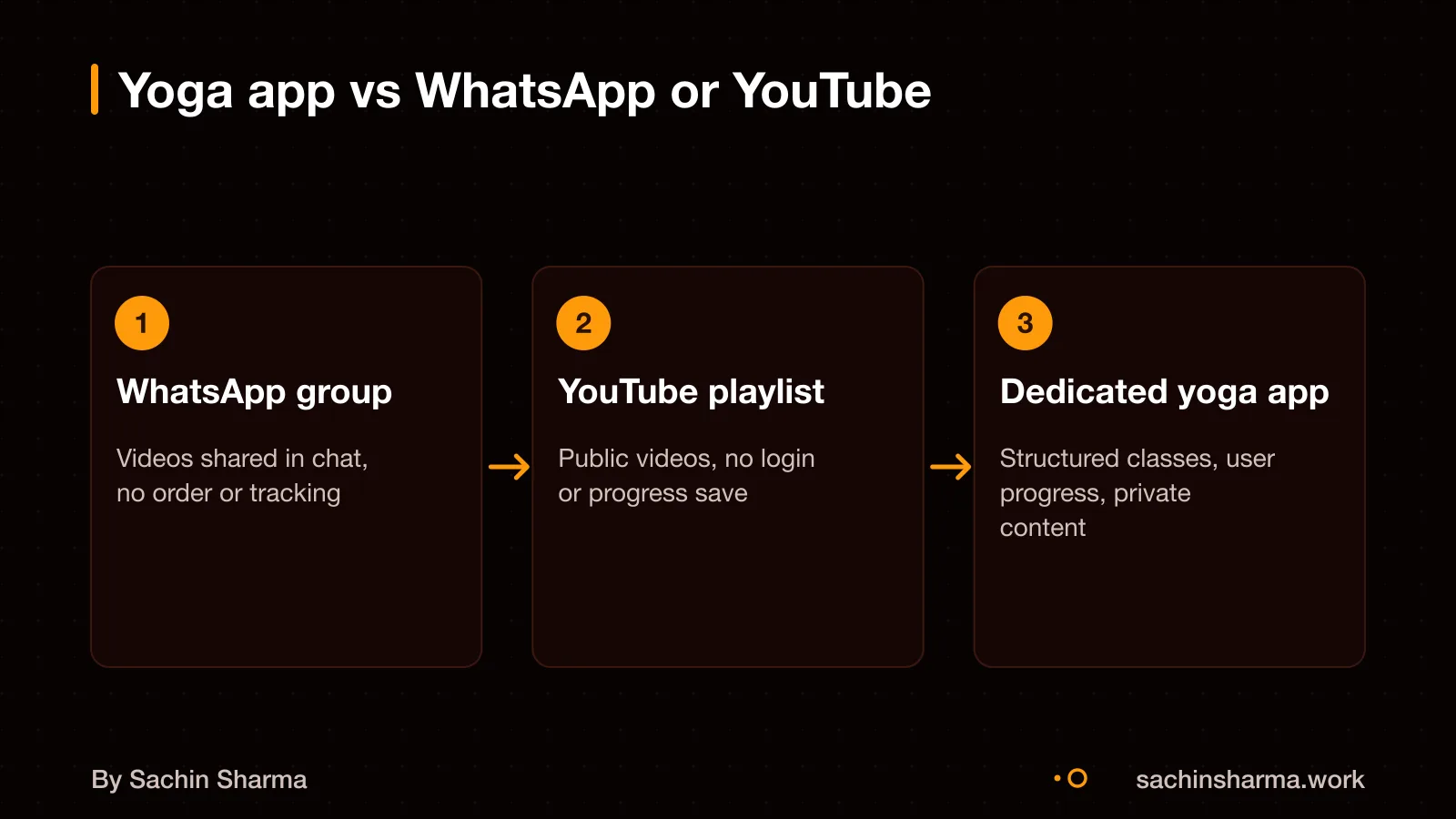
What is a yoga app and how is it different from WhatsApp or YouTube?
A yoga app gives you control over content, branding and user experience in a way WhatsApp or YouTube cannot. It is made for yoga studios, teachers or aggregators who want a dedicated space for their students. Studios use custom apps to share classes, manage bookings and build loyalty under their own brand. Teachers can offer structured programs that guide consistent practice, which free platforms do not support well. Aggregators use apps as marketplaces where users book and pay for classes from multiple instructors.
For example, Down Dog offers guided sessions with a subscription model at ₹669 per month. Glo provides high-quality yoga and meditation content at ₹2,999 per month. In contrast, WHO mYoga is a free app by the World Health Organization. The Government of India, meant for public awareness, not business use. These apps work offline, update regularly and keep users engaged through personalisation, things you cannot achieve with WhatsApp groups or YouTube links. A custom app also lets you own your audience, avoid third-party fees and tailor features to your teaching style.
Must-have vs nice-to-have features in a yoga app
Should you use a no-code platform or build custom?
Use a no-code platform to test your idea fast and cheap. As an estimate, this costs $99 per month on tools like Passion.io. It works if you only need video hosting, basic payments and a simple schedule.
Choose custom development when you need UPI payments, GST invoices or OTP logins. No-code tools have limited support for UPI integration. Custom apps can use Razorpay or direct UPI flows with full compliance. GST invoice generation is rarely built into no-code platforms but is fully possible in custom apps.
Custom apps also support offline use in low-connectivity areas, which most no-code platforms do not. You get full control over SMS OTPs using services like MSG91 or Firebase Auth, while no-code options offer only basic support.
No-code is best for small audiences and quick validation. Custom is better when you need scale, unique workflows or your app becomes a key business advantage.
For Indian yoga teachers with plans to grow, add local payments or go offline, custom is often the stronger start.
Build or buy a yoga app: custom, white-label or platform? compares all three paths.
Still unsure between no-code and custom? Tell me your audience size and monetisation plan and I will say which fits.
Message me on WhatsAppWhat features increase the cost the most?
Live classes and AI posture feedback raise your app’s cost the most because they add real-time data, live streaming and complex analysis. A live class needs video broadcasting, stable connections and scheduling, which is harder than storing pre-recorded videos. As of now, the exact cost to add live classes is not known, but it will require more time and testing than basic features.
AI posture feedback uses your phone’s camera to track body joints. Give voice cues during a pose, like Zenia does with 16 joint points. Building AI into software raises the price. Vay, for example, is not an app itself but a motion-analysis engine used by other apps to power real-time feedback. This kind of feature needs specialist tools and more development work.
Subscriptions add complexity too. They require secure user accounts, payment tracking, renewal reminders and backend systems to manage access. While the exact cost is not known, adding subscriptions means more code, more testing and ongoing support.
Sachin Sharma uses Flutter and Next.js for mobile and full-stack development. For example, using Flutter or Next.js may speed up development, but complex features still take more time and skill.
Want to know if live classes or AI are worth it for your students? Send one line on your teaching style and I will say yes or no.
Message me on WhatsApp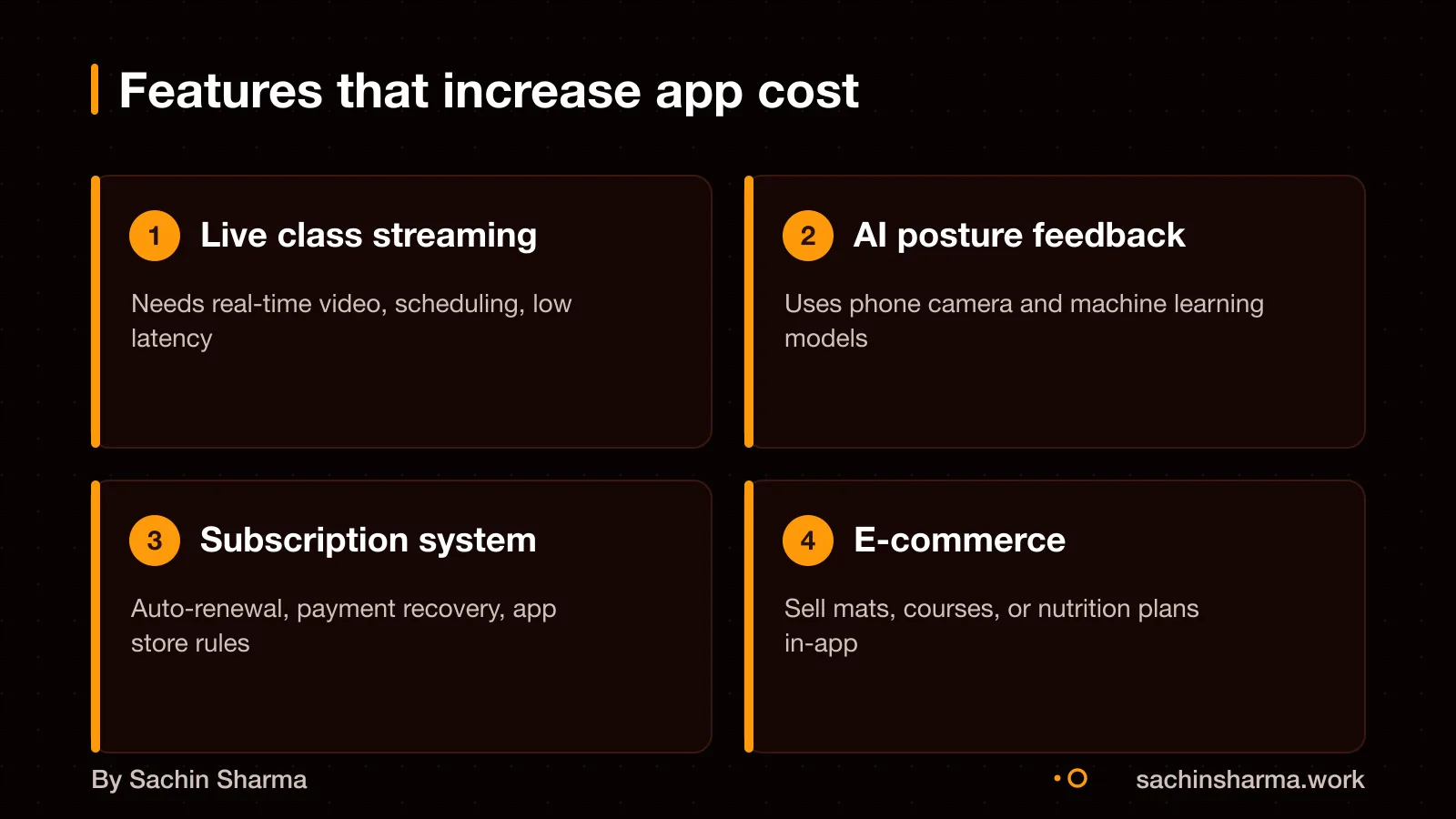
How long does it take to build a yoga app?
A yoga app can take 2 to 14 months, depending on scope. A simple mobile app takes 2 to 4 months to develop. Custom development timelines range from 4-6 months for simple builds to 12-14 months for multi-feature platforms.
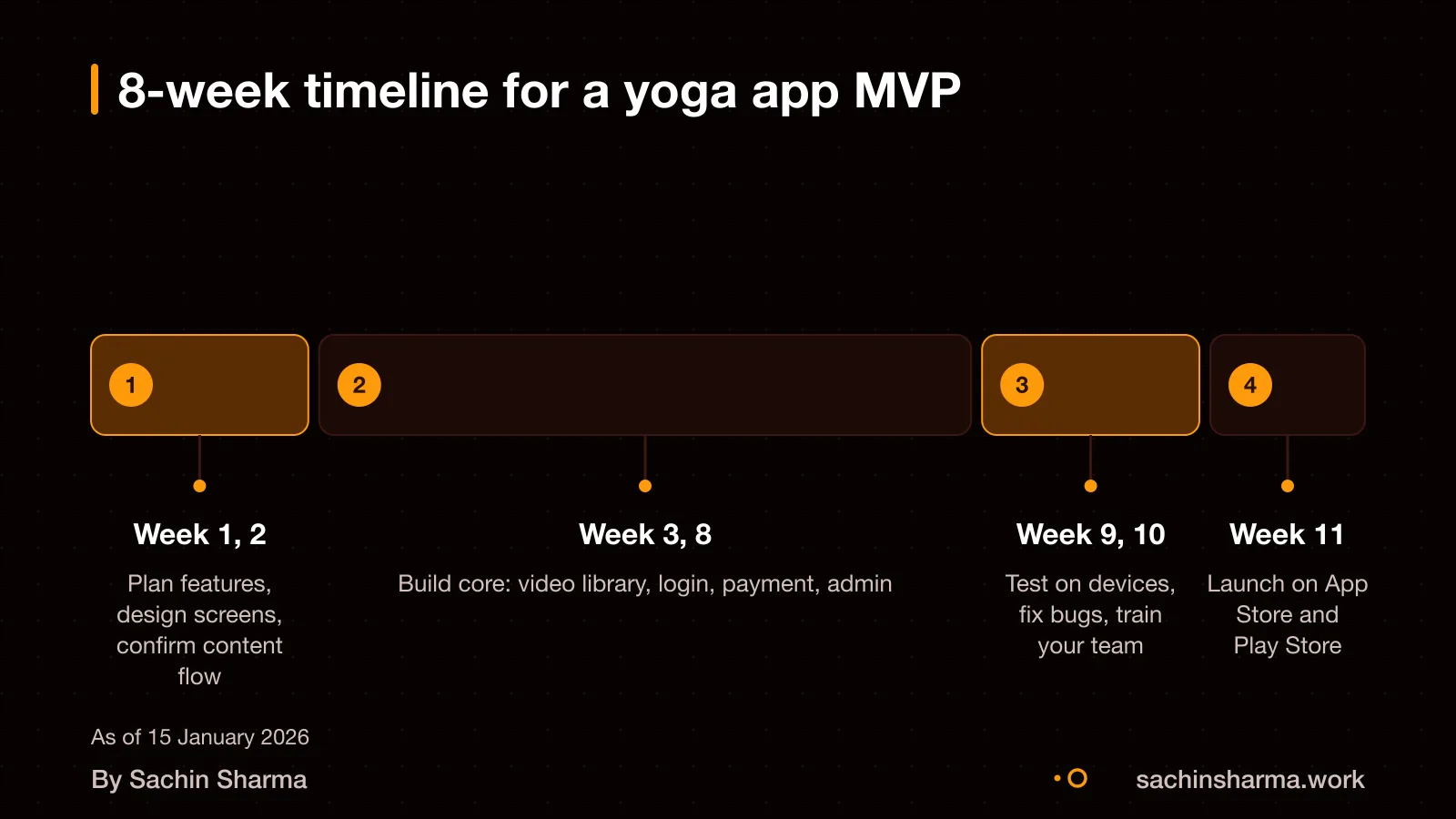
In the first month, we finalise features, design screens and set up the codebase. Month two focuses on core functions: user sign-in, video playback and a basic library. As an estimate, a yoga session library takes about 24 hours to implement. Months three and four add offline access, payments and admin tools.
Delays happen when features change mid-way, content is late or live streaming is added. Live classes need stable video, scheduling and server scaling, which take more time than planned. E-commerce for yoga gear also adds effort, with an estimated 24 hours just for integration.
For a clear timeline, start with an MVP and add features after launch. This keeps the first version on track and lets you test demand early.
Week-by-week timeline for building a yoga app
Can you start basic and add features later?
Yes, you can start with a basic app to test your idea and add features later. First, use a no-code platform to validate your concept with real users at low cost and effort. This helps you check if people want your content before spending on custom development. Once you have feedback and a growing audience, move to a custom-built app for better performance, branding and scale. For example, begin with a simple membership site on a no-code tool that shares pre-recorded videos and collects payments. When demand grows, build a custom yoga app with offline access, progress tracking and live classes. This two-phase approach lowers your risk by confirming interest first and investing in custom features only when needed. It also lets you refine your plan based on actual user behaviour.
Who owns the app code and store accounts?
You own the app only after formal handover, not by default. Under Indian law, I, as the developer, am the first owner of the copyright in the code I write. Even if you paid for it. The only way to transfer ownership is through a written assignment signed by me. Without it, you cannot legally update, modify or hand the app to another developer.
Owning "the app" means owning seven separate assets: the source code, the copyright or intellectual property (IP), your Google Play developer account. Your Apple Developer account, the domain name, the backend servers and database, and any third-party accounts or API keys used in the app. I will help you set up and transfer each one.
You can move to another developer after ownership is transferred. Once the code and accounts are in your name, any qualified developer can take over. Apple and Google allow app transfers between accounts, and during and after the transfer, your app keeps its reviews, ratings and update history.
For full control, ask for a written assignment of code ownership at the end of the project. You can read more about getting your source code Can I get the source code of my app?.
What maintenance does a yoga app need after launch?
After launch, your yoga app needs ongoing support to stay fast, safe and bug-free. L1 support handles basic user issues like login help or password resets. L2 deals with bugs, crashes and performance fixes. L3 is for major updates, like adding new features or upgrading the app’s core software. As an estimate, L1 costs $900 to $2,000/month for full-time agent work. L2 costs $2,000 to $4,500/month for a monthly engineer. L3 costs $6,000 to $10,000/month for fractional engineer allocation. These are per-role costs and may not all be needed at once.
Most projects include a 30-day bug warranty after launch, during which any issues found are fixed at no extra cost. This covers errors in the original build but not new feature requests. I offer fixed monthly plans for ongoing maintenance, so you know the cost upfront and avoid surprise bills. This includes regular updates, security checks and minor improvements. You only pay more if you ask for new features.
Worked example: cost to build a focused MVP
As an estimate, a focused yoga app MVP may cost ₹6 lakh. Based on assumptions of 8 weeks of work by 2 people at ₹15,000 per person per day, reuse of templates, and no e-commerce or live classes. This includes 40 screens, user login, video hosting for 30 days of content, and core features like a session library. Totalling ₹24 lakh in effort, scoped down by reusing templates, skipping e-commerce and live classes, and avoiding agency layers.
The session library feature takes 24 hours to implement. Adding e-commerce for yoga gear also takes 24 hours, but is left out to keep costs low. Video hosting uses a third-party provider with a flat monthly fee, not built from scratch. The ₹6 lakh estimate is below the ₹1.5L to ₹4L range for basic custom MVPs. Because it assumes tight scoping and direct work with the developer, not an agency.
Assumptions: 8-week timeline, 2-person team, ₹15,000/day market rate for developers, no custom design work. No live streaming, no AI features, and use of proven tools like Firebase and Flutter. As an estimate, this scope fits a yoga teacher or studio that wants to offer on-demand content without complex features.
Next step: message me on WhatsApp with what you want to build. No forms, no sales team.
Message me on WhatsAppWhen a yoga app is not worth it
If you already use WhatsApp to share videos and reminders, and your students stay engaged. A custom app may not add enough value to justify the cost. You are better off staying where your audience already is.
If your main goal is to host videos, take payments and run a schedule. A no-code platform like Passion.io or Kajabi can do this at low monthly cost. These tools are faster to set up and need no developer help.
If you do not have a steady stream of original content or a loyal student base, an app will not fix that. An app amplifies what you already do well, it does not create demand. Focus first on building your practice and teaching live classes.
Assumptions behind the numbers
- Default rate is ₹15,000 per day per person
- Default duration is 8 weeks
- Default team size is 2 people
- Live class cost impact is unknown
- AI feature cost impact is unknown
- Subscription model cost impact is unknown
Work out your own number
I won't hand you a number that pretends to be the market. Instead, here is the working: set the weeks, the people and the rate, and see where the money goes.
Your working total
₹4,40,00011 weeks × 2 people × 5 days × ₹4,000- Scope and design18%
- Build55%
- Testing and fixes18%
- Launch and stores9%
The weeks shown are an example of a small app, there to be changed. Fees you pay others (store accounts, cloud, SMS) are not in this total.
What moves the price
- More screens or roles
Each extra user type (customer, admin, rider) is close to another app.
- Real-time features
Live tracking and chat need more design and more testing.
- Many integrations
Every payment, SMS, maps or ERP link is its own piece of work.
- Cutting to one platform first
Starting with one clear flow can be half the work.
- Using managed services
A managed backend for login and data removes weeks.
- A clear scope up front
Changes mid-build are the most expensive weeks.
Fees that go to someone else
Google Play developer account
A one-time registration fee, paid to Google. Check the current amount.
Apple Developer Program
A yearly fee paid to Apple. Check the current amount.
Cloud, SMS, maps, payments
Usage-based, billed by the provider to you.
Ask for these before you sign
- How many weeks per phase, and with how many people?
- What is not included?
- Which fees do I pay to others directly?
- What happens to the price when I change my mind?
- What does the first month after launch cost?
Questions people ask
I include video hosting, user accounts, content planning and offline access. I do not include live classes or AI posture feedback. The app is built natively for Android and iOS using Flutter. You get full ownership of the source code after handover. See what features a yoga app needs.
We agree on a fixed scope first, then I bill in milestones. There are no agency layers, I work directly with you. Each milestone includes clear deliverables and payments. This keeps costs predictable and progress visible.
At design, you get wireframes and UI screens. At build, you get core features and user flows. At test, you get a bug-free version on test devices. At launch, you get the app live on Google Play and App Store. Each stage is signed off before the next begins.
Yes, you can use your own designer. I integrate smoothly with external design teams. Just share the assets and style guide early. I use them to build pixel-perfect screens in Flutter.
Yes, I handle technical submission to Google Play and App Store. I prepare the builds, set up store listings, and manage signing and release. You provide the business details and marketing text. Apple charges 99 US dollars per year for developer membership.
Changes reset the timeline and cost. We agree on scope first to avoid surprises. If you add a feature later, it goes into a new milestone. This keeps the project on track and budget under control.
Yes, I offer L1, L2 and L3 support plans. L1 costs $900 to $2,000/month for basic help. L2 costs $2,000 to $4,500/month for a fractional engineer allocation. L3 costs $6,000 to $10,000/month for a fractional engineer allocation.
Yes, UPI payments and OTP login are fully supported in custom apps. I use native code for full UPI flows and services like MSG91 or Firebase Auth for OTP. No-code platforms offer only basic support.
Yes, offline mode is built in for low connectivity. The app stores videos, classes and user progress locally. It syncs when the network returns. This is fully possible in custom development, not in no-code tools.