What is a custom e-commerce app?
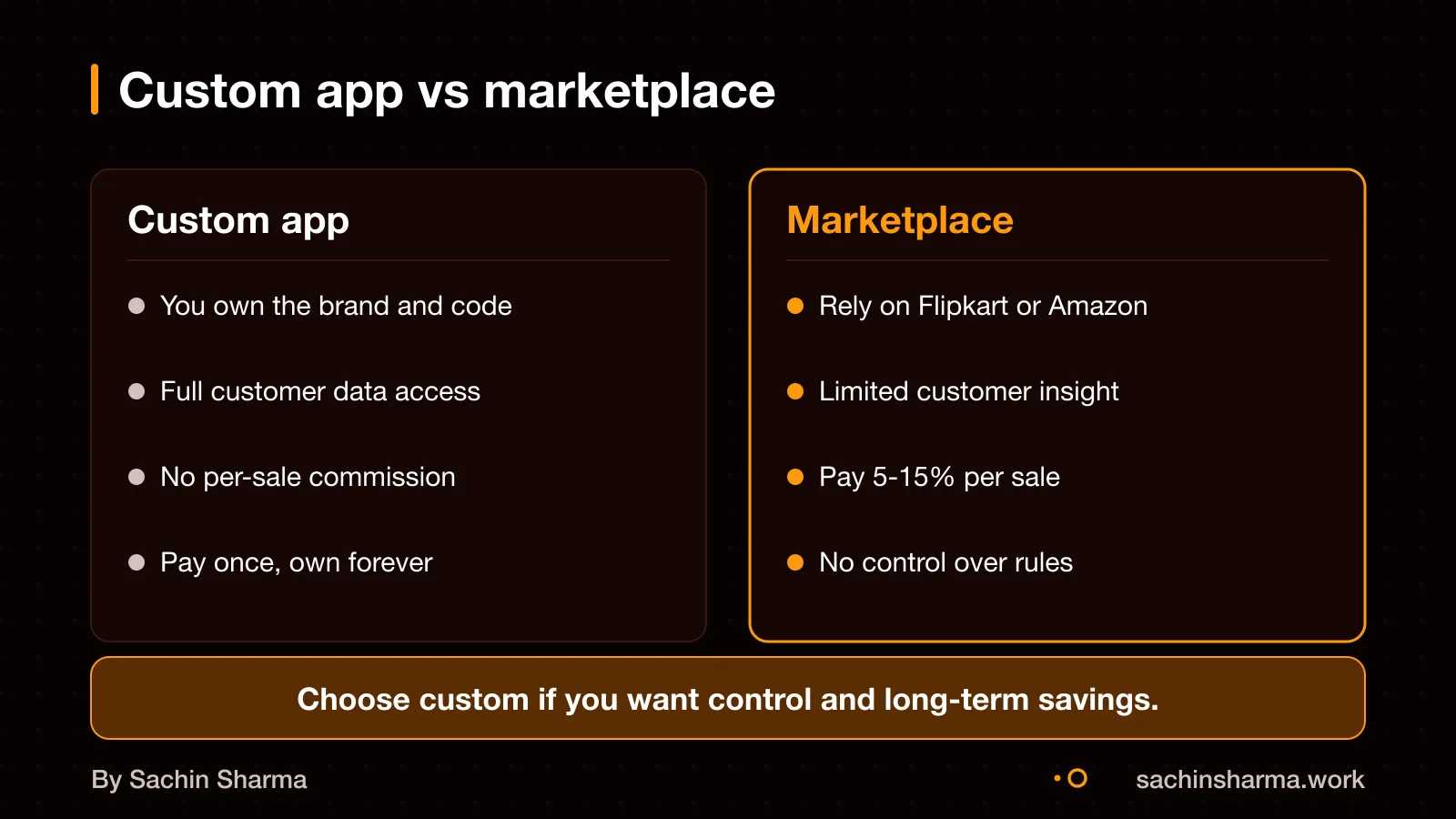
A custom e-commerce app is built only for your business, giving you full control over how customers shop, unlike selling on Flipkart or Amazon. You own the customer journey, not the marketplace.
Marketplaces charge a fee on every sale and may add service costs, cutting into your profit. You also rely on their algorithms to show your products, which depend on ads, pricing, reviews and other rules beyond your control.
With a custom app, you keep all the revenue and decide how your brand appears. You collect and use customer data directly, as long as you follow India’s DPDP Act 2023. This helps you build loyalty and repeat sales.
Using a marketplace makes sense if you want quick reach with low upfront cost. But if you want to stand out, control costs long-term, and own your customer relationships, a custom app is the better path.
For a full look at your options, see the Best way to build an e-commerce app in India.
Do you really need a custom app?
A custom app makes sense only if your business needs unique features that off-the-shelf platforms cannot support. For most small businesses in India with less than $1M annual GMV, a hosted solution like Shopify is faster, cheaper and more reliable. These platforms offer mobile-optimised stores, payment integration and inventory management out of the box. You can test your idea with a Shopify store first and validate demand without spending ₹3+ lakh on a custom build.
Mobile apps do offer a better user experience than mobile websites, with faster load times, offline access and personalised notifications. But that benefit matters most after you have proven demand and need deeper engagement. If your business is under ₹8 crore in annual sales (about $1M GMV), start with Shopify Basic or Advanced. It gives you a working store in days, not months.
A custom app justifies its cost only when your workflow, branding or customer journey is so distinct that templated solutions fail. Examples include multi-vendor marketplaces, offline-first retail apps or AI-driven personalisation. If you are still testing your idea, a custom app is likely too early and too expensive. Build simple first, then scale.
What features drive the cost?
The most expensive features in an e-commerce app are AI-driven search, multi-vendor marketplaces, and offline mode. These require more development time and complex integrations. AI search needs training data and model tuning. Multi-vendor setups need separate dashboards, commission logic, and dispute systems. Offline mode means the app must store data locally and sync when back online, adding technical layers.
Native apps for both iOS and Android cost more because they need two separate codebases and teams. I use Flutter, a cross-platform framework. This cuts initial development cost by 20% to 30% compared to native. You still get a smooth experience, but we save time and money.
Security also adds cost. Stronger protections like end-to-end encryption or biometric login take more work. If your app handles sensitive data, this is worth it. For simpler stores, standard SSL and secure APIs may be enough.
For example, a fashion e-commerce app with AI search. Offline browsing will cost more than a basic store with online-only access and standard filters. You can start simple and add these later.
What features does a fashion ecommerce app need?
How is the cost split?
The largest share of your budget goes to backend development. UI/UX design and frontend come next. As an estimate, backend takes 40 to 50 percent of the total cost. Design takes 25 to 35 percent. Frontend takes 20 to 30 percent. Backend takes the largest budget because it handles core logic like inventory, orders, payments, user accounts and security. This must be reliable and scalable. For example, processing a single order involves checking stock, applying discounts, calculating taxes, updating inventory, and sending confirmations. All of this runs on the backend.
UI/UX design shapes how users browse, search and buy. A smooth flow reduces drop-offs. Frontend turns that design into a working app on phones. It uses tools like Flutter. Planning and testing are part of the build process. Their exact cost share is not published. You can see a full cost breakdown in our guide on app development costs in India. What does it cost to build an app in India?.
Have a quote in hand? Send it to me and I will mark what is missing.
Message me on WhatsApp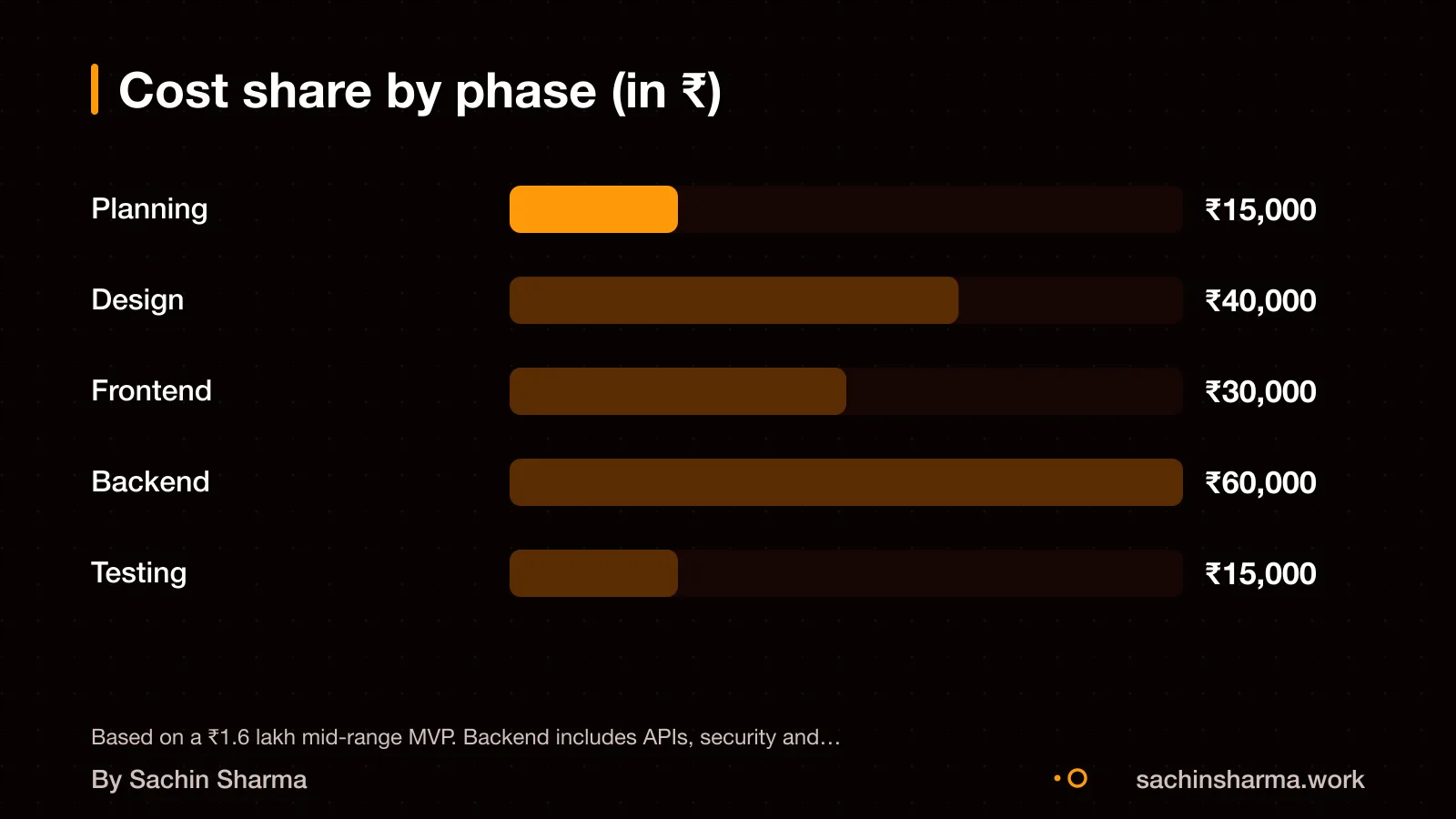
How do I price the work?
However, compared to agencies, my costs are lower because there are no management layers or sales teams. For example, US agencies charge $150 to $250 per hour, while offshore agencies charge $25 to $49 per hour. Since I work directly with clients, you avoid the markups that agencies add for coordination and overhead. Offshore development generally offers cost advantages by tapping into skilled teams in lower-cost regions. But the exact savings depend on the project’s scope and complexity. As no evidence states my rate or model, the best way to get a clear number is to share your idea.
Want a number for your idea? Send one line on WhatsApp. I reply with what drives the cost and what to cut.
Message me on WhatsAppHow long does it take to build?
A basic MVP takes 10 to 16 weeks. A mid-range version includes wishlist, order tracking, push notifications, basic personalization, multiple payment options, social login, and a basic admin panel. A growth-stage app with cross-platform iOS and Android delivery typically takes 20 to 30 weeks. The timeline depends on how many features you need and how quickly you can review and approve each stage. For example, adding order tracking, wishlist, push notifications, and multiple payment options increases the scope and time. Delays often come from late feedback, unclear requirements, or changes during development. While I work at a steady pace, you can shorten the timeline slightly by providing quick decisions and complete content early. However, rushing too much risks quality, especially in testing and bug fixes. The process for handling delays or scope changes is not specified [unknowns]. For a timeline tailored to your product, see how long it takes to build a fashion ecommerce app.
What happens during development?
The process runs in five steps: discovery, design, build, test, and launch. I work closely with you at each stage to shape the app to your business goals. In discovery, you provide your business model, customer flow, and feature priorities. I use this to define the app’s scope and structure.
During design, you review wireframes and give feedback on layout, branding, and navigation. Your input ensures the app matches how your customers shop. Then, in the build phase, I write clean, maintainable code for both front-end and back-end. You will see progress every week and can suggest small adjustments.
Testing includes unit tests, integration tests, and beta testing with real users. You help by sharing the beta with a few trusted customers and reporting issues. I fix bugs and fine-tune performance based on their experience.
For launch, I prepare the app to meet store rules. As of 31 August 2026, new Android apps must target Android 16 (API level 36) to be listed on Google Play. I handle the technical setup, but you must provide a valid business address, GSTIN, and a signed developer account agreement. You own the account; I guide you through each step.
After launch, I hand over all source code and design files. You can update the app anytime or hire another developer. If you need help later, I offer maintenance support at an hourly rate. For legal protection, we should sign a development agreement before work starts. See What legal agreements for app development? for what to include.
Freelancer, agency or me?
Choosing between a freelancer, an agency or a direct developer like me comes down to control, risk and cost. An agency spreads the risk with team coverage, includes project management and peer code reviews, and guarantees continuity. This comes at a higher price, as you pay for overhead and process. Freelancers charge less but place the burden of project management on you, and your project risks delay if they become unavailable.
I work directly with you, with no agency layers. This cuts costs and speeds up decisions. Unlike a freelancer who may work alone, I follow peer-review practices and maintain clear documentation, though I do not have a formal team. My continuity depends on our agreed timeline, and I aim to deliver on time. As seen in past projects where lead-to-delivery time fell from two weeks to four days.
Agencies often formalise intellectual property (IP) in contracts, while freelancers may not. I provide full source code and design files. However, ownership terms are not stated in a standard agreement; you should confirm with me before starting [unknowns].
If you need a structured team and formal processes, an agency may suit you better. If you want lower cost, faster feedback and direct access to the builder, working with me is a strong middle path.
Freelancer or agency for a first app? compares these options in detail.
How do you handle GST and DPDP Act 2023?
The DPDP Act 2023 has been passed but its commencement date has not yet been notified by the Central Government. Once it is active, I will follow its rules for any app that processes personal data.
For consent flows, the DPDP Act requires a clear notice before collecting personal data, explaining what data is collected and why. Consent must be free, specific, informed, and given through a clear affirmative action like a checkbox or tap. This means your app must show a simple, readable notice and get active consent before collecting any personal information from users.
The government may notify certain data fiduciaries as Significant Data Fiduciaries, including those processing personal data of children. In that case, you must appoint a Data Protection Officer based in India and hire an independent data auditor to check compliance. These steps are your responsibility as the business owner. I can guide you on what to expect, but you must consult a legal expert to meet these requirements.
For GST registration, you need a PAN, and the process requires at least two promoters to be listed. An OTP is valid for 10 minutes during registration. A different OTP is sent to your email and mobile number for authentication. The same application form is used whether you are registering as a normal, composition, or casual taxpayer. You select 'Taxpayer' in the dropdown to proceed.
I do not currently hold a GST registration, but if your project requires it, I can register and pass the cost to you. For DPDP compliance, I build apps with privacy in mind, like minimising data collection and enabling consent prompts, but final legal responsibility lies with you. You should talk to a lawyer about your obligations under the DPDP Act and the Consumer Protection (E-Commerce) Rules 2020 for app owners.
What does maintenance cost?
Maintenance costs 10% to 15% of the build cost in year one. Rising to 18% to 25% in year two and 20% to 30% in year three. This covers bug fixes, updates, security patches, performance monitoring and user support. About 60% of this cost is fixed, including hosting, third-party API fees, OS compliance and app store charges.
For example, if your app cost ₹10 lakh to build, expect to pay ₹1 to ₹1.5 lakh in the first year. ₹1.8 to ₹2.5 lakh in the second, and ₹2 to ₹3 lakh in the third. These costs rise as your user base grows, new OS versions launch and technical debt accumulates.
If you skip maintenance, your app may stop working after an OS update or security patch. It could lose access to key APIs, suffer performance issues or fail compliance checks under the DPDP Act 2023. Over time, bugs will pile up and user trust will drop.
You can reduce risk by budgeting early for ongoing updates. Hosting and core integrations should stay active even at minimum spend. For a live example of ongoing costs, see how much it takes to build a Quick commerce app (How much to build a quick commerce app with me: scope, price, timeline).
Not sure if your project has this risk? Tell me the plan in two lines and I will say yes or no.
Message me on WhatsApp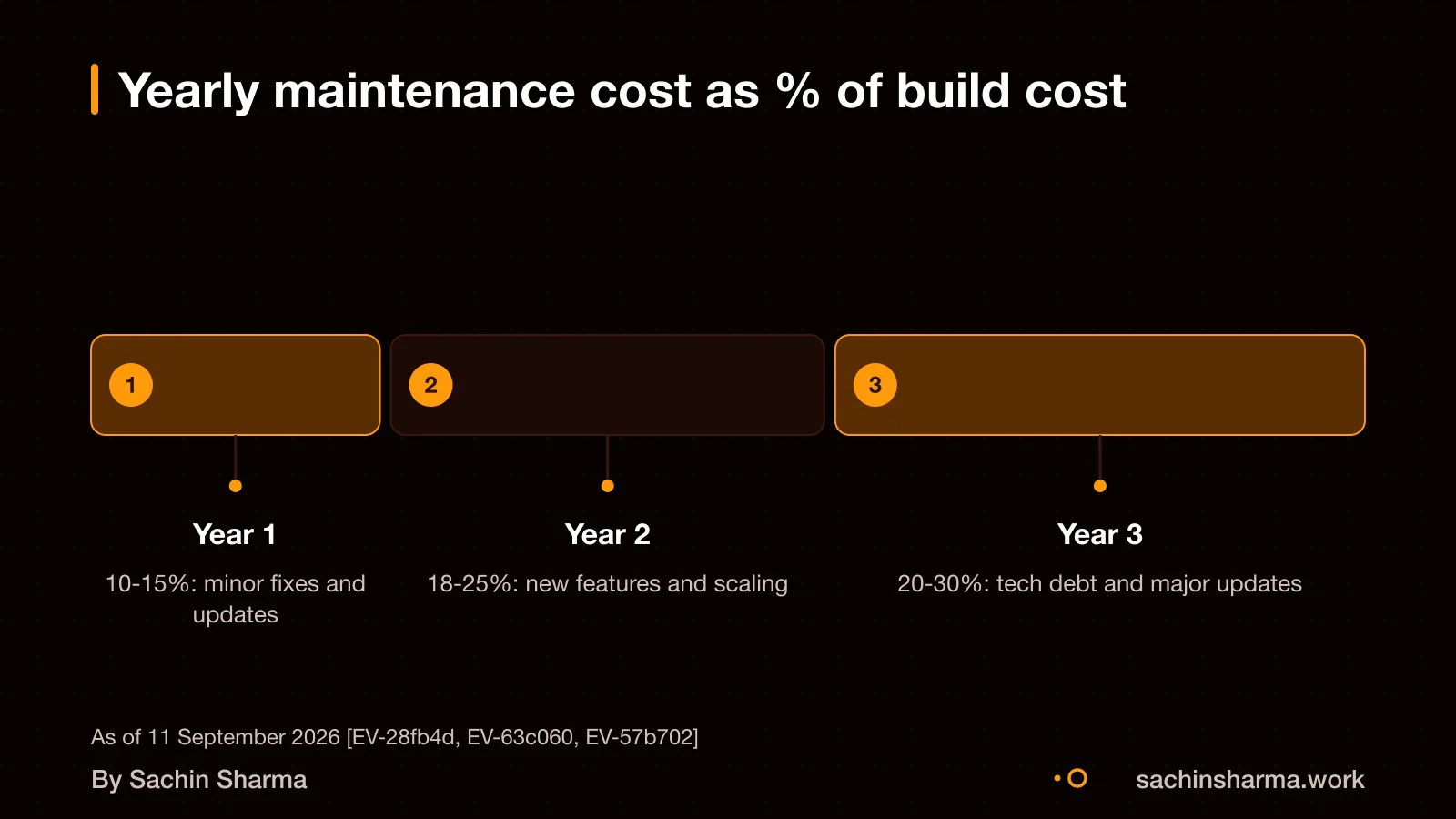
What third-party services do you pay for?
You pay directly for third-party tools like payment gateways, SMS services, cloud hosting, and app store fees. These are separate from my development fee and billed to you by the provider. For example, Razorpay charges per transaction for payments, Twilio for SMS delivery, and Google Cloud Platform (GCP) for hosting your backend and storage. You also pay annual fees to publish on the Google Play Store and Apple App Store.
These costs are part of your ongoing maintenance budget. Around 60% of that budget is fixed and predictable, covering hosting, third-party APIs, OS compliance, monitoring, and store fees. I help you choose cost-effective, reliable services that meet Indian business needs, but you sign and manage those accounts directly.
App store fees are small one-time or yearly charges. Payment gateway and SMS costs vary with usage. Hosting on GCP depends on traffic and storage but starts low for MVPs. I do not mark up these services, you pay only what the vendor charges.
Worked example: MVP e-commerce app
As an estimate, assuming a basic e-commerce app with 5 screens and one payment gateway. The cost ranges from ₹32 lakh to ₹64 lakh and the timeline is 10 to 16 weeks. This estimate is based on converting the evidence-based USD ranges into Indian rupees at an exchange rate of ₹80 per dollar. Backend development, which includes setting up product catalogues, shopping cart logic and payment integration, is estimated at ₹6.4 lakh to ₹36 lakh. Frontend development for the user interface is estimated at ₹4.8 lakh to ₹28 lakh. UI/UX design adds ₹6.4 lakh to ₹12 lakh to the total. Since the app is built from scratch, every screen and interaction must be custom-coded and tested.
For example, a simple app selling handmade crafts with screens for home, product listing, product detail, cart. Checkout, using Razorpay or Stripe as the single payment gateway, would fall in this range. The time estimate of 10 to 16 weeks includes design, development and testing phases. This does not include time for client delays, scope changes or rework. The estimate assumes no complex features like AI search, multi-vendor support or offline mode. Costs can rise if more integrations, custom animations or compliance needs are added. The pricing model used is not known [unknowns].
How to verify claims and avoid mistakes
Check a developer’s past work by asking for live apps or websites you can test yourself. Look for apps in your industry. Try key tasks like browsing products or checking out. If source code is public, review it for quality and structure. Avoid claims like “powered by AI” without a clear function.
Common scoping mistakes include adding too many features early. Examples are wishlists or reviews before validating demand. Another mistake is ignoring offline needs. For example, stock sync during internet outages adds complexity. Start with core sales flow: browse, cart, checkout, order tracking.
Vague quotes use terms like “full-featured” without listing screens or integrations. A clear quote names each feature. For example, “product search with filters” or “Razorpay integration.” It also states what is not included. If the quote lacks a feature list, ask for one.
Can I see apps you’ve built?
I have not delivered a public-facing e-commerce app that you can verify. The work I have built includes apps in personal productivity, legal tech, gig management. Media discovery, but none are e-commerce platforms for a client. For example, MojoCinema is a movie discovery app that lets users save titles locally and explore Indian and regional films. Sameframe is a desktop tool that finds duplicate photos and videos without uploading them. These are technical showcases, but they do not reflect e-commerce functionality. There is no verifiable evidence of a completed client e-commerce project, so I cannot share a live store or case study with business impact. You should treat any claim about e-commerce delivery as unverified.
Who owns the code and design?
You own the app’s code and design after full payment, unless otherwise agreed. This means you can move it to another developer or platform at any time. The app can be transferred to another App Store Connect account. While staying live on the App Store, with all reviews, ratings and user access preserved. You also retain control over updates during and after the transfer.
You pay for them directly and manage access, but their code is not yours. The custom code built for your app, the frontend, backend and design files, is yours to use, modify or hand over. No agency layers or hidden ownership structures are involved.
However, the exact legal terms of ownership, including licensing of source code or design assets, are not specified in the evidence. Since ownership details may affect your rights, check the contract before signing. Ask for a clause that confirms full transfer of source code and design files upon final payment.
When you should not build a custom app
When you should not build a custom app
Do not build a custom e-commerce app if you have not yet achieved product-market fit. You need steady monthly sales and clear customer demand before investing in a custom solution. Without this, your funds may be better spent on marketing or improving your current offering.
Do not build a custom app if your main goal is discovery. Selling on Flipkart or Amazon gives you access to millions of buyers without the high cost of custom development. These marketplaces handle payments, delivery and customer service.
Do not build a full product if a prototype or MVP is enough. If you are testing an idea or need investor proof, a simple prototype with core features may suffice.
Assumptions behind the numbers
- Rate is ₹2,500/hour as a mid-point for Indian agency rates.
- Team size is 2 people per phase on average.
- Maintenance is 20% of build cost as default.
- Third-party fees are not part of the build cost.
- Cross-platform is assumed; native doubles the frontend/backend effort.
Work out your own number
I won't hand you a number that pretends to be the market. Instead, here is the working: set the weeks, the people and the rate, and see where the money goes.
Your working total
₹7,60,00019 weeks × 2 people × 5 days × ₹4,000- Planning11%
- Design16%
- Frontend32%
- Backend26%
- Testing11%
- Launch5%
The weeks shown are an example of a small app, there to be changed. Fees you pay others (store accounts, cloud, SMS) are not in this total.
What moves the price
- Multi-vendor setup
Each vendor role adds weeks like a mini app.
- AI-powered search
Smart filters and recommendations take extra design and tuning.
- Offline mode
Local storage and sync logic are complex to test.
- One platform first
Start with Android or iOS to cut scope.
- Managed backend
Use Firebase or Supabase to skip backend weeks.
- Fixed scope upfront
Fewer changes mean fewer surprise weeks.
Fees that go to someone else
Google Play developer account
A one-time fee of ₹2,200 (as of April 2026). Paid to Google.
Apple Developer Program
₹9,900 yearly. Paid to Apple.
Cloud, SMS, maps, payments
Usage-based. Billed by provider to you.
Ask for these before you sign
- How many weeks per phase, and with how many people?
- What is not included?
- Which fees do I pay to others directly?
- What happens to the price when I change my mind?
- What does the first month after launch cost?
Questions people ask
I include discovery, design, build, test and launch phases. We start with understanding your business goals and end with a fully tested app. Each phase has clear deliverables and your input shapes the final product.
A written agreement defines the scope, deliverables and payment terms before work starts. Clear scope prevents misunderstandings and keeps the project on track. Without a defined scope, delays and cost overruns are likely. Check this for your case with a chartered accountant or lawyer.
You get wireframes in design, a clickable prototype next, then a test build with core features, and finally the launched app. Each milestone lets you review progress and give feedback. Testing includes unit, integration and beta tests.
A sample contract helps you understand clauses like scope, payment, timelines and ownership. I do not share my client agreements, but you can use a standard template to prepare. See 'What legal agreements for app development?' for a guide.
Scope changes are common but must be documented and priced separately. We agree on how the change affects timeline and cost before proceeding. This keeps the project transparent and under control.
Yes, I ensure your app meets Google Play and Apple App Store guidelines, including targeting the required API level. As of 31 August 2026, new Android apps must target API level 36. I handle technical compliance for approval.
I collect only the data you need and store it securely. Consent is taken clearly and users can withdraw it. I follow India’s Digital Personal Data Protection Act and global best practices. Check this for your case with a data protection officer.
I integrate Razorpay, Paytm, Stripe and other local gateways based on your business needs. Each has different fees and settlement times. Maintenance includes updates when APIs change.
An offline mode is possible but increases cost and complexity. It lets users browse and add to cart without internet, syncing when back online. As an estimate, this adds 20% to 30% to development time and cost.
Post-launch support includes bug fixes, security patches, performance monitoring and user support. I address issues missed in testing and keep the app stable. Maintenance costs 10% to 15% of build cost in year one.