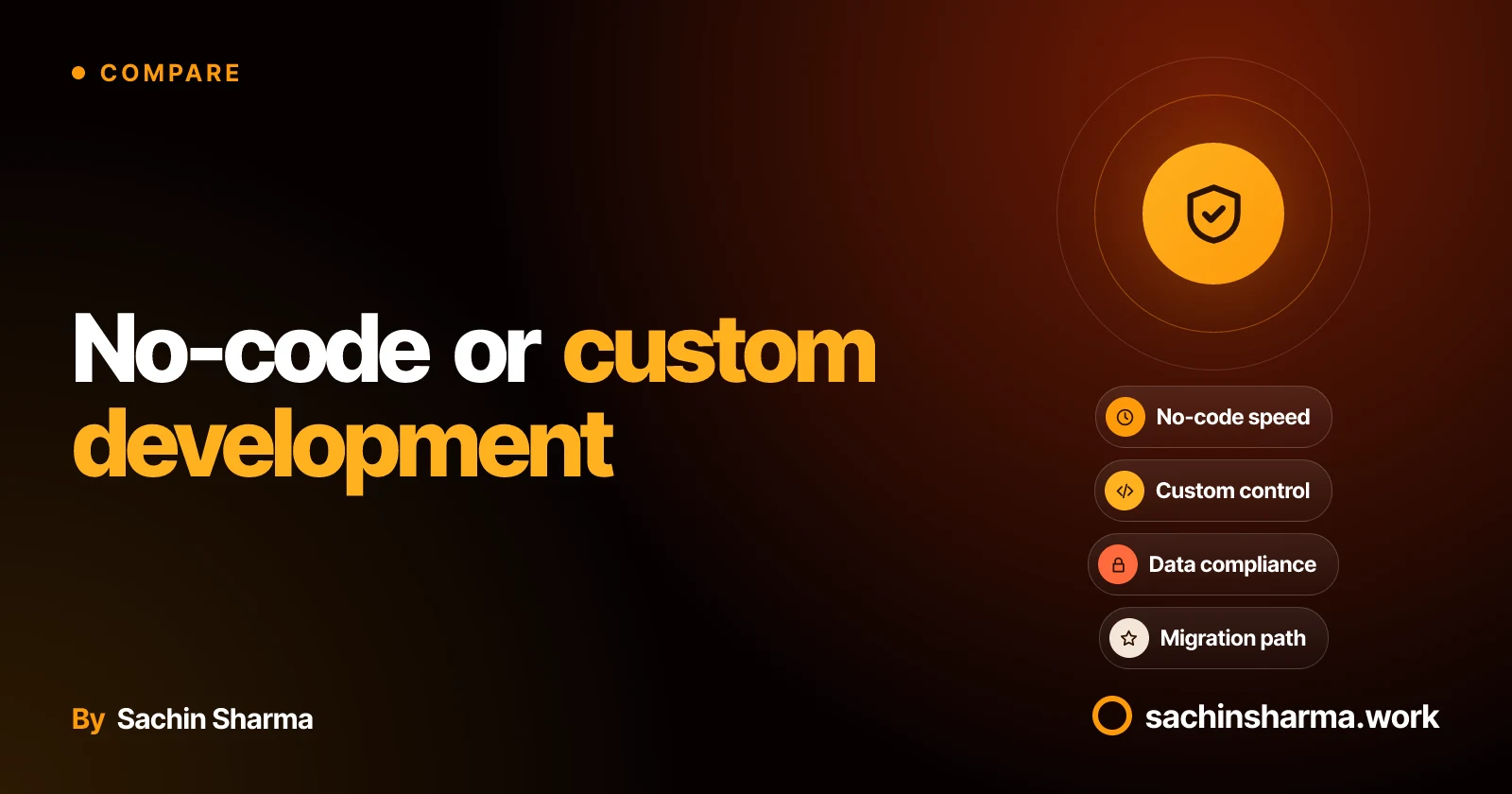
What is no-code and how is it different from custom development?
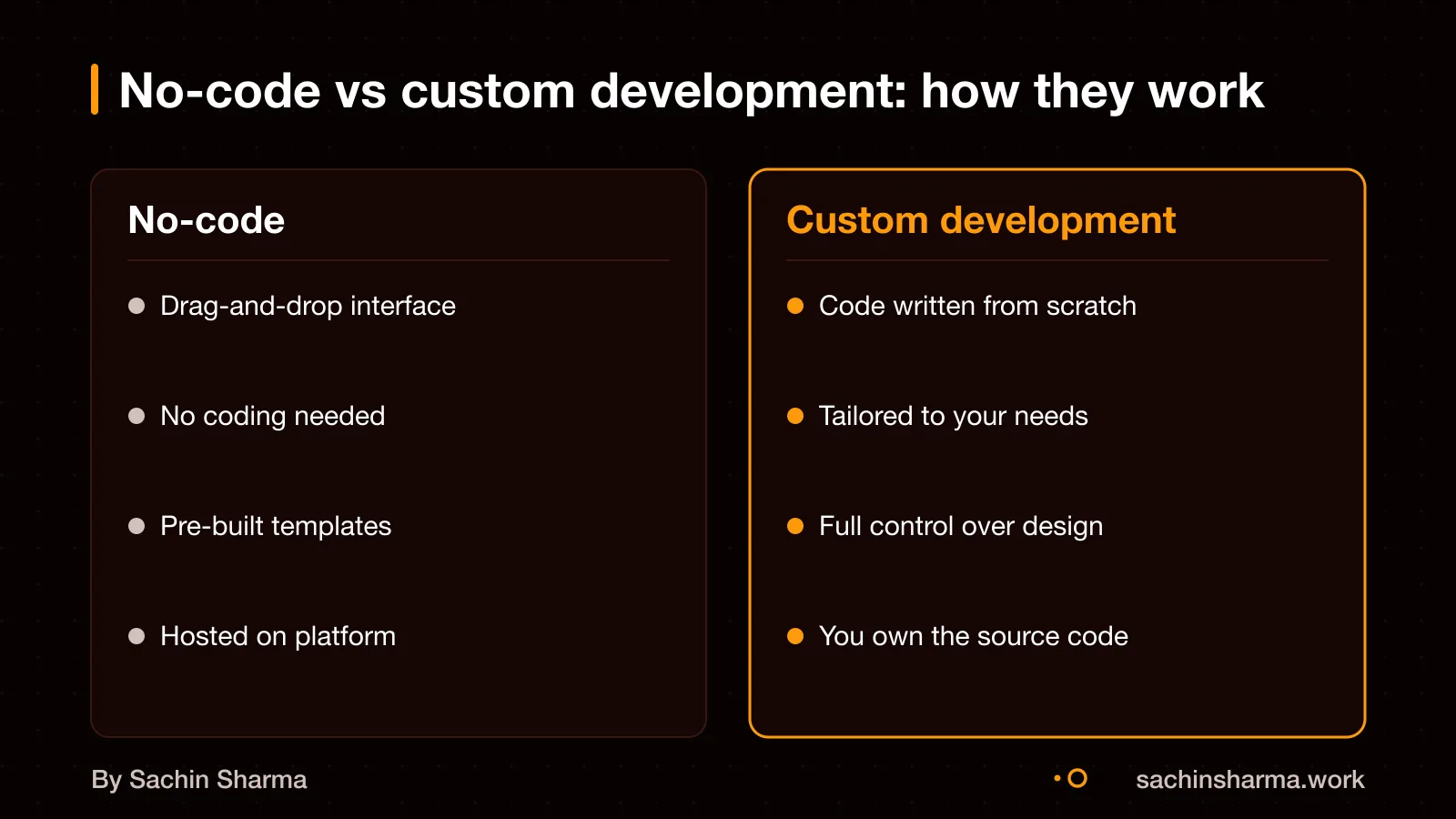
No-code development means building apps using drag-and-drop tools and pre-built blocks, without writing code. You choose from set features and arrange them like puzzle pieces to create a working app. This is fast and easy to start, especially for simple tools or testing an idea.
Custom development means writing code from scratch to build software that fits your exact needs. A developer codes each part, so the app can do complex tasks, work offline, or connect deeply with other systems.
With no-code, you have less control over how the app works and what it can do, since you are limited to the platform’s blocks. With custom development, you control every detail, from user experience to data storage, and can change it anytime.
When to choose no-code development
No-code is best for testing ideas fast, building internal tools, or launching a simple app on a tight budget. It lets you start without writing code and get feedback quickly. This path suits founders, small teams, or business owners who want to validate a concept before spending more. You gain speed and lower upfront cost, but trade control over complex features or deep integrations. For example, a local service business can use no-code to launch a booking form or inventory tracker in days, not months. As a rule, choose no-code when making an MVP or a simpler internal solution. Many SaaS teams start here and shift to custom code once their needs grow. If you are launching web apps and MVPs in Next.js, I build them custom. But I recommend no-code if you need something live now with minimal spend.
When to choose custom development
Choose custom development when you need full control over your app’s logic, data and security. Custom code lets you add features that no-code tools cannot support, such as offline-first use, deep third-party integrations or end-to-end encryption. For example, Loopin, a habit tracker I built, works offline and syncs data securely to Google Drive. A feature that would not be possible on most no-code platforms.
You need custom development when your app must integrate tightly with existing systems, like a CRM. Inventory or accounting software, or when it handles sensitive data that requires audits. No-code platforms do not allow security audits, but custom code gives full access for checks and compliance. This matters for businesses in legal, health or finance, where data control is non-negotiable.
Scalability also demands custom code. If your user base is growing fast or your workflows are unique, no-code limits can slow you down. Custom apps scale on your terms, in performance, architecture and ownership. While they cost more up front, they offer long-term control and adaptability. See how I deliver custom software development for Indian businesses.
How much does no-code development cost?
A small no-code app starts at $36 to $60 per month. This covers basic features on platforms like Adalo. As your app grows in users or data, costs can rise fast. On those platforms, this setup could cost $400 to $1,000 per month due to overage fees. Typical price ranges depend on the platform and features. Entry plans suit early testing. Mid-range plans fit apps with more users or integrations. Entry-level plans start at $36 to $60/month but can rise to $3,000 to $8,000/year as your app grows. These are not one-time fees but ongoing monthly or annual bills.
How much does custom development cost in India?
A custom app can cost $40,000 to $150,000 upfront, with monthly maintenance from $1,000 to $10,000. This range depends on your app’s complexity, team size and tech choices. For example, a simple service app may cost near ₹50,000. A product with AI, offline use or deep integrations can reach ₹10 lakh. Maintenance includes updates, hosting, bug fixes and minor feature tweaks. Service businesses often spend less at the start, as they need fewer features than scalable products. What drives your final cost is the number of user roles, third-party APIs, compliance needs and how much custom logic you require. As an estimate, assuming a mid-range app with two user types, one payment gateway. Basic reporting, the build cost is ₹3 lakh to ₹5 lakh. You can reduce cost by starting with a minimal version and adding features later.
what it costs to build an app in India
Want a number for your idea? Send one line on WhatsApp. I reply with what drives the cost and what to cut.
Message me on WhatsAppHow long does each option take to build?
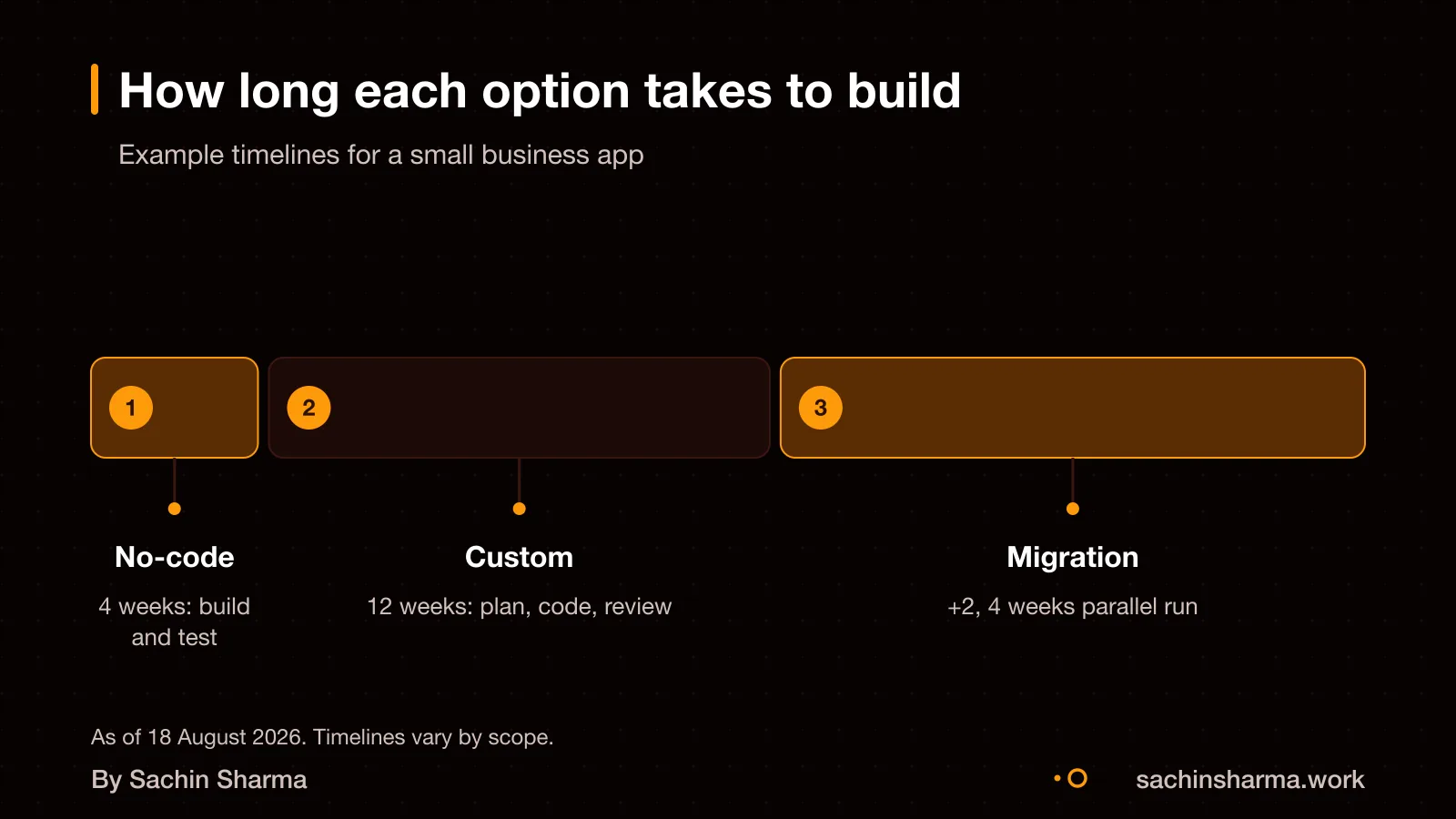
No-code can get a working app live faster than custom development. This speed comes from using drag-and-drop tools and pre-built features instead of writing code from scratch. For simple apps like forms, dashboards or internal tools, no-code lets you test ideas quickly.
Custom development takes longer because it includes planning, coding, testing and deployment phases. Each step needs careful work to build reliable, secure software. Complex features like offline access, AI or deep integrations add more time.
Migrating from no-code to custom later adds time to your timeline. This includes data transfer, rebuilding core logic and testing the new system. But this only matters if you outgrow the no-code platform, not all apps do.
There is no published data on what slows down no-code or custom projects. Delays depend on team size, scope changes and feedback speed. You should plan buffer time for both paths.
Who owns your app or code?
In no-code, you do not own the source code. The app runs on the platform's infrastructure, and you cannot export it as working code like React or Flutter. For example, Bubble.io does not let you download your app as a codebase you can host elsewhere. You can take your data out, but not the app logic or design as code.
Custom development gives you full rights to the source code. I write the code and hand it over to you. You can modify it, host it anywhere, and even hire another developer to work on it. This means full control over your app’s future.
Most no-code tools allow data export, so you can leave the platform with your records. But you cannot rebuild the app without starting over. With custom apps, you own both data and code. For Apple apps, you can restrict distribution to your organisation using Apple Business Manager.
Can I migrate from no-code to custom later?
Yes, you can migrate from no-code to custom development later, but it is not a simple switch. Instead, migration means rebuilding your app from scratch using custom code. You will keep your idea and user feedback, but not the app itself.
The process involves three main steps: first, exporting your data in a usable format like CSV or JSON; second, designing. Coding the new app with your chosen tech stack; third, testing thoroughly to ensure nothing breaks in the transition. Some platforms may limit what data you can export, so check this early.
You lose the time and money spent on the no-code version. Features, workflows and integrations must be rebuilt. If your app has grown complex, this can take months and cost more than the original build. Still, many teams do this when their usage, integrations or compliance needs outgrow the platform.
If you plan to add AI features later, consider how a rebuild will affect timelines. For example, moving from a no-code tool to a custom AI chatbot means starting over on both the app and the agent logic.
Not sure if your project has this risk? Tell me the plan in two lines and I will say yes or no.
Message me on WhatsAppSupport, risks and limits after launch
A custom app needs regular updates, bug fixes, and security patches to stay secure and fast. You must review user-impacting features rolled out by the platform. For example, a sudden change in a no-code platform’s login system could break your app unless you test it first.
No-code apps carry risks like vendor lock-in and limited security control. If the platform changes its pricing, features or terms, you may be forced to adapt or migrate. Since you do not own the code or infrastructure, you cannot run full security audits on no-code platforms. This lack of control can be a problem if your app handles sensitive data.
Flexibility is also limited because no-code tools only allow features the platform supports. For example, adding offline access or deep AI logic may not be possible. If you later need these, you may have to rebuild in custom code.
Legal and data rules for Indian businesses
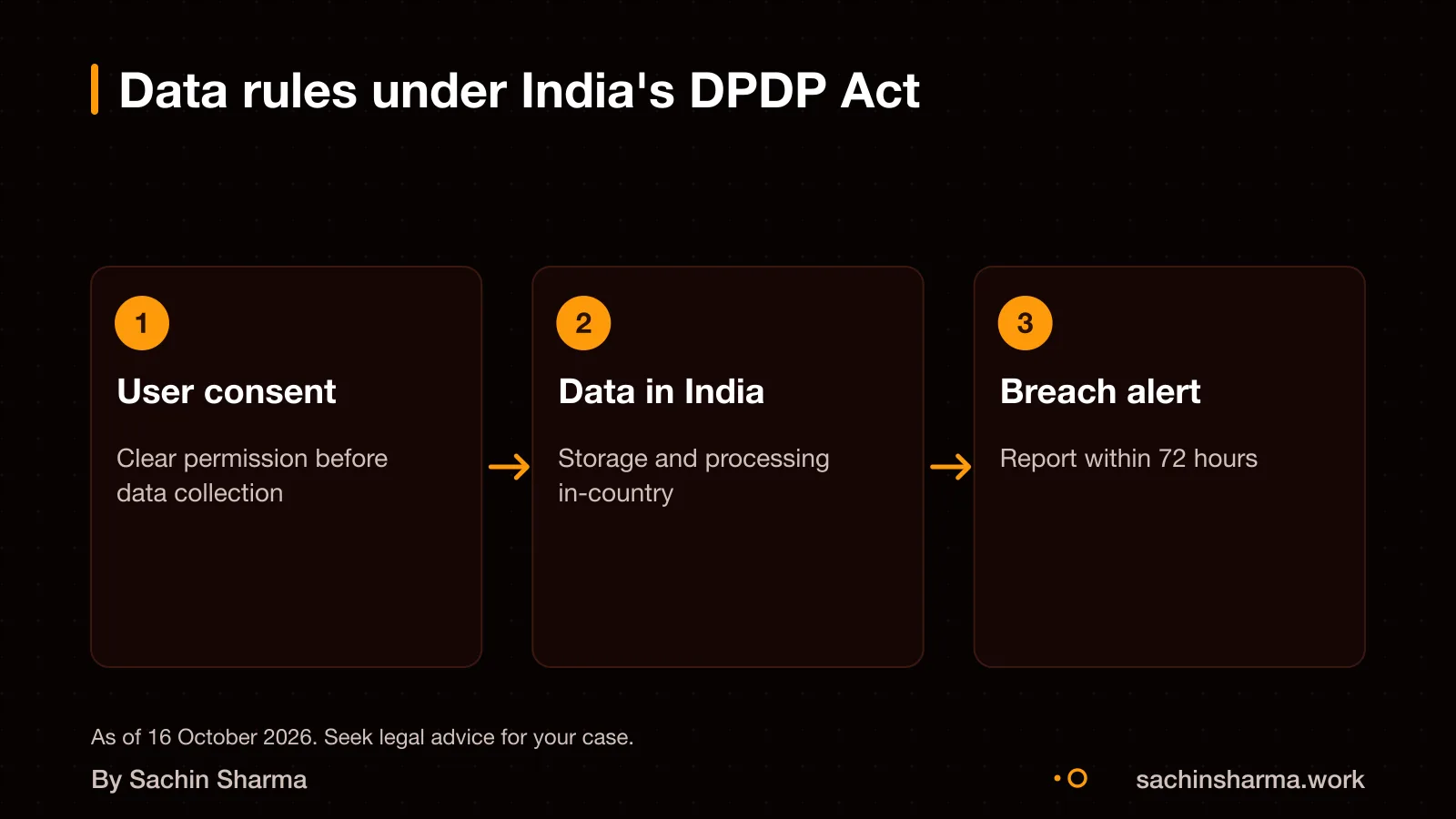
Yes, the DPDP Act applies to your app if it offers goods or services in India or processes data of individuals in India. No matter where your business is based. You must get clear and specific consent before collecting or using personal data. This consent must be given freely and through a clear action, like checking a box or tapping "I agree".
You must report data breaches to the Data Protection Board within 72 hours of becoming aware of them. Fines for serious violations can go up to ₹250 crore. This applies whether you build with no-code tools or custom code.
Most no-code platforms do not guarantee full DPDP compliance out of the box. You remain responsible for how data is collected, stored and used. Check each platform’s privacy settings and data-handling policies before choosing one. For example, if your app collects phone numbers or email addresses, you must explain why and get active consent.
Since support after a no-code app launch is not known, plan for compliance updates yourself. Assign someone on your team to review changes in data rules. For custom apps, I build privacy controls into the code, such as consent logs and data export tools.
If you are unsure whether your app falls under the DPDP Act, consult a legal expert who specialises in data protection in India. Rules apply the same way regardless of the tech stack.
Proof of delivered custom apps
I have built custom software for Indian businesses, including a multi-tenant dealership management platform. A brand website was built for a family-run conglomerate. These systems support operations across multiple brands and outlets. The platform was built for their 5-brand, 8-outlet two-wheeler dealership vertical. The website strengthens their public presence and customer reach. Both were delivered as part of a direct engagement, with no agency layers. You can see a real example in Aashwasan, a gig and contract management app. Aashwasan: a gig and contract management platform solves the problem of disorganised freelance work by giving users a single place to manage contracts and deadlines.
When this advice does not apply
When this advice does not apply
No-code is not enough if your app must work offline, process sensitive data with end-to-end encryption, or connect deeply with other systems. For example, a clinic app that stores patient records on the device and syncs later needs custom code. Custom development is overkill if you only need a form, a simple dashboard, or a tool for internal use with under 50 users. A restaurant owner tracking daily sales does not need a custom app. This advice is not for large firms with in-house teams or startups with venture funding aiming for rapid scaling. If you already have developers, the trade-offs change. Consider whether you need full control or just speed to market. For simpler needs, no-code may save time and cost. For complex, secure or scalable apps, custom is better. Ask yourself: does my use case need features beyond what no-code tools offer? in-house team or outsource?
Next steps to decide
Next, you need a clear idea of what you want to build and your business goals. I can help you decide whether no-code or custom development fits your stage, budget and long-term plans. After you reach out, I will ask about your project, review what matters most and suggest a path with clear trade-offs.
Next step: message me on WhatsApp with what you want to build. No forms, no sales team.
Message me on WhatsAppAssumptions behind the numbers
- No-code base cost: $36 to $60/month ()
- No-code 3-year cost: $1,296 to $2,160 (base only, no overages)
- Custom upfront cost: ₹50,000 to ₹10 lakh ()
- Custom maintenance: ₹1,000 to ₹10,000/month ()
- No-code speed: days to weeks ()
- Custom speed: 4 to 16 weeks ()
Pick your situation
I build both no-code and custom apps, so I benefit from either path. My past work includes a no-code legal tool and custom dealership software.
Pick your situation
No-code wins. No-code lets you build and show a working version in days. Ideal for MVPs and early feedback.
The whole comparison
| No-code | Custom | |
|---|---|---|
| Initial cost | $36 to $60/month | ₹50,000 to ₹10 lakh |
| Speed to first version | Days to weeks | 4 to 16 weeks |
| Ownership of code | None, tied to platform | Full, yours to modify |
| Offline support | Limited or none | Built-in if chosen |
| AI and deep integrations | Plugins only | Full access and control |
| Long-term cost (3 years) | $1,296 to $2,160 (base) + overages | ₹50,000 to ₹10 lakh + ₹12,000 to ₹1.2 lakh/year |
Whichever you choose, ask these
- Can I switch from no-code to custom later?
- What happens if I stop paying the no-code bill?
- Will I own the data in a custom app?
- Do you help with ongoing maintenance?
Questions people ask
I recommend no-code for testing ideas and custom development for scaling. No-code is faster and cheaper to start, ideal for MVPs and simple apps. Custom gives full control, stronger security, and room to grow.
Yes, but you cannot export the app as working code. Data can be moved, but the app must be rebuilt from scratch. The timeline and cost depend on the app's size and platform used.
Many teams do this, but migrating later can cost 2 to 4 times the original build. If you expect fast growth, plan for a future rebuild. Start with clean data design to ease the transition.
Most do not. They need constant internet access. Custom apps like Loopin are built offline-first: they show local data immediately and sync when back online. This is critical for field teams or patchy networks.
Yes. Under the DPDP Act, you are responsible for user data even if it is stored on a third-party platform. You must ensure valid consent and report breaches within 72 hours. Check this for your case with a chartered accountant or lawyer.
Check their portfolio, GitHub activity, and real client work. Android verification helps but is not enough. I share apps I have built, like Loopin and Aashwasan, so you can see the quality and scope.
Custom apps need monthly maintenance for security updates, bug fixes, and feature tweaks. No-code platforms handle some updates but charge ongoing subscriptions. You still manage user access and data rules.