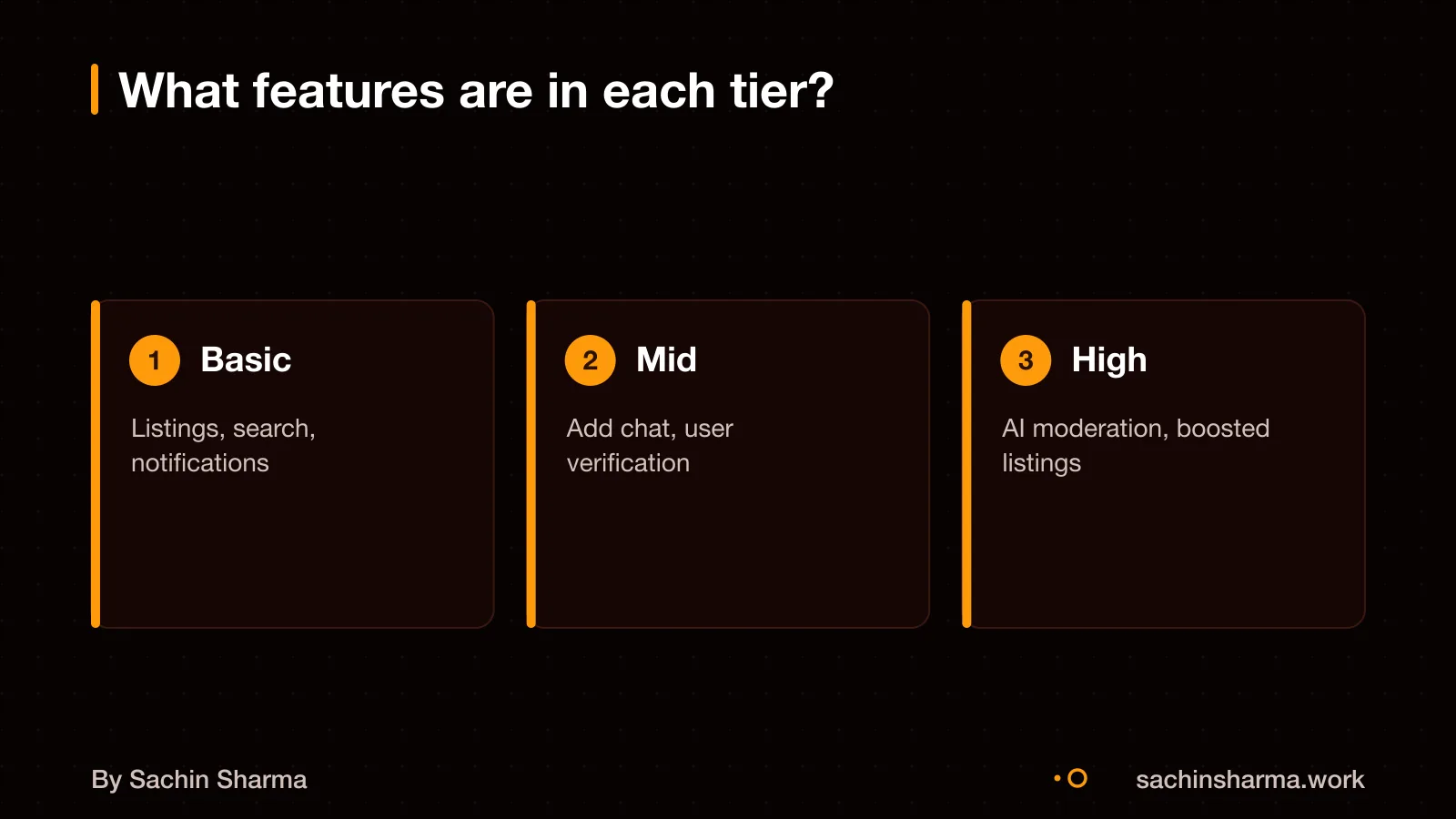
What features are in basic, mid and high-tier builds?
A basic classifieds app includes listing creation, search, categories and user notifications. This means you can post an item, let others find it by keyword or type, and get alerts when something changes. It is for startups testing demand with a lean product.
A mid-tier build adds in-app chat and user verification. Chat lets buyers and sellers talk without sharing phone numbers. Verification builds trust by confirming identity through email, phone or document checks. These features help if you expect high user volume or private sales.
A high-tier app includes AI-based listing moderation, boosted listings and analytics. AI checks photos for stock images or watermarks to block fake posts. Boosted listings let sellers pay to appear higher in search. Analytics show traffic, conversion and user behaviour. These suit funded ventures scaling quickly.
Feature choices directly affect cost. More features mean more development time and testing. Basic apps cost less and launch faster. Mid and high-tier apps need more budget but offer better engagement and safety.
| Tier | Core Features | Add-Ons | Best For |
|---|---|---|---|
| Basic | Listings, search, categories, notifications | None | Testing your idea |
| Mid | All basic features | In-app chat, user verification | Growing user base |
| High | All mid-tier features | AI moderation, boosted listings, analytics | Scaling a live marketplace |
For a clear idea of what you need, see Must-have vs nice-to-have features for a classifieds app.
How do you price and bill for development?
My rate of ₹2,000/hour is an estimate based on the $25 to $60/hour range for developers in India in 2026. Converted at ₹80 per dollar. For projects with a fixed, well-defined scope, I recommend a fixed price. This gives you certainty and protects against cost overruns. Fixed pricing works best when requirements are locked before development starts.
For projects where the scope is unclear or likely to evolve, hourly billing is better. It allows flexibility to adjust features, fix issues, or explore new needs without renegotiating the entire contract. Hourly pricing makes sense when scope is genuinely uncertain and evolving.
This is not a promised rate for every project. It may vary based on complexity, duration, and tech needs.
A quote does not include third-party costs like domain registration, hosting, app store fees, or SMS and email services. It also does not cover content creation, marketing, or legal compliance tasks such as drafting privacy policies or GST registration. These are your responsibility or require a separate agreement.
Want a number for your idea? Send one line on WhatsApp. I reply with what drives the cost and what to cut.
Message me on WhatsAppHow long does it take to build a classifieds app?
A classifieds app MVP takes 4 to 6 months to build. This timeline covers a working app with core features like listings, search, user accounts and secure payments. The exact time depends on how many features you include and how quickly you make decisions. If you cut non-essential features or add more developers, it can be faster. Complex features like AI search or real-time chat add time.
You can start as soon as we agree on scope and sign a contract. There is no fixed lead time to begin. I work directly with you, not through an agency, so delays from layers of approval are avoided. For example, a multi-tenant platform for a family-run business was delivered in under 6 months. With lead-to-delivery time cut from 2 weeks to 4 days.
If you need a simpler version faster, we can plan a smaller MVP. A basic app with listings and contact forms could take less time. The 4 to 6 month range assumes a solid app built in Flutter or Next.js, ready for real users. You should allow extra time for testing, feedback and fixes before launch.
For a detailed breakdown of each phase, see the Timeline for building a classifieds app from scratch.
What are the steps in your development process?
I run a process that includes planning, design, development, testing, and launch, based on standard steps for building a classified app. Each phase has clear deliverables and room for your feedback. We meet weekly by video call to review progress and decide next steps. You can request changes at any stage.
In the plan phase, we define your app’s goals, target users, and core features.
The design phase may include layout, screen flows, and user experience, as part of the design step in building a classified app.
The build phase may involve coding in Flutter or Next.js, which is part of the development step in building a classified app.
You can give feedback at every stage. I revise mockups and builds until they meet your needs. Major changes after design may affect timeline and cost.
Next step: message me on WhatsApp with what you want to build. No forms, no sales team.
Message me on WhatsApp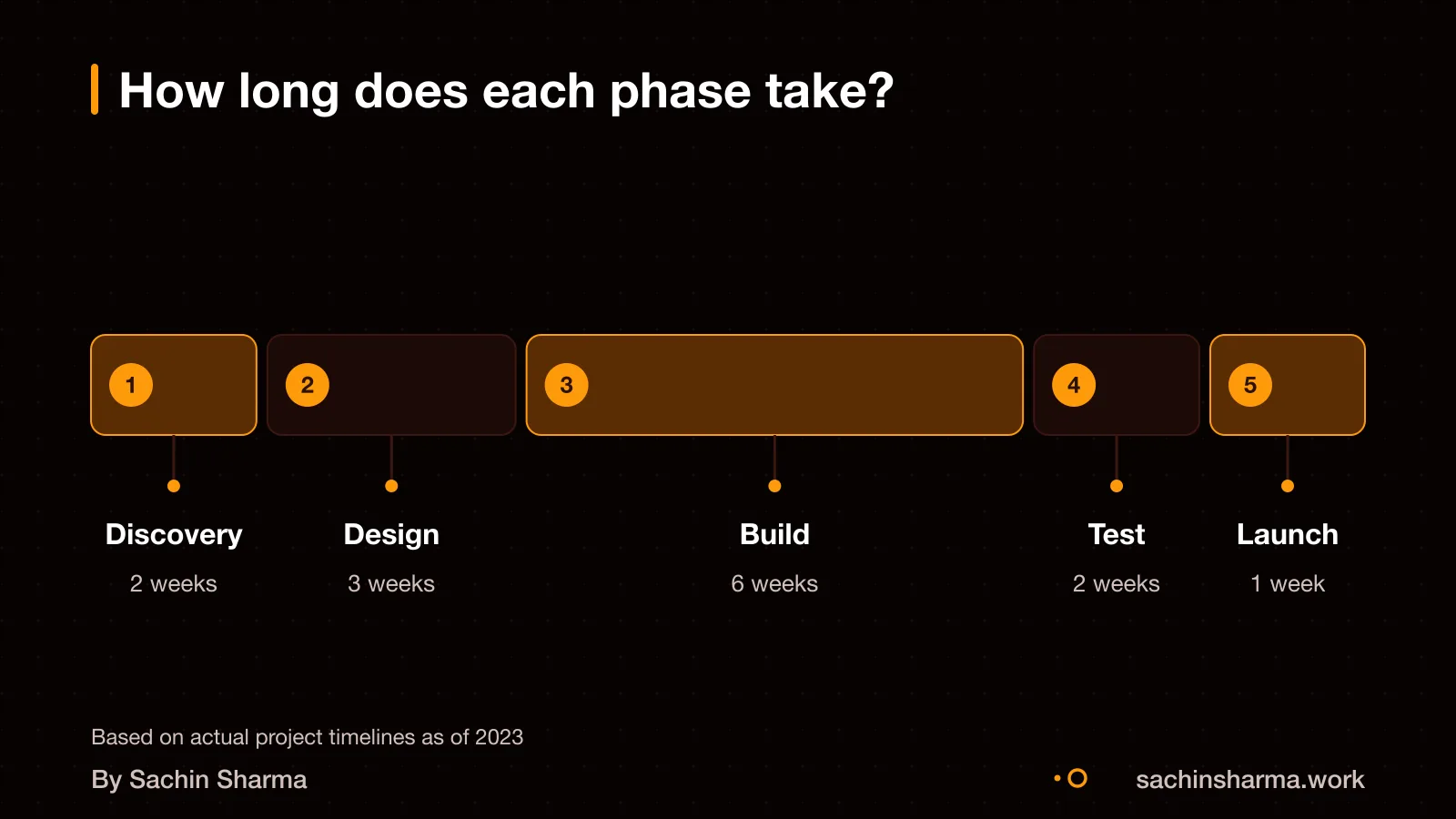
Do you work alone or with a team?
I work directly with clients. This includes working with businesses like a family-run conglomerate in Chhattisgarh. As a solo developer, I take full ownership of the code and timeline, which keeps communication fast and changes predictable.
For tasks outside my core development work, I may bring in trusted freelancers only if needed. For example, a specialist designer can help with the app’s look and feel, or a QA tester can validate edge cases before release. You will know in advance if someone else joins, and I remain your main point of contact.
If I am unavailable due to illness or leave, I plan buffers into the timeline to protect your deadlines. I also document code clearly so another developer can step in if absolutely necessary. Quality is ensured through code reviews, automated testing where relevant, and regular check-ins with you.
This model works best when you want direct access to the person building your app and clear accountability for every feature.
Why Flutter or Next.js for your classifieds app?
I recommend Flutter for your classifieds app if you want a fast, cross-platform mobile app with a smooth user experience. Flutter compiles to ARM or Intel machine code as well as JavaScript. The Hot Reload feature lets me update the app and see changes almost instantly. Flutter also works well with Google services like Firebase for real-time data, Google Maps for location-based listings, and Google Pay for secure transactions.
Next.js is better when your app needs a strong web presence, like a public-facing website or an admin dashboard for managing listings and users. It runs on the server, loads fast, and is easy to optimise for search engines. I use it for tools that need forms, reports, or content that changes often.
For backend, I use Firebase for apps that need quick setup and real-time sync, such as chat or live listing updates. For more control or complex logic, I build a custom backend with Next.js and a database like PostgreSQL.
You cannot switch the main tech stack after launch without rebuilding most of the app. But I design the architecture so that parts like the backend or design system can be reused if you later expand to another platform.
Flutter vs native vs PWA for classifieds apps
Should you build a PWA or a native app?
A PWA (Progressive Web App) is a website that acts like an app. You can add it to your phone’s home screen, use it offline, and get push notifications. It works across Android and iOS without separate builds.
A PWA makes sense if you want lower development cost and faster launch. It is easier to update and does not need approval from app stores. Businesses like JD.ID saw a 53% rise in mobile conversions after switching to a PWA. Hulu also saw a 27% increase in return visits with their PWA.
But PWAs have limits. Apple’s Safari supports only basic PWA features, even though it has done so since 2018. On iPhones, PWAs cannot access Face ID, background audio, or advanced push notifications. Apple’s PWA support is weaker than Chromium-based browsers like Chrome.
A PWA can use some device features. These include camera, location, and local storage. But it cannot run background tasks reliably or support real-time chat when closed. For features like in-app messaging or offline chat, a native app is better.
Native apps, built with Flutter or Next.js, give full access to device hardware. They support offline-first sync, background processing, and rich notifications. If your classifieds app needs chat, voice, or live updates, go native. A PWA works only if core features do not rely on deep device integration.
What third-party costs should you budget for?
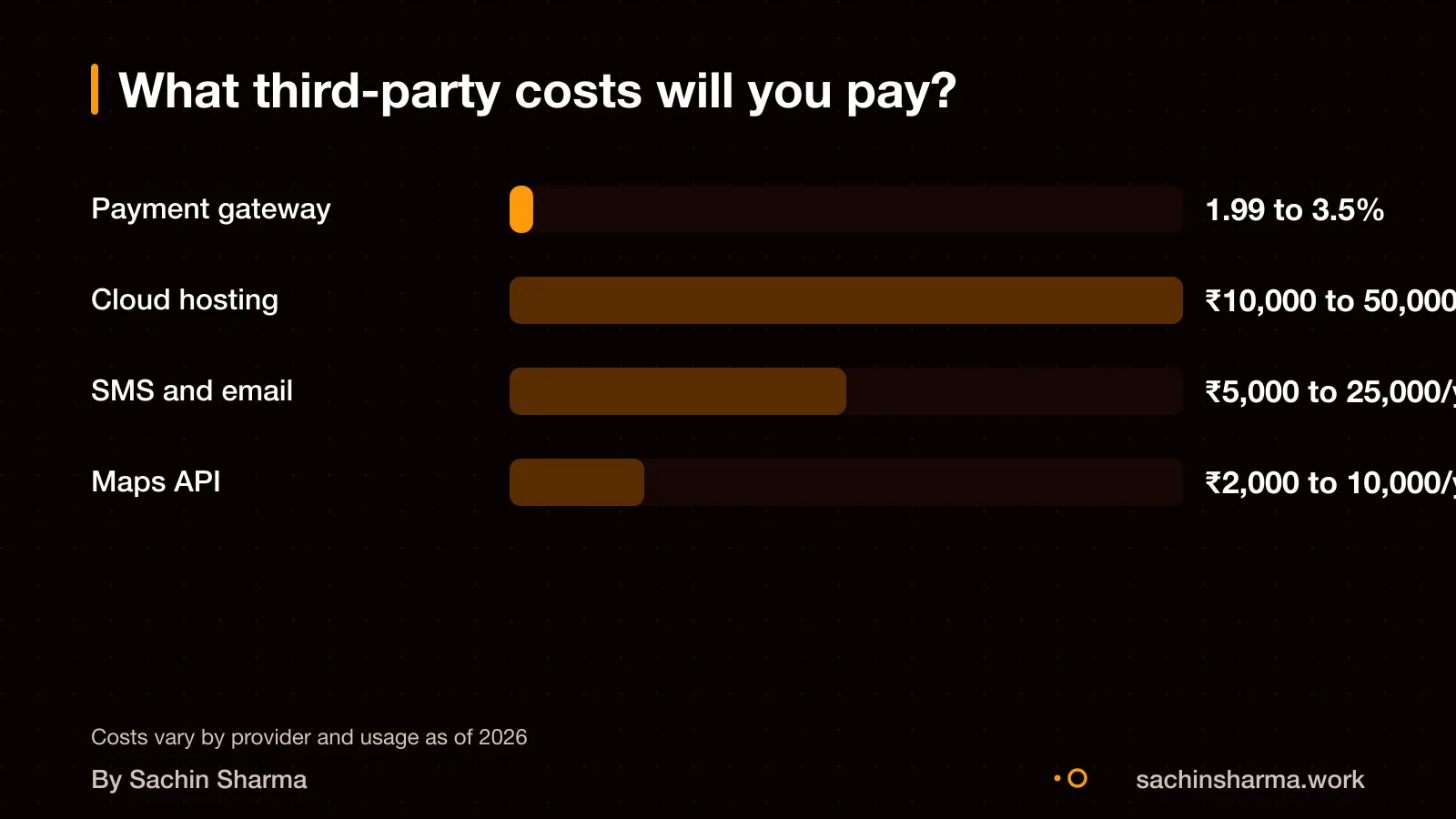
Maps, SMS, and payment gateways are not included in my development fee and must be budgeted separately. You pay for what you use, and costs depend on your volume and provider. I do not mark up these services or take a cut.
Payment gateway fees apply per transaction. For UPI, the government mandates zero merchant discount rate (MDR), so you pay 0% on standard person-to-merchant UPI payments. For domestic card and net banking transactions, fees cluster around 2% plus 18% GST. Cross-border card payments add 1.5% to 3% in conversion and network fees. The average gateway fee in India ranges from 1.99% to 3.5% + GST.
Cloud hosting, SMS for OTPs, and map APIs (like Google Maps) are usage-based. Costs rise with traffic and requests. For example, sending 10,000 SMS at ₹0.20 per message costs ₹2,000 per month. Hosting a small app on a basic server starts at ₹1,500 per month.
I do not help negotiate lower rates with third-party providers. You sign directly with them. I can advise on which services are cost-effective and reliable based on past projects. For high-volume needs, some providers offer custom pricing, but you must request it yourself.
What are the risks of building a classifieds app?
The main risk in building a classifieds app is miscommunication, not technical skill. This happens when expectations are unclear, feedback is delayed, or scope changes without agreement. I reduce this risk with weekly syncs, written updates, and a fixed scope for each phase.
Scope changes during development can delay timelines and increase costs. To manage this, we agree on a core feature set first. Any new request is logged as a change order. We review it together before proceeding, so you stay in control of time and budget.
Bugs after launch are rare but possible. Minor issues are fixed in the next update. For critical bugs, like a broken payment or login, I respond within 24 hours and prioritise the fix. Post-launch support is included for 30 days.
Delays often come from late feedback or unclear inputs. To prevent this, I set clear deadlines for your reviews and send progress updates every Friday. If a delay looks likely, I flag it early with options to adjust.
Automatic filters catch spam, profanity, and suspicious content in listings. This reduces harmful posts before they go live. You can also let users report suspicious listings for manual review. These tools lower the risk of fraud and build trust.
How much does adding in-app chat increase the cost?
Adding in-app chat increases cost because it adds real-time messaging, user presence tracking, and message history storage to your app. This means your backend must handle live connections, not just static listing data. As a result, the system becomes more complex and harder to scale safely.
It is better to plan for chat early. If you add it later, you may need to rework the user authentication, database structure, and notification system. Building it from the start keeps the architecture clean and reduces rework.
An alternative is to use a third-party messaging service like WhatsApp or Telegram for buyer-seller communication. This avoids backend complexity but gives you less control over the user experience. Another option is email-based replies, where users respond to alerts without logging into the app.
While the exact cost to add chat is not published, it increases backend workload significantly. You should budget extra time and funds if real-time interaction is core to your app’s value. For a lean start, consider delaying chat until after launch, once you have user feedback.
A basic chat system needs message sending, read receipts, and block controls. More features like group chat, file sharing, or moderation increase cost further. Since real-time systems are harder to test and debug, they also take more development hours.
As of now, the cost to add in-app chat is not published [unknown]. You can message me on WhatsApp with your use case, and I will tell you whether it’s better to build now or later.
How much does AI-based listing moderation cost to implement?
AI-based listing moderation uses models to scan listing photos and flag stock images, watermarks, or misleading content. This means fewer fake or low-quality posts reach your users. As a result, your team spends less time manually checking each listing. For example, if 30% of listings use stock photos, AI can catch most of them before they go live.
But AI moderation is not perfect. It may miss subtle scams or mislabel valid posts as suspicious. You still need a human to review flagged content. Also, training the model on Indian market trends, like common fraud patterns in used electronics or rental listings, takes extra time and data.
The cost to implement AI-based listing moderation is not published. It depends on the model choice, accuracy needed, and how tightly it must integrate with your app. As an estimate, assuming a pre-trained model with custom rules for Indian categories, the work may take 60 to 80 hours. At ₹2,000 per hour, that is ₹1.2 to ₹1.6 lakh.
Whether it is worth the cost depends on your volume. If you expect over 500 listings per week, automation saves time and improves trust. For smaller apps, manual checks may be cheaper and more reliable.
What does a boosted listing feature cost to build?
A boosted listing lets users pay to promote their post at the top of search results or in high-visibility sections. This helps your app earn revenue every time a seller wants more visibility. As of now, the cost to build this feature is not published. It involves technical work like a payment trigger, a visibility timer, a dashboard for users to manage boosts, and rules to prevent abuse. These systems must sync across devices and update in real time. Boosted listings are common in high-tier classifieds apps, where monetisation goes beyond one-time fees. Since this feature touches payments, data and user experience, it requires careful design. You should plan for it early if your business model depends on it.
What do you need from me to start the project?
To start, share your core goals and who your users are. I need to know what problem your classifieds app solves and for whom. You do not need final mockups, clear ideas or rough sketches are enough at this stage.
Decide on the key features you want in the first version. For example, do you need user accounts, search filters, or payment support? Also, choose your main platform: Android, iOS, or web. These choices shape the scope and timeline.
I work directly with you as a solo developer. Once we agree on the goal and key features, I can start planning the build. How long before work starts depends on how quickly you can confirm these basics. There are no agency delays, but no fixed timeline for start is published.
As an estimate, assuming you have your idea ready, planning can begin within a week of our first talk. The exact steps to start a project with me are not specified yet. You should confirm what you need to prepare.
Can I see examples of classifieds apps you’ve built?
I have not delivered a standalone classifieds app. But I have delivered apps with core features like listings, search, user accounts and real-time updates. MojoCinema lets users browse movie listings, search, view actor pages and save to a local watchlist. Aashwasan supports gig and contract listings with filtering and notifications.
You can see live demos of these apps on my portfolio page, though source code is closed. They show how I structure data, design user flows, and handle offline access. There are no public client projects specifically for classifieds apps, and I cannot share private work without consent.
You cannot talk to past clients directly, as their contact details are confidential. However, you can verify public claims: check the live apps on the app stores, review repository READMEs on GitHub, or test the features yourself. This lets you judge the quality of the interface, performance and attention to detail before deciding to work with me.
When this advice is wrong
- You should not build a classifieds app if your market is too small to support user growth. In that case, use a platform like OLX or Facebook Marketplace instead.
- A WordPress site with a classifieds plugin is better if your budget is under ₹5 lakh. You only need basic listings without custom workflows or mobile apps.
- You need an agency if your project requires a large team, 24/7 support, or multiple parallel deliverables like branding, marketing and app store optimisation. I work solo and focus on development only.
- Now is not the right time if you cannot commit time to review builds, approve designs or manage user moderation. A custom app needs your active input to succeed.
Related reading: Build vs buy a classifieds app: custom, white-label or platform?, How to build a Classifieds (OLX-style) app: features, stack and timeli.
Still unsure? Tell me your budget and timeline and I will say which model fits.
Message me on WhatsAppAssumptions behind the numbers
- ₹2,000/hour rate
- 6-hour workday
- 5-day week
- Basic classifieds app as MVP
- No prior design or scope
Work out your own number
I won't hand you a number that pretends to be the market. Instead, here is the working: set the weeks, the people and the rate, and see where the money goes.
Your working total
₹4,40,00011 weeks × 2 people × 5 days × ₹4,000- Scope and design18%
- Build55%
- Testing and fixes18%
- Launch and stores9%
The weeks shown are an example of a small app, there to be changed. Fees you pay others (store accounts, cloud, SMS) are not in this total.
What moves the price
- Add in-app chat
Enables anonymous communication between users. Adds complexity to design and testing.
- Add AI moderation
Detects misleading content using image analysis. Needs ongoing model tuning.
- Add boosted listings
Requires payment handling, priority sorting logic and admin controls.
- Cut to one platform first
Starting with Android or iOS alone halves early effort.
- Use managed services
A managed backend for auth and data reduces weeks.
- Lock scope upfront
Avoiding mid-build changes saves the most expensive weeks.
Fees that go to someone else
Google Play developer account
A one-time registration fee, paid to Google. Check the current amount.
Apple Developer Program
A yearly fee paid to Apple. Check the current amount.
Cloud, SMS, maps, payments
Usage-based, billed by the provider to you.
Ask for these before you sign
- How many weeks per phase, and with how many people?
- What is not included?
- Which fees do I pay to others directly?
- What happens to the price when I change my mind?
- What does the first month after launch cost?
Questions people ask
A classifieds app includes listing creation, search, categories, notifications and an admin panel. You can post items, let others find them by keyword or type, and get alerts when something changes. For search, users can filter by category, location or keyword.
I use fixed pricing when your requirements are clear before development starts. If the scope evolves, I bill hourly at ₹2,000 per hour. Fixed pricing gives certainty, while hourly suits changing needs.
You get clear deliverables at each stage: a written spec, design mockups, a test build, the final app, and full source code. This means you can review progress and give feedback before we move to the next phase.
I have built apps with classifieds features, but there is no public case study yet
This is not known from the available evidence. Running a platform may have legal and tax implications. Check this for your case with a chartered accountant or lawyer.
Ownership is not stated in the evidence. By default, you should own the code and data once you pay for development. Confirm this in your contract before work starts.
App maintenance costs 15 to 20% of build cost yearly. For a ₹10 lakh app, annual maintenance is 15 to 20% of build cost. This covers updates, hosting, security patches and minor fixes.
I use signup checks like email, selfie and location verification. Only verified users can send messages. User reports help flag suspicious content early.
Adding chat later increases cost because it needs real-time messaging, user presence and message history. It is easier and cheaper if planned at the start.