What a fleet tracking app does
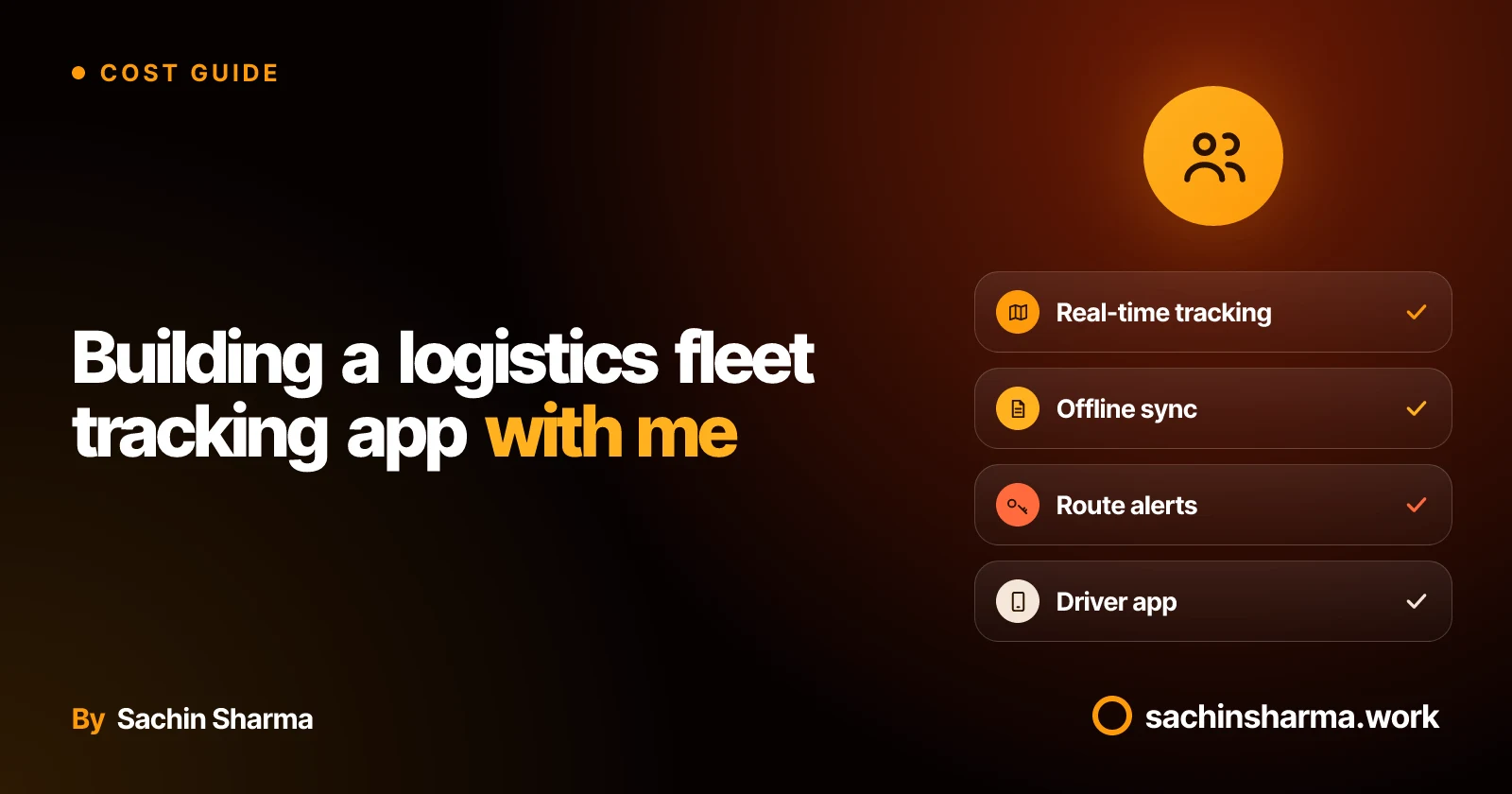
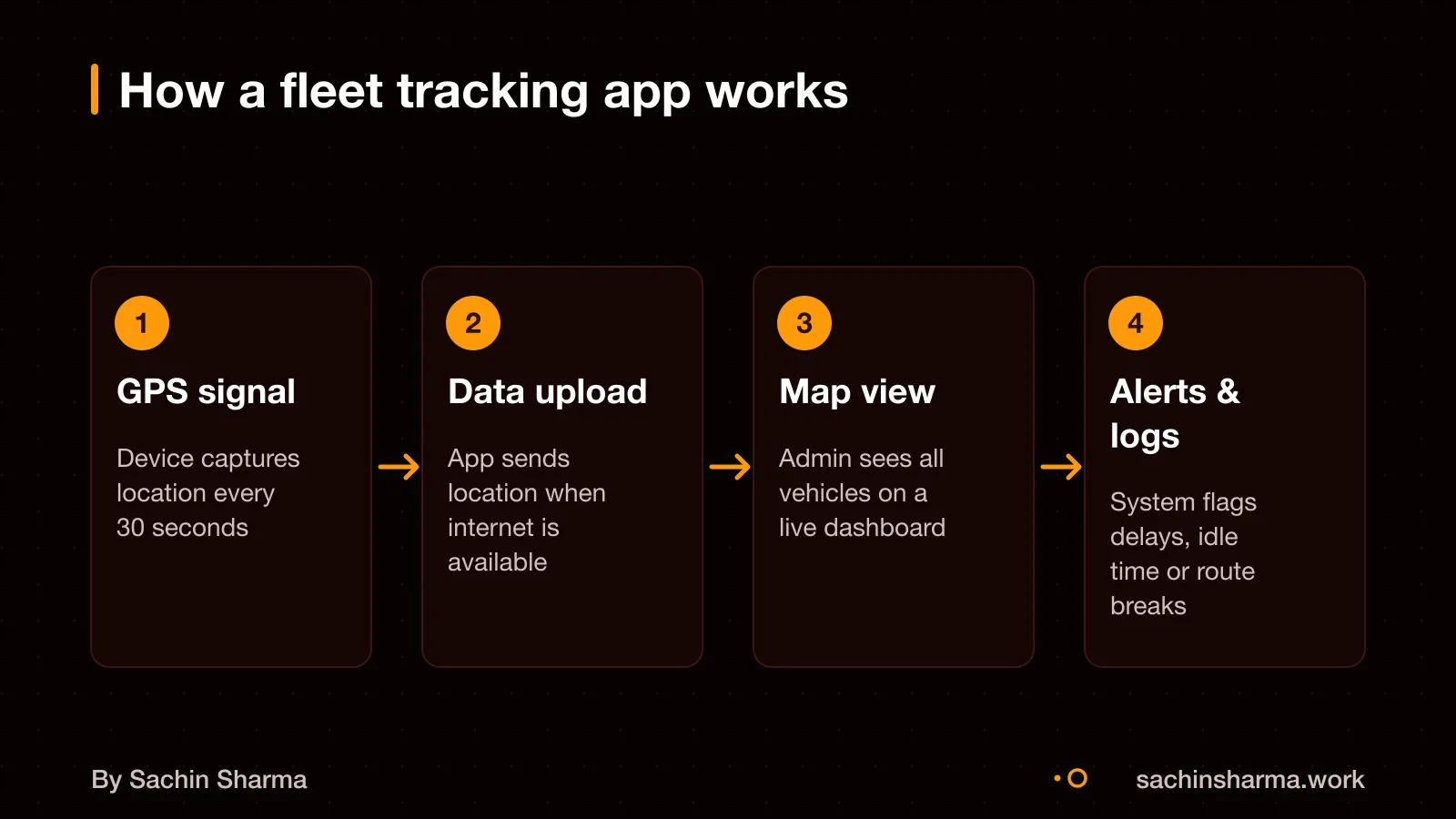
A fleet tracking app helps monitor vehicles and drivers in real time. Fleet tracking can model and follow fleet data and create a web-based map display of journey information. Instead of just showing a dot on a map, it tells you what each vehicle is doing. When it will arrive, how far it has to go, and whether the trip is on schedule. This works by connecting the app to GPS and telematics devices in some vehicles. The app is part of a system with interconnected modules for different operational areas. When one thing changes, like a driver swap or a delayed pickup, the app helps update the rest of the workflow automatically. For example, if a delivery is running late, the app can adjust the ETA and notify the customer without manual input.
What features does a logistics fleet tracking app need?
Build or buy: when custom makes sense
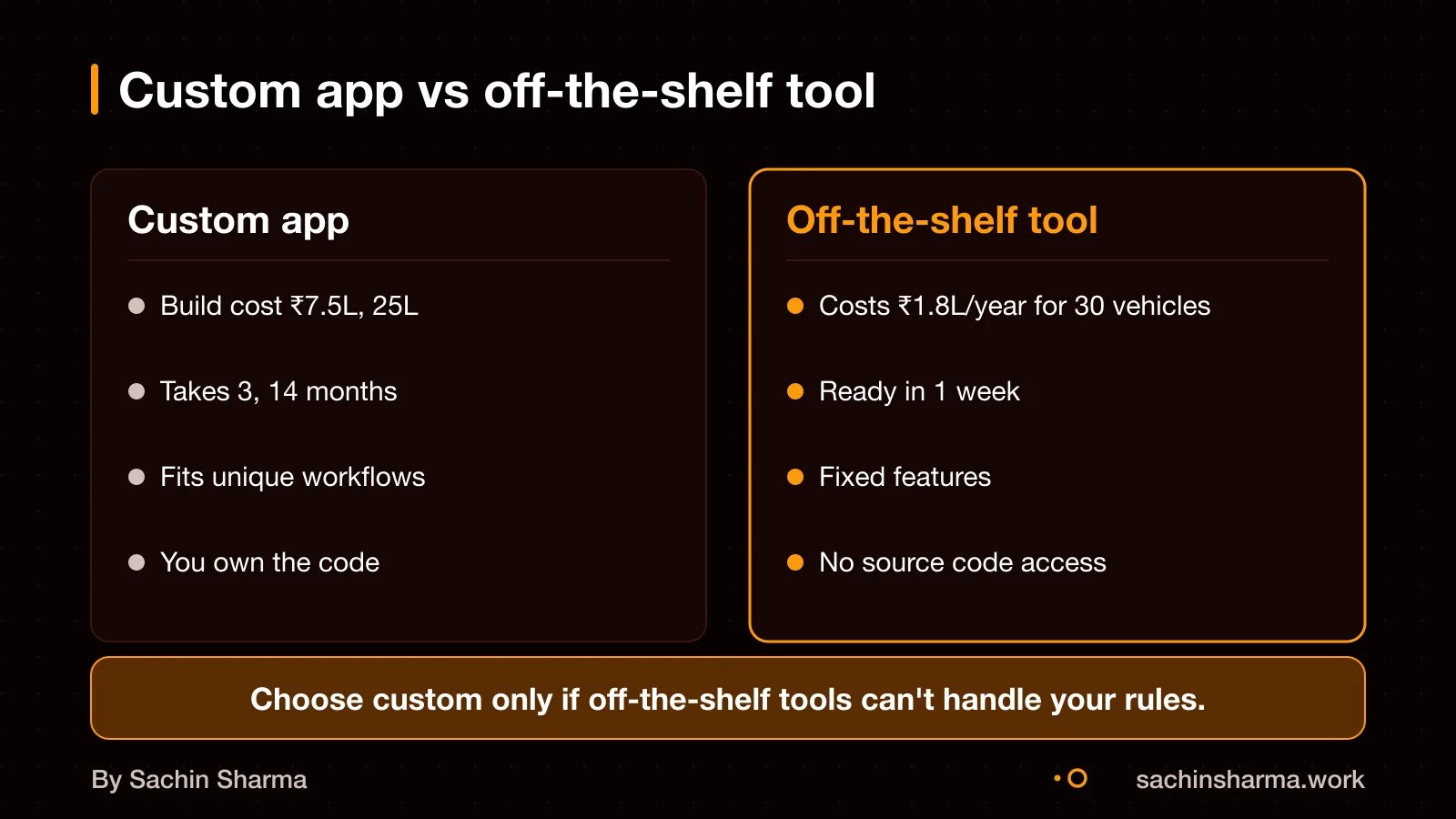
Off-the-shelf SaaS tools work well at first but become costly and limiting as your fleet grows. They follow generic logic, but no fleet is truly average.
Buy SaaS if your needs match standard workflows and you want to start fast. For 30 vehicles, a SaaS platform costs €1,500 per month as of June 2026. That adds up to ₹21.6 lakh per year at ₹16 per euro, which can exceed the upfront cost of a custom build over time.
The trade-off is control versus speed. Custom software costs more upfront but fits your exact workflows, especially if they give you a competitive edge. SaaS saves time early on but may force you to change how you work. If your fleet’s value lies in how you run it, the software should follow your logic, not the other way around.
Build or buy a logistics fleet tracking app: custom, white-label or platform? compares all options with real trade-offs.
What the build cost covers
The quoted price covers design, development, testing and integration for your fleet tracking app. You get a working product built for your needs, not a partial delivery. Backend development takes the largest share of the cost, as it handles APIs, databases and business logic that keep the system running. For example, routing rules, driver logs and compliance checks run on the backend.
UI/UX design can cost between $5,000 and $50,000, depending on the app complexity. A custom interface ensures your dispatchers and drivers can use the app without confusion. Data work, sourcing, cleaning and labelling, typically takes 15% to 25% of the total budget and is part of the build.
Building for Android only saves 30% to 40% compared to Android and iOS together. Most fleet operators in India use Android devices, so this cut makes sense unless your drivers use iPhones. All integrations, like GPS hardware, fuel sensors or payroll systems, are scoped upfront and built in.
Features that use AI, real-time tracking or offline sync raise the cost because they add technical depth. Simple apps cost less, but custom logic always adds effort. Scope changes during production can cost 30 times more than in planning.
Recurring costs after the app is built
You will pay for hosting, third-party services and annual maintenance. Hosting runs your app on servers so it stays online. Third-party services include maps, SMS alerts and cloud storage, which charge per use. You may also pay for updates, bug fixes and support after launch. As an estimate, annual maintenance costs 15 to 25% of the original build cost each year the app is in use. Over time, these costs can add up to two to four times the initial development spend. Software maintenance often makes up 50 to 80% of the total lifetime cost of your app. You will need to budget for these separately. Common third-party fees apply for GPS data, route optimisation APIs, and driver notification SMS. I do not mark up these services, you pay the provider directly. Maintenance and support are scoped per project, not sold as a fixed plan. For your case, I can list what each cost bucket likely includes.
Want a number for your idea? Send one line on WhatsApp. I reply with what drives the cost and what to cut.
Message me on WhatsAppHow long does it take to build a fleet tracking app?
A basic fleet tracking MVP takes 4 to 6 weeks to launch. This includes one mobile platform (Android or iOS), real-time GPS location tracking, driver login and a simple admin dashboard. You can test core features with a small group of vehicles.
A full system with advanced features like ML routing can take 16 to 22 weeks. These features include multi-platform support, fuel usage alerts, maintenance scheduling, route optimisation and compliance logs. Such a system fits mid-sized fleets with complex daily operations.
Large enterprise systems may take 12 to 18 months or more to develop. These include features like machine learning for dynamic routing, integration with ERP systems, multi-tenant access and custom reporting. The timeline depends on how many departments need to use it and how much legacy data must be migrated.
Key factors that affect your timeline are the number of features, device compatibility needs, third-party integrations and how fast you can review and approve builds. You can shorten the time by starting with an MVP and adding features later. For a detailed breakdown, see How long does it take to build a logistics fleet tracking app?.
How integration with GPS devices works
I connect your app to GPS hardware and telematics devices installed in vehicles. If a device uses a different protocol, the integration layer can be adapted to translate its data into a common format the app can use. This keeps the core app stable while supporting your hardware.
You can test with real devices during development to see how location tracking behaves across actual hardware, networks and conditions. Real-device testing catches issues that simulators miss, like delayed signals or power-saving interruptions.
GPS errors often come from weak signals, tall buildings, tunnels or poor device calibration. Environmental factors and OS-level power settings can also delay or drop location updates. These cause inaccurate positions or missed check-ins.
Geolocation testing helps identify issues related to GPS accuracy, permission handling, and fallbacks like network-based location. This verifies that the app handles permission prompts, GPS locks, and fallbacks like network-based location. Testing also confirms that location data is logged correctly even when the app runs in the background.
How the app works in areas with no internet
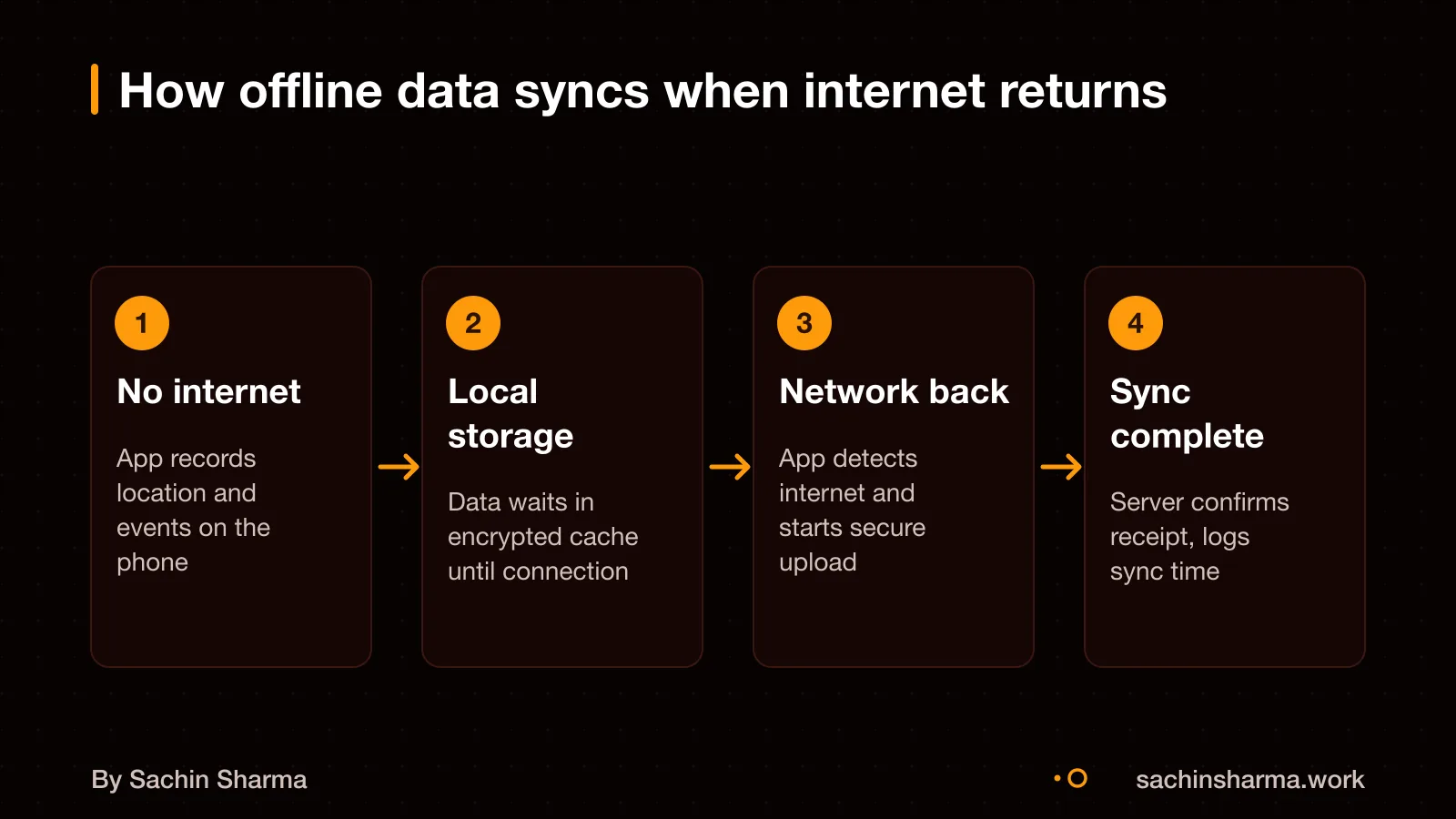
Yes, the app can work offline. I build apps using an offline-first approach, so you see your local data right away. This means drivers and managers can keep working during network gaps. When the device reconnects, it syncs by reconciling local and server data. I use lazy writes: changes save locally first, then sync when the network is back. For sync timing, pull-based sync works best for brief to intermediate periods of no network connectivity. In push-based synchronization, the local data source tries to mimic a replica set of the network data source to the best of its ability. For example, a driver logging a delivery in a remote area saves it offline, and it uploads once back in coverage.
Do you own the source code?
Yes, you own the source code once the app is delivered. The transferor is responsible for exchanging the actual code set and building assets directly with the recipient. You can move the app to another developer at any time. To transfer it, you will need the full codebase and access to the app store accounts. The code and build assets are exchanged directly between you and the new developer. You can transfer the app on platforms like the App Store while keeping its reviews and download availability. After the transfer, the original developer loses access to sales data and analytics. This means you control the app fully from day one.
What happens after the app is launched?
Support and updates depend on your contract. I can include a support package in your scope, or you can hire help as needed. Without one, response time depends on my current workload. You own the source code, so you are free to work with any developer.
How an engagement with me works explains the phases, milestones and input needed from you.
Worked example: cost for a mid-tier app
A ₹15 lakh fleet tracking app includes a customer app, driver app, dispatcher panel and admin backend for a logistics fleet. This is at the lower end of a full ecosystem build, which costs ₹15 to ₹25 lakh. The number assumes you need four core components: real-time GPS tracking, job assignment, proof-of-delivery capture, and a web dashboard for dispatchers.
The cost is built from market data on app complexity tiers. A customer-only app starts at ₹3.5 lakh, while adding a driver app raises it to ₹8 to 14 lakh. The jump to ₹15 lakh reflects added features like route optimisation, compliance logs, and multi-user access controls in a dispatcher tool. No founder fact gives my exact pricing, so this uses published ranges for India in 2026.
As an estimate, assuming a 12-month active life, annual maintenance will cost 15 to 25% of the build price. This covers bug fixes, OS updates, and minor feature tweaks. Hosting and third-party services like maps or SMS are extra and depend on your monthly usage.
Assumptions: - You need a full ecosystem (customer, driver, dispatcher, admin). - The app runs on Android only. - Integration is with standard GPS devices using common telematics protocols. - Maintenance is calculated as 15 to 25% of build cost per year. - No major new features are added post-launch.
Next step: message me on WhatsApp with what you want to build. No forms, no sales team.
Message me on WhatsAppWhen this advice is wrong
When this advice is wrong
You should not build a custom app if your fleet operations follow standard routes, driver shifts and compliance rules. Off-the-shelf tools already handle these well and cost less to run.
If you only need basic location tracking and speed alerts, a ready-made GPS tracking service is faster to set up and cheaper over time. Custom apps make sense only when your business logic is unique, such as custom routing rules or integration with internal systems.
Using an existing SaaS tool is better if you want quick setup, lower cost and no maintenance burden. Build only when buying cannot meet your core workflows.
Related reading: What does it cost to build an app in India?, How an engagement with me works.
Assumptions behind the numbers
- Exchange rate: ₹83.33 = $1
- Platforms: Android + iOS by default
- Team: 1 designer, 2 developers, 1 tester
Work out your own number
I won't hand you a number that pretends to be the market. Instead, here is the working: set the weeks, the people and the rate, and see where the money goes.
Your working total
₹7,20,00018 weeks × 2 people × 5 days × ₹4,000- Discovery & Scope11%
- Design17%
- Development56%
- Integration17%
The weeks shown are an example of a small app, there to be changed. Fees you pay others (store accounts, cloud, SMS) are not in this total.
What moves the price
- + Telematics or ELD
Each device type adds weeks for setup and testing.
- + AI or ML features
Routing, predictions or analytics need more design and data work.
- - One platform first
Start with Android or iOS to cut cost and time.
- - Fewer user roles
Skip dispatcher or admin to start smaller.
Fees that go to someone else
Cloud hosting
Usage-based, paid directly to AWS/GCP/Azure.
Maps & geocoding
Per request or monthly plan, paid to provider.
SMS & notifications
Per message or bulk plan, paid to service.
Ask for these before you sign
- How many weeks per phase, and with how many people?
- What is not included?
- Which fees do I pay to others directly?
- What happens to the price when I change my mind?
- What does the first month after launch cost?
Questions people ask
Yes, you can start with a minimal viable product (MVP) and add features later. An MVP lets you test the core idea with real users and gather feedback before building more. This reduces risk and focuses spending on what works.
Yes, you own the source code once the app is delivered and can transfer it to another developer. I do not retain rights to the code. You are responsible for sharing the code and assets with the new developer, as Apple and Google allow app transfers between accounts.
Annual maintenance costs 15 to 25% of the original development budget in the first year after deployment.
Yes, I can integrate your app with ERP or fuel card systems if they offer API access. The cost depends on how complex the data flow and validation rules are. Most fleet systems include integration with ERP systems, GPS hardware, ELD devices, and fuel card platforms.
Critical bugs found after launch are fixed as part of post-delivery support. To avoid disputes, we define what 'works' means during the discovery phase using real business scenarios and acceptance criteria.
Fleet tracking apps for commercial vehicles must follow AIS-140 standards for GPS devices. Check this for your case with a chartered accountant or lawyer.
I test the app using your real data and run acceptance checks against your business rules. I show how edge cases like delayed sync or wrong inputs are handled. This ensures the app works as needed before launch.